


A vocabulary list helps educators and parents know which spellings can be taught to kids at what time. Mastering the English vocabulary gives both teachers and parents flexibility in terms of helping children with the basics and then moving on to other words to spell for other activities. This article covers easy vocabulary words for kids with their meanings to help build a strong foundation early on.
Thank you for reading this post, don't forget to subscribe!
The grade level of vocabulary words for children is based on the difficulty level, the pattern of occurrence, and spelling materials. This article is here to help your little one learn vocabulary words for classes 1, 2, and 3 to boost their word power and communication skills.
What are Vocabulary Words?
Vocabulary can be defined as a set of words — the words that make up a language, or the words you are trying to teach your child. Vocabulary is essential for children of all age groups, as it forms the foundation of how they express themselves. Every person’s vocabulary is unique and develops with age, evolving through reading, conversation and everyday experiences. The more words your child learns, the more effectively they will be able to communicate their thoughts and feelings with others.
Important Vocabulary Words for Kids
It does not matter which grade your child belongs to; it is imperative to introduce them to slightly tougher words at an early stage. Your child will hear these words in school and may use them in daily conversations, so learning them early can boost both comprehension and confidence. Some essential vocabulary words for kids include ancient, border, coast, device, examine, flutter, grace, individual, journey, and many others that gradually expand their word power.
Types of Vocabulary
Understanding the different types of English vocabulary words for kids can help parents and teachers introduce them in a more structured way. Here’s a look at the main categories your child will come across while learning.
- Listening Vocabulary – The words a child understands when they hear them. This is the first and often largest type of vocabulary to develop, growing through everyday conversations, stories and songs.
- Speaking Vocabulary – The words a child actively uses while talking. This is usually smaller than listening vocabulary, since children tend to understand more words than they use out loud.
- Reading Vocabulary – The words a child recognises and understands while reading. This expands steadily as children are exposed to age-appropriate books and stories.
- Writing Vocabulary – The words a child can use correctly in their own writing. This is typically the smallest of the four, as it requires both knowing a word and being able to spell it.
Vocabulary Words for Kindergarten Kids
Kindergarteners should be taught vocabulary words that are simple, but the list can be vast. This will help support their written and verbal communication. The explicit teaching of new words allows students to access academic language and helps them to understand complex texts.
| Ran | Man | Her |
| Here | Dog | Him |
| Cow | Home | Fat |
| Good | Ride | His |
| Day | Cat | Like |
| Car | Box | Hot |
| Play | Ball | Cold |
| Bed | Yes | Book |
| Pan | No | Far |
| Fun | One | Tree |
Vocabulary Words For Class 1 Kids
Vocabulary words for grade 1 should include words kids understand and know at this level. Students don’t have to spell or read the words to understand their meanings. Make your children start learning new words; some words are listed below:
| Dear | Mumble | Instead |
| Huge | Enormous | Attention |
| Worried | Special | Prefer |
| Positive | Miserable | Ignore |
| Grumpy | Embarrassed | Annoy |
| Wonder | Searching | Almond |
| Ordinary | Measuring | Arrest |
| Gigantic | Disappointed | Backbone |
| Warning | Respect | Base |
| Opposite | Lovely | Custard |
| Frustrated | Discover | Dance |
| Uncomfortable | Rhyme | Customer |
| Observing | Listen | Blister |
| Focus | Directions | Butter |
| Surprise | Repeat | Camel |
| Notice | Leader | Crab |
| Feast | Curve | Century |
| Suggestion | Remind | Cinnamon |
| Note | Jealous | Garden |
| Fascinating | Curious | Generous |
| Suddenly | Question | Ginger |
| Nibble | Important | Cough |
| Fair | Consequence | Dictionary |
| Stomp | Proud | Distant |
| Nervous | Invite | Dawn |
| Explore | Comfortable | Eardrum |
| Squirm | Protect | Experiment |
| Negative | Investigate | Yellow |
| Exhausted | Calm | Equality |
| Spotless | Problem | Excuse |
Vocabulary Words For Class 2 Kids
Vocabulary words for grade 2 are the building blocks for understanding and expressing children’s ideas. As children are exposed to complex language, they start using more advanced vocabulary, and difficult words help them describe their observations, explain concepts, and make predictions. Some of the Class 2 vocabulary words are listed below.
| Safe | Proof | Settle | Evening |
| Peak | Ocean | Scholar | Excess |
| Past | Moist | Reflect | Earth |
| Net | Label | Present | Fair |
| Leap | Insect | Notice | Excite |
| Herd | Fresh | Nervous | Create |
| Gasp | Feast | Mention | Lizard |
| Flap | Effect | Leader | Local |
| Edit | Doubt | Instrument | Mountain |
| Deep | Design | Greedy | Science |
| Damp | Cycle | Gravity | Committee |
| Chew | Cause | Frighten | History |
| Calm | Brave | Friendly | Computer |
| Cage | Beach | Energy | Keyboard |
| Bare | Amaze | Difference | Printer |
| Yard | Zig Zag | Describe | |
| Wise | Wonder | Cooperation | |
| Team | Whisper | Community | |
| Sway | Volunteer | Arranged | |
| Soil | Village | Amusing | |
| Worry | Universe | Island | |
| Tower | Tremble | Invent | |
| Stack | Treasure | Dozen | |
| Skill | Telescope | Shiver | |
| Rumour | Stream |
Vocabulary Words For Class 3 Kids
Vocabulary words for grade 3 are used often across all subjects, from language, history and arts to maths and science. Third graders who have a better understanding of vocabulary and its importance in reading complex sentences do great in academics.
| Drift | Decay | Struggled | Risk |
| Woe | Treasure | Confess | Individual |
| Doze | Nation | Steer | Brilliant |
| Wit | Thrill | Loyal | Revive |
| Outcome | Custom | Coast | Imitate |
| Distant | Theory | Starve | Brief |
| Wisdom | Mystify | Locate | Reverse |
| Origin | Crumple | Cling | Harsh |
| Disease | Talent | Spoil | Border |
| Wander | Mural | Limit | Responsible |
| Ordeal | Crew | Climate | Habit |
| Digest | Moisture | Solution | Bold |
| Opposite | Coward | Launch | Respect |
| Diagram | Symbol | Clever | Resident |
| Volunteer | Misery | Signal | Grasp |
| Opponent | Convince | Chill | |
| Device | Swift | Sensitive | |
| Vision | Method | Journey | |
| Observe | Continent | Certain | |
| Delicate | Survey | Schedule | |
| Defend | Marsh | Capture | |
| Nursery | Contain | Scatter | |
| Deed | Suitable | Intend | |
| Triumph | Magnificient | Cable | |
| Nectar | Consider | Intelligent |
Activities That Can Help Your Child Learn Vocabulary Words
Reading books and newspapers with your children and engaging them in conversations are some of the important ways to build a 3-year-old’s vocabulary word list. The more they get exposed to interesting words, the more they may have an understanding of the word. A 5-year-old’s vocabulary list should be taught multiple times and in different contexts so they do not forget easily.
1. Fill in the Blanks Vocabulary Game
1. Vijay is an………………man.
Ans – honourable/honest/wise
2. I like playing the………..
Ans – piano/guitar/an instrument
3. The school will close for Christmas…………….
Ans – holidays
4. A butterfly has…………….wings.
Ans – beautiful/colourful
5. My friend won the last tennis…………
Ans – tournament
6. Make sure to read all the…………….carefully.
Ans – instructions
7. Our English teacher gave us report writing as ……………
Ans – homework
8. ………………… is the best time of the year.
Ans – Winter/Summer/Spring
9. Mathematics is my……………subject.
Ans – favourite
10. Our journey to Kashmir was a………………..one.
Ans – memorable/fun/happy
11. Shweta is the most……………student in our class.
Ans – intelligent
12. Dove is a symbol of …………….
Ans – peace
13. It is important tomaintaina ……………..diet to avoid disease attacking the body.
Ans – healthy
14. He shifted from one …………..to another
Ans – job/place/home/<any situation>
15. The Indian army earned a magnificent ……………over the invading army.
Ans – victory
2. Teach the Word of the Day
Introducing a new word daily will increase your child’s vocabulary by 365 words every year, and is an interesting and fun activity with which the whole family can get involved. You can take the help of a word-a-day calendar or a website to pick a new word for your kid to learn. Make sure that you teach your child words according to their grade. A 3-year-old vocabulary word list will be different compared to a 5-year-old vocabulary list.
3. Roll a Dice Activity
Use this teaching resource with your kid while building their vocabulary. Make your children practice it daily for a better result.
Let your kid choose a vocabulary word and then roll a die to complete the activity. The next step is to record the answers as per the activity mentioned on the dice.
The six vocabulary activities include:
i) Let your kid define the word
ii) Ask them to use the word in a sentence
iii) Ask them the antonym for the word
iv) Let them write a synonym for the word
v) Ask them to draw a picture of the word
vi) The last step is to act it out
4. Ask Your Children to Use New Words in Sentences
There’s no use in your child learning new words if they do not apply them to a sentence. Asking them to use a word in a written or spoken sentence will help them understand its context and meaning. If your child’s school assigns weekly spellings, get them to write a sentence using each word. Encourage them to look it up in a dictionary if they are not sure of its meaning.
5. Play Word Games with Your Kid
Transform learning into playtime with our Brain Boosting Flashcards featuring animals, birds, fruits, and vegetable names. These cards introduce new vocabulary and motivate your child to explore and learn with each exciting game. Elevate their educational experience today – buy the flashcards now and discover the joy of learning!
Reading books or magazines with your child is a great way to familiarise them with new words and increase their vocabulary. You can also use the above techniques for fun and easy teaching.
Common Mistakes Kids Make With Vocabulary
Learning new words often comes with a few common slip-ups along the way. Here are some mistakes to watch out for and how to gently correct them.
- Using Words Out of Context – A child might say “I examined my toy” instead of “I looked at my toy,” using a word that is technically correct but doesn’t quite fit the everyday situation. Explaining when a word is appropriate to use helps children apply it correctly.
- Mixing Up Similar-Sounding Words – Children often confuse words like “quite” and “quiet,” or “accept” and “except,” since they sound or look alike. Practising these words in separate sentences helps children tell them apart.
- Overusing a Favourite Word – A child might describe everything, from food to a movie to a toy, as simply “nice” or “good,” instead of trying words like “delicious,” “exciting” or “amazing.” Encouraging them to explore synonyms helps widen their vocabulary naturally.
- Misspelling New Words – A child may correctly say the word “beautiful” out loud but spell it as “byootiful” while writing, since writing vocabulary develops later than speaking vocabulary. Regular reading and writing practice helps reinforce correct spellings over time.
- Forgetting Word Meanings Quickly – A child might learn the word “enormous” one day but go back to using “big” a week later if the new word isn’t used again. Encouraging children to use new words in daily conversation helps the words stick.
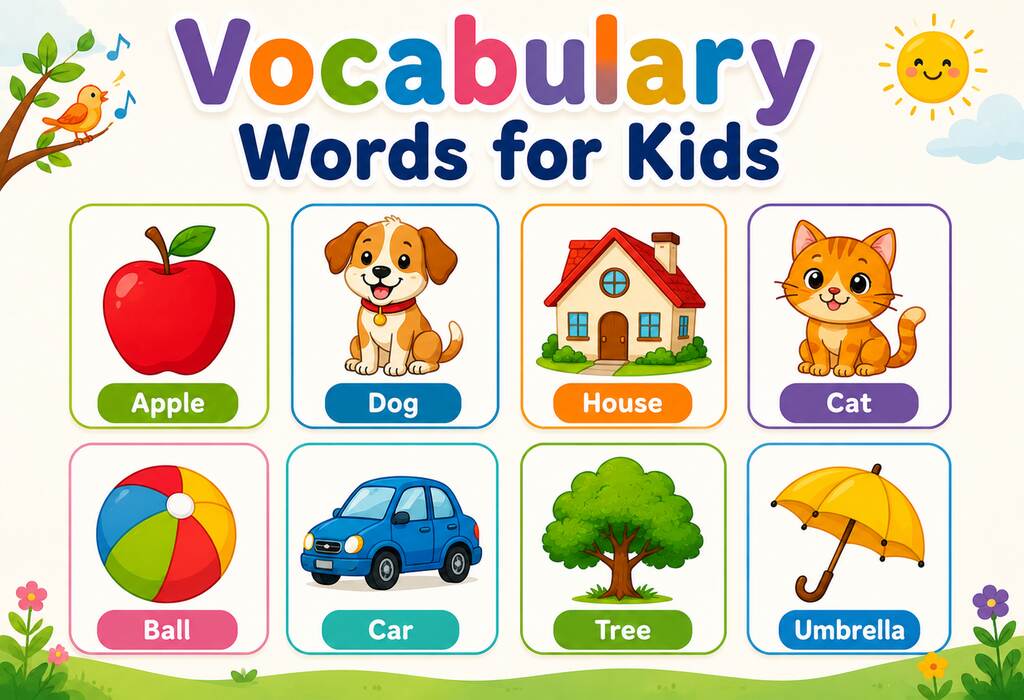
Here’s a handy chart that brings together all the vocabulary words covered in this article in one place. It makes for a quick and easy reference for your child.
FAQs
1. How Many New Words Should My Child Learn Each Week?
There is no fixed number, but learning around 5 to 10 new words a week, along with regular practice, helps children build a strong vocabulary steadily without feeling overwhelmed.
2. What Is a Good Way to Practise New Vocabulary Words Daily?
Using a new word in a sentence at least once a day, whether while speaking or writing, helps children remember it better and use it naturally over time.
3. Should I Correct My Child Immediately if They Use a Word Incorrectly?
It is best to gently correct them in the moment with a simple explanation, as this helps them understand the mistake without discouraging them from trying new words.
4. Can Playing Games Help My Child Practise Vocabulary Words?
Yes, games like word matching, crossword puzzles or “I Spy” using descriptive words can make learning new vocabulary more enjoyable and memorable for children.
Building a strong vocabulary is one of the most valuable skills a child can develop, laying the foundation for confident reading, writing and communication. With regular practice, exposure to new words, and a little patience, your child will steadily grow their word power and express themselves with greater clarity and ease.
Also Read:
Learn Describing Words for Children
Compound Words for Kids with Types and Activities
Four Letter Words for Children to Improve Vocabulary