


Measurement is an important concept in mathematics that we must teach our children. The skill of measuring is one that most children are eager to learn, since it’s easy to see real-life applications. We normally measure things in our daily lives. We use various units to measure the shape of things, such as inches, feet, meters, and centimetres. It totally depends on the size or shape of the thing to find the correct unit of measurement. For instance, cm is the appropriate unit of measurement for measuring the height of a pen. Similarly, to measure the height of a stool, the foot is the appropriate unit.
Thank you for reading this post, don't forget to subscribe!
A common question that arises when learning these units is the ‘foot and feet difference,’ which helps students understand when to use each term. We start with teaching children the basics of measuring, big and small or long and short, but at some stage of their academic life, children are taught about other ways of measuring height, objects or things. Feet in maths are one way of measuring the height of objects or people.
What are ‘Foot’ and ‘Feet’?
Foot and feet are standard units of measurement used to measure the length of objects, people, and distances, with one foot equal to 12 inches. Foot is the singular form for a single unit, while feet is the plural form used for two or more, and the difference of foot and feet matters most when writing measurements correctly, such as “1 foot” versus “5 feet”.
What is the Difference Between Foot and Feet?
Although the meaning of foot and feet is the same, let’s look at the main difference between foot and feet.
1. Singular And Plural
“Foot” means a single unit of measurement. But “feet” is its plural form.
Eg – “One foot is made of 12 inches.”
2. Language
In spoken language, the foot can be used with plural measurements when the measurement is an adjective.
3. Modifier
The word “foot” is used in place of “feet” with plural measurement when the measurement acts as a modifier.
Few Examples of Foot and Feet for Children
Here are some examples of the words “foot” and “feet” to help kindergarteners grasp the concept a little more easily.
- The bread was one foot long.
- The pole was 20 feet high.
- The boys were sitting 7 feet away from the girls.
- The height of a child is 4 feet.
- The new pencil was half a foot long.
- The ladder reached 10 feet up the wall.
- The dog ran 15 feet across the garden.
- The table is 3 feet wide.
- The kite string was 50 feet long.
- The puddle was 2 feet away from the door.
Relationship Between Foot and Feet and Other Measurements
It is important to teach children the relationship between the foot and other measurements. Let’s have a look at them.
1. Conversion Of Feet Into Inches
Feet (ft) and inches (in) are two units of measuring length, most commonly used in the United States.
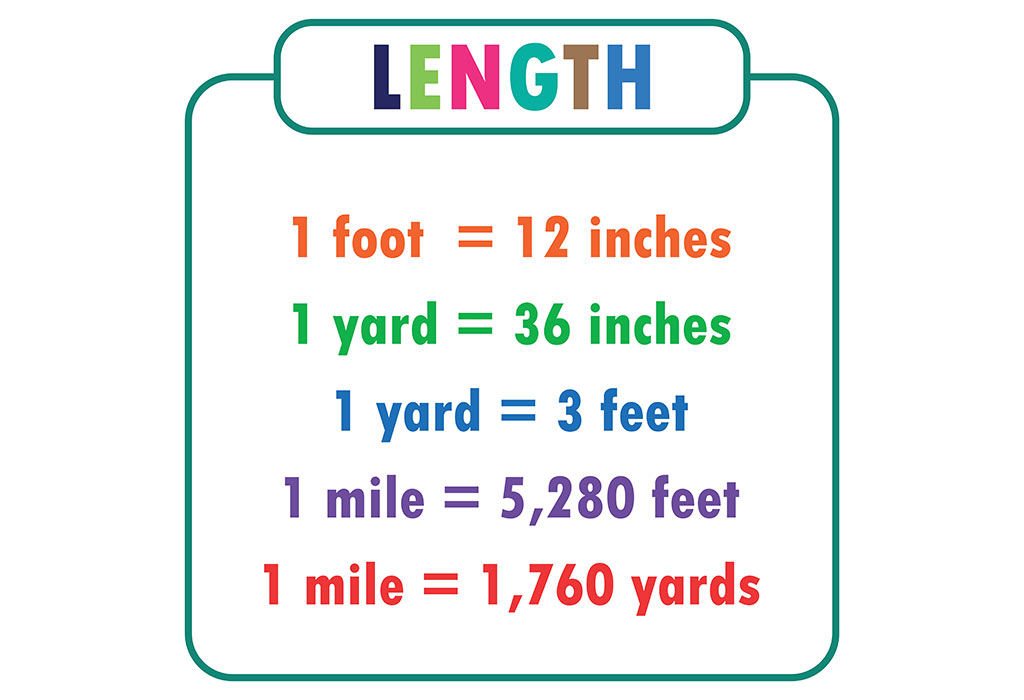
1 foot = 12 inches or 1 inch = 1/12 feet
Example: if a teddy bear is 12 inches in height, its height in ft = 1 foot.
2. Conversion Of Feet Into Yards
Yards and feet are generally used to measure length. Both units (yards and feet) are used in the imperial and US customary system of measurements.
1 yard = 3 feet or 1 foot = ⅓yard
Example: A playground is 12 yards in length. We have to fence the length in feet. Now, to get the length in feet, we divide 12 by 3, which gives 4 ft.
3. Conversion Of Feet Into Meters
1 meter = 3.28 feet or 1 foot = 0.3048 meters
Example: The height of a pole is 5 m. The height of the wall in foot = 5 X 3.28 = 16.4 feet
4. Conversion Of Feet In to Centimetres
1 centimetre = 0.0328 feet or 1 foot = 30.48 cm
Example: The height of a wall is 6 feet. So, the approximate height of the wall in cm will be 6 X 30.48 = 182.88 cm.
Facts about Foot and Feet
The foot has been used as a unit of measurement since ancient times, long before standard rulers existed. Here are some interesting facts about foot and feet that children will enjoy learning.
- The foot was originally based on the length of a human foot, but which foot it was based on changed depending on the ruler in charge at the time.
- Ancient Egyptians, Greeks, and Romans each used a slightly different length for their version of a “foot,” so a foot in one ancient civilisation wasn’t the same as a foot in another.
- Until the 1950s, the length of a foot was not even the same across all English-speaking countries.
- A basketball hoop is set at exactly 10 feet high, a number chosen in 1891 almost by accident, based on the height of the railing at the gym where the game was invented.
- Aeroplanes measure altitude in feet instead of metres because of a 1940s international aviation agreement that most countries still follow today.
- The Eiffel Tower grows about 6 inches taller in the summer because the iron expands in the heat.
- In India, people commonly describe a person’s height in feet and inches rather than centimetres, even though the country officially follows the metric system.
- The “foot” was once so inconsistent that kings would sometimes change its official length to suit construction projects or taxes.
- The tallest man ever recorded, Robert Wadlow, was 8 feet and 11 inches tall.
- Despite being called “feet,” the unit has nothing to do with shoe size, since shoe sizing uses a completely separate measuring system invented in the 1800s.
FAQs
1. Is It Ever Correct To Write “1 Feet”?
No, “1 feet” is always incorrect; the singular number 1 must always be paired with foot, never feet.
2. Do You Still Write Foot Even With A Big Number Sometimes?
Yes, when the measurement comes before a noun, it describes, like “a five-foot table” or “a six-foot fence,” the noun, so the number stays singular even when the number is more than one.
3. How Can Children Practise Writing Foot And Feet Correctly?
A good way to practise is to measure real objects at home, such as a table or a door, and then write a full sentence, such as “The door is 7 feet tall.”
4. Should The Abbreviation “Ft” Be Written With A Full Stop?
No, “ft” is usually written without a full stop, and it stays the same whether it means one foot or many feet, so it is never written as “fts”.
We hope the concept of “foot” and “feet” is now clear to your little one. If you have any more questions, please share them in the comments below, and we will reply in no time.
Also Read:
2D Shapes for Children
Place Value System for Kids
Numerical Expression to Improve Math Skills