



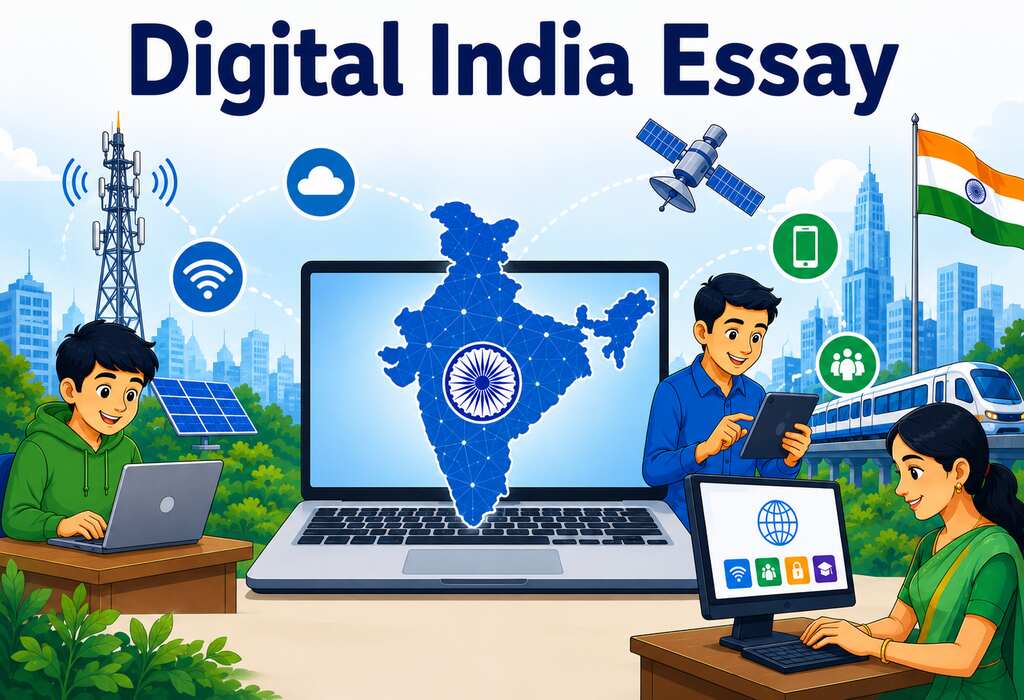
India’s ambitious vision for a digitally empowered nation has transformed the way millions of citizens access government services, education, and everyday technology. Launched in 2015, the Digital India programme aimed to bridge the gap between urban and rural communities by connecting them through robust digital infrastructure and internet connectivity. Writing an essay on Digital India in English is a wonderful exercise for students of all ages, as it encourages them to reflect on the remarkable strides their country has made in technology and governance.
Thank you for reading this post, don't forget to subscribe!
This collection covers a wide range of formats from simple 10-line summaries to detailed long-form essays making it accessible for learners at every stage. Whether you are looking for essays for classes 1, 2, and 3 or more advanced compositions for higher grades, this guide offers clear, well-structured writing samples to inspire and inform young minds about India’s digital journey.
Points To Remember When Writing An Essay on Digital India
Writing a compelling ‘Digitalisation in India’ essay is easier when you follow a few simple guidelines. Keep these key points in mind before you put pen to paper.
- Understand The Topic First – Before writing, research the Digital India initiative thoroughly, including its goals, key pillars, and impact on citizens across urban and rural areas.
- Plan Your Structure – Divide your essay into a clear introduction, body paragraphs, and conclusion to ensure your arguments flow logically from one point to the next.
- Use Relevant Facts And Figures – Support your points with accurate statistics, such as internet penetration rates, the growth of UPI transactions, or the number of Common Service Centres established nationwide.
- Keep Your Language Simple And Clear – Avoid overly complex vocabulary, particularly for school-level essays, and express your ideas in straightforward, easy-to-understand sentences.
- Stay Focused On The Subject – Do not stray into unrelated topics; every paragraph should directly relate to digitalisation and its significance for India’s development.
- Include Real-Life Examples – Reference tangible initiatives such as Aadhaar, DigiLocker, BharatNet, or the PM Wani scheme to add depth and credibility to your writing.
- Proofread Before Submitting – Always review your essay for grammatical errors, spelling mistakes, and factual inaccuracies before final submission.
10 Lines On Digital India
Sometimes, the most effective way to understand a big topic is to break it down into its most essential ideas. These few lines on Digital India offer a simple yet informative snapshot, perfect for young learners and quick reference.
- Digital India is a programme started by the Government of India on 1st July 2015.
- It was launched by Prime Minister Narendra Modi to help India grow with the help of technology.
- The main goal of Digital India is to make sure every citizen can use the internet and digital services.
- It helps people in villages access the internet, just like people in cities.
- With Digital India, people can pay for goods and services with their phones instead of cash.
- Students can easily access online lessons and learning materials thanks to this initiative.
- The government now offers many services online, so people do not need to stand in long queues.
- DigiLocker allows people to store important documents, such as certificates and identity cards, on their phones.
- Digital India has helped create new jobs by encouraging young people to start their own technology businesses.
- This initiative is helping India become a modern, connected, and self-reliant nation for the future.
Paragraph on Digital India
A short paragraph is a great way to summarise a big topic clearly and concisely. Read on for a simple paragraph on Digital India, perfect for students of all ages.
Digital India is a programme launched by the Indian government in 2015 to make technology available to every citizen. To achieve this, it aims to connect villages to the internet, make government services available online, and encourage people to use digital payments instead of cash. As a result, students can learn online, people can store important documents on their phones, and farmers can access useful information digitally. Furthermore, it has helped create jobs for young people in the technology sector. Overall, Digital India is building a stronger, more connected nation where every citizen can benefit from the power of technology.
Digital India Essay In 150 Words
A 150-word essay is a great way to practise putting your thoughts together in a clear and organised manner. The short essay below on Digital India is perfect for students seeking a simple yet comprehensive piece of writing.
Digital India is an initiative launched by the Government of India on 1st July 2015. Its chief objective is to connect every citizen to the internet and provide government services online.
Before this initiative, many villagers lacked access to the internet or digital tools. Digital India addressed this by introducing affordable connectivity to rural areas and establishing Common Service Centres nationwide.
Today, citizens can pay bills, schedule appointments, and retrieve essential documents from their phones. Students participate in online classes, and farmers monitor weather conditions and market rates digitally.
The programme has motivated young people to launch technology-driven businesses, generating thousands of new jobs throughout the country.
Digital India is more than technology—it empowers citizens with equal opportunity to flourish in a connected society. By bridging urban and rural divides, it inspires innovation and inclusion. E-governance makes services and information accessible. Thus, Digital India transforms lives and builds a brighter future for the nation.
Short Essay On Digital India
A short essay is a great way to express your thoughts on a topic clearly and confidently. The essay below covers all the key ideas about Digital India in a simple, easy-to-understand format.
Digital India is one of the most important programmes ever launched by the Government of India. Started on 1st July 2015 by Prime Minister Narendra Modi, it aims to transform India into a digitally empowered nation where every citizen has access to technology and online services.
Before this initiative, millions of people in rural areas had little or no access to the internet. Government services required long queues and endless paperwork. Digital India changed all of this by bringing affordable internet connectivity to villages and making government services available online.
Today, citizens can pay bills, apply for documents, and access healthcare information from the comfort of their homes. Students can attend online classes and access study materials without needing expensive books. Farmers can check weather forecasts, crop prices, and government schemes using their mobile phones.
Programmes such as DigiLocker, BharatNet, and the Unified Payments Interface have made everyday life simpler and more convenient for millions of Indians. Cashless payments have grown rapidly, reducing the country’s reliance on physical currency and enabling faster, safer transactions.
Digital India has also created exciting opportunities for young entrepreneurs and technology professionals. Thousands of startups have emerged across the country, generating employment and driving economic growth.
However, challenges such as limited digital literacy and unreliable internet connectivity in some regions still need to be addressed for the programme to reach its full potential.
Overall, Digital India is a powerful step towards building a fairer, stronger, and more connected nation for every citizen.
Long Essay On Digital India
A long essay lets you explore a topic in much greater detail. The essay below covers Digital India thoroughly, making it ideal for higher-class students.
Digital India is a landmark programme launched by the Government of India on 1st July 2015 under the leadership of Prime Minister Narendra Modi. Its vision is to transform India into a digitally empowered society where every citizen, regardless of location or background, has access to technology and online services. By connecting rural and urban India through digital infrastructure, the programme has changed the way people interact with the government, manage their finances, and access education and healthcare. Today, Digital India stands as one of the world’s most ambitious digital transformation initiatives.
Objective Of Digital India
The programme was built around three core goals — creating a strong digital infrastructure, delivering government services digitally, and improving citizens’ digital literacy. It aims to ensure that every Indian has access to affordable internet, can use online government services without visiting offices, and has the skills needed to participate in the digital economy. Beyond connectivity, Digital India also seeks to encourage innovation, support startups, and generate employment opportunities in the technology sector.
Pillars Of Digital India
| PILLAR | DESCRIPTION | OUTCOME |
| Broadband Highways | Expanding high-speed internet across India | BharatNet connecting villages |
| Universal Mobile Connectivity | Ensuring mobile network coverage in all regions | Expansion to remote and rural areas |
| Public Internet Access | Setting up digital service centres in communities | Common Service Centres (CSCs) |
| E-Governance | Digitising government services for efficiency | Applying for certificates online |
| E-Kranti | Electronic delivery of all government services | Online scholarships and benefits |
| Information For All | Providing public access to government information | Digital notice boards |
| Electronics Manufacturing | Boosting domestic production of technology | Make in India electronics |
| IT For Jobs | Training youth for IT and related jobs | Rural IT skill development programmes |
| Early Harvest Programmes | Quick-impact projects for rapid results | Wi-Fi hotspots at public places |
Advantages
- Easier Access to Government Services – Citizens can now apply for documents, pay bills, and file complaints online, saving time and eliminating the need to wait in long queues.
- Growth of Digital Payments – Platforms such as the Unified Payments Interface (UPI) have made cashless transactions quick, safe, and accessible to everyone, including small businesses and street vendors.
- Better Education Opportunities – Students across the country can access online lessons, study materials, and courses from top institutions, making quality education available to all.
- Improved Healthcare Access – Telemedicine services and online health records allow people in remote areas to consult doctors and access medical information without travelling long distances.
- Support for Farmers – Farmers can now check weather forecasts, crop prices, and government schemes digitally, helping them make better decisions and improve their livelihoods.
- Job Creation and Entrepreneurship – The digital ecosystem has encouraged thousands of young Indians to launch startups and technology-based businesses, generating employment across the country.
Digital India has truly changed the way the country functions, bringing government services, education, healthcare, and financial tools to the fingertips of millions. The initiative has also accelerated the adoption of emerging technologies like artificial intelligence, cloud computing, and the Internet of Things, making India more competitive in the global digital landscape.
Through public-private partnerships, collaboration between industries and government bodies has increased, ensuring that the benefits of digital transformation reach even India’s most remote regions.
While challenges such as digital literacy gaps and uneven internet access in remote areas remain, the programme continues to make steady progress. With sustained effort and investment, Digital India has the potential to build a more inclusive, transparent, and prosperous nation where every citizen can benefit equally from the power of technology.
Facts about Digital India
Digital India has achieved some truly remarkable milestones since its launch in 2015. Here are some interesting facts that highlight just how far the programme has come.
- Digital India was launched on 1st July 2015, a date now celebrated annually as Digital India Day across the country.
- India processes more digital payments in a single month than most developed nations do in an entire year, thanks to UPI.
- Aadhaar is the world’s largest biometric ID system — enrolling over 1.3 billion people, more than the entire population of any country except China and India itself.
- BharatNet has laid over 600,000 kilometres of optical fibre cable underground — enough to circle the Earth more than 15 times.
- DigiLocker allows citizens to store driving licences, mark sheets, and birth certificates on their phones, making physical documents almost unnecessary.
- India went from 251 million internet users in 2015 to over 900 million today — one of the fastest digital expansions in human history.
- Thanks to Direct Benefit Transfer, the government has saved over ₹2.5 lakh crore by eliminating fake beneficiaries and sending money directly to citizens’ bank accounts.
- India’s Common Service Centres serve more people digitally than the combined populations of several European countries.
- PMGDISHA trained over 60 million rural citizens in digital skills — making it one of the largest digital literacy drives ever undertaken globally.
- India’s homegrown UPI payment system has been adopted by several countries, including France, the UAE, and Singapore, putting India on the global digital map.
What Will Your Child Learn From an Essay on Digital India?
Reading and writing an essay on Digital India provides children with more than just facts about a government programme. It helps them recognise how technology influences daily life through internet access, digital payments, and online education. It also guides them to consider challenges, such as limited connectivity in rural areas, and why addressing these issues is essential for India’s progress. Building on these insights, children gain further perspective as they reflect on their country’s progress.
Through this topic, children gain an appreciation for India’s digital achievements and develop critical thinking skills about how technology can be used responsibly and inclusively to benefit everyone.
FAQs
1. How Can I Make My Essay More Interesting?
Include surprising facts, real-life examples, and your own thoughts on how Digital India has changed everyday life. Describing how technology helps students, farmers, or village communities can make your writing more engaging.
2. Should I Practice Writing This Essay Multiple Times?
Yes, practising regularly helps you write faster, improve your vocabulary, and organise your thoughts more clearly. Try writing the essay in different lengths to prepare for any question that may appear in an exam.
3. How Do I Write A Good Conclusion For My Essay?
A good conclusion briefly summarises the main points of your essay and ends with a positive thought about India’s digital future. Keep it short, clear, and confident.
4. Are There Any Common Mistakes I Should Avoid?
Avoid copying sentences directly from textbooks, going off-topic, or using overly complicated words. Always proofread your essay before submitting it to catch spelling and grammar mistakes.
Digital India has changed millions of lives and continues to shape the future of our country in exciting ways. For students, learning about this initiative is not just about scoring well in exams — it is about understanding the world they are growing up in.
Whether you are writing a short 10-line piece or a detailed long-form essay, the key is to write clearly, use simple language, and express your ideas with confidence. With regular practice and the right guidance, every student can master this topic and develop a lifelong appreciation for how technology is building a stronger, more connected India.
Also Read:
Essay on India of My Dream
Essay On India Gate for Kids
Essay on Indian Culture and Tradition