



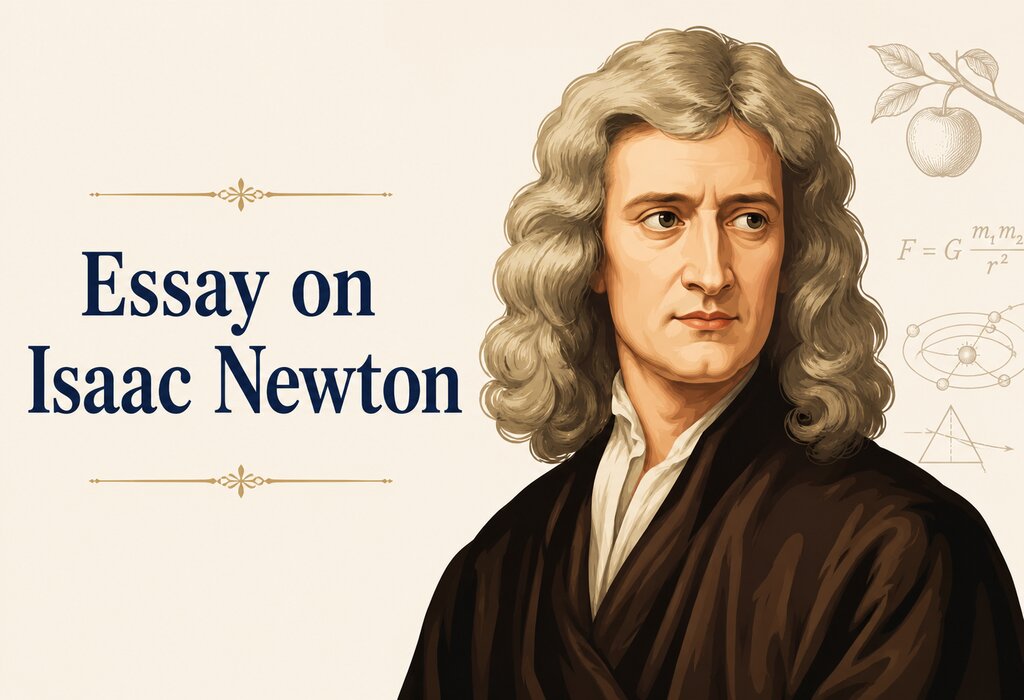
- Key Points To Remember When Writing An Essay On Isaac Newton
- 10 Lines On Isaac Newton
- Paragraph On Isaac Newton
- Essay On Isaac Newton In 100 Words
- Essay On Isaac Newton In 200 Words
- Essay On Isaac Newton In 300 Words
- Essay On Isaac Newton In 500 Words
- What Will Your Child Learn From An Essay On Isaac Newton?
- FAQs
Isaac Newton stands as one of the most extraordinary scientific minds in human history, and writing an essay on Isaac Newton in English is a wonderful way to explore his groundbreaking discoveries that continue to shape our understanding of the natural world. Born in Woolsthorpe, Lincolnshire, in 1643, Newton’s remarkable intellect laid the foundations of classical mechanics, optics, and calculus, transforming humanity’s perception of the universe.
Thank you for reading this post, don't forget to subscribe!
Whether you are a student preparing for a school assignment or a curious reader wishing to explore his profound legacy in greater depth, this collection of essays offers something for everyone. From concise 10-line summaries to comprehensive 500-word analyses, each piece has been carefully crafted to suit varying academic needs.
This guide walks you through his life, laws of motion, and lasting contributions to science and mathematics, making it easier than ever to appreciate the genius of one of history’s greatest thinkers.
Key Points To Remember When Writing An Essay On Isaac Newton
Writing an essay on Isaac Newton becomes much easier when you know what to focus on. Here are some key points to keep in mind before you begin.
- Start With a Strong Introduction – Open with a brief overview of Newton’s life and his significance in science.
- Focus on His Key Discoveries – Cover his most important work, including the laws of motion, gravity, optics, and calculus.
- Follow a Clear Structure – Organise your essay with a proper introduction, body paragraphs, and conclusion.
- Use Simple and Clear Language – Write in a straightforward manner that is easy to read and understand.
- Support Your Points With Facts – Include relevant dates and verified information to keep your essay accurate.
- End With a Meaningful Conclusion – Summarise Newton’s legacy and reflect on why his work still matters today.
- Review Before Submitting – Proofread your essay carefully to correct any grammatical errors, spelling mistakes, or unclear sentences.
10 Lines On Isaac Newton
Here are 10 lines on Isaac Newton to help you get started quickly. These are simple and easy to remember for students of all ages.
- Isaac Newton was born on 4th January 1643 in Woolsthorpe, Lincolnshire, England.
- He is widely regarded as one of the greatest scientists and mathematicians in history.
- Newton discovered the law of universal gravitation, famously inspired by an apple falling from a tree.
- He formulated the three laws of motion, which form the foundation of classical mechanics.
- Newton made significant contributions to the field of optics, including the study of light and colour.
- He co-invented calculus, a branch of mathematics used widely in science and engineering.
- Newton built the first practical reflecting telescope, improving astronomical observation.
- He studied at Trinity College, Cambridge, where he developed many of his groundbreaking theories.
- His famous work, Philosophiæ Naturalis Principia Mathematica, published in 1687, changed the course of science.
- Newton passed away on 31st March 1727, leaving behind a legacy that continues to inspire generations.
Paragraph On Isaac Newton
This paragraph offers a few lines on Isaac Newton that cover the most important aspects of his life and work. It is simple, easy to understand, and ideal for students looking for a quick overview.
Isaac Newton was a brilliant English scientist and mathematician born in 1643 in Woolsthorpe, England. He is best known for discovering the law of gravity, formulating the three laws of motion, and making groundbreaking contributions to optics and calculus. His famous work, Principia Mathematica, published in 1687, revolutionised the world of science and mathematics. Newton studied at Cambridge University and went on to become one of the most influential thinkers in human history, leaving a legacy that endures to this day.
Essay On Isaac Newton In 100 Words
Here is a short 100-word essay on Isaac Newton that covers the key highlights of his life and contributions. It is simple, clear, and well-suited for students in early classes.
Isaac Newton was one of the greatest scientists and mathematicians the world has ever known. Born in Woolsthorpe, England, in 1643, he showed exceptional curiosity and intelligence from a young age. Newton discovered the law of universal gravitation, explaining why objects fall to the ground. He formulated the three laws of motion, which remain fundamental to physics today. His contributions to optics revealed how white light splits into colours. Newton also co-invented calculus and built the first reflecting telescope. His landmark work, Principia Mathematica, changed science forever. He passed away in 1727, leaving behind an unmatched legacy in the history of human knowledge.
Essay On Isaac Newton In 200 Words
Here is a short essay on Isaac Newton in 200 words that explores his life, discoveries, and lasting impact on science. It is ideal for students seeking a slightly more detailed overview without being overly lengthy.
Isaac Newton was a remarkable English scientist, mathematician, and philosopher, widely regarded as one of the most influential figures in the history of science. Born on 4th January 1643 in Woolsthorpe, Lincolnshire, Newton displayed an exceptional talent for learning from an early age.
Newton’s most celebrated discovery was the law of universal gravitation, which explained how every object in the universe attracts every other object. He also formulated the three laws of motion, which laid the groundwork for classical mechanics and transformed our understanding of how the physical world operates.
In the field of optics, Newton demonstrated that white light is composed of a spectrum of colours by passing it through a prism. He co-invented calculus alongside Gottfried Wilhelm Leibniz, a mathematical tool that revolutionised science and engineering. Additionally, he designed and built the first practical reflecting telescope, significantly advancing the field of astronomy.
His landmark publication, Principia Mathematica, released in 1687, is considered one of the most important scientific works ever written. Newton was also elected President of the Royal Society and was knighted by Queen Anne in 1705.
Isaac Newton passed away on 31st March 1727, leaving behind a legacy that continues to inspire scientists and thinkers worldwide.
Essay On Isaac Newton In 300 Words
Here is a 300-word essay on Isaac Newton covering his life, discoveries, and contributions to science. It is ideal for students looking for a more detailed overview.
Isaac Newton was one of the most brilliant and influential scientists in human history. Born on 4th January 1643 in Woolsthorpe, Lincolnshire, England, Newton grew up in modest circumstances but displayed a remarkable aptitude for learning from a very young age. He went on to study at Trinity College, Cambridge, where his extraordinary intellectual journey truly began.
Newton’s greatest contribution to science was undoubtedly the law of universal gravitation. Legend has it that the sight of a falling apple prompted him to investigate why objects are drawn towards the earth. This curiosity led to one of the most significant scientific breakthroughs in history. Alongside this, he formulated the three laws of motion, which became the cornerstone of classical mechanics and continue to underpin modern physics to this day.
In optics, Newton conducted pioneering experiments with prisms, demonstrating that white light is composed of a spectrum of colours. This remarkable discovery transformed the scientific understanding of light and opened new avenues of research. He also designed and built the first practical reflecting telescope, which greatly advanced the study of astronomy.
Newton co-invented calculus alongside German mathematician Gottfried Wilhelm Leibniz, providing science and engineering with a powerful mathematical tool that is still widely used today. His landmark publication, Philosophiæ Naturalis Principia Mathematica, released in 1687, is widely considered one of the greatest scientific works ever written, bringing together his theories of motion and gravitation in a single, unified framework.
Beyond his scientific achievements, Newton served as a Member of Parliament, was elected President of the Royal Society, and was knighted by Queen Anne in 1705, becoming Sir Isaac Newton.
He passed away on 31st March 1727, leaving behind an extraordinary legacy that continues to shape science, mathematics, and human thought worldwide. His remarkable discoveries and relentless curiosity remain a source of inspiration for generations.
Essay On Isaac Newton In 500 Words
Here is a detailed 500-word essay on Isaac Newton covering his life, discoveries, and contributions to science and mathematics. It is ideal for students in higher grades seeking a thorough, well-structured piece.
Isaac Newton was one of the greatest scientists and mathematicians the world has ever known. His extraordinary discoveries in physics, mathematics, and optics transformed our understanding of the natural world and laid the foundation for modern science. Newton’s work continues to influence scientific thought and research to this day, making him one of the most celebrated figures in human history.
Early Life And Education
Isaac Newton was born on 4th January 1643 in Woolsthorpe, Lincolnshire, England. He grew up in modest circumstances and was raised largely by his grandmother after his father passed away before his birth. Despite a difficult childhood, Newton showed a remarkable talent for learning from a young age. He attended The King’s School in Grantham before securing a place at Trinity College, Cambridge, in 1661, where his extraordinary intellectual journey truly began.
Major Discoveries And Contributions
1. Law Of Universal Gravitation
Newton discovered that every object in the universe exerts a gravitational pull on every other object. This groundbreaking theory explained why objects fall to the ground and how planets orbit the sun.
2. Three Laws Of Motion
Newton formulated three laws of motion that became the cornerstone of classical mechanics. These laws describe how objects move and respond to forces, and they remain fundamental to physics and engineering today.
3. Optics And The Spectrum Of Light
Using a prism, Newton demonstrated that white light is composed of a spectrum of colours. This pioneering experiment transformed the scientific understanding of light and laid the groundwork for modern optics.
4. Invention Of Calculus
Newton co-invented calculus alongside German mathematician Gottfried Wilhelm Leibniz. This powerful mathematical tool revolutionised science and engineering and continues to be widely used across numerous fields today.
5. Reflecting Telescope
Newton designed and built the first practical reflecting telescope, which used mirrors instead of lenses to produce clearer images. This invention significantly advanced the field of astronomy and telescopic observation.
Isaac Newton’s Famous Books
- Philosophiæ Naturalis Principia Mathematica – Published in 1687, this landmark work brought together Newton’s theories of motion and universal gravitation in a unified framework. It is widely regarded as one of the most important scientific works ever written.
- Opticks – Published in 1704, this book documented Newton’s experiments with light and colour, including his famous prism experiments. It was widely read across Europe, making his findings accessible to a broader audience.
- Arithmetica Universalis – Published in 1707, this work compiled Newton’s lectures on algebra and arithmetic, making a significant contribution to mathematics.
Achievements And Honours
- Fellow Of The Royal Society – Newton was elected a Fellow of the Royal Society in 1672, recognising his outstanding contributions to science and establishing him as one of the leading scientific minds of his era.
- President Of The Royal Society – Newton served as President of the Royal Society from 1703 until his death in 1727, reflecting his immense standing within the global scientific community.
- Member Of Parliament – Newton represented the University of Cambridge as a Member of Parliament on two separate occasions, demonstrating that his influence extended well beyond the world of science.
- Knighted By Queen Anne – In 1705, Queen Anne knighted Newton, and he became Sir Isaac Newton, one of the first scientists ever to receive this prestigious honour.
- Buried At Westminster Abbey – Upon his death in 1727, Newton was given a state funeral and buried at Westminster Abbey, an honour reflecting the extraordinary esteem in which he was held.
Isaac Newton passed away on 31st March 1727, leaving behind a legacy that has stood the test of time. His discoveries in gravity, motion, optics, and mathematics revolutionised science and continue to shape our understanding of the universe. Newton remains a timeless symbol of human curiosity, intellect, and the relentless pursuit of knowledge.
What Will Your Child Learn From An Essay On Isaac Newton?
Reading and writing an essay on Isaac Newton teaches children the value of curiosity, perseverance, and independent thinking. Through his life story, they gain a foundational understanding of key scientific concepts such as gravity, motion, and light, encouraging an early interest in science and mathematics. From an essay-writing perspective, it also helps children develop essential skills such as structuring their thoughts clearly, organising information logically, and expressing ideas coherently and confidently.
FAQs
1. How Can I Make My Essay On Isaac Newton More Interesting?
Include interesting facts, such as the story of the falling apple, to make your essay engaging. Using simple and clear language also helps keep the reader hooked from start to finish.
2. How Can I Improve My Essay Writing Skills?
The best way to improve is to practise regularly. Start with shorter essays and gradually work towards longer ones, paying attention to structure, grammar, and clarity with each attempt.
3. What Is The Best Way To Remember Facts About Isaac Newton?
Read through key points regularly and try writing them down from memory. Breaking the information into smaller sections, such as his early life, discoveries, and achievements, makes it easier to retain and recall during an exam.
4. How Can I Check If My Essay Is Good?
Read your essay aloud once you have finished writing it. This helps you spot awkward sentences, grammatical errors, and missing information. You can also ask a parent or teacher to review it for feedback.
Isaac Newton’s life and work offer a wealth of inspiration for students of all ages. Whether you are writing a brief 10-line summary or a detailed 500-word essay, understanding his discoveries and contributions makes the writing process both enjoyable and rewarding. Regular practice and a clear structure will help you craft an impressive essay every time, allowing you to do full justice to the legacy of one of history’s greatest minds.
Also Read:
APJ Abdul Kalam Essay
Essay on Gautam Buddha
Essay on Swami Vivekananda