



Last Updated on September 18, 2026
The letter I brings together an unusual mix of animals, some familiar, like the iguana and impala, and others far more obscure, like the indri or the isopod. Children exploring animals with ‘I’ for kids will notice this letter leans heavily on regional and scientific names rather than everyday household ones, making it a genuinely interesting letter to explore.
Thank you for reading this post, don't forget to subscribe!
This guide gathers animal names that start with the ‘I’ in English, each paired with a short, specific detail rather than a generic description. The list moves from familiar wildlife to smaller, lesser-known species below.
List Of Animal Names Starting With I
This set of ‘I’-letter animal names spans grasslands, rainforests, oceans, and even farms. Below are 15 animals starting with I, each with a description, animal type, and habitat.
1. Iguana
The iguana is a large, spiny-backed lizard known for basking motionless in the sun for hours to regulate its body temperature. Despite its fierce look, most species are herbivores, feeding mainly on leaves, flowers, and fruit.
Type Of Animal: Reptile
Where It Is Found: Iguanas are found across Central and South America, particularly in tropical forests and near water.
2. Impala
The impala is a slender, graceful antelope known for its powerful leaping ability, capable of jumping up to 3 metres high to escape predators. Large herds often move together, using speed and coordination rather than size to survive.
Type Of Animal: Mammal
Where It Is Found: Impalas are found across the savannas and woodlands of eastern and southern Africa.
3. Indian Elephant
The Indian elephant is a large, intelligent mammal known for its smaller ears and rounded back compared to its African cousin. Herds are led by an experienced female, and elephants are known to mourn and revisit the remains of deceased herd members.
Type Of Animal: Mammal
Where It Is Found: Indian elephants are found across forests and grasslands in India and parts of Southeast Asia.
4. Indian Peacock
The Indian peacock is a large, vividly coloured bird best known for the male’s dramatic, fan-shaped tail covered in shimmering blue and green “eye” patterns. It is also India’s national bird, deeply woven into the country’s art and folklore.
Type Of Animal: Bird
Where It Is Found: Indian peacocks are widely found across India and parts of Sri Lanka, often near forests and farmland.
5. Imperial Eagle
The imperial eagle is a large bird of prey known for its dark feathers and pale golden crown. It mates for life and often reuses the same nest for many years, adding fresh material each breeding season.
Type Of Animal: Bird
Where It Is Found: Imperial eagles are found across parts of Eastern Europe, the Middle East, and Central Asia.
6. Ibex
The ibex is a wild mountain goat known for its long, curved horns and remarkable ability to scale near-vertical cliffs with ease. Males use their horns in dramatic head-butting clashes during the breeding season.
Type Of Animal: Mammal
Where It Is Found: Ibex are found across mountainous regions in Europe, Asia, and parts of Africa.
7. Ibis
The ibis is a wading bird known for its long, downward-curving beak, used to probe mud for food. It was considered a sacred bird in ancient Egyptian culture, closely linked to the god Thoth.
Type Of Animal: Bird
Where It Is Found: Ibises are found near wetlands and rivers across Africa, Asia, and the Americas.
8. Indri
The indri is one of the largest living lemurs, known for its loud, wailing call that can carry for over a kilometre through dense forest. Unlike most lemurs, it has almost no tail.
Type Of Animal: Mammal
Where It Is Found: Indris are found only in the rainforests of eastern Madagascar.
9. Inchworm
The inchworm is the crawling larval stage of certain moths, known for its distinctive looping movement, arching its body forward as if measuring its path. This movement gives the inchworm its name.
Type Of Animal: Insect
Where It Is Found: Inchworms are found on trees and shrubs almost worldwide.
10. Indian Cobra
The Indian cobra is a venomous snake known for rearing up and spreading a wide, distinctive hood when it feels threatened. It has long been featured in South Asian folklore and traditional snake-charming practices.
Type Of Animal: Reptile
Where It Is Found: Indian cobras are found across India and neighbouring South Asian countries.
11. Indian Star Tortoise
The Indian star tortoise is a small land tortoise known for the striking star-shaped patterns on its domed shell. It moves slowly and relies almost entirely on its shell for protection from predators.
Type Of Animal : Reptile
Where It Is Found: Indian star tortoises are found across dry grasslands and scrub forests in India and Sri Lanka.
12. Irukandji Jellyfish
The Irukandji jellyfish is a tiny, almost transparent jellyfish known for delivering one of the most painful stings of any marine creature despite its small size. Its sting can cause a delayed reaction, making it especially dangerous.
Type Of Animal: Invertebrate
Where It Is Found: Irukandji jellyfish are found in the coastal waters off northern Australia.
13. Isopod
The isopod is a small, hard-shelled crustacean known for curling into a tight ball when threatened, much like a woodlouse. Some deep-sea species can grow surprisingly large compared to their tiny freshwater relatives.
Type Of Animal: Crustacean
Where It Is Found: Isopods are found in oceans, freshwater, and damp soil almost worldwide.
14. Ivory-billed Woodpecker
The ivory-billed woodpecker is one of the largest woodpecker species in the world, historically known for its powerful bill and striking black-and-white plumage. It is now considered extremely rare, with some believing it may already be extinct.
Type Of Animal: Bird
Where It Is Found: Ivory-billed woodpeckers were historically found in old-growth forests in the southeastern United States and Cuba.
15. Indian Runner Duck
The Indian Runner duck is a distinctive, upright-standing duck breed known for running or waddling rather than the typical waddling gait of most ducks. It is one of the few farm animals that start with the letter ‘I’, valued for its high egg production.
Type Of Animal: Bird
Where It Is Found: Indian Runner ducks are kept on farms worldwide, originally bred in Southeast Asia.
More Animal Names Beginning With I
Beyond the animals covered above, there are several more letter ‘I’ animal names worth knowing, ranging from farmland breeds to species rarely seen outside their native habitats.
- Icefish
- Iceland Gull
- Ichneumon Wasp
- Ide
- Illadopsis
- Inca Tern
- Indian Bullfrog
- Indian Grey Mongoose
- Indian Hare
- Indian Leopard
- Indian Palm Squirrel
- Indian Wild Ass
- Indigo Bunting
- Indigo Snake
- Inland Taipan
- Ipswich Sparrow
- Irish Setter
- Irish Wolfhound
- Italian Greyhound
- Ivory Gull
Animals That Start with ‘I’ – Chart
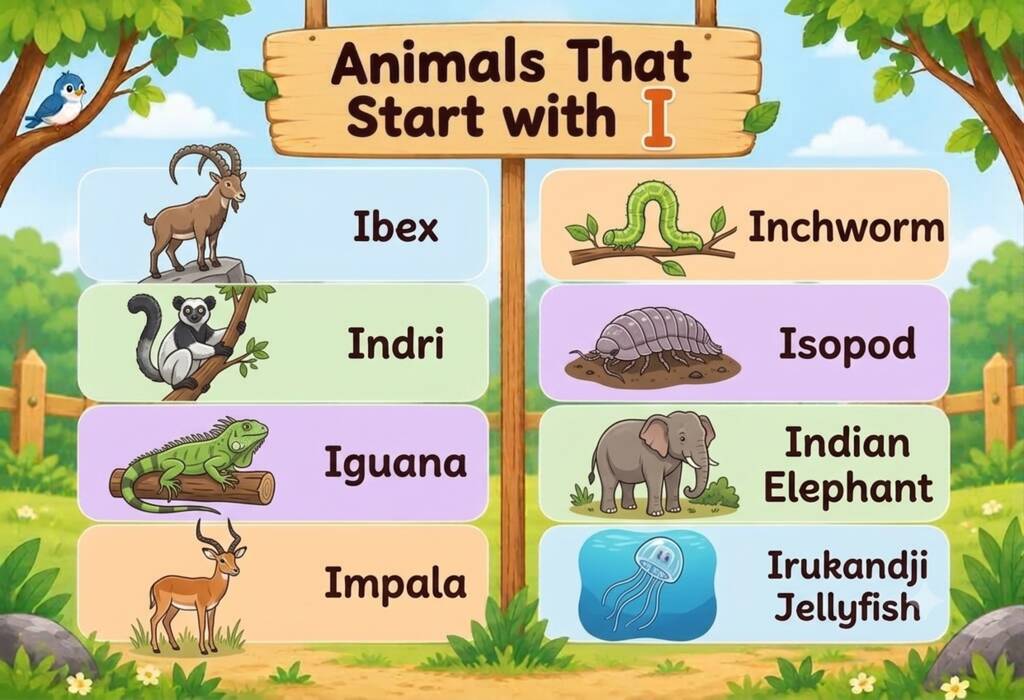
To browse every letter ‘I’ animal name from this guide at once, the chart below lists them all together.
FAQs
1. Which ‘I’ Animal Is Considered One Of The Most Dangerous In The Ocean?
The Irukandji jellyfish is considered extremely dangerous despite its tiny size, capable of delivering a sting far more painful than its appearance would suggest.
2. Is The Ivory-billed Woodpecker Still Alive Today?
Its status remains uncertain; some believe small populations may survive in remote forests, while many scientists consider the species likely extinct due to a lack of confirmed sightings in decades.
3. Why Does The Indri Have Such A Loud Call?
The indri’s wailing call helps it communicate territory and location across dense rainforest, where dense vegetation would otherwise make it difficult for troops to stay in contact.
4. Are All Animals Starting With ‘I’ Wild Species?
No, while most are wild, the Indian Runner duck is a farmed breed kept for its eggs, showing that the letter I covers domesticated animals too, even if farm names are rare.
I proves to be a genuinely varied letter, pairing recognisable names like the iguana and impala with rarities such as the indri and Irukandji jellyfish. Exploring these wild animals with the letter ‘I’ alongside the occasional farmed breed gives children a good sense of just how much ground a single letter can cover.