



Last Updated on September 10, 2026
R brings back a much longer list after the short stretch with Q, offering everything from bold birds of prey to cheerful garden regulars found across nearly every continent. Kids curious about bird names that start with the letter ‘R’ will come across familiar favourites like the robin alongside more unusual finds like the rhea.
Thank you for reading this post, don't forget to subscribe!
This guide gathers together a solid set of birds that start with ‘R’ for preschoolers and kids, each paired with a picture and a few easy-to-remember facts. Spending time with these ‘R’ letter bird names gives children a natural way to expand their vocabulary while picking up small details about how different species live and behave. Here’s a look at the birds starting with R.
List Of Bird Names That Start With ‘R’
Whether darting through gardens or striding across open plains, birds beginning with ‘R’ cover an impressively wide range. Below is a selection of well-known species, along with facts and sightings to help kids recognise them.
1. Robin
The robin is a small, familiar garden bird known for its bright orange-red chest and cheerful, year-round song.
Did You Know?
- Robins are known for being unusually bold around humans, often approaching gardeners closely.
- They sing throughout the year, including during the colder winter months.
- Robins are fiercely territorial and will defend their space from other robins.
- Both male and female robins look almost identical.
Where You Might See: Robins are widely found across the United Kingdom and much of Europe, particularly in gardens and woodlands.
2. Raven
The raven is a large, glossy black bird known for its intelligence, deep croaking call, and impressive problem-solving skills.
Did You Know?
- Ravens are considered one of the most intelligent bird species in the world.
- They can mimic sounds, including human speech, in captivity.
- Ravens have been known to use simple tools to access food.
- They often form lifelong bonds with their mates.
Where You Might See: Ravens are found across much of the Northern Hemisphere, including mountains, forests, and coastlines.
3. Rooster
The rooster is the adult male chicken, easily recognised by its bright red comb and loud crowing call at dawn.
Did You Know?
- Roosters don’t only crow at sunrise; they can call out at any time of day.
- They have an internal body clock that helps regulate their crowing pattern.
- Roosters use a variety of calls to warn hens of danger.
- Their bright feathers and comb help attract hens during courtship.
Where You Might See: Roosters are kept on farms and in backyards nearly worldwide.
4. Roadrunner
The roadrunner is a fast, ground-dwelling bird known for sprinting across open desert rather than flying.
Did You Know?
- Roadrunners can run at speeds of up to 32 kilometres per hour.
- They mainly hunt lizards, insects, and even small snakes.
- Roadrunners rarely fly, preferring to escape danger on foot.
- They sunbathe by spreading their feathers to absorb morning warmth.
Where You Might See: Roadrunners are found across the deserts of the southwestern United States and Mexico.
5. Red-tailed Hawk
The red-tailed hawk is a large bird of prey known for its broad wings and reddish-brown tail, often seen soaring above open land.
Did You Know?
- Red-tailed hawks are one of the most common hawks in North America.
- Their sharp, piercing call is often used in films to represent any bird of prey.
- They can spot small prey from great heights while soaring.
- Red-tailed hawks build large nests, often reused for several years.
Where You Might See: Red-tailed hawks are widely found across North America, particularly near open fields and roadsides.
6. Rhea
The rhea is a large, flightless bird native to South America, closely related to the ostrich and emu.
Did You Know?
- Rheas can run at speeds of up to 60 kilometres per hour.
- Male rheas are responsible for incubating the eggs and raising the chicks.
- They have long, powerful legs built for running rather than flying.
- Rheas often live in flocks alongside deer and other grazing animals.
Where You Might See: Rheas are found across the grasslands of South America, particularly Argentina and Brazil.
7. Rock Pigeon
The rock pigeon is the wild ancestor of the common city pigeon, known for its stocky body and soft cooing call.
Did You Know?
- Rock pigeons naturally nest on cliff ledges, which is why they adapt so easily to city buildings.
- They can recognise themselves in a mirror, a rare trait among birds.
- Rock pigeons have an exceptional homing ability, once used to carry messages.
- Their feather colours can vary widely, from grey to white to reddish-brown.
Where You Might See: Rock pigeons are found almost worldwide, particularly in cities, cliffs, and farmland.
8. Red-winged Blackbird
The red-winged blackbird is a striking songbird, with males easily recognised by the bright red and yellow patches on their wings.
Did You Know?
- Male red-winged blackbirds fiercely defend their territory, even chasing off much larger birds.
- Their bright wing patches, called epaulets, are used to signal dominance.
- Red-winged blackbirds often nest in dense marshland reeds.
- They are considered one of the most abundant birds in North America.
Where You Might See: Red-winged blackbirds are widely found across North America, particularly in wetlands and marshes.
9. Ruby-throated Hummingbird
The ruby-throated hummingbird is a tiny, fast-flying bird known for the male’s brilliant red throat patch.
Did You Know?
- Ruby-throated hummingbirds can beat their wings up to 53 times per second.
- They are the only hummingbird species that regularly breeds in eastern North America.
- Despite their small size, they migrate incredible distances, some crossing the Gulf of Mexico non-stop.
- Their heart can beat over 1,200 times per minute during flight.
Where You Might See: Ruby-throated hummingbirds are found across eastern North America during the breeding season.
10. Rock Ptarmigan
The rock ptarmigan is a hardy grouse species known for turning completely white in winter to blend into snowy surroundings.
Did You Know?
- Rock ptarmigans moult their feathers several times a year to match the changing seasons.
- Feathers grow on their feet, acting like natural snowshoes.
- They can survive extremely cold Arctic and mountain conditions.
- Rock ptarmigans dig shallow burrows into snow for shelter during storms.
Where You Might See: Rock ptarmigans are found in Arctic and mountainous regions across North America, Europe, and Asia.
11. Ring-necked Pheasant
The ring-necked pheasant is a large, colourful bird, with males known for their striking green head and white neck ring.
Did You Know?
- Ring-necked pheasants prefer running over flying when startled, though they can burst into fast, short flights.
- They were introduced to many countries originally for hunting purposes.
- Male pheasants are far more colourful than females, which have duller, camouflaged feathers.
- Pheasants feed mainly on seeds, grain, and insects.
Where You Might See: Ring-necked pheasants are widely found across the United Kingdom, Europe, Asia, and North America, particularly in farmland.
12. Razorbill
The razorbill is a black-and-white seabird known for its thick, blade-like beak and strong swimming ability.
Did You Know?
- Razorbills use their wings to “fly” underwater while diving for fish.
- They nest on narrow, rocky cliff ledges in large colonies.
- Razorbills are closely related to the extinct great auk.
- Their sharp-edged beak gives the bird its name.
Where You Might See: Razorbills are commonly found along coastal cliffs in the United Kingdom, Iceland, and other North Atlantic regions.
13. Roseate Spoonbill
The roseate spoonbill is a striking pink wading bird known for its long, flat, spoon-shaped beak.
Did You Know?
- Roseate spoonbills get their pink colouring from pigments in the shrimp and small crustaceans they eat.
- They feed by swinging their spoon-shaped beak side to side through shallow water.
- Roseate spoonbills often nest alongside herons and egrets in mixed colonies.
- Their bald, greenish head stands out against their bright pink feathers.
Where You Might See: Roseate spoonbills are found in wetlands across the southeastern United States, Central America, and South America.
14. Red-billed Quelea
The red-billed quelea is a small finch known for forming some of the largest flocks of any bird species in the world.
Did You Know?
- Red-billed quelea flocks can number in the millions, darkening the sky as they pass overhead.
- They are considered one of the most numerous wild bird species on Earth.
- Quelea flocks can strip entire fields of grain within hours.
- Males develop a black face mask during the breeding season.
Where You Might See: Red-billed queleas are found across sub-Saharan Africa, particularly in grasslands and farmland.
15. Ruffed Grouse
The ruffed grouse is a plump woodland bird known for the male’s dramatic wing-drumming display during the breeding season.
Did You Know?
- Male ruffed grouse beat their wings rapidly against the air to create a deep drumming sound, without any physical contact.
- Their drumming can be felt as much as heard from a distance.
- Ruffed grouse have specially adapted toes that act like snowshoes in winter.
- They rely heavily on camouflage to avoid predators.
Where You Might See: Ruffed grouse are found in forests across the northern United States and Canada.
More ‘R’ Letter Birds
Beyond this list, the letter R covers several more ‘R’ starting birds’ names, many of which are lesser known but just as interesting to discover. The table below rounds up 20 additional species.
| Radjah Shelduck | Rainbow Lorikeet |
| Red Crossbill | Red Grouse |
| Red Junglefowl | Red Knot |
| Red-backed Shrike | Red-billed Hornbill |
| Red-breasted Merganser | Red-crested Pochard |
| Red-eyed Vireo | Red-legged Partridge |
| Red-necked Grebe | Red-shouldered Hawk |
| Redshank | Redstart |
| Reed Warbler | Ring-billed Gull |
| Ringed Plover | Rufous Hummingbird |
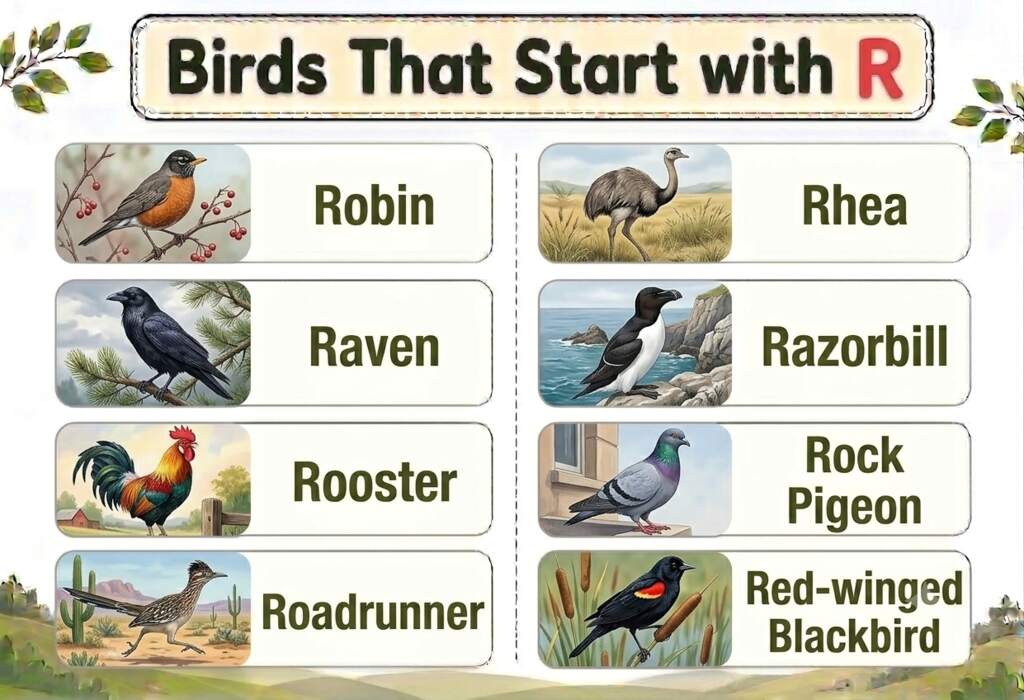
Birds That Start With ‘R’ – Chart
Need a fast way to check which birds start with the letter ‘R’? Scroll through the chart below to see every bird this guide has covered.
FAQs
1. Why Do Male Ruffed Grouse Drum Their Wings Instead Of Making Vocal Calls?
Male ruffed grouse create their drumming sound entirely through rapid wingbeats against the air, a display that carries well through dense forest where vocal calls might not travel as effectively.
2. How Are Red-billed Quelea Flocks AbleToGrow So Large?
Red-billed queleas breed rapidly and nest in massive colonies, allowing their populations to grow into some of the largest flocks of any bird species, sometimes numbering in the millions.
3. Why Do Roseate Spoonbills HaveABald Head?
A bald, featherless head helps roseate spoonbills stay cleaner while feeding, since their beaks are frequently submerged in mud and shallow water while foraging.
4. Are Ravens And Crows The Same Bird?
No, while ravens and crows belong to the same family and look somewhat similar, ravens are generally larger, have deeper calls, and sport a distinctive wedge-shaped tail in flight.
R proves to be a strong letter for bird names, pairing everyday favourites like the robin and rooster with more dramatic species such as the rhea and roseate spoonbill. Getting to know these bird names starting with ‘R’ is a simple way to grow kids’ vocabulary, one distinctive species at a time.