



Last Updated on October 7, 2026
A speech on Navratri helps children share what this nine-night festival means and why we celebrate it.Navratri is one of India’s happiest festivals, full of colour, music, dance and prayer. If you are looking for a speech on Navratri in English, this article gives simple, easy-to-learn speeches, 10 lines, a short story and useful tips. Read, practise and present with confidence in class, at a school function or at home.
Thank you for reading this post, don't forget to subscribe!
Here are 10 easy lines on Navratri that kids can read and remember quickly.
- Navratri is a happy festival of nine days.
- We pray to Maa Durga during Navratri.
- Maa Durga is brave, strong and kind.
- She rides a tiger or a lion.
- We wear colourful clothes and decorate our homes.
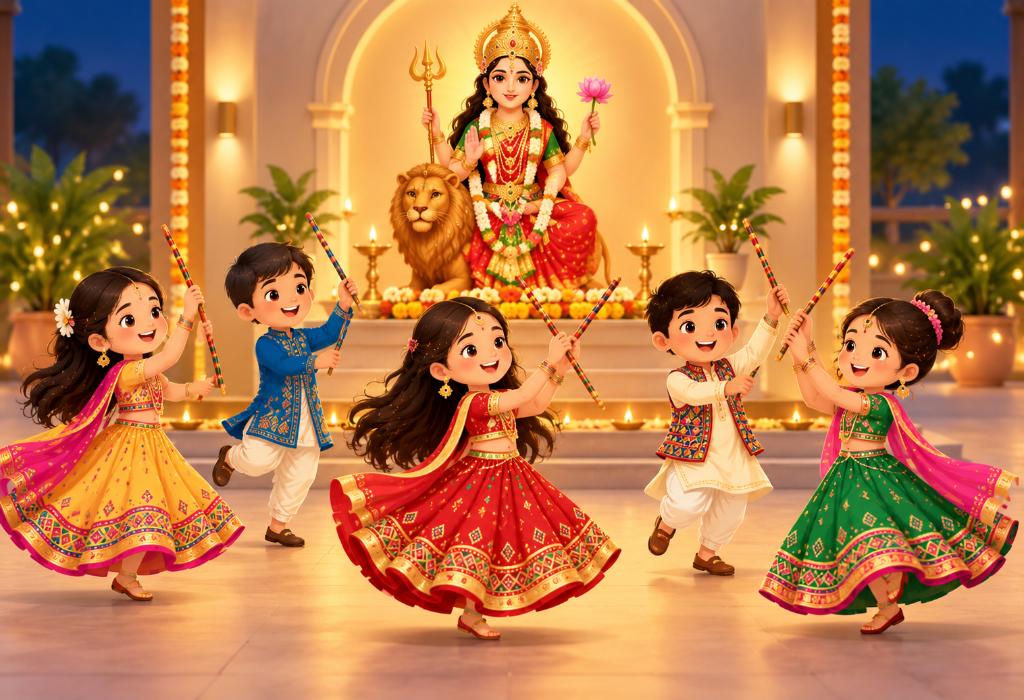
- We dance Garba and Dandiya with family and friends.
- We visit the temple and light diyas.
- We eat yummy sweets and share them with everyone.
- Navratri teaches us that good always wins over bad.
- Happy Navratri to all!
Good morning, respected teachers and my dear friends.
Today, I want to talk about Navratri. Navratri is a festival of nine days, and we pray to Maa Durga during this time. Maa Durga is brave and strong. She defeated a bad demon named Mahishasura, and that is why we say good always wins over bad.During Navratri, we wear colourful clothes, decorate our homes and dance Garba and Dandiya with friends and family. We also share sweets with everyone. Navratri teaches us to be brave, kind and honest. Happy Navratri to all! Thank you.
Good morning, Respected Teachers.
Today, I am going to talk about one of my favourite festivals, Navratri.
Navratri means “nine nights”. It is a festival of nine days, and we pray to Maa Durga during this time. Maa Durga is very brave, strong and kind. Long ago, a bad demon named Mahishasura troubled everyone. Maa Durga fought him and won. This story teaches us that good always wins over bad. On the tenth day, we celebrate Dussehra.
During Navratri, everyone is happy. We wear colourful clothes, decorate our homes with flowers and light diyas. We visit the temple and sing the aarti together. In the evening, we dance Garba and Dandiya with our family and friends. We also eat yummy sweets and share them with our neighbours. Navratri teaches us many good things. We should be brave like Maa Durga, speak the truth and be kind to everyone. We should also respect our mothers, sisters and teachers. I love Navratri because it brings everyone together.
Happy Navratri to all of you!
Good morning, respected principal and teachers.
Do you like festivals with lots of music, colours and yummy food? I do! That is why Navratri is my favourite time of the year. Today, I want to tell you what Navratri feels like in my home.
Navratri means nine nights, and each night is special. On the first day, my family places a kalash and plants tiny seeds in a small pot. By the end of the festival, green shoots grow, and I love watching them every morning. Every day, we light a diya and sing the aarti to Maa Durga. We pray to nine forms of the Goddess, one on each day. My grandmother says Maa Durga is like a protector who keeps everyone safe. She is strong, but she is also loving. Some people keep fasts during these days and eat special fruits and light food. At the end, we share prasad with everyone.
My favourite part is the evening Garba. We wear bright clothes, hold hands, clap and dance in circles with our friends. Dandiya sticks tap together to the beat of the music, and everyone smiles.
On the eighth or ninth day, many families invite little girls home, wash their feet, give them gifts and food. It teaches us to respect girls and women everywhere.
Navratri teaches me to be brave, kind and thankful. After nine days, we celebrate Dussehra, remembering that goodness always finds a way.
Happy Navratri, everyone! Thank you.
Good morning, respected principal, teachers and my dear friends.
Today, I want to share nine small promises, one for each night of Navratri. During these nine nights, we pray to nine forms of Maa Durga. Each one can teach us something good, so let us learn from all of them.
On the first night, we worship Maa Shailputri, the daughter of the mountains. I promise to be strong and steady like a mountain. On the second night, we pray to Maa Brahmacharini, who prayed with great patience. I promise to be patient and finish my homework without being reminded.
On the third night comes Maa Chandraghanta, who has a moon on her forehead and is very brave. I promise to try new things, even when I feel nervous, just like speaking on stage today. On the fourth night, we worship Maa Kushmanda, whose smile is said to have created the universe. I promise to smile often and speak politely to everyone.
On the fifth night, we pray to Maa Skandamata, the loving mother of Kartikeya. I promise to respect and help my mother and grandmother. On the sixth night is Maa Katyayani, the fierce warrior. I promise to stand up for what is right and always tell the truth.
On the seventh night, we worship Maa Kalaratri, who takes away fear. I promise to face my fears and not run away from problems. On the eighth night is Maa Mahagauri, who is calm and gentle. I promise to keep my heart peaceful, control my anger and keep my surroundings clean.
On the ninth night, we pray to Maa Siddhidatri, who gives wisdom and blessings. I promise to keep learning every day and thank my teachers for guiding me. These promises are small, but together they can make a big difference. After nine nights, we celebrate Dussehra, which reminds us that goodness always wins.
Of course, Navratri is also about dancing Garba, wearing new clothes and eating sweets, and we should enjoy all of it. But a real festival is also about what we learn and how we treat others. So this Navratri, let us dance with joy and grow in goodness. Happy Navratri, everyone! Thank you.
FAQs
1. Why do we celebrate Navratri?
We celebrate it because Maa Durga was brave and defeated a bad demon. It teaches us that good always wins over bad.
2. How can my child prepare for a speech on Navratri?
Choose a short speech that suits your child’s age and read it aloud together a few times. Practise a little every day, speak slowly and add simple actions like folded hands to remember the lines. Keep it fun and cheer your child on!
3. Which goddess do we pray to in Navratri?
We pray to Maa Durga. Each day, we worship one of her nine forms, such as Maa Shailputri, Maa Brahmacharini and Maa Siddhidatri.
4. What do people do during Navratri?
People visit temples, light diyas, sing aarti, dance Garba and Dandiya, and eat yummy sweets with family and friends.
5. What do we learn from Navratri?
We learn to be brave, kind and honest. We also learn to respect everyone and always do good things.
6. What comes after Navratri?
After nine nights of Navratri, the tenth day is Dussehra. On this day, we celebrate the victory of good over bad.
Navratri is a time to pray, dance and spend happy moments with family and friends. We hope this small speech on Navratri helps your child feel ready to speak in class or at a school function. Read it a few times, say it slowly and enjoy the moment. Wishing you and your little ones a very Happy Navratri!
Also Read:
Essay on Navratri for Kids
Essay on Dussehra in English
Essay on Durga Puja for Children