


- List Of Common 3-Letter Words Starting With P
- More 3-Letter ‘P’-Words
- 3-Letter Everyday Objects That Start With P
- Three-Letter Animal Names That Start With P
- Positive Three-Letter Words That Begin With P
- Three-Letter Nouns Beginning With P
- 3-Letter Adjectives Starting With P
- Sentences Using Three-Letter P Words
- Activities To Teach 3-Letter Words Starting With P For Kids
- FAQs
Last Updated on October 20, 2026
Children ready to move past earlier letters often find 3-letter words that start with P especially rewarding, since pig, pen, pat and pup are all words they already use in daily conversation. Sounding these out loud builds a real sense of achievement, since the words connect straight to things a child already knows.
Thank you for reading this post, don't forget to subscribe!
Parents, carers and teachers can lean on this collection of three-letter words starting with P for students to turn a plain word list into something closer to a lesson plan. Below, you’ll find a full set of meanings, themed word groups, ready-made sentences and activities built around P.
List Of Common 3-Letter Words Starting With P
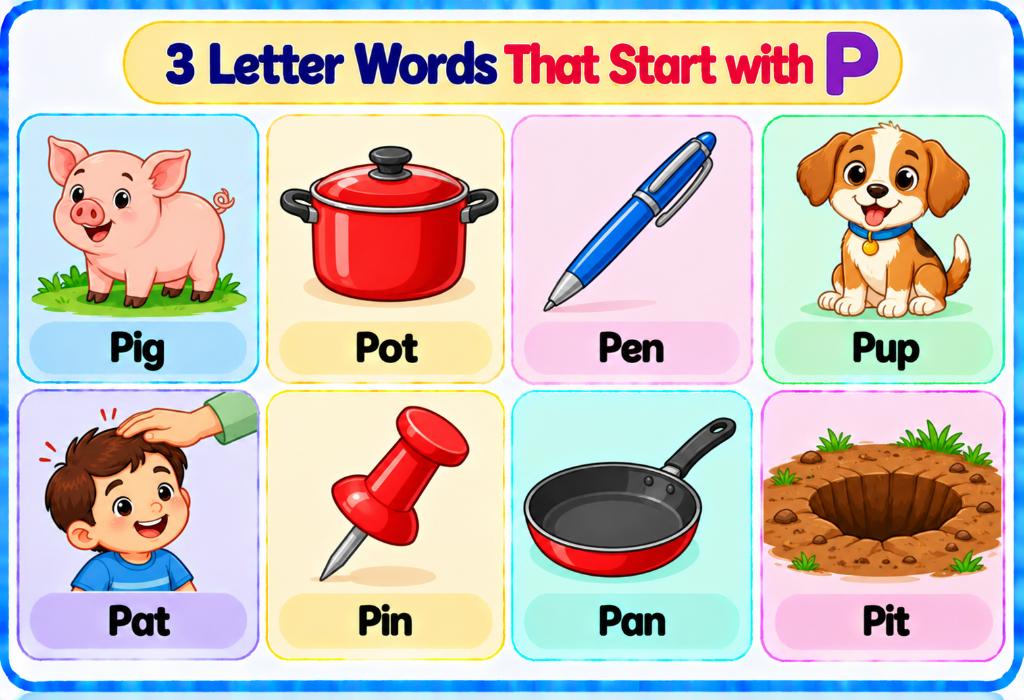
P turns out to be one of the richer letters in this series, so there’s no shortage of 3-letter words beginning with P to choose from. Below are fifteen that children are likely to meet early, each explained in a single line.
- Pig – A farm animal known for its round body and curly tail.
- Pot – A round container used for cooking or holding plants.
- Pen – A tool used for writing, or a small fenced area for animals.
- Pup – A young dog.
- Pat – To gently tap or stroke something with an open hand.
- Pin – A small, thin piece of metal with a sharp point, used for fastening things.
- Pan – A flat metal container used for cooking.
- Pit – A large hole dug in the ground.
- Peg – A small clip or hook used to fasten or hang things.
- Pod – A long seed case, such as on a pea plant.
- Paw – An animal’s foot, often with claws.
- Pie – A baked dish with a pastry crust and a filling.
- Pal – An informal word for a friend.
- Pea – A small, round green vegetable.
- Pop – A short, sharp sound, or an informal word for a fizzy drink.
More 3-Letter ‘P’-Words
A handful of lesser-known 3-letter P words sit beyond the common list above, useful once a child is ready for slightly trickier vocabulary.
| Par | Pub |
| Pew | Ply |
3-Letter Action Words That Start With P
Some of the most useful three-letter words that start with P aren’t things at all, but things you do. Pat, pop and ply all describe an action a child can picture or perform straight away.
| Pat | Pop |
| Ply |
3-Letter Everyday Objects That Start With P
Open a kitchen drawer or garden shed and P words start turning up everywhere: a pot on the stove, a pin on the noticeboard, a peg on the line.
| Pot | Pen |
| Pin | Pan |
| Peg | Pie |
Three-Letter Animal Names That Start With P
Only two creatures earn a spot here at exactly three letters, but both are firm favourites with young children, one from the farm and one from home.
| Pig | Pup |
Positive Three-Letter Words That Begin With P
Not every letter offers a feel-good word in just three letters, but P does: “pal” is the sort of word a child reaches for naturally when talking about a friend.
| Pal |
Three-Letter Nouns Beginning With P
Whether it’s an animal, a food or something found in the kitchen, every word below answers the question “what is it?” — the hallmark of a noun.
| Pig | Pot |
| Pen | Pup |
| Pan | Pod |
| Paw | Pie |
3-Letter Adjectives Starting With P
P doesn’t offer much in the way of true describing words at exactly three letters, so this group stays thin — there’s still plenty to explore in the word lists and activities above.
Sentences Using Three-Letter P Words
Seeing a word sitting inside a full sentence, rather than standing alone on a list, is what turns recognition into real reading. Read each line below aloud and have your child pick out the P word.
- The pig rolled happily in the mud.
- Mum put the soup in a big pot.
- I wrote my name with a blue pen.
- The pup wagged its tail with joy.
- Dad gently patted the dog’s head.
- I found a shiny pin on the floor.
- We fried eggs in a hot pan.
- The cat’s paw left prints in the snow.
- Grandma baked an apple pie for us.
- My best pal came over to play.
Activities To Teach 3-Letter Words Starting With P For Kids
Flashcards work, but children often remember words better once they’ve acted them out. These 3-letter words starting with P for kindergarten and preschoolers are built around movement, sound and pretend play rather than sitting still.
1. The Peg Line Countdown
Clip a row of clothes pegs along a string, each one holding a small picture or word card. Children pull one peg at a time, working backwards from ten, reading the word aloud before it joins a growing pile on the floor.
2. Pin The Tail, P-Style
Adapt the classic blindfolded game by pinning a paper tail onto a large paper pig instead of a donkey. Before each turn, the child must say “pig” and “pin” out loud, connecting both words to the action they’re about to take.
3. Fizzy Pop Sound Match
Record or imitate a few short “pop” sounds — bubble wrap, a party popper, a cork — and have children close their eyes and guess which object made the noise. Afterwards, talk about how “pop” describes both the sound and the drink.
4. Pie Slice Sharing
Cut a paper or felt “pie” into equal slices and have children work out how to share it fairly among a small group. As they hand out each piece, they say “pie” and count the slices together.
5. Pat, Don’t Startle
Using a soft toy animal, practise the difference between patting gently and grabbing too hard, talking through why animals prefer a calm pat. This ties the word “pat” to a real, useful lesson in kindness towards pets.
FAQs
1. Why Do British And American English Disagree On What “Pop” Means?
In British English, “pop” most often describes a sudden sound or a quick visit, as in “I’ll pop round later,” while in American English it’s also a common word for a fizzy drink. Noticing this difference is a useful, light way to introduce children to regional variation in English.
2. Is A “Pod” Always Something A Pea Grows In?
No, “pod” has taken on newer meanings too, such as a small, separate compartment or group, like a pod of dolphins or a seating pod. Mentioning both the plant sense and these other uses shows children how old words pick up new jobs over time.
3. Why Does “Pig” Sometimes Get Used To Describe A Person?
Informally, calling someone a “pig” can mean they’re eating too much or being messy, borrowing the animal’s reputation rather than describing a real pig’s behaviour. This is a good moment to explain that animal words are often used unfairly as insults, even when they don’t reflect how the animal actually behaves.
4. What Makes “Pat” Different From Similar Words Like “Tap” Or “Touch”?
“Pat” specifically suggests a gentle, repeated or affectionate touch, usually with an open hand, which sets it apart from a single quick “tap” or a more general “touch.” Comparing these three words side by side helps children notice how English often has several close synonyms with subtly different shades of meaning.
5. Why Do So Many P Words Involve Cooking Equipment?
Pot, pan and peg (for hanging up tea towels or aprons) cluster around the kitchen partly by coincidence, since these are old, everyday items that have kept short, simple names for centuries. Walking through a real kitchen together and spotting these objects turns the word list into something tangible rather than abstract.
From a muddy pig to a shared slice of pie, three-letter P words give children a lively set of everyday vocabulary to practise. Working these words into cooking, play and simple games at home helps them stick far better than repetition alone.