


- List Of Common 3-Letter Words Starting With S
- More 3-Letter ‘S’-Words
- 3-Letter Action Words That Start With S
- 3-Letter Everyday Objects That Start With S
- Three-Letter Animal Names That Start With S
- Positive Three-Letter Words That Begin With S
- Three-Letter Nouns Beginning With S
- 3-Letter Adjectives Starting With S
- Sentences Using Three-Letter S Words
- Activities To Teach 3-Letter Words Starting With S For Kids
- FAQs
Last Updated on October 20, 2026
Few letters give children as much to work with as S does, and 3-letter words that start with S are often among the very first a young reader masters, from sun and sit to sad and six. The letter’s hissing sound is distinctive and easy to isolate, which makes these words a natural anchor point in early phonics.
Thank you for reading this post, don't forget to subscribe!
For anyone building a lesson around three-letter words starting with S for students, this guide covers the ground thoroughly: a full word list, themed categories, ready-made sentences and hands-on activities, all centred on S.
List Of Common 3-Letter Words Starting With S
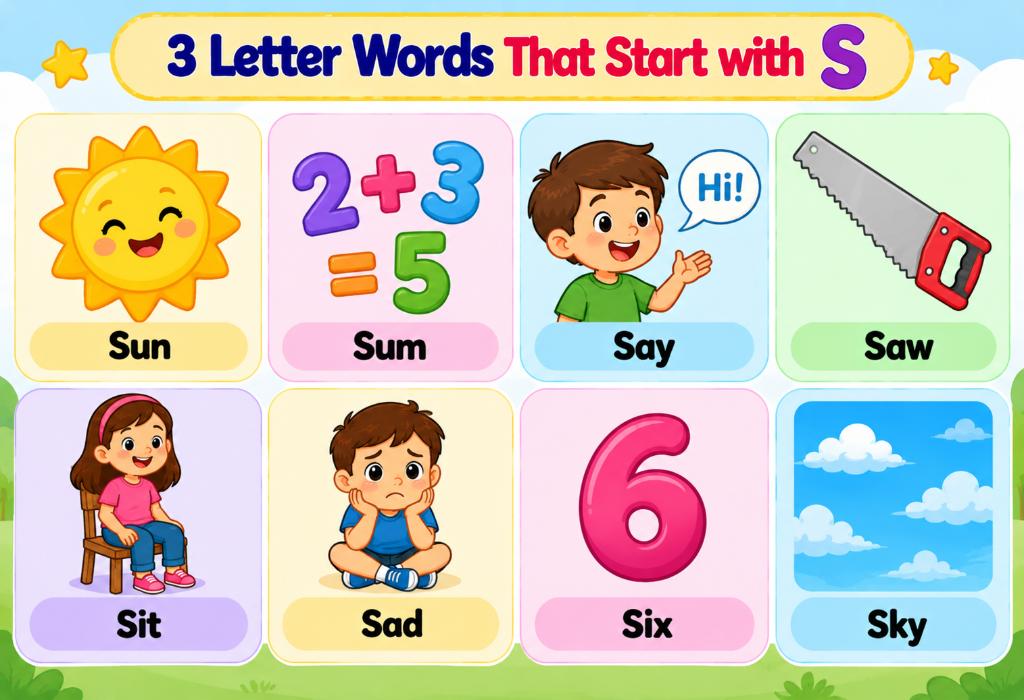
S is one of the most generous letters in the alphabet for short words, so narrowing 3-letter words beginning with S down to fifteen means leaving several good ones out. Here’s a solid starting set for early readers.
- Sun – The bright star at the centre of our solar system that gives us light and heat.
- Sit – To rest your body down on a chair or the ground.
- Sad – Feeling unhappy.
- Six – The number 6.
- Sob – To cry with short, heavy breaths.
- Sow – A female pig, or to plant seeds in the ground.
- Spy – Someone who secretly watches or gathers information.
- Say – To speak words aloud.
- Set – To put something in a particular place, or a group of matching items.
- Sky – The space above the earth where clouds and the sun appear.
- Soy – A bean used to make foods like tofu and soy sauce.
- Sip – To drink in small amounts.
- Sir – A polite word used to address a man.
- Saw – A tool used for cutting wood, or the past form of “see.”
- Sum – The total when numbers are added together.
More 3-Letter ‘S’-Words
Beyond the essentials, S offers a wide pool of further genuine 3-letter S words that reward children once they’re reading confidently.
| Sly | Sap |
| Sty | Sin |
| Sew | Sea |
| See | Sue |
| Spa | Sot |
3-Letter Action Words That Start With S
Several S words describe something a child can physically do, which makes them a good match for simple instructions and games.
| Sit | Sow |
| Say | Sip |
| Sob | Set |
| Sew | See |
3-Letter Everyday Objects That Start With S
A saw in the shed, a set of blocks on the floor, sap from a tree trunk — plenty of S words name things children will recognise straight away.
| Saw | Spa |
| Sap |
Three-Letter Animal Names That Start With S
S does offer a genuine animal name at exactly three letters once you look past the more obvious options: a sow is a female pig, a word children may already know from farm stories.
| Sow |
Positive Three-Letter Words That Begin With S
Praise comes easily with S, since this is the letter behind one of the most universally recognised words of approval in English.
| Sun |
Three-Letter Nouns Beginning With S
From the sky above to a tool in the shed, these S words all name something a child can point to or picture.
| Sun | Sky |
| Sir | Saw |
| Sum | Soy |
| Sea | Spa |
| Sap | Sow |
3-Letter Adjectives Starting With S
S supplies a genuine descriptive word that children will reach for often when talking about their own feelings.
| Sad |
Sentences Using Three-Letter S Words
Putting a word into a full sentence helps a child see how it actually gets used, not just how it looks on its own. Read these together and ask your child to spot the S word each time.
- The sun felt warm on my face.
- Please sit down at the table.
- I felt sad when my toy broke.
- She counted all the way to six.
- The baby began to sob loudly.
- The farmer’s sow slept in the barn.
- I saw a plane in the sky.
- Dad cut the wood with a saw.
- We added the numbers to find the sum.
- Can you say your name for me?
Activities To Teach 3-Letter Words Starting With S For Kids
Built around sound, texture and movement, these 3-letter words starting with S for kindergarten and preschoolers give children several different ways into the same small set of words.
1. Snake Hiss Trail
Lay a long, winding rope or chalk line on the ground shaped like a snake, and have children slither along it, hissing the “s” sound the whole way. At set points along the trail, pause and say an S word together before continuing the hiss.
2. Sow And Grow Jar
Plant a few fast-growing seeds, like cress, in a clear jar with damp cotton wool, and check on it daily. Each visit, children say “sow” and “grow,” watching the word connect to something changing in front of them over several days.
3. Sip And Guess
Offer small sips of a few different, safe drinks with eyes closed, and have children guess what they’re tasting based on flavour alone. After each guess, they say “sip” before moving to the next sample.
4. Six Steps Challenge
Mark six spots on the floor with chalk or tape and have children complete a different small task at each one, like a hop, a clap or a spin. Counting up to “six” as they go links the number word to a physical sequence rather than rote counting.
5. Sawdust Sensory Tray
With adult supervision, let children explore a tray of clean, soft wood shavings (or a safe substitute like shredded paper) with their hands, talking about how a saw might have made them. This connects the tool word “saw” to a tactile, sensory experience.
FAQs
1. Why Does “Saw” Have Two Totally Different Jobs In English?
“Saw” works as a cutting tool, but it’s also simply the past tense of “see,” and the two meanings have no connection beyond sharing the same letters. Reading both uses in separate sentences helps children understand that identical spelling doesn’t always mean identical meaning.
2. Is “Soy” Only Used To Talk About Food?
Mostly, yes, since “soy” usually appears alongside beans, milk or sauce, but it’s worth mentioning that it comes from a Japanese word that travelled into English through trade centuries ago. Sharing this bit of history can be an interesting aside for children curious about where food words come from.
3. Why Do Children Often Learn “Sit” Before Other S Action Words?
“Sit” is usually one of the very first instructions children follow, both in language and in everyday routines like mealtimes, which is why it tends to stick early. This familiarity makes it a reliable anchor word when introducing other S verbs for the first time.
4. Does “Set” Always Mean The Same Thing?
No, “set” can mean to place something down, a matching group of items, or even the sun going down in the evening, making it one of the more flexible three-letter words in English. Pointing out a few of these different uses in conversation helps children see how context shapes meaning.
5. Why Does “Sow” Have Two Such Different Meanings Depending On How It’s Pronounced?
Spelled identically but pronounced differently, “sow” as in planting a seed rhymes with “go,” while “sow”, meaning a female pig, rhymes with “cow.” This is a good word to read aloud together, since the spelling alone won’t tell a child which meaning is intended.
From the warmth of the sun to a sow resting in the barn, three-letter S words offer children one of the richest word sets in this entire series. Working these words into daily routines, games and conversations gives children plenty of natural chances to practise without it ever feeling like a lesson.