


- List Of Common 3-Letter Words Starting With T
- More 3-Letter ‘T’-Words
- 3-Letter Action Words That Start With T
- 3-Letter Everyday Objects That Start With T
- Three-Letter Animal Names That Start With T
- Positive Three-Letter Words That Begin With T
- Three-Letter Nouns Beginning With T
- 3-Letter Adjectives Starting With T
- Sentences Using Three-Letter T Words
- Activities To Teach 3-Letter Words Starting With T For Kids
- FAQs
Last Updated on October 22, 2026
Toys, ten fingers, a tug on a sleeve — 3-letter words that start with T turn up constantly in a child’s day, which makes them easy to teach through everyday moments rather than only through flashcards. Their short, punchy sound also makes them satisfying for little ones to say out loud.
Thank you for reading this post, don't forget to subscribe!
This guide works through three-letter words starting with T for students, with a full word list, themed tables, example sentences and simple activities to bring T words to life at home or in the classroom.
List Of Common 3-Letter Words Starting With T
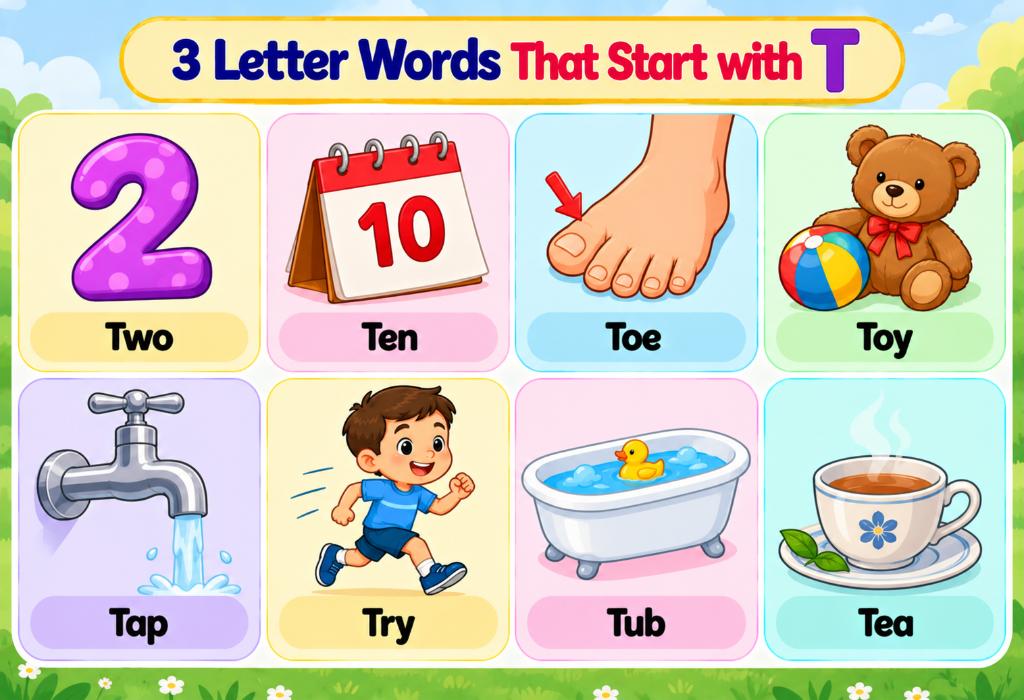
Here is a set of fifteen 3-letter words beginning with T that children are likely to meet early on, each with a short, clear meaning.
- Top: The highest part of something, or a spinning toy.
- Ten: The number 10.
- Toe: One of the small parts at the end of a foot.
- Tin: A metal container, often used for food.
- Tap: A device that controls the flow of water, or to hit something lightly.
- Tag: A small label, or a chasing game played by children.
- Toy: Something made for a child to play with.
- Try: To make an attempt at something.
- Tub: A large, open container, often used for bathing or storage.
- Tea: A hot drink made from dried leaves, or a light evening meal in some regions.
- Tie: A strip of fabric worn around the neck, or to fasten something together.
- Tan: A light brown colour, often from time spent in the sun.
- Tip: The pointed end of something, or helpful advice.
- Tug: To pull something firmly.
- Two: The number 2.
More 3-Letter ‘T’-Words
Once the common words feel familiar, these additional T words are worth introducing for extra practice.
| Tad | Tux |
| Taj | Tho |
| Tow |
3-Letter Action Words That Start With T
A tug on a rope, a tap on a shoulder, a try at something new — these T words all describe something a child can actually do.
| Try | Tap |
| Tug | Tow |
| Tie |
3-Letter Everyday Objects That Start With T
From a toy on the carpet to a tin in the cupboard, these 3-letter T words name plenty of objects children already recognise.
| Top | Toy |
| Tin | Tub |
| Tea |
Three-Letter Animal Names That Start With T
T doesn’t lend itself to animal names the way some other letters do, so young readers won’t find one in this group — but there’s plenty more to explore in the rest of the article.
Positive Three-Letter Words That Begin With T
A warm cup shared gives T its most comforting word, one tied closely to cosy, unhurried moments at home.
| Tea |
Three-Letter Nouns Beginning With T
Toys, body parts, drinks and numbers all sit comfortably inside this group of T words naming people, places and things.
| Top | Toe |
| Tin | Toy |
| Tub | Tea |
| Tie | Tip |
3-Letter Adjectives Starting With T
A sun-kissed colour gives T a genuine describing word children will recognise from warm days outdoors.
| Tan |
Sentences Using Three-Letter T Words
Reading a three-letter word that starts with T inside a full sentence helps it stick far better than meeting it alone on a list. Go through these together and ask your child to spot the T word in each one.
- The spinning top wobbled before it fell.
- I counted all the way to ten.
- I stubbed my toe on the step.
- Mum opened a tin of soup for lunch.
- Please turn off the tap when you’re done.
- We played a game of tag in the park.
- My favourite toy is the red car.
- I will try my best on the test.
- Dad filled the tub with warm water.
- Grandma made a pot of tea for everyone.
Activities To Teach 3-Letter Words Starting With T For Kids
These 3-letter words starting with T for kindergarten and preschoolers work well as short, hands-on moments scattered through the day rather than one long sitting.
1. Tag Team Word Chase
Play a simple game of tag where, instead of being “it,” the person caught must say a T word before chasing someone else. The constant movement keeps the words tied to action rather than memorisation.
2. Tub Float Or Sink
Fill a tub or basin with water and gather a mix of small objects, some that float and some that sink. As each item goes in, children predict the outcome and say “tub” before testing their guess.
3. Tea Party Manners
Set up a pretend tea party with toy cups and a teapot, practising polite phrases like “please” and “thank you” as the tea is poured. Children take turns saying “tea” before each refill, linking the word to a shared social moment.
4. Toe-To-Top Stretch
Lead a simple stretching routine where children reach down to touch their toes, then slowly stretch their arms up to the top of their reach. Calling out “toe” and “top” at each end of the stretch connects both words to clear, opposite movements.
5. Tin Can Telephone
Make a simple two-cup string telephone using clean tins or cups, and let pairs of children take turns whispering a T word to each other across the room. The slightly tricky listening makes the words feel like a genuine secret worth catching.
FAQs
1. Why Does “Tea” Mean Both A Drink And A Meal?
In some regions, “tea” refers to a light evening meal rather than just the drink, a tradition that grew out of afternoon tea gradually becoming a full sitting. Mentioning this helps children understand that everyday words can carry different meanings depending on where a family is from.
2. Is “Tag” Always About A Chasing Game?
No, “tag” also describes a small label attached to clothes or luggage, quite separate from the playground game of the same name. Pointing out both uses helps children see how one short word can belong to two completely different parts of daily life.
3. Why Do So Many T Words Relate To Numbers?
“Ten” and “two” both happen to be short, three-letter number words, which makes T a useful letter for linking early reading with early counting. Practising them together, rather than separately, can reinforce both skills at once.
4. Does “Tip” Always Mean The Same Thing?
Not quite, since “tip” can mean the pointed end of an object, a small piece of useful advice, or even money left for good service, depending on the sentence. Working through a few examples together shows children how context changes which meaning applies.
5. Why Is “Tug” Often Paired With The Word “War” In Games?
Tug of war gets its name directly from the action of pulling, or tugging, as hard as possible against an opposing team, which makes it a natural, physical way to introduce the word. Playing a simple version at home ties the word to a clear, memorable feeling of effort.
From a spinning top to a shared cup of tea, three-letter T words bring together objects, actions and feelings that already fill a child’s everyday world. Weaving these words into games, mealtimes and quiet moments helps them become second nature rather than something learned only from a page.