


- List Of Common 3-Letter Words Starting With W
- More 3-Letter ‘W’-Words
- 3-Letter Action Words That Start With W
- 3-Letter Everyday Objects That Start With W
- Three-Letter Animal Names That Start With W
- Positive Three-Letter Words That Begin With W
- Three-Letter Nouns Beginning With W
- 3-Letter Adjectives Starting With W
- Sentences Using Three-Letter W Words
- Activities To Teach 3-Letter Words Starting With W For Kids
- FAQs
Last Updated on October 22, 2026
Children usually pick up 3-letter words that start with W faster than most, since the letter carries a soft, rounded sound that’s easy to say and easy to spot at the start of a word like “wet” or “win.”
Thank you for reading this post, don't forget to subscribe!
This guide gathers three-letter words starting with W for students, with a full word list, grouped tables, example sentences and hands-on activities built around W.
List Of Common 3-Letter Words Starting With W
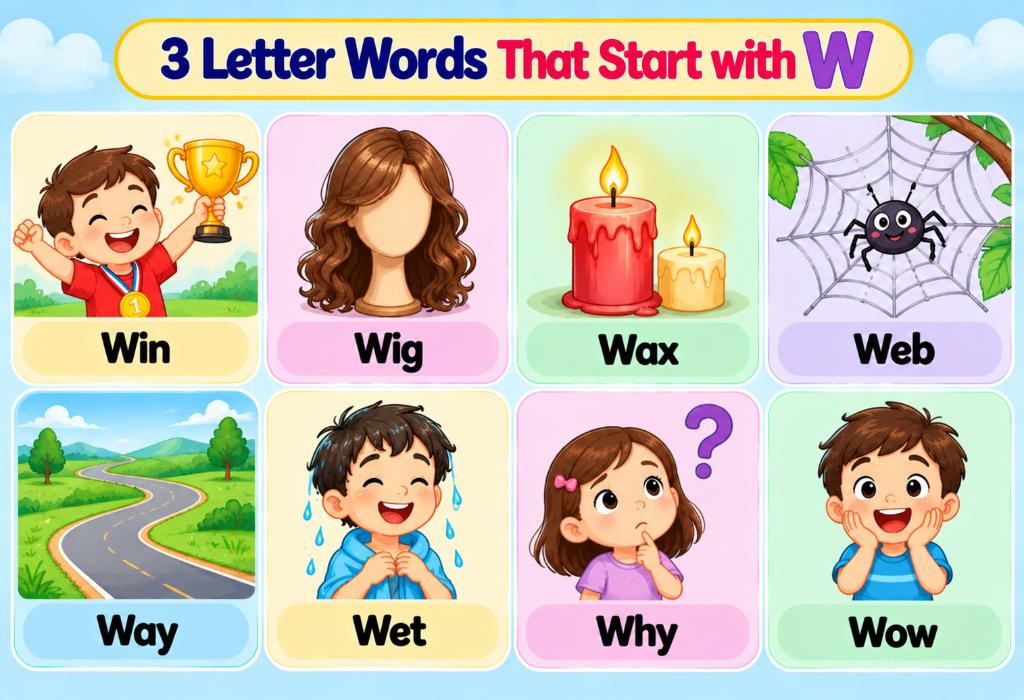
Why does W show up so often in a child’s first storybooks? Partly because question words like “who” and “why” sit right alongside everyday nouns and verbs in this set of fifteen 3-letter words beginning with W.
- Wet – Covered or soaked in water or another liquid.
- Win – To come first or succeed in a game or contest.
- Wig – A covering of false hair worn on the head.
- Web – A network of threads spun by a spider.
- Wax – A soft, meltable substance used to make candles.
- Way – A direction, path or method of doing something.
- War – A serious conflict fought between groups or countries.
- Was – The past form of “is,” used to describe something that already happened.
- Wit – Clever and quick humour.
- Wok – A round, deep pan used for frying food quickly.
- Wag – To move something, like a tail, quickly from side to side.
- Wed – To marry someone.
- Who – A word used to ask about a person.
- Why – A word used to ask the reason for something.
- Wow – A word used to show surprise or amazement.
More 3-Letter ‘W’-Words
Children confident with the list above are ready for a few trickier entries, including one borrowed from a well-known card game.
| Woe | Wen |
| Woo | Wan |
3-Letter Action Words That Start With W
Winning a race, wagging a tail, marrying a partner this group of W words all describe something happening, not something sitting still.
| Win | Wag |
| Wed | Woo |
| Wax |
3-Letter Everyday Objects That Start With W
Look closely at a dressing-up box or a kitchen shelf and a few of these 3-letter W words are probably already within reach.
| Wig | Web |
| Wax | Wok |
Three-Letter Animal Names That Start With W
No genuine three-letter animal name begins with W, so young readers won’t find an example in this group but there’s still plenty to explore in the word lists and activities above.
Positive Three-Letter Words That Begin With W
Nothing beats the sound of a crowd shouting “win,” which makes it the clearest feel-good word W has to offer.
| Win |
Three-Letter Nouns Beginning With W
From a spider’s web to a chef’s wok, these W words all name something solid enough to picture or point to.
| Wig | Web |
| Way | War |
| Wit | Wok |
3-Letter Adjectives Starting With W
Describing words are thin on the ground for W at exactly three letters, but “wan,” meaning pale or tired-looking, is a genuine one.
| Wan |
Sentences Using Three-Letter W Words
Children remember a three-letter word that starts with W far better once they’ve seen it doing a job inside a real sentence. Work through these together and ask your child to spot the W word in each one.
- My socks got wet in the puddle.
- She was so happy to win the race.
- The actor wore a curly wig on stage.
- A spider spun its web in the corner.
- The candle was made of soft wax.
- Which way should we turn at the lights?
- The dog began to wag its tail with joy.
- We stir-fried the vegetables in a wok.
- Who left the door open?
- “Wow,” she said, staring at the fireworks.
Activities To Teach 3-Letter Words Starting With W For Kids
Pulling W words into movement and sound helps them stick far better than reading them silently off a page. Try these 3-letter words starting with W for kindergarten and preschoolers.
1. Wag Along
Tie a soft fabric strip to the back of each child’s waistband like a tail, and have them “wag” it by wiggling their hips while music plays. When the music stops, they freeze and say the word “wag” before starting again.
2. Web Weaving String Game
Give children a ball of wool and have them pass it to each other across a circle, holding onto their strand each time, until a web shape forms in the middle. Once finished, talk about how a real spider builds its web the same patient way.
3. Wok Stir Pretend
Set up a play kitchen with a bowl standing in for a wok and some soft toy vegetables, letting children “stir-fry” while naming each item as it goes in. Finish by asking what sound the food might make sizzling in a real wok.
4. Who, What, Wow Detective
Hide a few small objects around the room and have children ask “who,” “what” and other simple questions to guess what’s hidden before shouting “wow” when they find it. This turns three short W words into a proper mini investigation.
5. Wax Candle Watch (Adult-Led)
With an adult handling anything hot, let children safely observe a candle burning from a distance and talk about how the wax slowly melts and changes shape. Afterwards, ask them to describe in their own words what happened to the wax.
FAQs
1. Why Do So Many Question Words Start With W?
English question words like “who,” “why,” “what” and “when” nearly all share the same W-H spelling pattern, a leftover from Old English that’s stuck around for centuries. Pointing this out helps children notice a genuine pattern rather than treating each question word as unrelated.
2. Is “Wax” Only About Candles?
No, “wax” is also used to describe the moon appearing to grow larger each night, as in “a waxing moon.” Mentioning this second meaning gives children an early, simple way into talking about the night sky.
3. Why Does “Wok” Look Like It Doesn’t Belong With Other English Words?
“Wok” is a borrowed word, taken directly from Cantonese, and its spelling doesn’t follow typical English patterns because of that origin. It’s a useful, gentle way to show children that English regularly adopts words from other languages, especially around food.
4. Does “Win” Always Mean Beating Someone Else?
Not necessarily, since people often talk about a “small win” to describe personal progress that has nothing to do with competing against anyone. Introducing this broader sense of the word helps children see success as something personal, not just about coming first.
5. Why Is “Wow” Considered Its Own Type Of Word?
“Wow” belongs to a small group called interjections, words that exist purely to express a sudden feeling rather than to name, describe or do anything. It’s worth explaining that these short outburst words follow different rules from the nouns and verbs children are used to.
From a tail-wagging dog to the simple joy of a win, three-letter W words give children plenty of everyday language to hold onto. Letting these words show up naturally in play and conversation works far better than memorising them in isolation.