

- What Are Positive Words?
- Benefits of Teaching Positive Words To Children
- List of Positive Words For Children
- Positive Phrases To Motivate And Inspire Kids
- Funny Positive Words For Children
- Powerful And Encouraging Words For Kids to Express Love
- Positive Words For Children In School
- Positive Words For Kids Who are Having a Bad Day
- Tips To Use Positive Words for Children
- Positive Words Quiz
- Lists Of Positive Words – Chart
- FAQs
Last Updated on September 28, 2026
Even though words are the building blocks of language, they are highly powerful in delivering a message. Even a tiny word, once spoken, can have a tremendous influence. Good words can create a wave of positivity. However, negative words can harm you permanently. Children pick up everything by watching the world surrounding them. Therefore, using good language among children and giving words of encouragement to kids is vital. Kids typically have a positive outlook on life since they enjoy its small joys.
Thank you for reading this post, don't forget to subscribe!
What Are Positive Words?
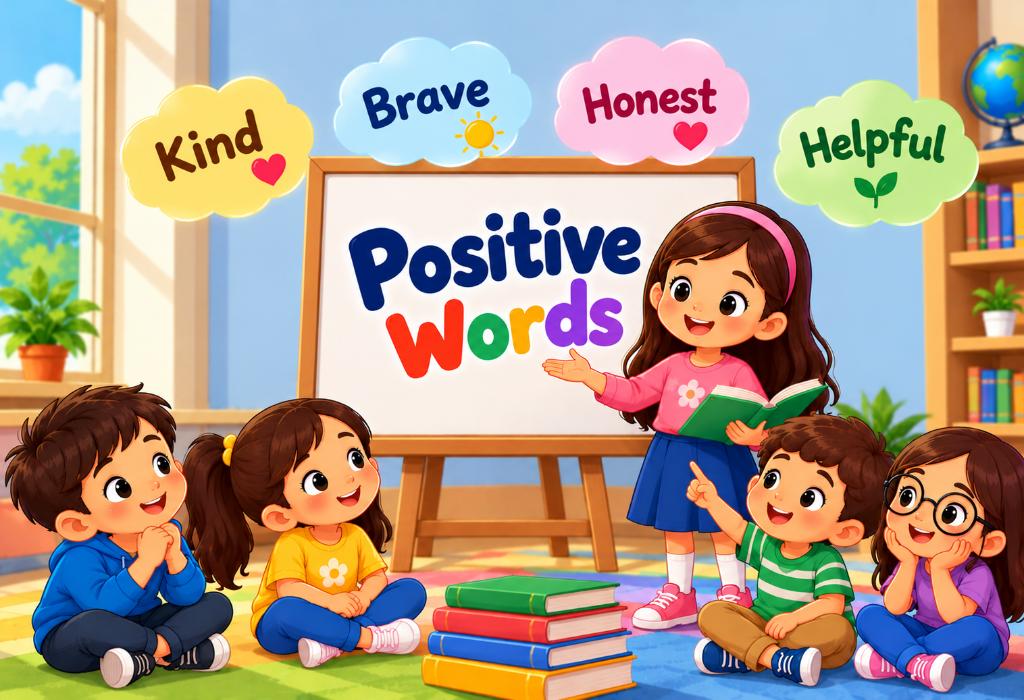
Positive words are simple yet powerful expressions that spread joy, kindness, and confidence in everyday conversations. Introducing positive words to preschoolers early on helps them build a warm, optimistic outlook as they grow and learn. From simple words like “wonderful” and “brave” to phrases like “you can do it,” positive words lay the foundation for a child’s confidence and self-belief from a very early age. Here are a few examples:
| POSITIVE WORD | MEANING |
| Happy | Feeling pleased, cheerful, or glad. |
| Kind | Being caring, helpful, and considerate to others. |
| Brave | Showing courage and confidence in difficult situations. |
| Friendly | Being warm, pleasant, and easy to talk to. |
| Honest | Telling the truth and behaving in a trustworthy way. |
Benefits of Teaching Positive Words To Children
- Giving your children a few encouraging words each day will aid their mental growth and boost their moral strength.
- Positive phrases will make the kids feel better about them, and become more self-assured. Kids will develop self-confidence at their growing age, which is great.
- It will create a joyful, encouraging home environment. These phrases also teach kids to be loving, motivating, and empathic towards everyone.
- It will alter children’s self-perceptions for the better. In return, this would help them develop self-confidence.
- Kids who hear these encouraging words have greater self-confidence, which allows them to recover more quickly from failures and cultivate perseverance and a will to succeed.
- Kids who learn positive words and grow in a positive environment. Their positive attitude helps them become successful in their academic, professional and personal life.
List of Positive Words For Children
Kids who are praised and rewarded for their efforts develop into uplifting, driven, and compassionate people. Below is a list of encouraging words for students.
| Alphabets | Words |
| A | Accomplished, Active, Adaptable, Admirable, Adorable, Adventurous, Affectionate, Amazing, Ambitious, Amusing, Animated, Artistic, Attentive, Authentic, Awesome |
| B | Balanced, Beautiful, Believable, Brave, Bright, Brilliant |
| C | Calm, Candid, Capable, Careful, Caring, Charismatic, Cheerful, Coherent, Committed, Communicative, Compelling, Confident, Consistent, Constructive, Courageous, Courteous, Creative, Curious |
| D | Decisive, Delightful, Dependable, Detailed, Determined, Devoted, Diplomatic, Distinguished, Dynamic |
| E | Eager, Eloquent, Empathetic, Enchanting, Endearing, Endless, Enduring, Engaging, Enigmatic, Enterprising |
| F | Fantastic, Fashionable, Fast, Fervent, Fierce, Flexible, Focused, Focussed, Forgiving, Frank, Free-spirited, Friendly |
| G | Generous, Gentle, Genuine, Gifted, Giving, Gracious, Gutsy |
| H | Happy, Helpful, Honest, Honorable |
| I | Imaginative, Incredible, Instinctive, Intense, Interesting, Inventive |
| K | Kind |
| L | Leader, Lively, Lovable, Loved, Loving, Loyal |
| M | Magical, Modest, Motivating |
| N | Natural, Nurturing |
| O | Original, Outgoing |
| P | Particular, Passionate, Patient, Perceptive, Persuasive, Phenomenal, Philosophical, Poetic, Polite, Positive, Powerful, Practical, Productive, Protective, Proud |
| Q | Quick |
| R | Reflective, Reliable, Resourceful, Responsible |
| S | Secure, Sensational, Sensible, Serious, Sincere, Skillful, Sociable, Spontaneous, Steady, Straight-forward, Stunning, Successful, Sympathetic |
| T | Talented, Terrific, Thoughtful, Trusting, Trustworthy |
| U | Understanding, Upbeat |
| V | Valuable, Vibrant |
| W | Warm, Wise, Witty, Wonderful, Wondrous, Worthy |
| Y | Young |
Positive Phrases To Motivate And Inspire Kids
Here are some inspiring quotes for school children that you may use to motivate and support them.
- Try your best rather than expecting to succeed.
- Avoid comparing yourself to others.
- Embrace your dreams.
- You’ll overcome this.
- You’re a strong person.
- You’re working hard.
- Let’s try it your way, I see.
- It’s acceptable to make errors.
- You’re a fantastic leader.
- You can succeed in life, in my opinion.
- Never give up; keep going.
- Aim for the stars.
- Your concepts are brilliant and original.
- Good work! You have put in great dedication and hard work in accomplishing your goal.
- You’re the best!
Funny Positive Words For Children
Your kid’s morale will soar thanks to these amusing words of support. Imagine situations where a kid has come second or third in the running race competition and feels sad about not winning.
- The evening before a test is comparable to the evening before Thanksgiving. You are unable to sleep while holding out hope for a dawn miracle.
- Listen to your parents; they completed their education before Google.
- The simplest profession you’ll possibly have is attending school.
- The only simple thing one could do to improve your appearance is to smile.
- Nothing is impossible. The very word declares, “I’m possible!”
- Be fantastic! Be an avid reader!
- It’s just a ritual whenever your mom asked, “Would you like some advice?” Your response, whether yes or no, is irrelevant, and you will nonetheless obtain it.
- The difference between triumph and try is a little tumph.
- Dreams come to a size too big so that we can grow into them.
- We all learn by experience, but some of us have to go to summer school.
- Take your risks now. As you grow older, you become fearful and less flexible. I mean that literally. I hurt my knee this week on the treadmill, and it wasn’t even on.
- You have brains in your head, and you have feet in your shoes. You can steer yourself in any direction you choose.
- Don’t judge a fish by its ability to climb a tree.
- Keep looking up, there may be a rainbow waiting for you.
- Not everyone who takes extra paper during finals writes extra sense.
Powerful And Encouraging Words For Kids to Express Love
You can utilise loving language frequently during the day. While you are putting your children to bed or leaving them off in the mornings, you should use these expressions in particular. By seeing us, they will also learn to express their love towards you and the other family members.
- I will always believe in you.
- You are important to me.
- Your concepts are incredibly original.
- You’re a vital part of this family, and I appreciate spending quality time with you.
- We consider it a blessing to have you in our lives.
- I’m very happy to be your parent.
- You make me smile.
- You have my undying love.
- You hold a special place in my heart, and I adore you right now, just as you are.
- You have my unconditional support.
- Your birth has given us so much happiness.
- I want to sit and eat with you.
- You can say anything to me. I am all ears.
- Nothing can make me love you less.
- You being with me gives me strength.
Positive Words For Children In School
Kids need encouragement at home as well as in school. Teachers use many positive words to make kids feel happy and secured. Here is a list of some for your reference.
- You are kind and thankful!
- Go play!
- Nobody is perfect and that’s absolutely fine.
- You are amazing.
- You can tell your teacher anything.
- Let me know, if you need assistance.
- It’s okay to be sad!
- We will do it together.
- You can say no.
- How you want to do it?
- Sharing will make you happy.
- Thank you for being such a nice kid.
- Have Fun!
- Help everyone around.
- I need you.
Positive Words For Kids Who are Having a Bad Day
It’s important to support young people in being themselves so they can find their answers to issues and individual life pathways. There are numerous approaches you can inform them of how they have been evolving into their greatest selves. On bad days, positive words can bring a lot of positivity in them.
- You have bravery.
- You are such a good person.
- Never be ashamed to seek assistance, dear.
- Every day marks a fresh start, and life is an emotional roller coaster.
- Every day will not be the same as today.
- You have a lot of talent. Keep your outlook up; miracles are possible.
- Each night sky ends with a brand-new day that is brimming with possibilities.
- Nothing can make you lose your shine.
- Not your physique is surrendering; it’s your mentality. And the power to change your thoughts is completely on you.
- Stand back up!
- While it is undoubtedly difficult, you have the power to change it.
- You are powerful.
- You can overcome every challenge with the support of your confidence.
- Take a moment to pause. Furthermore, things will improve.
- Even though climbing a hill is never simple, you must continue working toward your objective.
- No gain without pain!
- How you handle a poor day is more important than whatever uncertainty you may have had.
- I love you, and I know you are doing the best you can.
Tips To Use Positive Words for Children
It is insufficient to merely start teaching positive words for students. These terms should be learnt by them and utilised in conversation. Below are some pointers to assist you in educating your children on the proper usage of encouraging language for children.
- Always begin and conclude the day with supportive remarks, and include numerous words uplifting and encouraging for children in your speech. It demonstrates your appreciation and concern for someone rather than merely applauding them. Your children will watch you and want to imitate you.
- Always place more emphasis on their talents than their endeavours. Kids who are only complimented for their accomplishments become convinced they are hopeless of doing anything else. Furthermore, this will teach children how to express their gratitude to their friends and family near them.
- Use words of encouragement to reassure your kid that you think about them and would be there for them. This teaches kids to be empathetic and to encourage others without being aggressive. Therefore, it greatly impacts their learning and advancement.
- Just be careful not to over-praise them. While giving your children compliments and trying to make them feel special is a big part of the number of positive phrases for children, it’s essential to refrain from going overboard. However, encourage them to accomplish their objective without becoming critical of them.
Positive Words Quiz
Put your knowledge of short positive words to the test with this fun, simple quiz designed to help children learn the power of uplifting language.
1. Which of these is a short positive word that means very good or excellent?
a. Dull
b. Harsh
c. Brilliant
d. Gloomy
Answer: c. Brilliant
2. Which word would you use to encourage a friend who is trying something new?
a. Nervous
b. Tired
c. Quiet
d. Brave
Answer: d. Brave
3. Which of these words means full of happiness?
a. Joyful
b. Grumpy
c. Bored
d. Restless
Answer: a. Joyful
4. Which short positive word means you did something really well?
a. Oops
b. Fantastic
c. Maybe
d. Unsure
Answer: b. Fantastic
5. Which word would a teacher use to praise a student for good work?
a. Careless
b. Messy
c. Slow
d. Wonderful
Answer: d. Wonderful
6. Which of these words means to believe in yourself?
a. Doubt
b. Worry
c. Confident
d. Nervous
Answer: c. Confident
7. Which word describes someone who never gives up?
a. Lazy
b. Weak
c. Distracted
d. Determined
Answer: d. Determined
8. Which of these is a positive word that means showing care for others?
a. Selfish
b. Kind
c. Rude
d. Harsh
Answer: b. Kind
9. Which short positive word means full of energy and excitement?
a. Lively
b. Sleepy
c. Quiet
d. Dull
Answer: a. Lively
10. Which word would best describe a child who helps others without being asked?
a. Careless
b. Forgetful
c. Thoughtful
d. Distracted
Answer: c. Thoughtful
Lists Of Positive Words – Chart
Here is a carefully put-together chart of positive words to help children discover the joy of uplifting language. From words that describe kindness to those that celebrate effort, this list covers it all.
FAQs
1. How Can Children Start Practising Positive Words Every Day?
Children can start small by replacing one negative word with a positive one each day. Keeping a journal in which they write down three positive words and their meanings is a great way to steadily build the habit.
2. Can Positive Words Help A Child Do Better In School?
Yes. When children use encouraging language with themselves and their peers, it builds a growth mindset that makes them more willing to try, make mistakes, and keep improving, all of which supports better learning outcomes.
3. Are There Fun Activities To Help Children Practise Positive Words?
Word games, flashcards, fill-in-the-blank sentences, and storytelling activities are all enjoyable ways to help children practise positive words without it feeling like a lesson.
4. Should Parents And Teachers Use Positive Words Too?
Very much so. Children learn primarily through observation, so when the adults around them speak with kindness and encouragement, children naturally absorb and mirror that language in their own communication.
Words have the power to shape how children think, feel, and grow. Encouraging children to use positive words from an early age is one of the simplest yet most meaningful things a parent or teacher can do. Whether it is through everyday conversation, fun activities, or a little daily writing practice, building a habit of uplifting language helps children develop confidence, kindness, and resilience that stays with them for life.
Also Read:
Two Letter Words for Kids to Learn
Four Letter Words for Children to Improve Vocabulary
Compound Words for Kids with Types and Examples