



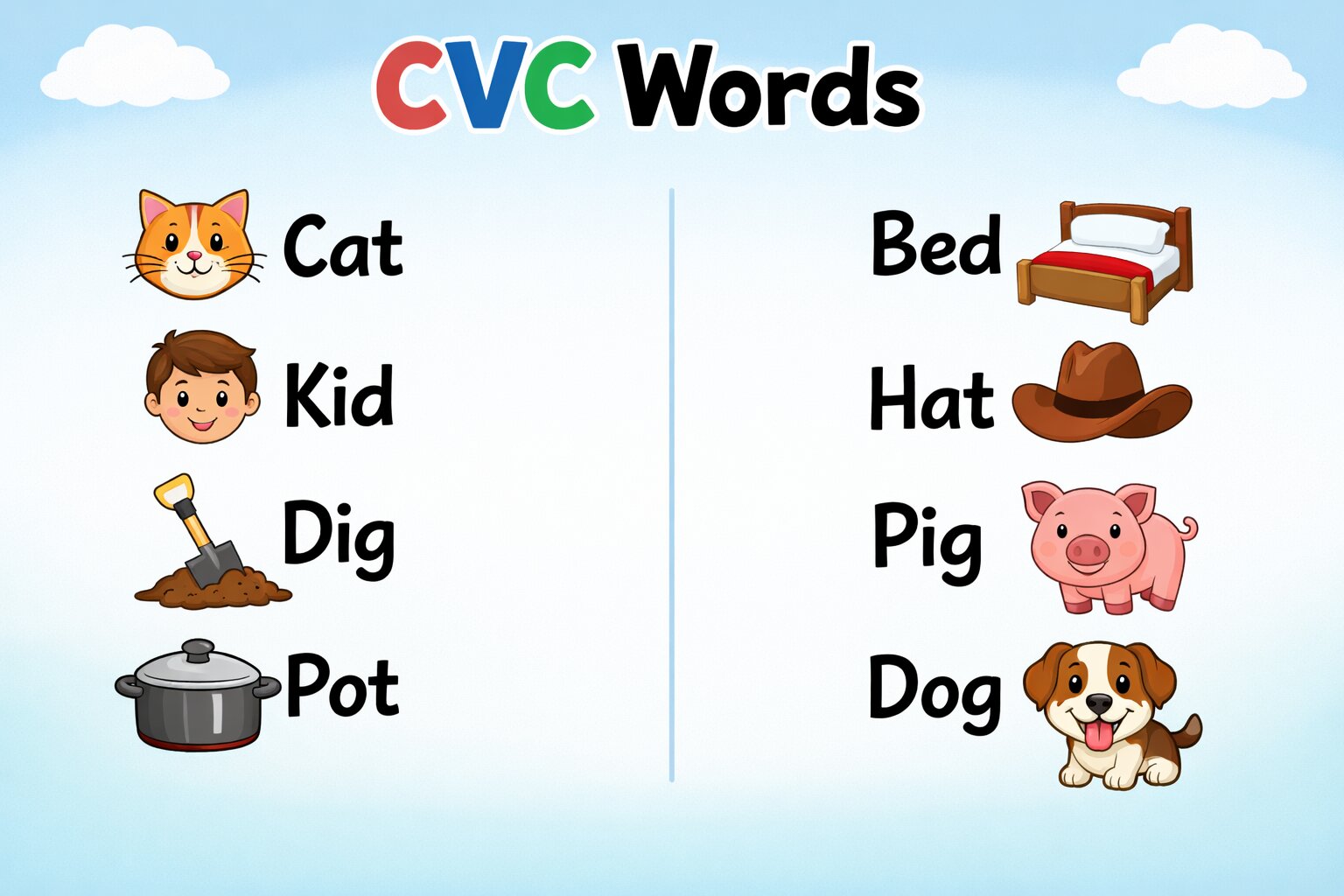
CVC words for kindergarten form a foundational element of early phonics instruction. These three-letter words, structured as consonant-vowel-consonant (CVC)—such as ‘cat’, ‘pin’, and ‘bed’—enable young learners to practise sound blending, segmentation, and recognition systematically.
Thank you for reading this post, don't forget to subscribe!
This article explains what CVC words are and provides a detailed list for reference. It includes CVC words with pictures to support visual learning and effectively reinforce letter-sound relationships. Additionally, CVC worksheets for kindergarten offer structured activities, including matching exercises, sentences with CVC words, and fill-in-the-blank, tailored for classroom or home use.
Suitable for educators, parents, and early years practitioners, these resources align with school curricula and promote essential literacy skills. They facilitate targeted phonics development in a clear, progressive manner.
What are CVC Words?
The phrase “CVC words meaning” refers to words that follow a consonant-vowel-consonant structure. CVC stands for Consonant-Vowel-Consonant, and examples include ‘hat’, ‘dog’, and ‘pen’. Understanding the meaning of CVC words is important for early learners because these simple three-letter words help children practice blending individual letter sounds to form complete words. Mastering CVC words builds a strong foundation for reading and spelling, making it easier for young students to decode new words as they continue learning phonics.
When Should Kids Start Learning CVC Words?
Children generally start learning short CVC words during the Reception year, typically around ages 4 to 5, as they develop an understanding of basic letter sounds. Introducing these simple words at this early stage strengthens phonemic awareness and lays the foundation for reading fluency in kindergarten.
Why Is It Important For Kids To Learn CVC Words?
Learning CVC words provides kindergarten children with crucial phonics skills, empowering them to decode and blend sounds on their own. As they master these words, children advance to constructing CVC sentences, which boosts reading comprehension, spelling accuracy, and self-assurance in early literacy. This solid foundation supports future literacy milestones and promotes lasting language development.
Additionally, practising CVC words helps develop auditory discrimination, listening skills, and the ability to recognise sound patterns, which are essential for tackling more complex words and sentences as children progress in their education.
CVC Words List
This section provides a clear, organised list of common CVC words, grouped by their middle vowel sound for easy reference. Teachers and parents can use it to support consonant-vowel-consonant worksheets.
Short ‘A’ CVC Words
| Cat | Hat |
| Mat | Bat |
| Rat | Sat |
| Fat | Pat |
| Van | Jam |
Short ‘E’ CVC Words
| Bed | Red |
| Hen | Ten |
| Pen | Men |
| Jet | Net |
| Pet | Web |
Short ‘I’ CVC Words
| Pig | Big |
| Dig | Hit |
| Sit | Fit |
| Pin | Win |
| Lip | Kid |
Short ‘O’ CVC Words
| Dog | Fog |
| Log | Jog |
| Pot | Hot |
| Top | Mom |
| Rob | Sock |
Short ‘U’ CVC Words
| Bus | Sun |
| Fun | Run |
| Hug | Mug |
| Bug | Rug |
| Cut | Nut |
High Frequency CVC Words
This section highlights the most common CVC words used in early reading materials. These words build reading speed and confidence for kindergarten learners.
| cat | man | had |
| bed | red | hen |
| pig | big | sit |
| dog | hot | pot |
| sun | run | bug |
How Can You Teach CVC Words To Kids?
This section explores effective approaches for teaching CVC words to kindergarten children. It provides practical guidance for educators and parents.
1. Sound Blending Cards
Use flashcards with individual letters; children slide them together to form words like ‘c-a-t’. This reinforces blending skills, helping kids transition from sounds to whole words.
2. CVC Word Hunts
Hide word cards around the room for children to find and read aloud. It makes learning active and fun, boosting recognition and memory through movement.
3. Magnetic Letter Boards
Provide magnetic letters for kids to build CVC words on a board. Hands-on manipulation strengthens fine motor skills and phonemic awareness.
4. Picture Matching Games
Pair CVC word cards with corresponding images, like ‘dog’ with a dog picture. This visual association aids decoding and vocabulary building.
5. CVC Bingo
Create bingo cards with CVC words; call out words for matching. The game format encourages repetition and quick word identification.
6. Sentence Building Blocks
Use blocks printed with CVC words to form simple sentences. It extends blending to context-based reading comprehension.
7. Phonics Songs and Rhymes
Sing songs featuring CVC words, like ‘The cat sat on the mat’. Rhythm and repetition make sounds memorable and enjoyable.
8. Worksheet Fill-Ins
Use CVC free printable worksheets like the one we provide in the article, where kids fill in missing letters in CVC words. Targeted practice improves spelling and independent writing.
CVC Words Worksheets
This section features engaging CVC practice worksheets designed for kindergarten phonics reinforcement. Download and print them to support structured learning at home or school.
FAQs
1. Why Do We Use CVC Words?
CVC words are short and simple, perfect for beginners. They help you learn to read by mixing sounds together quickly.
2. How Do I Say CVC Words Fast?
Practice saying the sounds together without stops, like ‘c-a-t’ becomes ‘cat’. Say them in games or songs to get quicker.
3. How Many CVC Words Are There?
There are hundreds! Start with common ones like ‘pin’, ‘top’, and ‘bus’, then learn more every day.
Learning CVC words helps children build a strong foundation for reading in kindergarten and later years. The lists, activities, and CVC worksheets here give kids a fun, effective way to practice phonics. Start today to help your child gain lasting reading skills.
Also Read:
Sight Words for Kids
Compound Words for Kids
Pictionary Words for Children
High Frequency Words for Kids