



Last Updated on February 13, 2026
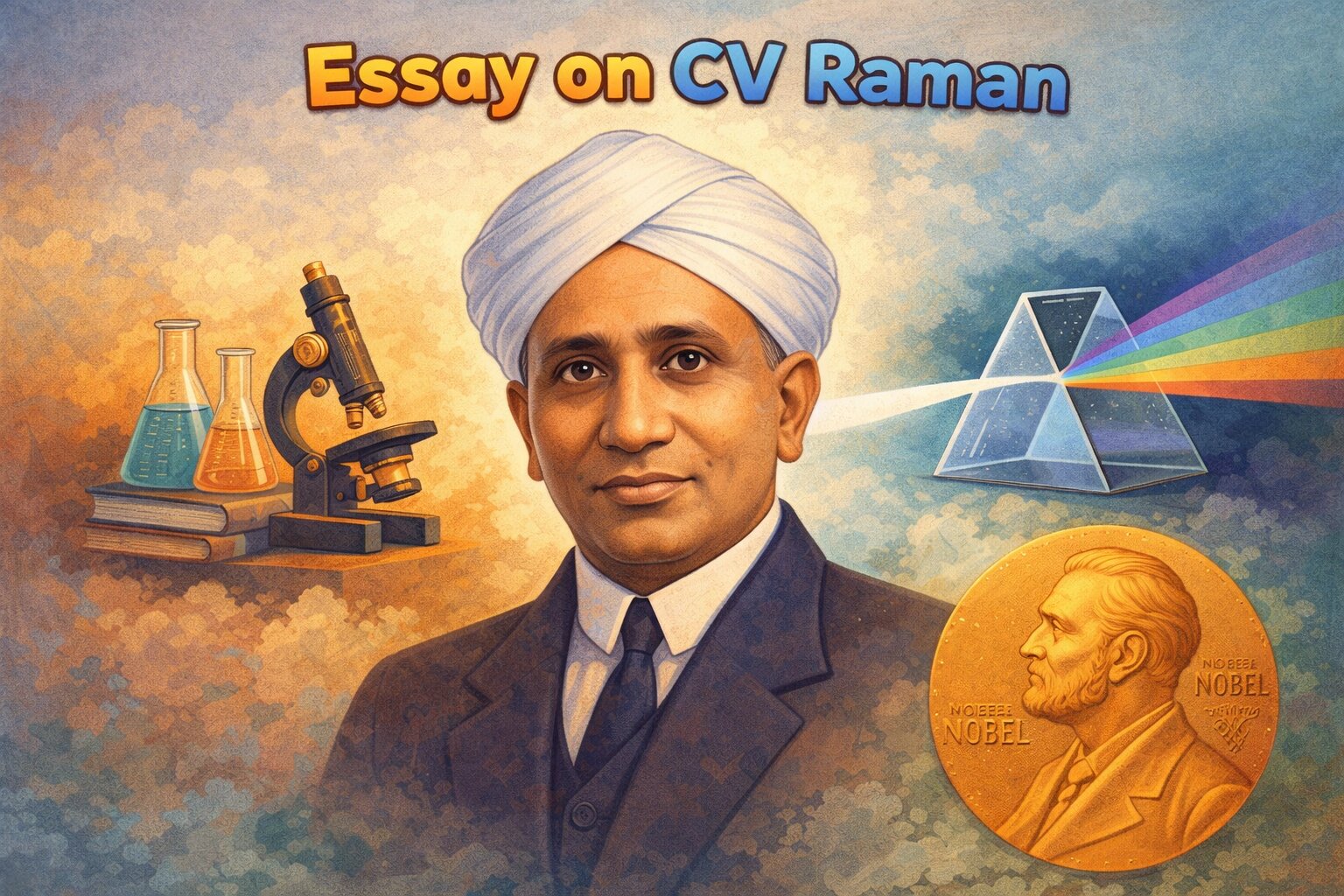
In the sparkling world of science, Sir Chandrasekhara Venkata Raman, or C.V. Raman, stands tall as a hero for curious young minds. This article offers various formats for an essay on C.V. Raman – short ones for little learners, longer tales for school projects, and fun speech styles too! Born on 7 November 1888 in Tamil Nadu, Raman was a boy who loved puzzles and light experiments.
Thank you for reading this post, don't forget to subscribe!
His genius shone brightest with the Raman Effect, which revealed how light dances through colours, earning him India’s first Nobel Prize in Physics in 1930. Dive into this C.V. Raman essay in English to discover his joyful journey, from schoolboy wonders to diamond discoveries.
Pick a format, grab your pencil, and write your own story of this light-loving legend. Let’s make science sparkle together!
Key Points To Remember When Writing An Essay On CV Raman
Writing an essay on C.V. Raman for students and children? These key points provide essential guidance for a clear and effective composition.
- Begin with a clear introduction outlining his life and main achievements.
- Organise the body into logical paragraphs on his work and discoveries.
- Use simple words, clear examples, and interesting facts for young readers.
- Include a strong conclusion on his lasting impact.
- Keep sentences short; aim for 200-300 words.
- Revise for smoother flow by using words like “next” or “then” to connect ideas.
10 Lines On CV Raman
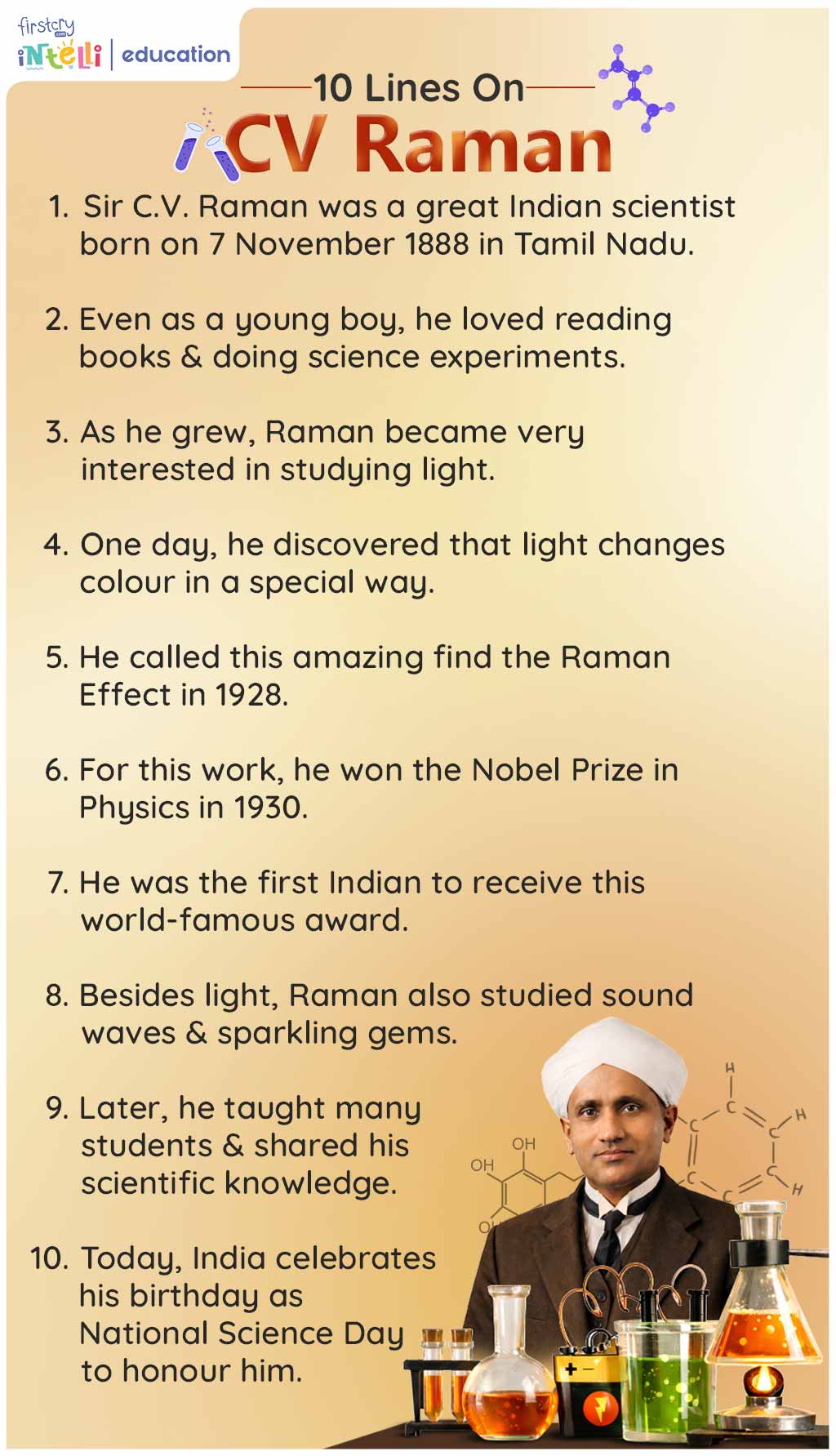
These 10 concise lines create a short essay for classes 1, 2, and 3 on Sir C.V. Raman, covering his birth in 1888, the discovery of the Raman Effect, the Nobel Prize, and his science legacy. Young learners can use this simple format to understand and write about India’s light pioneer.
- Sir C.V. Raman was a great Indian scientist born on 7 November 1888 in Tamil Nadu.
- Even as a young boy, he loved reading books and doing science experiments.
- As he grew, Raman became very interested in studying light.
- One day, he discovered that light changes colour in a special way.
- He called this amazing find the Raman Effect in 1928.
- For this work, he won the Nobel Prize in Physics in 1930.
- He was the first Indian to receive this world-famous award.
- Besides light, Raman also studied sound waves and sparkling gems.
- Later, he taught many students and shared his scientific knowledge.
- Today, India celebrates his birthday as National Science Day to honour him.
Paragraph On CV Raman
This short paragraph on C.V. Raman offers a neat essay for classes 1, 2, and 3, presented in a single, flowing block. It highlights his life, key discoveries, and inspiration for children.
Sir C.V. Raman was a famous Indian scientist born on 7 November 1888 in Tamil Nadu. He was very interested in light from a young age. In 1928, he discovered the Raman Effect, which shows how light scatters and changes colour. This great work won him the Nobel Prize in Physics in 1930, making him the first Indian to receive it. Raman also studied sound and gems. He taught many students with joy. India honours him on National Science Day. His life inspires children to explore science.
Essay On CV Raman In 100 Words
This essay on C.V. Raman in 100 words suits classes 1, 2, and 3 perfectly. It shares his story, discoveries, and lessons in a simple, engaging way.
Sir C.V. Raman was born on 7 November 1888 in Tiruchirappalli, Tamil Nadu. His father was a teacher, so their home was full of books. At school, Raman excelled in maths and physics. While working in Kolkata, he became curious about why the sea looks blue. This question led to his discovery of the Raman Effect in 1928, which explains how light scatters into different colours. In 1930, he became the first Indian to win the Nobel Prize in Physics. He also started a science institute and studied musical instruments. Raman encouraged children to observe nature carefully. National Science Day is celebrated on 28th February in his honour.
Essay On CV Raman In 200 Words
This 200-word essay brings C.V. Raman’s story to life for children. It details his early interests, key inventions, honours, and motivation for budding scientists.
Sir Chandrasekhara Venkata Raman was born on 7 November 1888 in Tiruchirappalli, Tamil Nadu. His father was a teacher who encouraged his curiosity. Raman did very well in school, especially in science and maths. He started college at just 11 years old because he loved learning. In 1907, he began working in Kolkata, but he always wanted to do research.
Raman was curious about why the sea looks blue. A ship journey in 1921 inspired him to study light. Years later, he showed in his lab that light scatters and creates new colours. This discovery, called the “Raman Effect” in 1928, changed physics. The world quickly recognized his work. In 1930, he became the first Indian to win the Nobel Prize in Physics.
Back in India, Raman became the head of the Indian Institute of Science. He also studied violin strings, gemstones, and the colours of flowers. He was knighted in 1929 and gained worldwide respect. Although he was strict, he inspired his students to be curious.
Raman died in 1970, but his legacy lives on. National Science Day is celebrated on his birthday. When you see a rainbow or the blue sky, you can remember Raman. He showed us to ask questions, try new things, and that science is open to everyone.
Essay On CV Raman In 300 Words
This 300-word essay tells the story of C.V. Raman for young readers. It shows how he started with little and went on to change science, hoping to inspire others to make their own discoveries.
Sir C.V. Raman, a leading Indian scientist, was born on 7 November 1888 in Tamil Nadu. His father, a Sanskrit teacher, inspired him early on. Raman excelled in school and entered college at 11, shining in physics. Unable to study in England due to health, he joined the finance service in Kolkata at 19, but his true passion was science. On weekends, Raman experimented at the Indian Association for the Cultivation of Science. Using simple tools, he studied light and its mysteries, including why the sky is blue.
Observing ships at sea sparked more questions. In February 1928, he discovered the Raman Effect—when light scatters and molecules shift their wavelength, creating a unique signature. His findings gained worldwide recognition.
In 1930, Raman was awarded the Nobel Prize in Physics at the age of 42, becoming the first Indian recipient of this honour. Upon his return, he was celebrated by large crowds. He subsequently resigned from government service, was knighted, and assumed leadership of the Indian Institute of Science in Bangalore. Under his guidance, research flourished in areas such as the optical properties of colloids and crystals under polarised light. He also investigated the acoustics of Indian musical instruments and the properties of Himalayan ice.
Raman expected his students to work hard and think critically, often engaging in lively debates. He encouraged them to “Doubt all, test true.” After India gained independence, he was awarded the Padma Vibhushan. He passed away at age 82 on 21 November 1970. Though his eyesight faded, his legacy remains strong.
February 28, the day of his discovery, is now celebrated as National Science Day. Schools hold science fairs and activities. Raman’s message to children is to look closely at dew drops, ask questions about the stars, and imagine new ideas for the future. His excitement for science lives on in every rainbow. Be curious and observant, because science needs you.
CV Raman Essay In 500 Words
This 500-word essay on C.V. Raman examines his journey from early education to Nobel achievement. It discusses his scientific contributions, educational influence, and relevance for today’s youth.
Sir Chandrasekhara Venkata Raman was born on 7 November 1888 in Tiruchirappalli, Tamil Nadu. From his earliest days, Raman was surrounded by the spirit of inquiry. His father, a Sanskrit lecturer and math teacher, filled their home with discussions about science, language, and logic. Young Raman was naturally curious, often taking apart objects to see how they worked and asking endless questions about the world around him.
Though his family was not wealthy, they highly valued education, and Raman excelled in his studies from a young age. His lifelong fascination with light and its mysteries would eventually bring him international acclaim, and he would become a role model for generations of aspiring scientists.
Education And The Raman Effect
Raman showed exceptional talent early, graduating at the top of his physics class from Presidency College, Madras, at just 18. Although he dreamed of studying in England, health problems prevented him from making the journey. Undeterred, Raman joined the Indian Finance Department in Kolkata in 1907, where he excelled in his administrative duties.
However, his passion for science was undiminished; he spent evenings and weekends conducting experiments at the Indian Association for the Cultivation of Science. There, he worked with basic instruments, focusing on the behaviour of sound and light. His devotion paid off—by 1917, he was appointed the first Indian Palit Professor of Physics at the University of Calcutta and later served as president of the Indian Association for the Cultivation of Science.
Raman’s research atmosphere was one of collaboration and lively debate, inspiring many young scientists. During a ship voyage to England in 1921, Raman wondered why the sea looked blue. When he returned home, he used simple equipment to test different liquids and gems. On 7 February 1928, he made a breakthrough: light scatters from molecules and changes its wavelength, a discovery now known as the Raman Effect. This method helps reveal molecular details, similar to what infrared spectroscopy can do.
Work And Achievements
News raced worldwide. In 1930, Raman, 42, claimed Stockholm’s Nobel Prize in Physics, India’s sole winner at the time. Knighted, he served as the director of the Indian Institute of Science, Bangalore. Research flourished: crystal optics, the physiology of vision, and even the tones of temple bells. He founded the Indian Academy of Sciences and the journal Proceedings.
Raman received many awards, including the Bharat Ratna in 1954 and the Padma Vibhushan. He was known for his strong debating skills and for mentoring leading scientists such as Vikram Sarabhai. National Science Day, celebrated on 28 February, honours his 1928 discovery.
Death
Raman remained active in scientific research throughout his life. After suffering a heart attack in 1970, he declined hospitalisation and passed away at his home on 21 November 1970 at the age of 82. Despite losing vision in one eye, he maintained his intellectual acuity until his death.
C.V. Raman proved that genius needs no fancy tools, just sharp eyes and will. His Raman Effect is used in chemistry, medicine, and forensics today. Children, heed him: nature holds answers. Observe, question, persist – unlock your science tomorrow.
What Will Your Child Learn From The Essay On CV Raman?
Essays about C.V. Raman show children how curiosity and hard work can lead to great things. By exploring his blue-sea puzzle and the famous Raman Effect, young readers see how simple questions can lead to big discoveries. They also learn about India’s achievements in science, the excitement of conducting experiments, and the importance of observing nature closely. When students write their own essays, they build confidence, learn to think clearly, and develop a love for learning, just as Raman encouraged.
FAQs
1. How Can Children Add Personal Touches To A CV Raman Essay?
Children can link Raman’s curiosity to their own, such as “Like Raman with the sea, I wondered about rainbows.” This makes the essay unique, shows understanding, and helps teachers see real thought.
2. What Research Tips Help With CV Raman Essay?
Start with picture books or school library resources on Raman, note dates like 1928 for the Raman Effect, and reliable sites like Britannica Kids. Jot 3-5 facts, then mix with class notes for a balanced view.
3. How Do You Make A CV Raman Essay Stand Out In Class?
Include a surprising detail, such as Raman using his sister’s jewels for tests, and pose a thoughtful close like “What colours might Raman find in space?” Use bright headings or drawings too.
4. Should Children Use Quotes In CV Raman Essay?
Yes, pick easy ones like “Doubt is the key to knowledge” – Raman’s own words. Place in speech marks, explain simply, e.g., “He meant ask questions,” to show wisdom without copying.
These essays about C.V. Raman are meant to guide students and children in exploring science, much like his own discoveries about light. Sharing his story of curiosity, hard work, and success can inspire future scientists.
Also Read:
Essay On Wonders of Science
Essay on Science and Technology
GK Questions on Inventions, Inventors and Discoveries