


Last Updated on March 30, 2026
The Earth plays a vital role in our lives. It provides us with habitat, water, food, etc. The Earth came into existence millions of years ago, and billions of animals and humans have walked the same Earth we live on now. The Earth is home to over 5 million species of plants and animals, most of which have still not been identified or recorded. An essay on Earth in English is a common school subject because it is an important topic for children to think about and discuss.
Thank you for reading this post, don't forget to subscribe!
The Earth can be studied and written about in many different ways; you can write about it in terms of climate change, species, land formation, water composition and even the formation of the solar system and Earth’s position in it. The possibilities are endless! Here, we will discuss an essay on Earth for classes 1, 2 & 3 for kids.
Key Points To Remember When Writing An Essay On The Earth
Essay writing is an important skill that children must excel at, as it helps them in life. Strengthening their foundations helps them develop their skills and focus on improving the content of their essays. While writing essays, there are a few key points that one must remember –
- The language of your Earth essay in English must be simple and comprehensible.
- Teach words and sentences that your child understands and will be able to write when not assisted.
- Focus on the very basics, as this is for a lower primary class; children aren’t expected to write in detail.
- A good place to start would be what the Earth means to us as humans. What the Earth provides us with.
- Take care of the format of the essay. If in paragraph form, ensure that each paragraph is neither too short nor too long.
- Be clear about the direction of the essay in the beginning to ensure consistency.
- Keeping track of the word limit is key.
5 Lines On Earth
For young children, we will stick to the very basics in this essay format. We will write five lines about Earth in English for classes 1 and 2, where we live. We will progressively increase the intensity.
- The Earth orbits the Sun, which is the centre of our Solar System.
- Earth is the 3rd planet in our Solar System, out of eight in total.
- It is the only planet which supports life.
- It has both land and water bodies.
- It has rivers, valleys, mountains, hills, forests, oceans, plains and beaches.
10 Lines On Earth
Now that we have some basics laid down, we can start adding more details. If we closely observe the essay lines above, we can see the flow of information. We start with Earth’s position in the Solar System, then move on to its geographical features. Now, we can go into more detail for an essay for classes 1, 2, and 3
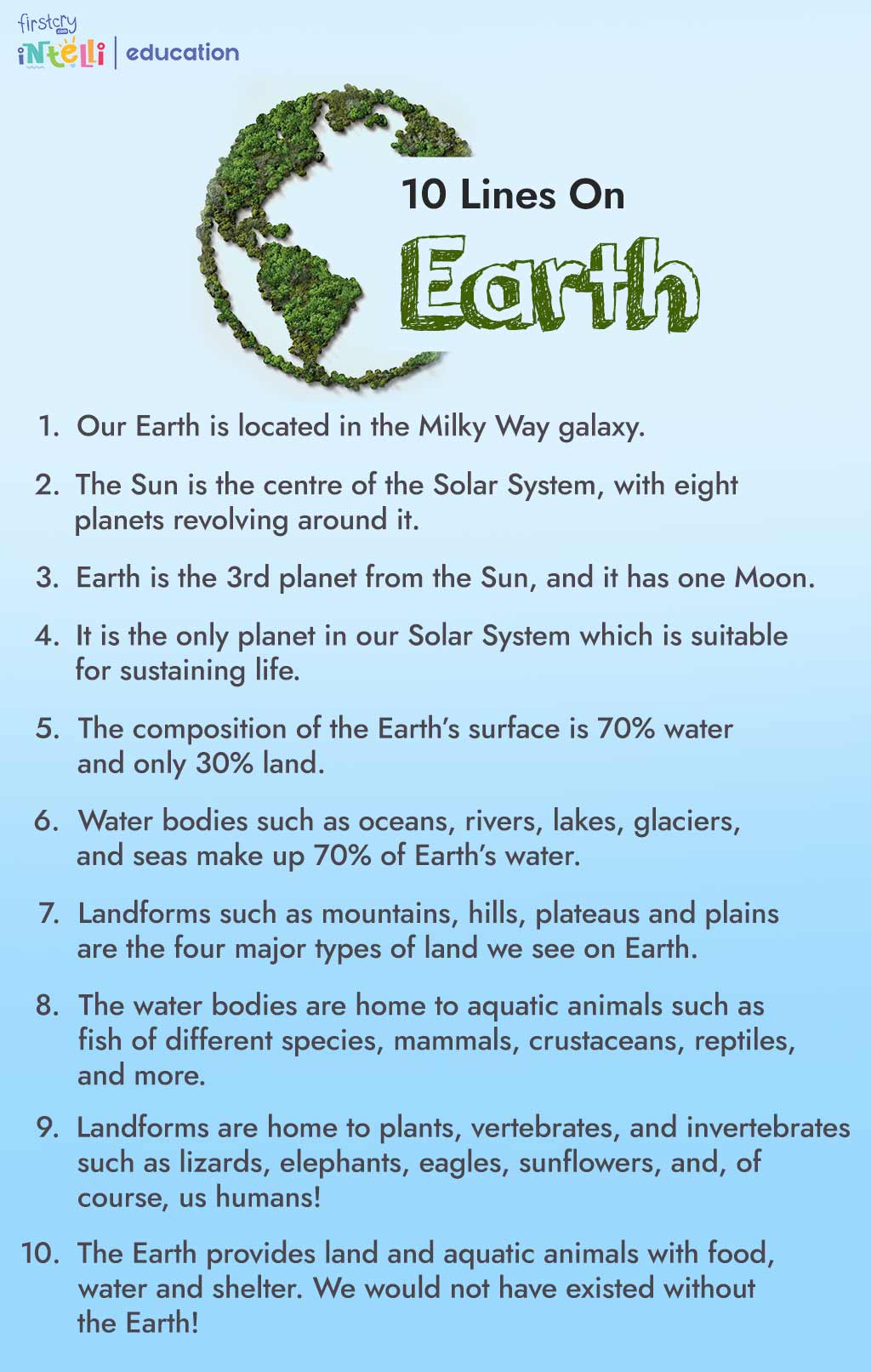
- Our Earth is located in the Milky Way galaxy.
- The Sun is the centre of the Solar System, with eight planets revolving around it.
- Earth is the 3rd planet from the Sun, and it has one Moon.
- It is the only planet in our Solar System which is suitable for sustaining life.
- The composition of the Earth’s surface is 70% water and only 30% land.
- Water bodies such as oceans, rivers, lakes, glaciers, and seas make up 70% of Earth’s water.
- Landforms such as mountains, hills, plateaus and plains are the four major types of land we see on Earth.
- The water bodies are home to aquatic animals such as fish of different species, mammals, crustaceans, reptiles, and more.
- Landforms are home to plants, vertebrates, and invertebrates such as lizards, elephants, eagles, sunflowers, and, of course, us humans!
- The Earth provides land and aquatic animals with food, water and shelter. We would not have existed without the Earth!
Paragraph On Earth
Now that we are comfortable with writing essays (information) in a numeric form, we can move on to writing essays in paragraph form. Below is an essay on Earth in 100 words.
Millions of years ago, the Earth formed in one small corner of the Milky Way galaxy. The Big Bang led to the formation of the Sun, eight planets, their moons, and other bodies, such as dwarf planets (including Pluto!). The Earth is the only planet in our Solar System which could sustain life. This is due to its strategic position: it is neither too close to the Sun nor too far away. This, coupled with the right elements, allowed landforms and water bodies to form. This, in turn, supported the evolution of life on Earth. Indeed, the Earth is one of a kind!
Essay On Earth In 150 Words
This 150-word essay introduces our precious blue planet and its wonders. It includes a paragraph about ‘Save Earth’ to inspire young minds towards conservation.
Earth is our beautiful, shared home, a vibrant blue-and-green planet spinning in space. Covered mostly by sparkling oceans, it has lush green forests, towering mountains, and vast deserts. Life thrives here with millions of plants, animals, and people living together peacefully. Rivers flow, winds blow, and seasons change, creating a perfect balance for all creatures. From colourful coral reefs to snowy polar caps, every unique corner shows nature’s magic. We breathe clean air, drink fresh water, and grow food from its rich soil.
To save Earth, we must act now against pollution and deforestation. Plant trees, reduce plastic use, recycle waste, and save water daily. Governments should promote clean energy, such as solar power. Schools can teach children to care for nature through simple habits. Together, we can fight climate change, protect wildlife, and keep our planet green. Let us promise to love and safeguard Earth for future generations.
Short Essay On Earth
Moving on to a slightly longer essay, we can start adding more information and adding paragraphs. Since you have limited words, be choosy about what you wish to write and what you wish to omit. Below is an essay for classes 1, 2, and 3 on Earth.
The Milky Way galaxy is home to many stars, planets and planetary systems. One such planetary system is our Solar System. Our Solar System has eight planets, with Earth being the fourth. The Earth rotates on its axis, causing day and night. It also revolves around the Sun in a fixed orbit, which causes the change in seasons.
The Earth’s strategic position and movement support the millions of plant and animal species that inhabit it. The right elements and external forces enabled the formation of land and water bodies, which provide habitats and nutrients for the millions of species on the planet.
Water bodies such as oceans, rivers and lakes are home to aquatic animals, including fish, whales and seahorses. Landforms are home to plants, animals and insects.
However, in more recent times, we humans have been overusing our resources and polluting the environment, negatively affecting the planet and its inhabitants. We must strive to save the planet now before it is too late.
Long Essay On Earth
Lastly, we will discuss and look at a long-form essay for class 3. Since we have more words to play with, we can start going in-depth and look at specific topics. We can also add sub-heads and paragraph breaks. We will first start with an introduction, followed by the subheads.
The Earth is unique. It is indeed one of a kind. When the Big Bang occurred, the right elements, temperature and pressure (among other factors) created the Earth. Subsequently, the topography and the organisms emerged. Years of evolution have brought us to today, where we can study and understand not only the Earth but also other planets and galaxies.
What Is Earth?
The word ‘Earth’ is a Germanic term meaning “the ground.” Earth is the only planet known to host and nurture living organisms, including ourselves. It is the fifth-largest planet in our Solar System. It is also the only planet which has water on its surface. About 71% of the Earth’s surface is water, while the remaining 29% is land. It has one natural satellite, the Moon.
Origin Of The Planet Earth
The beginning of our Universe was the Big Bang. It was too hot, but it slowly cooled down. Different particles began bumping into one another, eventually forming common elements. Our solar system was formed roughly 8.7 years after the Big Bang. All solar systems begin in the same way – from Nebulas. The collapsing of dust and gas molecules within the nebulae causes the formation of planets and stars. The gravitational pull acts here, pulling the gas molecules and dust particles together. As these particles grow, the attraction between the molecules increases. This eventually forms a planet.
However, the planet was still too hot to sustain life. Eventually, the planet began cooling down. The oceans are where life originated. Slowly, evolution caused organisms to move onto land, too. Over millions of years, the Earth has undergone many cycles of heating and cooling. This has resulted in mass extinctions and the wipeout of civilisations and organisms. However, planet Earth has managed to give birth to new organisms and help them evolve every single time.
Different Layers Of The Earth
The Earth is made up of three layers – the crust, the mantle, and the core.
1. The Crust
This is the outermost part of the Earth. It is mostly made up of solid rock and minerals. It is about 40km in thickness and is only 1% of the Earth’s mass. However, this part of the Earth harbours all known life in the Universe.
2. The Mantle
This is the middle part of the Earth. It is about 2900 km thick and consists of hot, dense, iron- and magnesium-rich solid rock. The Crust and the Mantle make up the lithosphere, which is broken into plates, both large and small.
3. The Core
The core is the innermost part of the Earth. It is further divided into two parts – the liquid outer core and the solid inner core. The temperatures here can rise upwards of 50,000 C.
Motion Of The Earth
The Earth has mainly two motions – Rotation and Revolution.
1. Rotation
The Earth rotates on its axis in a clockwise motion. It takes the Earth 23.9 hours to complete one rotation on its axis. The rotation of the Earth causes the change between day and night.
2. Revolution
The Earth orbits the Sun in a fixed, anticlockwise direction. It takes the Earth 365 days, 6 hours, and 9 minutes to complete one rotation around the Sun. The Earth’s revolution causes the seasons to change.
How Can We Protect Mother Earth?
There are many ways we can protect our Earth. Some ways are:
- Be conscious about overusing and overexploiting resources.
- Conserve energy, both fuel and electricity.
- Do not pollute your surroundings, especially with plastic.
- Remember the 3Rs – Reuse, Recycle and Reduce.
- Strive to conserve your local flora and fauna.
Amazing Facts About Earth For Kids
Below are some amazing facts about our Earth for kids:
- The name ‘Earth’ comes from the Old English and Germanic words that mean ‘the ground’.
- The Earth orbits around the sun at a whopping speed of 30 kilometres per second!
- The Earth’s diameter is 12,800 kilometres, making it the 5th largest planet in our solar system.
- The Earth is the only planet known to support life. The availability of abundant oxygen and water makes this possible.
- Due to the Moon slowing down Earth’s rotation, the days on Earth are, in fact, getting longer!
What Will Your Child Learn From The Essay On Earth?
Your child will learn a lot about our planet, including its origins, movements, and more. The essay on planet Earth will also help your child learn how to write a good composition with perfect techniques. This article takes you through essay writing in a step-by-step manner.
FAQs
1. Why Is Planet Earth Called A Blue Planet?
Planet Earth is called the Blue Planet because approximately 71% of its surface is covered with water, giving it a distinct blue appearance from space. This abundance of water makes Earth unique in our solar system.
2. When Is World Earth Day Celebrated?
World Earth Day is celebrated on 22nd April every year. On this day, people around the world participate in events and activities to raise awareness about protecting our planet and caring for the environment.
3. Why Is The Earth The Only Planet Known To Support Life?
Earth has the right combination of water, atmosphere, temperature, and essential elements to support life. Its protective atmosphere shields living beings from harmful radiation and maintains a stable climate.
4. What Can Students Do To Help Protect The Earth?
Students can help protect the Earth by conserving energy and water, reducing waste, recycling, planting trees, and spreading awareness about environmental issues in their schools and communities.
This article not only provides facts about Earth but also serves as a practical guide for students learning how to write essays on the topic. By exploring different formats — such as 10-line, short-paragraph, and long-form essays — children can see examples of structure, flow, and detail appropriate for various age groups and requirements. Understanding how to organise information, use subheadings, and build a logical narrative helps kids develop strong writing skills. Ultimately, mastering essay writing on Earth encourages both creativity and scientific curiosity, empowering students to express their knowledge with confidence.
Also Read:
Essay On The Sun for Kids
Save The Earth Essay for Children
10 Lines, Short and Long Essay on Environment