



Last Updated on February 25, 2026
Essay writing is an essential activity for kids, and the sooner it is introduced, the better it is for them. A perfect beginning to essay writing for kids can be through a short paragraph, rather than an elaborate essay, on a familiar topic, such as Holi. Writing a short paragraph will help develop creative thinking and improve their vocabulary and writing skills. Let us guide your child here to write a beautiful Holi Essay in English for Classes 1, 2 & 3. An essay on the festival of Holi will be an important piece of creative writing that will be useful to your child even later in life. More importantly, your child will gain more knowledge from an essay on the Holi festival, which is closely tied to India’s rich culture.
Thank you for reading this post, don't forget to subscribe!
Key Points To Remember When Writing An Essay On Holi
When writing an essay on ‘My Favourite Festival, Holi’ in junior school, your child must remember certain important points. Some of them are:
- Describe the importance of Holi in India, explaining why it is celebrated and what it means to different communities.
- Mention the time of the year Holi is celebrated, including which month or season it falls in and its relation to the Indian calendar.
- Explain who celebrates Holi, noting that it is enjoyed by people of all ages and backgrounds across India and in different parts of the world.
- Describe what people do on Holi, such as playing with colours, dancing, singing, and visiting friends and family to spread joy and happiness.
- List the popular delicacies people eat on Holi, like gujiya, mathri, and thandai, and discuss how food is an important part of the celebrations.
- Explain the significance of Holi, including its roots in mythology, the victory of good over evil, and the message of unity and togetherness in your composition on Holi.
5 Lines On Holi
Writing five lines on Holi in English for classes 1 & 2 can be a delightful task, as it allows young students to express their creativity and understanding of this vibrant festival. Here is a brief introduction to help you write five lines on Holi, highlighting its significance and joyous celebrations.
- Holi is a colourful festival that brings joy to everyone.
- During Holi, people throw coloured powders and water at each other.
- This is a special time when friends and family come together to celebrate.
- We enjoy eating sweet treats and other delicious foods on this day.
- Overall, Holi is a happy occasion that marks the beginning of spring.
10 Lines On Holi
Writing about Holi is always special, as this festival of colours is closely tied to India’s rich heritage. Here is an example of an essay for classes 1, 2, and 3 on Holi celebrations:
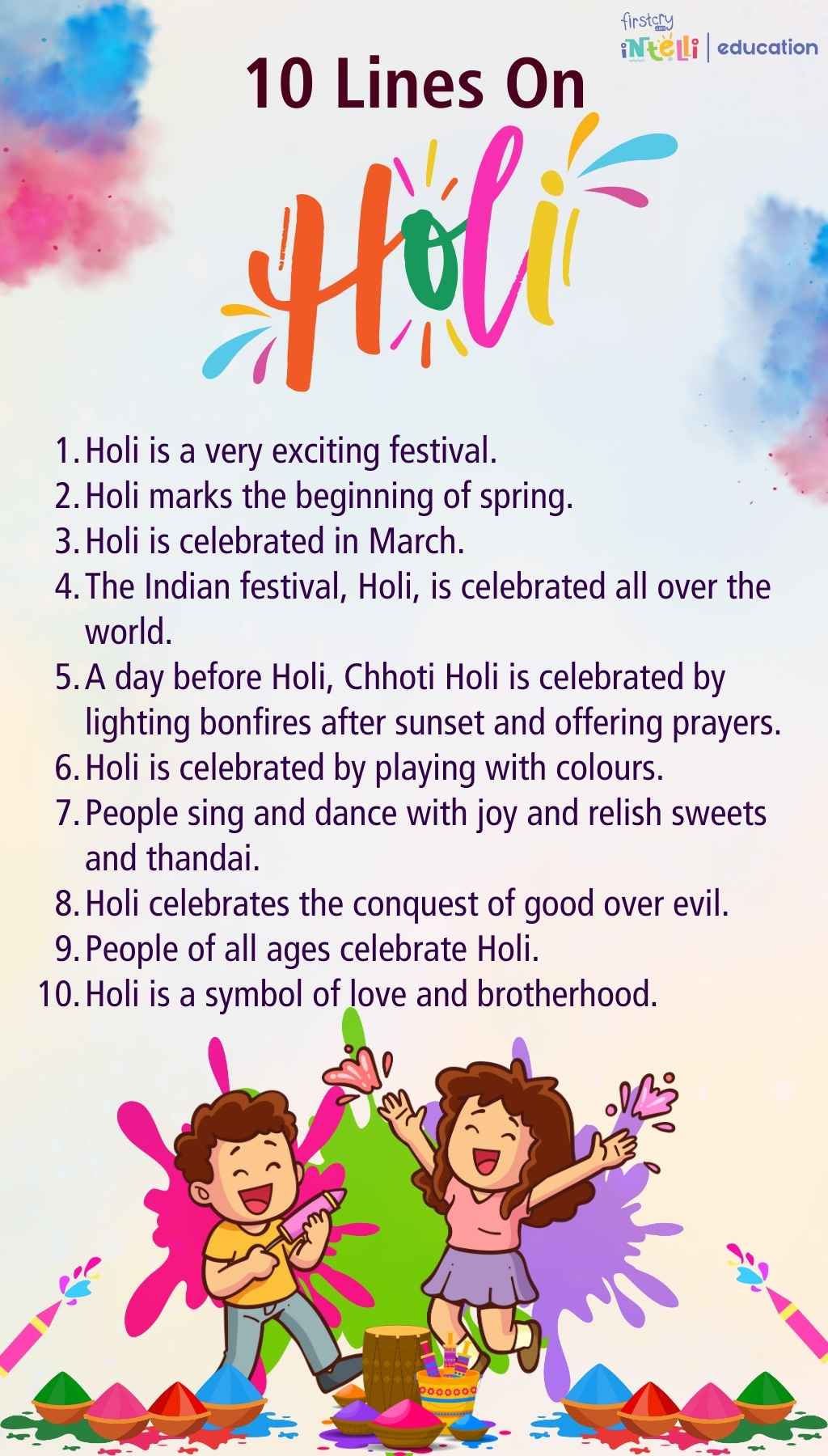
- Holi is a vibrant and exciting festival that fills everyone with joy and enthusiasm.
- Holi marks the joyful arrival of spring, bringing new life, fresh flowers, and greenery everywhere.
- Holi is usually celebrated in March, according to the Hindu calendar, and is eagerly awaited each year.
- The Indian festival, Holi, is celebrated with great enthusiasm not just in India but also in many countries around the world, uniting people across cultures.
- A day before Holi, people observe Chhoti Holi by lighting bonfires after sunset, gathering with family and friends, and offering prayers to mark the victory of good over evil.
- Holi is celebrated by playfully smearing and throwing vibrant colours on each other, symbolising happiness and unity.
- People sing, dance, and play traditional music while enjoying delicious sweets like gujiya and refreshing drinks like thandai.
- Holi celebrates the triumph of good over evil, inspired by the legend of Prahlad and Holika, teaching the value of courage and faith.
- People of all ages come together to celebrate Holi, making it a festival that brings families, friends, and communities closer.
- Holi stands as a symbol of love, friendship, and brotherhood, spreading the message of harmony and togetherness among everyone.
Paragraph On Holi
Writing a Holi festival paragraph allows students to express the vibrant spirit of this celebration. Here is an example to help you craft a cohesive piece about Holi.
Holi is a fun festival celebrated in India and around the world. It is known as the Festival of Colours because people throw coloured powders and water at each other. This makes everyone happy and is a great time to spend with friends and family. Before Holi, a big fire is lit to show that good always wins. On Holi, we eat sweet treats and enjoy each other’s company. It is a special time that marks the start of spring and brings joy to everyone. This joyful celebration is an excellent way to welcome the new season together.
Essay On Holi In English In 150 Words
India is a country that celebrates countless festivals, different cultures, and faiths. Holi is a very special festival in India. Well known as the festival of colours, it is filled with fun and festivities. Here’s a short essay on Holi:
Though Holi originated in India, it has been celebrated in regions all over the world for years. This festival of colours is celebrated in March and signifies the end of chilly winter days and the arrival of the pleasant spring season. People celebrate this festival with colours, songs, dances, sweets, and thandai or cold drinks. This is a festival of brotherhood and love. Holi is a festival that signifies the power of good over evil, the triumph of the holy power over the evil power.
As a global celebration, Holi brings people from different cultures and communities together. It is observed not only in India but also in countries like Nepal, the United States, the United Kingdom, and Australia, where it is celebrated with great enthusiasm by the Indian diaspora and local communities alike. The festival’s universal appeal lies in its vibrant colours and joyful atmosphere, symbolising renewal and unity.
Essay On Holi In 300 Words
Holi, the festival of colours, bursts with joy, music, and vibrant traditions that delight children across India. Here’s a simple essay on Holi in English, created for classes 1-3, blending history, celebrations, and valuable lessons.
Holi is the most colourful festival in India. It comes in spring, around March, filling the air with laughter, music, and bright powders called gulal. Everyone wears old clothes and plays with friends, forgetting all worries.
The story of Holi is magical. Long ago, a wicked king named Hiranyakashipu hated God. His son Prahlad loved God and prayed all day. The king’s sister Holika, who could not burn in fire, tried to kill Prahlad in flames. But God saved Prahlad, and Holika burned! We light bonfires on Holika Dahan to celebrate good winning over evil.
On Holi day, we wake early. Mothers make yummy gujiyas and thandai. We throw gulal—pink, yellow, green, blue—and spray water with pichkaris. Dhol drums beat loudly as we dance and sing. Even elders join the fun, hugging tightly. In the evening, we visit neighbours and share sweets like ladoos.
Holi teaches five big lessons. First, good always beats evil. Second, forgive friends and play happily. Third, share colours and food. Fourth, love nature as flowers bloom. Fifth, be kind every day.
Schools also celebrate Holi with great excitement. Children make colourful drawings, sing Holi songs, and listen to stories about the festival. Teachers explain the importance of friendship, sharing, and respect during these celebrations. This makes the festival even more enjoyable and meaningful for everyone.
Celebrate Holi safely too! Use natural colours, apply oil to the skin, throw gently away from the eyes, drink water, and stay near parents.
Holi spreads love like a rainbow. People greet each other with warm smiles and laughter, forgetting old arguments and starting afresh. It reminds us that spring brings new beginnings. Holi unites everyone—rich or poor, young or old. Its joyful spirit brings neighbours closer and builds lasting friendships. Let us promise to play safely and make happy memories. Happy Holi!
Long Essay On Holi For Children
Holi is a popular festival in India. Writing a beautiful essay on Holi in 300 words will be a piece of cake if your child understands and has experienced the festival. Here’s how a 3rd grader can write this piece.
History Of Holi
Holi is a very exciting festival in India. Popularly known as the festival of colours, it is beloved by children and grown-ups alike. This festival originated in India. Though it is mainly celebrated in India, it has been observed by many people scattered around the world over the years. Holi marks the end of the winter days and the beginning of positive, vibrant days of the spring season. Holi is usually celebrated in March. According to the Hindu calendar, the festival of Holi starts in the evening of Purnima (full moon). On this evening, people light a fire known as Holika Dahan. They sing Holi bhajans around this fire. This bonfire symbolises the triumph of God’s power over the power of evil. To understand the symbolic significance, you need to understand the story behind Holika Dahan.
An evil king named Hiranyakashyap, after being blessed by Lord Brahma, became so arrogant that he ordered everyone residing in his kingdom to worship him instead of God. Everyone obeyed him, except Prahlad, an ardent devotee of Lord Vishnu. So the king decided, along with his sister, to kill Prahlad. This sister’s name was Holika, and she had a blessing that no fire could ever touch her. So Holika sat in the fire with Prahlad on her lap. Holika was burned to ashes, and Prahlad was saved by his Lord Vishnu, marking the victory of good over evil.
Celebration Of Holi
The second and third days are Chhoti Holi and Rangwali Holi, when people smear each other with colours. They enjoy special sweets, such as gujiyas and malpuas, along with thandai or cold drinks. People of all ages come together to celebrate the festival with lots of enthusiasm. They wish each other Happy Holi, smear colours on each other’s faces, and soak in the essence of Holi. Children fill their water guns (aka pichkaris), water balloons, and buckets full of watercolour, and have so much fun! They sing, dance, and have a merry time. However, while playing with colours, choosing natural, organically sourced colours is always advisable over chemically processed ones to prevent infections and allergies.
During Holi, people also sing religious songs and play musical instruments like the dholak and kirtan. In the evenings, people often visit their friends and family. This is a day when everyone forgets their grudges and embraces each other with love. On Holi, Indians also celebrate the love of Radha and Krishna. One can witness grand Holi celebrations in Mathura and Vrindavan, two of the pilgrimage hubs in India. Here, the primary colours, blue, red and green played in Holi, have deeper meanings. Blue stands for Lord Krishna, red stands for fertility and love, and green stands for new beginnings. Holi is thus a celebration of love and brotherhood.
What Will Your Child Learn From Writing An Essay On Holi?
Essay writing is a crucial activity in your child’s development. When your child thinks about the points they will cover while writing an essay on Holi, they are improving their thought process and creativity. While putting the thoughts on paper, your child’s knowledge of framing sentences also improves, along with grammar and vocabulary. The Holi festival composition is one of the most enriching essays that your child can write. It gives them a very elaborate experience of a unique festival in India, strengthens their bond with centuries-old culture, and reminds them of the fun that the festival brings.
FAQs
1. What Is The Story Behind The Colours Of Holi?
The colours of Holi symbolise the victory of good over evil and the arrival of spring. They also represent the colours of nature and the joy of the season.
2. Why Do People Light Fires Before Holi?
Before Holi, people light fires, known as Holika Dahan, to symbolise the victory of good over evil. This tradition is based on a mythological story where a demon was defeated by fire.
3. What Kind Of Sweets Are Eaten During Holi?
During Holi, people traditionally eat sweets like gujiya, barfi, and jalebi. These sweets are often made at home and shared with friends and family.
4. Can Anyone Celebrate Holi?
Yes, anyone can celebrate Holi. It is a festival that welcomes people from all backgrounds to join in the celebrations and enjoy the colours and festivities.
5. How Can We Stay Safe During Holi?
To stay safe during Holi, it’s essential to wear old clothes, protect your eyes from colours, and drink plenty of water to stay hydrated. Also, be gentle when playing with colours to avoid hurting others.
Along with your child’s intellectual development, writing a few lines about Holi will connect them more deeply with the festival. And, because Holi touches everyone’s hearts with colours, love, and positivity, it is one of the most awaited festivals in the country. Writing an essay on Holi will instil these aspects in your child. Need we say more?
Also Read:
Essay on Festivals of India
Essay on Eid for Childrens
Essay on Indian Culture and Traditions