


Last Updated on December 24, 2025
Pongal is the most celebrated festival in Southern India. When your child writes an essay on Pongal for classes 1, 2 and 3, they learn the values and traditions associated with this festival. They learn about the cultural significance of the festival. When your little one writes a Pongal essay in English, their creative writing skills improve, and it lays the foundation of English grammar. Kids will learn to structure their thoughts on their Pongal festival essay and put their ideas on paper in short, simple sentences. Essay writing is critical; the earlier you introduce your child to it, the better.
Thank you for reading this post, don't forget to subscribe!
Key Points To Remember When Writing An Essay On Pongal
Your child must remember a few important points while writing about this beautiful festival. The points given below will help your child write about the festival.
- Allow your child to structure the ideas they want to write in their ‘My Favourite Festival Pongal while referring to the Pongal festival in the first step.
- The second step should outline all the points and ideas as you write the essay.
- In the third step, they will make short, simple sentences from the pointers.
- Motivate your child not to get stuck with any single idea.
- Help your child write with flow, so they cherish the essay-writing process.
- Your little one can write about why, when, and how Pongal is celebrated, including other details about the festival in their Pongal essay in English.
Five Lines On Pongal
The following section shares a few lines about Pongal, the famous harvest festival celebrated mainly in Tamil Nadu with great devotion and joy. These lines highlight the festival’s meaning, customs, and significance in farmers’ lives, helping you write your own essay for class 1:
- Pongal is a popular harvest festival celebrated in Tamil Nadu.
- It is dedicated to thanking the Sun God and nature for a good harvest.
- People cook a special dish called Pongal, made with rice, milk, and jaggery.
- Homes are decorated with colourful kolams, and festive joy fills the air.
- Pongal symbolises gratitude, happiness, and prosperity for everyone.
10 Lines On Pongal
Pongal is the grandest festival celebrated in Southern India and holds great cultural significance in people’s minds. Writing an essay for classes 1 and 2 can be an enriching experience for your kids. Given below are a few lines on Pongal:
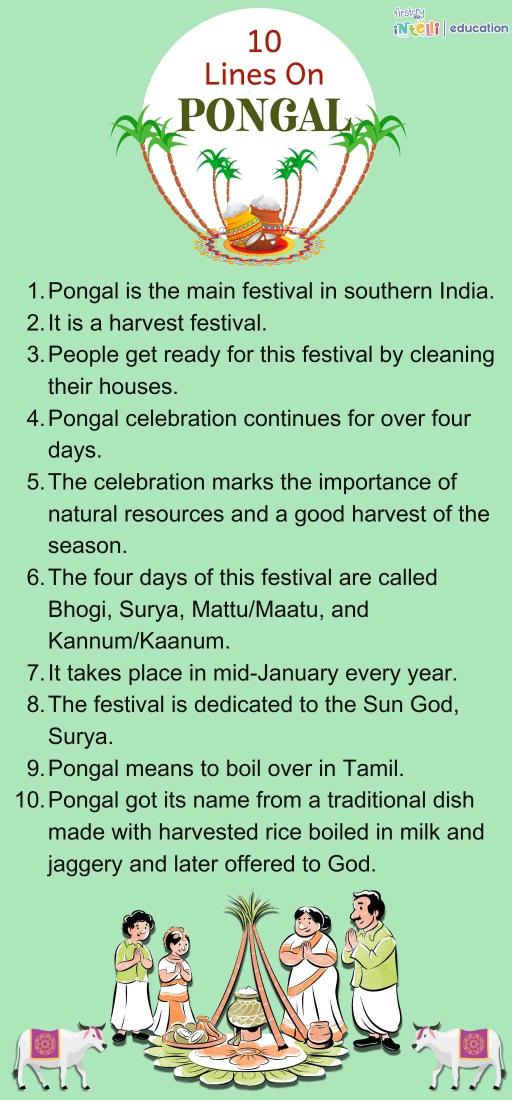
- Pongal is the main festival in southern India.
- It is a harvest festival.
- People get ready for this festival by cleaning their houses.
- Pongal celebrations continue for over 4 days.
- The celebration marks the importance of natural resources and a good harvest.
- The four days of this festival are called Bhogi, Surya, Mattu/Maatu, and Kannum/Kaanum.
- It takes place in mid-January every year.
- The festival is dedicated to the Sun God, Surya.
- Pongal means to boil over in Tamil.
- Pongal got its name from a traditional dish made with harvested rice boiled in milk and jaggery and later offered to God.
Paragraph On Pongal
Teachers require pre-primary students to write short paragraphs on various topics. Writing an essay on Pongal is one such activity. Below is a paragraph on Pongal for reference.
Pongal is a popular festival celebrated in Southern India. It is a harvest festival with significant cultural and traditional significance for those who celebrate it. It is a celebration of prosperity that comes with a good harvest. People prepare for this festival by cleaning and decorating their homes. The celebration spans four days, named Boghi, Surya, Mattu/Maatu, and Kannum/Kaanum. It takes place in mid-January each year. Pongal got its name from a traditional dish made with harvested rice, boiled in milk and jaggery, and later offered to God, referring to the ritual of Pongal, which means “to boil over” in Tamil.
Short Essay On Pongal
Pongal is a festival celebrated in southern India, and kids are often required to write an essay about it as an essay-writing exercise. Let us help your child write an essay for classes 1, 2 and 3.
Pongal is a festival of peace, prosperity, and joy. It is a harvest festival, also known as the farmers’ festival, as it marks the importance of a good harvest season and natural resources. According to some Sanskrit scholars, Pongal dates back to the Chola period. Festivities begin by cleaning and decorating houses and continue for four days. These four days are Bhogi Pongal, Surya Pongal, Mattu/ Maatu Pongal, and Kannum/Kaanym Pongal. The festival is dedicated to the Sun God; Surya-pongal means “to boil over” in Tamil. The festival got its name from a traditional dish, Pongal, made with harvested rice boiled in jaggery and milk and later offered to God. It is a festival that people enjoy to the fullest. As Pongal is celebrated in southern India, mainly Tamil Nadu, the rest of India celebrates Maghi, Bihu, Makar Sankranti, and Lohri simultaneously.
Essay On Pongal In 200 Words
This essay on Pongal explores the vibrant harvest festival celebrated with joy and devotion in Tamil Nadu. It highlights how Pongal honours nature, farmers, and the spirit of gratitude through meaningful customs and traditions.
Pongal is a major harvest festival celebrated with great enthusiasm in Tamil Nadu and some other southern states of India. It is dedicated to the Sun God and marks the beginning of the harvest season. The festival is observed for four days—Bhogi, Thai Pongal, Mattu Pongal, and Kaanum Pongal—each having its own significance and customs. Farmers express gratitude to nature, the Sun, and cattle for helping them grow their crops.
The highlight of the celebration is cooking the traditional dish called Pongal, made of newly harvested rice, milk, and jaggery. This dish is prepared in an earthen pot and allowed to boil over as a sign of prosperity. Homes are beautifully decorated with fresh flowers and colourful kolams (rangoli designs). Families come together to share meals, exchange gifts, and celebrate the season’s blessings.
Cattle, especially cows and bulls, are washed, decorated with garlands, and worshipped for their contribution to farming. Pongal also promotes values of gratitude, unity, and respect for nature. The cheerful songs, traditional dances, and community gatherings make this festival a time of togetherness and joy. Pongal truly represents the harmony between humans, nature, and hard work that sustains life. It reminds everyone to appreciate the simple joys and blessings of nature.
Essay On Pongal In 300 Words
This essay on Pongal helps students learn how to write about the festival in a structured, meaningful way. It covers Pongal’s history, traditions, and significance, offering ideas and points that make essay writing informative and engaging.
Pongal is one of the most celebrated harvest festivals in Tamil Nadu, marking the beginning of the harvest season and the end of winter. It is dedicated to the Sun God, who is thanked for providing energy and helping crops grow. The word Pongal means “to boil over,” symbolising abundance and prosperity. The festival usually falls in mid-January and lasts for four days—Bhogi, Thai Pongal, Mattu Pongal, and Kaanum Pongal—each day carrying special significance.
On the first day, Bhogi Pongal, people clean their homes, discard old items, and start fresh with positivity. The second day, known as Thai Pongal, is the main celebration when freshly harvested rice is cooked with milk and jaggery in a clay pot. As the dish boils over, people rejoice, saying “Pongalo Pongal!” to mark prosperity. This sweet dish is then offered to the Sun God as a gesture of gratitude.
The third day, Mattu Pongal, is devoted to honouring cattle, which play a vital role in farming. Cows and bulls are washed, decorated with flowers, and worshipped for their hard work. The last day, Kaanum Pongal, is a time for family gatherings, outdoor activities, and sharing festive meals.
During the festival, communities come together to organise cultural events, folk dances, and traditional games that reflect Tamil heritage. The atmosphere is filled with joy and music as people express their happiness and thankfulness for a good harvest. Children eagerly take part in kite-flying, bull-taming, and village fairs that make the celebration lively and colourful.
Pongal also carries a more profound message of environmental balance and respect for nature. It teaches people to live in harmony with the environment and value the hard work of farmers. Pongal is not just a festival—it is a way of expressing love, gratitude, and hope for prosperity in the coming year.
Long Essay On Pongal
As your kid progresses in their studies and understands simpler sentence structure, teachers will encourage them to write a long essay on topics like the Pongal festival. Let us help your child write an essay for class 3:
Pongal is an important festival with cultural and mythological importance in Hindu mythology. It is one of the main festivals of Southern India, especially Tamil Nadu. Marking the significance of good harvest crops like turmeric, rice, sugarcane, wheat, etc., it is a festival of joy, peace, and prosperity. Also known as the farmers’ festival, it is celebrated in mid-January every year. People clean their houses with great enthusiasm and get ready to welcome the grand celebration, which lasts four days. During this time, small drums, known as Bhogi Kuttu in Tamil, are played. The new flowering leaves appearing on the trees during this season are seen as a symbol of a new beginning of life.
As Pongal is celebrated in southern India, the rest of India celebrates Maghi, Bihu, Makar Sankranti, and Lohri with the same vigour. Pongal marks the beginning of everything good for farmers. Whatever we start during this period gives us fruitful and prosperous results.
Story And History Of Pongal Festival
There are so many legendary stories associated with the Pongal festival. According to one legend, Lord Shankar ordered his bull to go to earth and deliver a message to all his worshippers: bathe in oil every day and eat food only once a month. The bull went to earth and delivered the news in reverse, asking the people to bathe in oil once a month and eat daily. Lord Shankara became angry upon hearing this and asked him, “If people eat food every day, then from where will that food come?” He, therefore, ordered the bull, as a penalty, to go to earth and help humankind produce grains. According to some Sanskrit scholars, the Chola-period temples have traces of the Pongal dish.
Significance Of Pongal
India is an agricultural country, and the Pongal festival is of great importance. It is a harvesting festival, also known as the farmers’ festival, celebrated to thank the Sun God and Lord Indra for helping farmers get bountiful crops. Besides farmers, Pongal is considered a time of prosperity for everyone.
How Is Pongal Festival Celebrated?
Let us look at the four-day celebration of the traditional Pongal celebration.
- Bhogi Pongal: On the first day (Bhogi Pongal), people clean their houses and burn old and useless things.
- Suraj Pongal: People decorate the floor with wet rice flour called Kollam on this day. This art is made as an offering to the Sun God. People cook the Pongal dish in an earthen pot and share it with near and dear ones after offering it to God.
- Mattu/Maatu Pongal: On the third day, oxen and cows are given special importance and worshipped by putting turmeric sandalwood tilak on their foreheads and flower garlands.
- Kannum/Kaanum Pongal: This is also the final day of the Pongal festival. Everyone eats together on this day. People pray for the well-being of everyone and wish each other a long life, peace, and prosperity. Everyone gets the blessings of their elders on this day.
Attractions Of Pongal Festival
The attractions of Pongal are the Pongal dish, the floor art with wet rice, and the decorated bulls and cows.
What Will Your Child Learn From This Essay?
When your child writes on Pongal, they grow closer to their roots and traditions. Writing an essay also improves their creative writing skills.
FAQs
Let us discuss some frequently asked questions below.
1. What Is The Meaning Of The Word Pongal?
Pongal means to boil over in Tamil.
2. Where Is Pongal Celebrated In India?
Pongal is celebrated in Southern India, mainly in Tamil Nadu. Bihu, Makar Sankranti, and Lohri are celebrated around this time of year in the rest of India.
3. What Is The Essence Of Pongal, And to Whom Is It Dedicated?
Pongal is the celebration of the growth and harvest of new crops. The festival is dedicated to the Sun God for providing a brilliant climate for a bountiful harvest.
4. What Traditions Are Associated With Pongal?
Traditions include cleaning homes, preparing the special dish called Pongal, creating Rangoli designs, and engaging in various cultural activities.
5. What Activities Do Kids Enjoy During Pongal?
Kids enjoy making Rangoli, participating in games, helping in cooking, and learning about cultural traditions during the festival.
We hope the above essay on Pongal will help your little one write an insightful essay on this grand festival. Essay writing will also boost their creative writing skills. We have ensured that the language is straightforward for your little ones to understand.
Also Read:
Essay on Makar Sankranti for Kids
Essay on Festival of India for Children
Onam Essay for Children and Students