


- Key Points To Remember When Writing An Essay On Swami Vivekananda
- Five Lines About Swami Vivekananda
- 10 Lines On Swami Vivekananda
- Paragraph On Swami Vivekananda
- Swami Vivekananda Essay In 150 Words
- Essay On Swami Vivekananda In English In 300 Words
- Swami Vivekananda Essay In 500 Words
- What Will Your Child Learn From This Essay On Swami Vivekananda?
- FAQs
Last Updated on January 5, 2026
Children learn creative skills when they are told to pick a topic and write about it. For example, writing an essay on Swami Vivekananda in English will improve their reading and writing skills and make them learn a little bit of history. An essay on Swami Vivekananda for students of classes 1, 2 & 3 will allow them to conduct research and present all the information they gather in a structured way. It helps children develop the ability to write in their own words. Along the way, kids learn new words that help them build their vocabulary. When young people research to write their Swami Vivekananda essay independently, they learn to use reliable sources. It helps them understand concepts better than hearing about them from someone else, as they actively engage with the topic. We will cover some guidelines for essay writing.
Thank you for reading this post, don't forget to subscribe!
Key Points To Remember When Writing An Essay On Swami Vivekananda
Every essay needs a good structure. The following fundamental tips will help you learn how to write an essay on Swami Vivekananda:
- To start your essay about Vivekananda, try to recall everything you already know about the topic, and research it further if you can.
- Create a rough draft or an outline for the essay, keeping in mind which information you want to convey first.
- Always start with an introduction that helps your readers learn the basics of the topic before moving ahead.
- Always close with a conclusion that summarises all your main points.
Five Lines About Swami Vivekananda
Here are five lines on Swami Vivekananda in English for classes 1 & 2 to help young students learn about his inspiring life and teachings. These simple lines make it easy for children to understand his wisdom and love for the nation.
- Swami Vivekananda was a great saint and philosopher of India.
- He was born on 12th January 1863 in Kolkata.
- He spread the message of peace, strength, and unity.
- His famous speech in Chicago made India proud.
- We celebrate his birthday as National Youth Day every year.
10 Lines On Swami Vivekananda
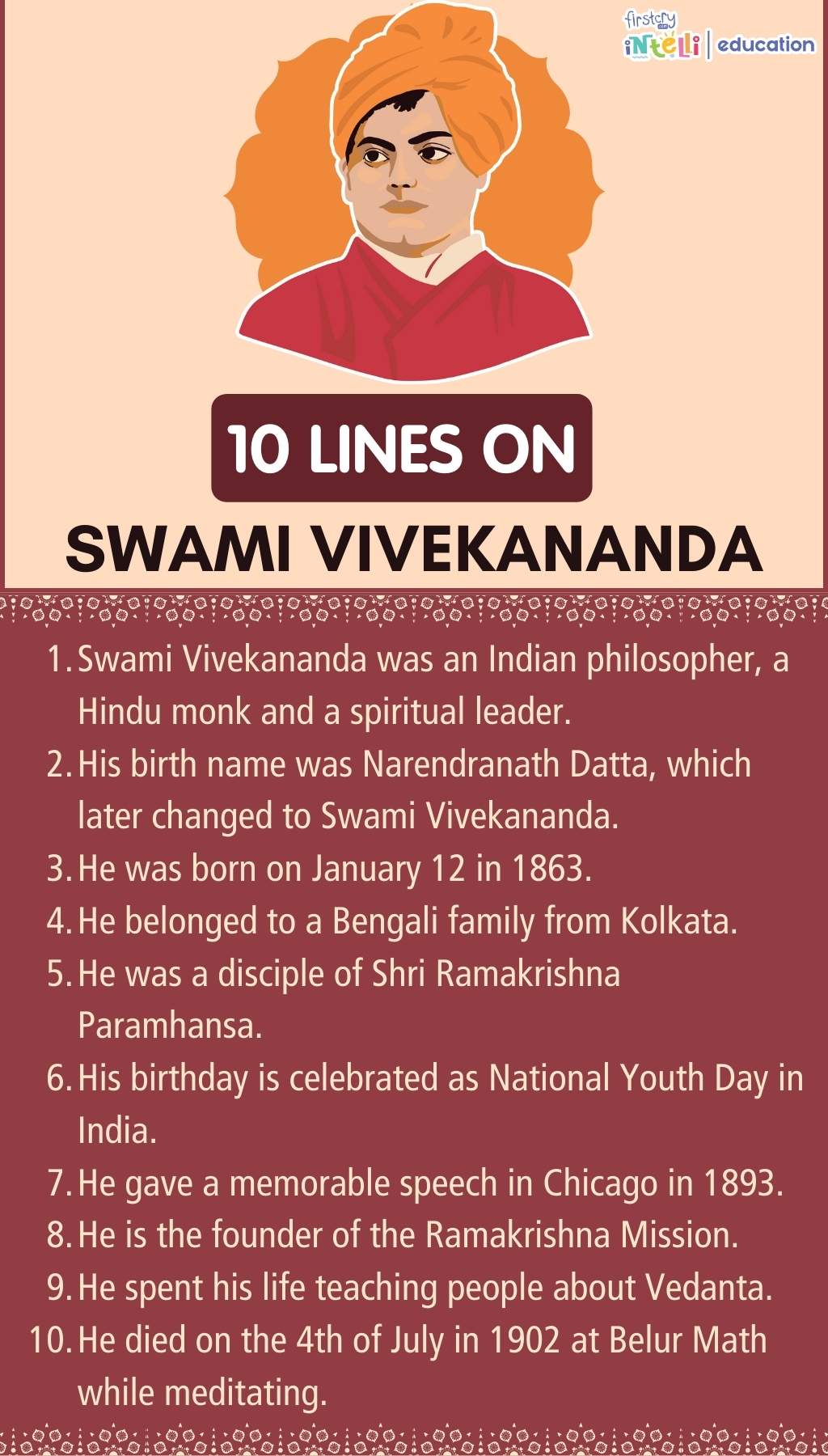
To get started, let’s look at some very basic facts. Here are a few lines about Swami Vivekananda. It will help kids to compose an essay for classes 1, 2, and 3:
- Swami Vivekananda was an Indian philosopher, a Hindu monk and a spiritual leader.
- His birth name was Narendranath Datta, which later changed to Swami Vivekananda.
- He was born on January 12, 1863.
- He belonged to a Bengali family from Kolkata.
- He was a disciple of Shri Ramakrishna Paramhansa.
- His birthday is celebrated as National Youth Day in India.
- He gave a memorable speech in Chicago in 1893.
- He is the founder of the Ramakrishna Mission.
- He spent his life teaching people about Vedanta.
- He died on the 4th of July in 1902 at Belur Math while meditating.
Paragraph On Swami Vivekananda
Now that we know some basic facts about Swami Vivekananda, we can try writing a paragraph about Swami Vivekananda in 100 words. Here’s an example of an essay on Swami Vivekananda in English in just a short paragraph:
Born in the 19th century, Swami Vivekananda belonged to a middle-class family in Kolkata. His birth name was Narendranath Dutta, and he adopted the name Swami Vivekananda only after gaining knowledge and becoming a Hindu monk. He taught the principles of Hinduism and Vedanta not only to people in his country but also to those living abroad. His famous speech in Chicago in 1893 is still discussed today. Swami Vivekananda was moved by Shri Ramakrishna Paramhansa’s devotion to God and became his disciple. Inspired by his spiritual teacher, Swami Vivekananda founded the Ramakrishna Mission in his name. He passed away while meditating daily on the 4th of July, 1902.
Swami Vivekananda Essay In 150 Words
A short essay on Swami Vivekananda would be ideal for helping kids learn about his life and message. This is a 150-word essay on Swami Vivekananda for kids:
Swami Vivekananda was a great philosopher, a Hindu monk, and a spiritual leader who believed in the mantra of simple living and high thinking. He was born on January 12 in a traditional Bengali family in Kolkata. Swami Vivekananda moved the world with his discourse of modern Vedanta and Raj Yoga at a very early age. He was well-versed in all Hindu scriptures, including the Ramayana, the Geeta, the Mahabharata, the Vedas, and the Upanishads. He had a profound knowledge of subjects such as History, Bengali literature, Sanskrit, and so on. Inspired by Sri Ramakrishna, Swami Vivekananda embraced him as his guru and embarked on his spiritual and philosophical journey to enlighten the world. He established the Ramakrishna Mission to provide aid to the poor and distressed. Swami Vivekananda introduced Western people to Indian culture, spirituality, philosophy, meditation, and Hinduism. He got global recognition following his famous speech in Chicago. He left the world on the 4th of July, 1902, while meditating.
Essay On Swami Vivekananda In English In 300 Words
Here is a detailed essay on Swami Vivekananda in English that highlights his inspiring life, teachings, and contributions to India’s spiritual and cultural growth. It helps students understand why he is remembered as a guiding light for India’s youth.
Swami Vivekananda was one of India’s greatest spiritual leaders and reformers, inspiring millions with his thoughts and teachings. He was born on 12th January 1863 in Kolkata as Narendra Nath Datta. From a very young age, he was intelligent, curious, and deeply interested in spirituality. He became a disciple of Sri Ramakrishna Paramahansa, who guided him on the path of truth and enlightenment. Under his guru’s influence, Vivekananda learned the importance of selflessness, service, and devotion to God.
Swami Vivekananda travelled across India, witnessing the poverty and suffering of people. This experience motivated him to work for the upliftment of people experiencing poverty and the spread of education. He believed that true religion means serving humanity. His message emphasised strength, confidence, and self-faith. In 1893, he delivered his historic speech at the World Parliament of Religions in Chicago, beginning with the famous words, “Sisters and Brothers of America.” His speech introduced the world to India’s rich spiritual heritage and message of universal brotherhood.
He founded the Ramakrishna Mission to promote education, social welfare, and moral values. Swami Vivekananda encouraged young people to be disciplined, brave, and hardworking. He said that the youth are the future of the nation and must use their energy to advance the nation.
Swami Vivekananda’s thoughts continue to inspire millions, especially the youth of India, to live with purpose, compassion, and courage. His birthday, celebrated as National Youth Day, reminds us of his teachings on character, service, and unity. Swami Vivekananda will always be remembered as a guiding light who awakened India’s spirit and inspired the world with his wisdom.
His life teaches us to overcome fear, believe in ourselves, and always stand for truth. He showed that through hard work and faith, anything is possible. His words continue to guide people toward a meaningful and strong life.
Swami Vivekananda Essay In 500 Words
The following paragraph is a long-form essay for class 3. Longer essays allow students to explore the topic more expansively. Here’s how students can craft their own long essay on Swami Vivekananda in English:
Childhood & Education
Swami Vivekananda was born in British-ruled India on 12th January 1863, in Shimla. He was born in a family of Bengali aristocrats from Calcutta (now Kolkata). He grew up among nine other siblings. He was named Narendranath Dutta by his parents. Vishwanath Dutta, his father, was a well-known lawyer at the Calcutta High Court. Bhuvaneshwari Devi was his mother, who was a housewife. Swami Vivekananda viewed her as a saint, describing her as a “Divine Spirit” in one of his many novels. His family’s religiousness and devotion had a massive impact on him. At the Scottish Church College, he studied Western Logic and Western Philosophy. Narendranath received a Bachelor of Arts degree in 1884. After graduation, he joined the Brahmo Samaj.
Meeting With Ramkrishna Paramhansa
Sri Ramakrishna was a spiritual leader and a sincere devotee of Hinduism. It is believed that he was a sage who could see the actual reality of the world. Swami Vivekananda came under his influence during his college days when he felt mentally and spiritually distraught. He was amazed to learn that his new guru could realise God just as he could. It was when he became one of the first disciples of Shri Ramakrishna that he actualised his true self and gained enlightenment. Ramakrishna deeply impacted Swami Vivekananda’s life. To spread the teachings of his guru, Vivekananda founded the Ramakrishna Mission in 1898.
Great Deeds By Swami Vivekananda
Swami Vivekananda is known as a nationalistic saint. In college, he learned about Western philosophers. From his guru, he learned about the principles of modern Vedanta. He founded the Ramakrishna Mission in his teacher’s name. He used this Mission to help out those in need in schools and hospitals and spread his guru’s teachings on spirituality. Swami Vivekananda had also volunteered his time to assist earthquake victims. He is globally loved, and his speech in Chicago at the Parliament of the World’s Religions remains the most discussed event at the global forum. Swami Vivekananda’s life continues to inspire people all over the world.
Swami took his last breath at Belur Math on the 4th of July in 1902. He was meditating like any other day when he quietly passed away. Some of his followers believe he took Samadhi- the action of letting your soul leave your body on will.
Teachings Of Swami Vivekananda
Swami Vivekananda’s teachings focus on strength, self-confidence, and service to others. He taught that every person is divine and that true religion means loving and helping all beings. He inspired the youth to be fearless, disciplined, and hardworking, and to build a strong character based on truth and purity. He also emphasised harmony between different religions, saying that all paths lead to the same God.
What Will Your Child Learn From This Essay On Swami Vivekananda?
A composition on Swami Vivekananda will inspire kids. This is a good learning exercise for children. It requires reading, remembering, writing, and composition- all skills that a good writer should have. The life and simplicity of Swami Vivekananda might also inspire children. Writing an essay on this spiritual leader will teach children about spiritual and religious philosophy, discipline, and the importance of gaining knowledge. His love for his teacher and his respect for his parents are aspects that positively impact impressionable minds. His life is an example of how one should let go of selfish motives and dedicate their time to helping vulnerable people.
FAQs
1. What is Swami Vivekananda best known for?
He is best known for his speech at the Parliament of the World’s Religions in Chicago in 1893, where he began with the words “Sisters and Brothers of America,” which introduced Hinduism to a global audience.
2. Why is Swami Vivekananda’s birthday celebrated?
His birthday, 12th January, is celebrated as National Youth Day in India, which recognises his emphasis on youth’s potential and their role in nation-building.
3. What were Swami Vivekananda’s teachings?
Swami Vivekananda taught the importance of self-realisation, service to humanity, and the unity of all religions. He believed the best form of worship was serving others and encouraged physical and moral strength.
Through this article, we have endeavoured to show you the best ways to write an essay for students of classes 1, 2, and 3. We hope it helps your child write a great essay on their own!
Also Read:
Essay on Lal Bahadur Shastri for Classes 1, 2 & 3
Essay Subhash Chandra Bose on for Classes 1, 2 & 3
Essay on Pandit Jawaharlal Nehru for Classes 1, 2 & 3 Kids