



- What Are Helping Verbs?
- Why Should You Teach Helping Verbs To Kids?
- Functions Of Helping Verbs
- What Is The Difference Between Main Verbs and Helping Verbs?
- Types Of Helping Verbs
- Helping Verbs List
- Examples Of Helping Verbs In Sentences
- List Of Helping Verbs (Tense-Wise)
- Common Mistakes You Should Avoid While Using Helping Verbs
- Fill In The Blanks Exercise
- FAQs
In English grammar, verbs are important because they show what is happening. Main verbs tell us the action or state, but helping verbs work with them to make sentences clearer and more accurate. They might seem small, but they matter a lot. For example, look at these two sentences: “The baby is sleeping.” and “The baby is sleeping.” Can you spot the difference? That’s how helping verbs work.
Thank you for reading this post, don't forget to subscribe!
Today, we will talk about helping verbs for kids. We’ll use simple definitions, clear examples, and worksheets to help you learn. At the end, you’ll also get a list of helping verbs you can keep and use whenever you need.
What Are Helping Verbs?
This section provides a clear and accessible definition of helping verbs.
According to the Merriam-Webster Dictionary, a helping verb (as, am, will, may) is an auxiliary verb that is used alongside the main verb to modify the tense, mood, number, or person of the sentence. As the name suggests, a helping verb is there to help the main verb.
For a simpler explanation of all helping verbs, consider the following:
A helping verb functions in conjunction with the main verb to form a complete verb phrase. It is important to note that not every sentence or clause requires a verb phrase; some English sentences are grammatically correct without the inclusion of a helping verb. For instance, “The dog barks” utilises only the main verb to convey the action.
Consider a second example: “The dog has been barking since morning.” In this sentence, the verb phrase “has been barking” is used in the present perfect continuous tense. Here, “has been” serves as the helping verb, while “barking” is the main verb.
Why Should You Teach Helping Verbs To Kids?
Helping verbs, also known as supporting verbs, serve functions beyond merely assisting main verbs. Teaching children about helping verbs, or supporting verbs, is essential for several key reasons:
- Helping verbs indicate the tense of an action, clarifying whether it occurred in the past, present, or future.
- They are instrumental in forming interrogative (question) sentences.
- The English language would lack both versatility and grammatical precision without helping verbs.
- Helping verbs express possibility, necessity, or obligation within a sentence.
- They play a critical role in constructing negative sentences.
- Helping verbs are essential for forming passive-voice sentences.
Functions Of Helping Verbs
Helping verbs play a crucial role in giving a sentence a proper structure. They help in expressing the intended message of the sentence, making it more comprehensible. For instance, the phrase “I go to the office” implies that the action occurs generally, not that it is happening in the present or the past.
When rephrased as “I am going to the office,” the sentence clearly states the tense and time of the action, that it is happening in the present. By incorporating the helping verb “am” into the sentence, we are able to indicate the precise action when it is happening, whether present, past, or future.
What Is The Difference Between Main Verbs and Helping Verbs?
If you are uncertain about the distinction between the main verb and the helping (or supporting) verb, refer to the following table for greater clarity.
| Feature | Main Verb | Helping Verb |
| Meaning | Denotes the main action | Supports the main verb |
| Example | She writes stories. | She is writing. |
| Independent? | A main verb can stand alone | A helping verb cannot stand alone |
Types Of Helping Verbs
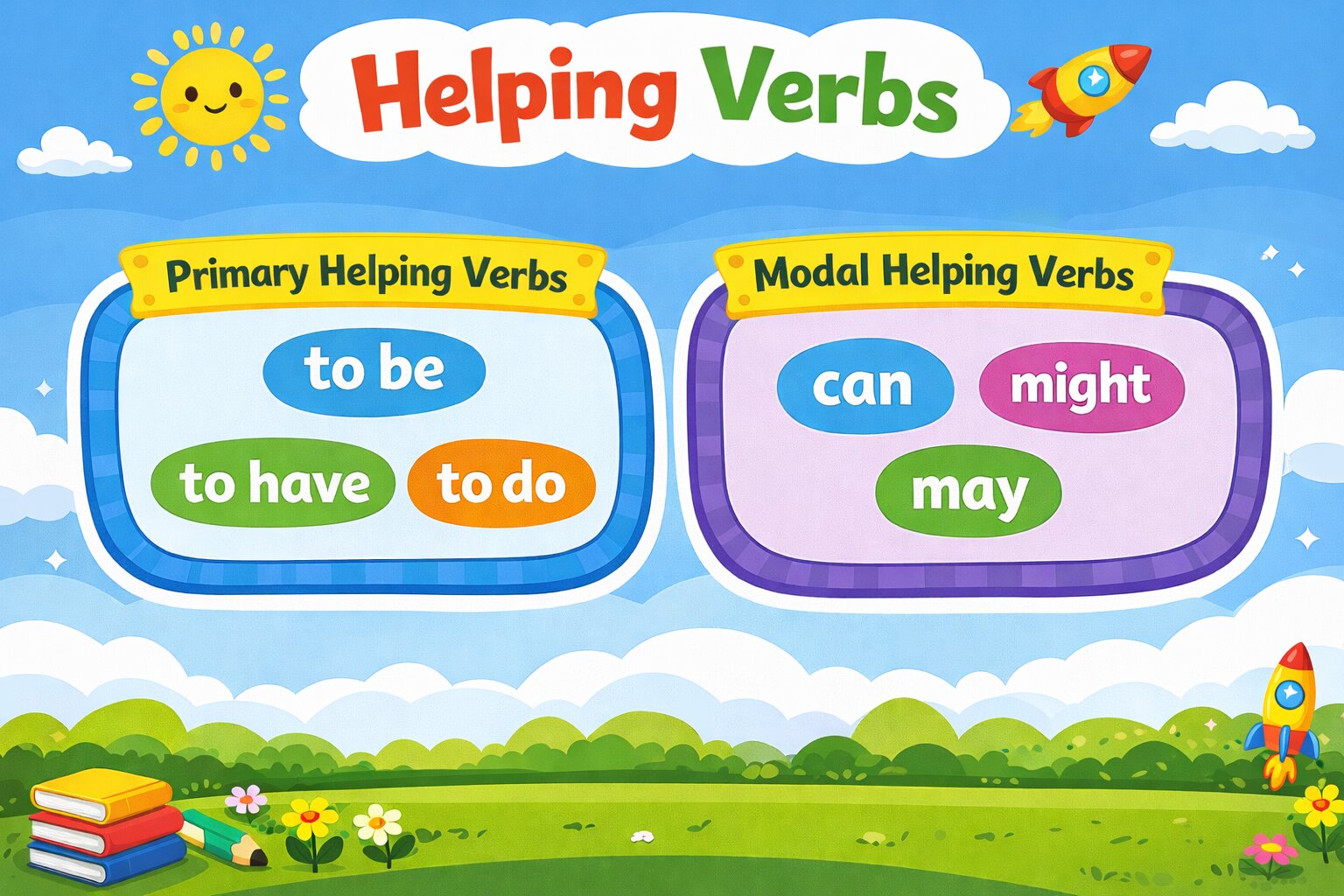
Helping verbs are mainly classified into two categories.
1. Primary Helping Verbs
Primary helping verbs help express verbs in an English sentence. The three primary auxiliary verbs include to be, to have, and to do, and all their verb forms. These verbs, called auxiliaries, accompany the main verb to form a verb phrase and are conjugated according to the tense.
- to be – am, is, are, was, were, be, been, being
- to have – have, has, had, having
- to do – do, does, did
Examples of primary helping verbs in sentences:
When helping verbs are used in a sentence, they accompany the past or present participle form of the main verb to create different tenses, especially the perfect and progressive tenses.
- I am having another apple.
- Steve was trying to open a kitchen valve but couldn’t.
- Who has travelled all of Asia?
- Mark had stolen the van by then.
- The badminton team has been waiting at the reception for over an hour.
- I do find that Broadway show amusing. (The helping verb Do does not set the verb tense. It emphasises the main verb.
2. Modal Helping Verbs
The purpose of modal helping verbs is to indicate any possibility, necessity, suggestion, permission, and ability. Not all helping verbs conjugate. Unlike primary auxiliary verbs, modal helping verbs do not conjugate as per the tense. This means they don’t change their forms and precede the unconjugated version of the main verb. Let us make it clear with some examples.
There are 9 main modal verbs:
- can
- might
- may
- could
- should
- will
- shall
- would
- must
Phrases, including need to, ought to, and had better, are often used with main verbs to form a single phrase.
Examples of modal helping verbs in sentences:
- I wish I could run faster.
- I might stay tonight at the office because of extra work.
- Would you mind if I access the lavatory first?
- Uncle Sal may sell his business by the end of the year.
- My father can pick my brother up with just one arm!
- Will you go for the interview my brother recommended?
- I shall become the class president in my second year.
- You must make your bed after waking up.
- This ought to clear the fog.
- He should study diligently if he wants to get admission to MIT.
Helping Verbs List
Although the helping verbs are limited in number, which is 23, they are used quite frequently. Here’s a concise list of helping verbs to help children and everyone keep them in mind easily.
Save or screenshot this table for later use!
| Primary Helping Verb | Be | am, is, are, was, were, be, being, been |
| Do | do, does, did | |
| Have | has, have, had | |
| Modal Helping Verb | Will | will, would |
| Shall | shall, should | |
| Can | can, could | |
| May | may, might | |
| Must | must | |
| Semi-modal Helping Verbs | Ought | ought, ought to |
| Dare | dare, dared | |
| Need | need, needed |
Examples Of Helping Verbs In Sentences
Here are easy-to-grasp helping verbs examples.
- She is going to the farmer’s market.
- They are playing football in the old ground.
- I am feeling tired today.
- He was practising his guitar when I called.
- We were waiting for the bus.
- She has finished her homework.
- I have seen that movie before.
- They had already left the party.
- I will call you later.
- She will be attending the meeting tomorrow.
- They will have completed the project by Friday.
- He does not like spicy food.
- I do understand your concern.
- She did complete the assignment on time.
- You can solve this problem easily.
- She may come to the party tonight.
- We must follow the rules.
- He should study harder for the exam.
- They have been working all day.
- She had been waiting for hours before help arrived.
List Of Helping Verbs (Tense-Wise)
This quick-to-understand chart of helping verbs clearly explains how auxiliary verbs work in different tenses.
| Tense | Helping Verb(s) | Example Sentence |
| Present Simple | do, does | She does like coffee. |
| Past Simple | did | They did finish the work. |
| Future Simple | will, shall | I will call you tomorrow. |
| Present Continuous | am, is, are | She is reading a book. |
| Past Continuous | was, were | They were playing outside. |
| Future Continuous | will be | I will be traveling next week. |
| Present Perfect | has, have | She has completed her homework. |
| Past Perfect | had | They had left before I arrived. |
| Future Perfect | will have | I will have finished by evening. |
| Present Perfect Continuous | has been, have been | She has been studying for hours. |
| Past Perfect Continuous | had been | They had been waiting for a long time. |
| Future Perfect Continuous | will have been | I will have been working here for 5 years. |
Common Mistakes You Should Avoid While Using Helping Verbs
Although minor, mistakes with the use of helping verbs can distort the sentence. Here are some common mistakes learners can learn to avoid while using helping verbs:
1. Omitting the helping verb in the present continuous tense. Yes, this happens quite often, unknowingly.
- Wrong: He playing guitar.
- Right: He is playing guitar.
2. Using two modal helping verbs together in a sentence.
- Wrong: He can might bring his niece to the birthday party.
- Right: He can bring his niece to the birthday party.
3. Unnecessary use of a helping verb when it is not needed.
- Wrong: I am lie.
- Right: I lie.
4. Incorrect helping verb usage for the subject. It mostly happens with singular and plural forms.
- Wrong: She have been working late at night.
- Right: She has been working late at night.
Fill In The Blanks Exercise
Fill in the blanks with the correct helping verb for the following sentences:
- The students _____ been waiting for the semester results for over a month.
- We _____ just going to start our session.
- _____ you ever met him?
- They _____ be boarding their flight tomorrow exactly at this time.
- Jasmine _____ looking ethereal in that ball gown tonight.
- _____ you still going to the gym we used to go to together?
- The defence minister _____ giving the press conference on the recent security updates of the country.
- He _____ stay tonight, but I’m not so sure.
- _____ you mind helping me lift this sofa?
- Don’t stress. Everything _____ going to be alright.
Are you finished? Check how far you have grasped the concept with these answers!
- The students have been waiting for the semester results for over a month.
- We were just going to start our session.
- Have you ever met him?
- They will board their flight tomorrow at exactly this time.
- Jasmine was looking ethereal in that ball gown tonight.
- Are you still going to the gym we used to go to together?
- The defence minister is giving a press conference on the country’s recent security updates.
- He might stay tonight, but I’m not so sure.
- Would you mind helping me lift this sofa?
- Don’t stress. Everything is going to be alright.
FAQs
1. How Many Total Helping Verbs Are There In English?
There are a total of 23 helping verbs, including both primary and modal helping verbs.
2. Can a Sentence Have More Than One Helping Verb?
Yes, but not always. Here’s a sample of a helping verb where two auxiliaries are used:
- “Joseph might have been waiting in the rain for hours.”
- “She would have called by now.”
In both the above sentences, two helping verbs work together with the main verb to form the verb phrase.
Understanding the concept of supporting (helping) verbs early on is essential to constructing clear sentences. These are helpful in forming questions, tenses, negatives, and voices, putting them in the VVIP category of English grammar.
We hope this guide on helping verbs for children and how to use them, along with helping verbs examples, helped you sharpen your English grammar. Forming a sentence using helping verbs is not difficult. With practice, you can effectively use helping verbs in sentences and communicate more fluently than ever.
Also Read:
Verb ‘To Be’ for Kids
Verb “To Do” for Kids
Modal Verbs for Kids
Verb ‘To Have’ for Children