



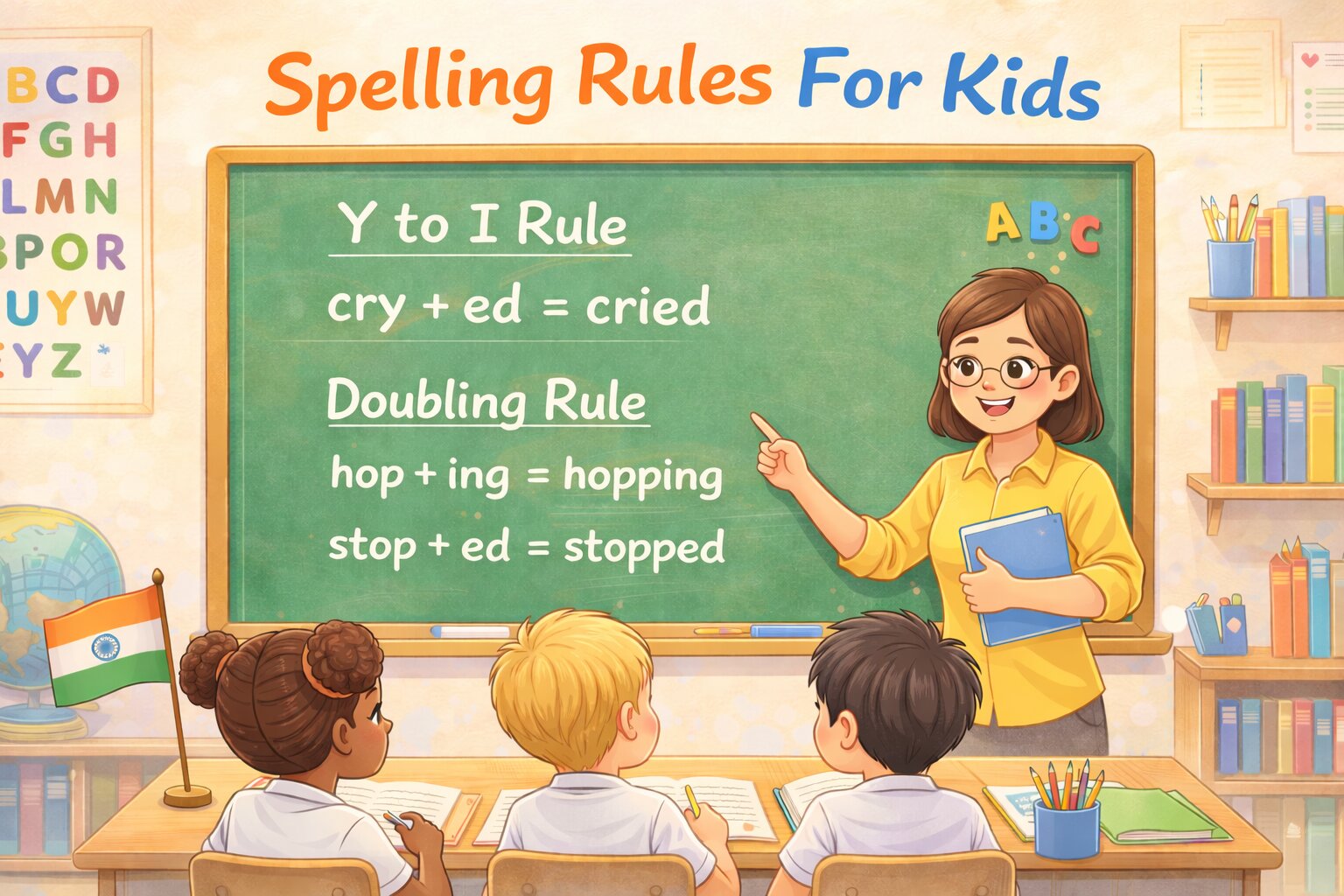
When children learn English spelling rules, writing becomes less confusing and more enjoyable. This article shares a simple list of spelling rules for kids, making English spelling easier to understand. By learning these patterns, young learners can tackle tricky words and feel more confident when they write.
Thank you for reading this post, don't forget to subscribe!
Imagine spelling “i before e except after c” without a second thought, or understanding the logic of English spelling rules—like why we double the final consonant in words such as “run” to make “running” but not in “open” to make “opening.” These aren’t random quirks but clever patterns rooted in the logic of English spelling rules and the language’s history. With clear explanations, vibrant examples like “receive” (i before e after c) and “neighbour” (ei when not after c), and fun practice tips, young spellers will discover the joy of getting it right.
Learning these rules helps kids with both schoolwork and creative writing. Start practising, and soon spelling will feel easy and natural.
What Are Spelling Rules?
Spelling rules are like secret codes that help children predict how words are written in English. They guide us on where to place vowels, when to double consonants, or how to handle silent letters. For instance, the rule “i before e except after c” explains why “believe” uses ‘ie’ but “ceiling” flips to ‘ei’. This list isn’t about memorising endless words; it’s about understanding patterns, such as adding ‘-ed’ to past tense verbs or changing ‘y’ to ‘i’ before ‘-es’. By mastering these rules for spelling words, kids gain confidence to spell independently, making writing adventures exciting rather than frustrating. Simple, right?
Why You Should Teach Spelling Rules To Kids?
Spelling patterns and rules help children learn to spell correctly and better understand English. This section explains the key benefits for their writing and reading skills.
1. Writing Confidence
Knowing spelling rules lets children write sentences without fear of mistakes. It helps them express ideas clearly in essays and stories.
2. Reading Improvement
Understanding rules for spelling words makes it easier to sound out new words. Children recognise terms faster when reading books.
3. Independent Learning
Children can spell on their own instead of asking for help. This builds self-reliance in schoolwork and daily tasks.
4. Vocabulary Growth
Rules show patterns in words, helping kids learn new terms quickly. They use them correctly in speaking and writing.
5. Homework Efficiency
Quick recall of spelling rules speeds up assignments. It leaves more time for play and other subjects.
6. Creative Expression
With solid spelling skills, children focus on storytelling ideas. They worry less about errors in their work.
7. Exam Success
Accurate spelling improves test and exam marks. It gives a strong start in language subjects.
8. Lifelong Literacy
Early grasp of rules supports better communication skills. This helps with emails, reports, and daily life.
How To Use Spelling Rules?
When spelling a word, recall the relevant rule, such as checking for vowel patterns or consonant doubling. Break the word into sounds, apply the rule step by step, and write it out. If unsure, compare with similar words you know. Double-check by reading aloud to catch errors. This process makes spelling reliable and quick.
Important Spelling Rules
These spelling guidelines cover the most common patterns children need for everyday words. Learn to spell accurately and build strong writing skills.
1. I Before E Except After C
Generally, use ‘ie’ in words such as “believe” and “field.” Use ‘ei’ after ‘c’, as in “receive” and “ceiling.” However, there are exceptions, such as “weird” and “seize.” Also, use ‘ei’ when it sounds like ‘a’, as in “neighbour” and “weigh.”
2. CVC Doubling Rule
For one-syllable words ending in a single vowel followed by a single consonant (CVC), double the final consonant before adding a vowel suffix like “-ing” or “-ed” (e.g., “hop” becomes “hopping”). Do not double if the word ends in w, x, or y.
3. Double Consonant Rule
Double the final consonant before adding “-ing” or “-ed” if the word is stressed on the last syllable and ends in a single vowel plus a single consonant (e.g., “begin” becomes “beginning”). Do not double when the final syllable is unstressed.
4. Y To I Rule
Change ‘y’ to ‘i’ before adding suffixes like “-es” or “-ed” to words ending in a consonant plus ‘y’ (e.g., “study” becomes “studies”). Do not change ‘y’ when adding “-ing” (“studying”) or if a vowel comes before ‘y’ (“stayed”).
5. Drop E Rule
Drop the final ‘e’ before adding a vowel suffix, such as “-ing” or “-ed” (“make” becomes “making”). Keep the ‘e’ before suffixes that start with a consonant, such as “-ment” (“advancement”) or sometimes “-able” (“loveable” or “manageable”). Note that some words can take either form.
6. Magic E Rule
The final ‘e’ in a word usually makes the preceding vowel long, as in “pin” becoming “pine” or “not” becoming “note.” However, not all words follow this pattern (e.g., “have” and “give”).
7. Vowel Teams
When two vowels appear together (vowel teams), they often make a single sound, as in “oa” in “boat” or “ai” in “rain.” Usually, the first vowel is pronounced, but there are exceptions (e.g., “said,” “friend”).
8. Adding S Or Es
Add “-s” to form the plural of most nouns (“cats”). Add “-es” to words ending in s, sh, ch, x, or z (“buses,” “watches”). For words ending in consonant + ‘y’, change ‘y’ to ‘i’ and add “-es” (“puppy” becomes “puppies”).
Examples Of Spelling Rules
Explore spelling rules in English with examples. Below, you’ll find practical examples that illustrate each rule using common words, helping children understand and remember these patterns.
- I Before E: believe, chief, field, piece (ie for long e).
- I Before E: receive, ceiling, deceive, perceive (ei after c).
- CVC Doubling: hop → hopping, run → running, sit → sitting, plan → planning (short vowel, double final consonant).
- Double Consonant: run → running, swim → swimming, big → bigger, stop → stopped (short vowel, double final consonant).
- Y To I: study → studies, carry → carried, happy → happier, dry → dried (consonant-y to i).
- Drop E: make → making, bake → baking, drive → driving, hide → hiding (drop before ing).
- Drop E: love → lovable, change → changeable, manage → manageable (keep before able).
- Magic E: pin → pine, kit → kite, tap → tape, mad → made (long i or a).
- Magic E: cub → cube, tub → tube, hug → huge, fad → fade (long u or a).
- Vowel Teams: boat, coat, road, goat (oa long o).
- Vowel Teams: rain, train, paint, snail (ai long a).
- Adding S: cat → cats, dog → dogs, book → books, car → cars (simple s).
- Adding Es: bus → buses, box → boxes, kiss → kisses (s, x, ss-ending).
- Adding Es: watch → watches, match → matches, dish → dishes, brush → brushes (ch, sh-ending).
- Y To I: cry → cried, fry → fried, carry → carried, try → tried (y to i + ed).
Fun Ways To Teach Spelling Rules To Kids
Make spelling rules exciting with games and activities that children enjoy. These methods help rules stick while keeping learning playful.
1. Spelling Bingo
Get some bingo cards with words that follow rules like i before e, such as “field” or “ceiling.” Call out clues or show pictures, and kids mark their cards until someone shouts “Bingo!” To win, they have to spell the word. This game makes learning patterns exciting and keeps kids coming back for more.
2. Word Hunt Game
Place cards with pairs like “pin” and “pine” (showing the magic e rule) around the room for a treasure hunt. Kids find the cards, sort them into groups based on the rule, and explain their choices. This activity gets everyone moving and helps kids spot tricky spelling patterns.
3. Rule Charades
Choose a word like “hopping” (which uses the CVC doubling rule), act it out with lots of energy, and let the group guess the word before saying the rule. Change players quickly to keep things lively. This game brings lots of laughs and helps kids remember spellings by moving their bodies.
4. Spelling Songs
Tune spelling rules to favourite kids’ songs, like using “Row Row Row Your Boat” for dropping the e: “Drop the e, drop the e!” Add claps, dance moves, and repeat it every morning. Catchy beats and movement make spelling rules memorable and fun for everyone.
5. Comic Strip Creation
Give kids blank comic pages and ask them to include five vowel team words, like “boat” or “rain,” in a funny story. They can draw and write, then share their comics with the class. This activity encourages creativity, gives kids extra spelling practice, and improves imagination while sneaking in solid spelling practice.
Spelling Rules Chart
This handy chart sums up the key spelling rules with examples at a glance. Print it out, pin it up, and watch kids refer to it for quick spelling fixes.
FAQs
1. What If A Spelling Rule Does Not Work?
Some words break rules they are called exceptions, like “seize” instead of i before e. Learn the top 10 exceptions and use a dictionary for the rest.
2. How Can I Remember All These Rules?
Make a personal rule book with drawings next to each one, like a hopping bunny for doubling. Review one page a day to build memory without stress.
3. Can Games Help Me Spell Better?
Yes! Play Hangman with rule words or apps like Spelling City. They make practice feel like play and track your progress.
4. What About Plurals Beyond S And Es?
Irregulars like “child/children” or “foot/feet” need memorising. Make flash cards for these specials.
You’re ready to become a spelling star! With key rules, clear examples, and fun games in your toolkit, tricky words will soon turn into easy friends. These strategies help you write stories, finish homework, and express your ideas with confidence. Try out a new rule each day, teach your friends, and watch your skills grow. Every word you spell brings you closer to mastering the magic of language. So grab your pencil let the adventure begin!
Also Read:
R Controlled Vowels with Examples
Singular and Plural Nouns for Kids
Long and Short Vowels for Preschoolers