


- List Of Common 3-Letter Words Starting With K
- 3-Letter Action Words That Start With K
- 3-Letter Everyday Objects That Start With K
- Three-Letter Animal Names That Start With K
- Positive Three-Letter Words That Begin With K
- Three-Letter Nouns Beginning With K
- 3-Letter Adjectives Starting With K
- Sentences Using Three-Letter K Words
- Activities To Teach 3-Letter Words Starting With K For Kids
- FAQs
Last Updated on October 16, 2026
3-letter words that start with K bring a fun, slightly unusual sound into a child’s reading practice, since K is used less often than letters like C or B. Words such as kid, key, kit and keg are short, clear and satisfying to sound out, making them a good next step for early readers. K is one of the rarer starting letters, so this guide keeps every list focused on genuine, familiar words rather than stretching to fill a fixed number.
Thank you for reading this post, don't forget to subscribe!
This guide is a handy set of three-letter words starting with K for students building their phonics skills, as well as parents and teachers looking for a ready-made lesson. Alongside the word list, you’ll find grouped tables, example sentences and hands-on activities to make K words memorable.
List Of Common 3-Letter Words Starting With K
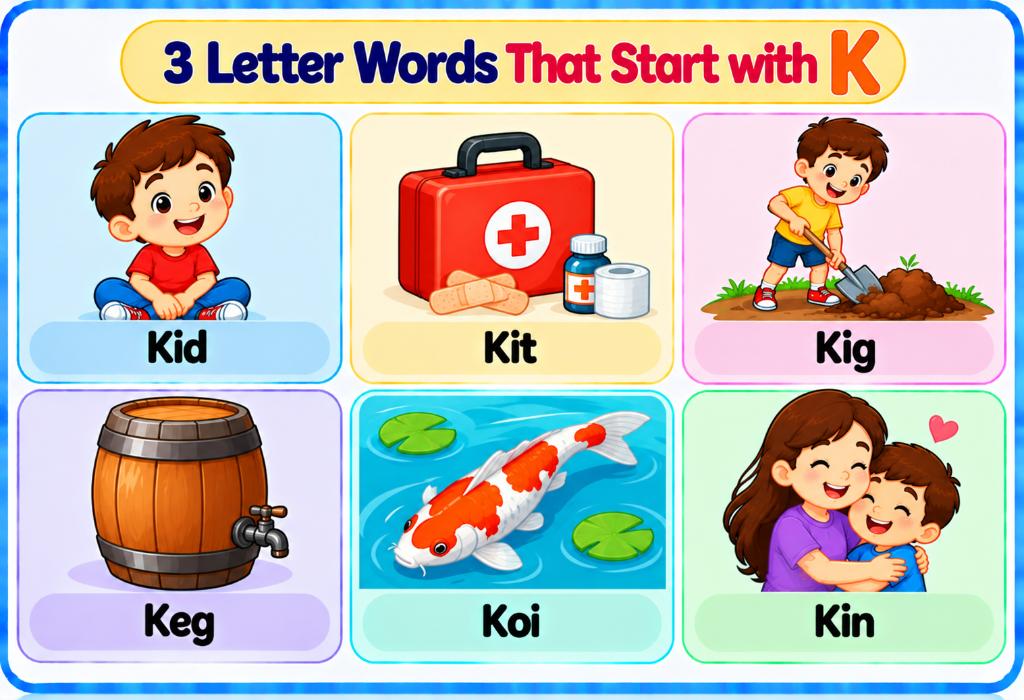
Here is a list of 3-letter words beginning with K that children come across early in their reading journey. K has fewer short words than most letters, so this list covers the genuine, commonly used ones rather than a fixed count.
1. Kid: A child, or a young goat.
2. Key: A small metal tool used to lock or unlock something.
3. Kit: A set of tools or equipment needed for a task or activity.
4. Keg: A small barrel, often used to store drinks.
5. Koi: A colourful, ornamental fish often kept in garden ponds.
6. Kin: A person’s family or relatives.
7. Kip: An informal word meaning a short sleep or nap.
K has very few additional three-letter words beyond the common ones above, so this table is shorter than other letters in this series.
| Koa | Kor |
3-Letter Action Words That Start With K
Genuine three-letter K verbs are rare, but “kip” fits well.
| Kip |
3-Letter Everyday Objects That Start With K
These K words name familiar items children may recognise at home or on a trip.
| Key | Keg |
| Kit |
Three-Letter Animal Names That Start With K
Only one true animal name fits into three letters: a colourful pond fish many children enjoy seeing.
| Koi |
Positive Three-Letter Words That Begin With K
Positive, feel-good words are tricky to find at just three letters for K, so this list stays small — but that leaves more room to focus on the handful of genuinely useful K words covered elsewhere in this guide.
Three-Letter Nouns Beginning With K
A noun names a person, animal, place or thing. These 3-letter K words cover family, animals and everyday objects.
| Kid | Key |
| Kit | Keg |
| Koi | Kin |
3-Letter Adjectives Starting With K
Describing words are especially hard to find at just three letters when it comes to K, so young readers won’t come across many examples here, but that’s perfectly fine — there’s still plenty to find in the other word groups above.
Sentences Using Three-Letter K Words
Simple sentences help children see how three-letter K words work in real reading, rather than as single words on a list. Read each one aloud slowly, then ask your child to point to the K word and say it back to you.
- The kid chased the ball across the yard.
- I lost my house key this morning.
- Dad packed his kit in the car.
- The keg was rolled into the cellar.
- We watched the koi swim in the pond.
- My kin came to visit for the weekend.
- Grandpa likes a short kip after lunch.
- The kit came with everything we needed.
- She hung the key on a small hook.
- Our kin gathered for a big family meal.
Activities To Teach 3-Letter Words Starting With K For Kids
These playful activities suit 3-letter words starting with K for kindergarten and preschoolers, and they work well at home or in a classroom. Because K has fewer words to draw on, these activities lean on repetition across a small, focused set.
1. Key And Lock Match
Set up a few toy locks or boxes with simple latches, each paired with a labelled key card. Children match the right “key” word to the right lock, saying the word aloud as they open it.
2. Koi Pond Scoop
Fill a shallow tray with water and a few toy fish, with K words taped underneath some of them. Children scoop out a fish with a net, read the word if there is one, and place it in a basket.
3. Kit Builder
Give children a small bag and a pile of mixed items, some belonging to a “kit” theme, such as a toy spanner or paintbrush. They pack their own kit bag while naming each item and saying the word “kit” aloud.
4. Kip Time Story
Read a short, calm story about an animal taking a kip, then ask children to pretend to curl up for their own gentle kip. Afterwards, talk about the word together and where else they might use it.
5. Family Kin Chart
Help children draw a simple picture of their kin, such as parents, siblings or grandparents, and label the page “My Kin.” This links the word to real people in their life rather than an abstract definition.
FAQs
1. Where Does The Word “Kin” Come From?
“Kin” is one of the oldest words in English for family, related to words like “kind” in its original sense of people of the same type or birth. Sharing this bit of history can help older children see how some short words carry a long story behind them.
2. Why Is A Baby Goat Called A “Kid” Just Like A Child?
Farmers have used “kid” for a young goat for centuries, and the word was later borrowed as an informal way to refer to a child. This is a fun example to share with children of how animal words sometimes cross over into everyday language.
3. Is “Key” Used To Mean Anything Other Than The Metal Object?
Yes, “key” can also describe the most important part of something, as in “the key point” of a story. Spotting this second meaning in books or conversation helps children see that familiar words can shift meaning depending on where they appear.
4. Why Do Koi Fish Appear So Often In Stories And Gardens?
Koi are popular in gardens partly because of their bright colours and calm nature, and they appear often in Japanese art and storytelling. Mentioning this gives the word “koi” a bit of cultural context beyond just naming a pond fish.
5. What’s A Simple Way To Explain The Word “Kip” To A Child Who Hasn’t Heard It Before?
Since “kip” isn’t used everywhere, comparing it to a word the child already knows, such as “nap,” gives them an easy way in. Learning that different people use different words for the same everyday thing is a gentle first step toward noticing language variety.
Three-letter K words are fewer in number, but the ones that remain, from a trusty key to a pond full of koi, are genuinely useful for early readers. Regular, varied practice with this smaller set helps children build confidence without needing an unusually long list.