

Last Updated on September 21, 2026
Learning to recognise and write letters is one of the earliest milestones in a child’s reading journey, and understanding small alphabet letters plays a big part in that process. These letters make up most everyday text, appearing in books, signs, and handwriting far more often than their taller, bolder counterparts.
Thank you for reading this post, don't forget to subscribe!
This article offers a simple, practical guide on how to teach lowercase letters, covering clear examples, common usage rules, and easy tips that make learning feel natural rather than repetitive. Whether your child is just starting to recognise letter shapes or ready to write them independently, this guide breaks down lowercase alphabet letters into manageable steps, helping build their confidence with the alphabet one letter at a time.
What Are Lowercase Letters?
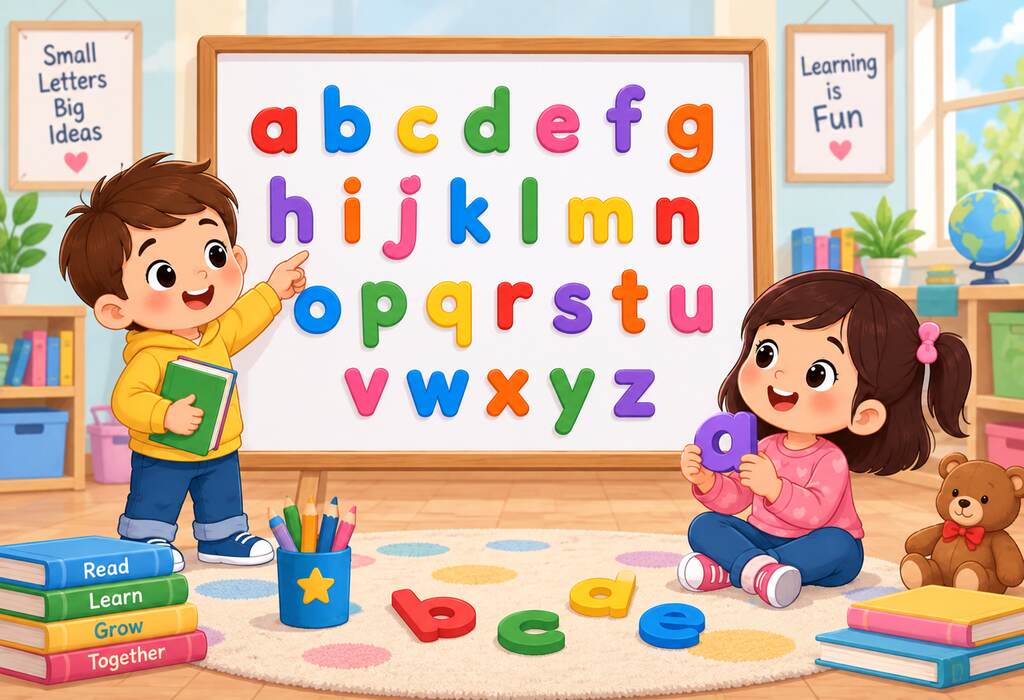
The lowercase letters of the alphabet are the smaller, simpler versions of each letter, used far more frequently than capital letters in everyday writing. Unlike uppercase letters, which are reserved for the start of sentences, proper nouns, and titles, lowercase letters make up the bulk of most words, sentences, and paragraphs.
| a | b |
| c | d |
| e | f |
| g | h |
| i | j |
| k | l |
| m | n |
| o | p |
| q | r |
| s | t |
| u | v |
| w | x |
| y | z |
At What Age Should Your Child Learn To Write Lowercase Letters?
Most children begin recognising letters, both uppercase and lowercase, between the ages of 3 and 4, often starting with the letters in their own name. Writing typically follows a little later, with many children developing the fine motor skills needed to form lowercase letters clearly between ages 4 and 5, around the time they start preschool or kindergarten.
That said, every child develops at their own pace, and it’s more important to focus on readiness than a strict age. Signs that a child may be ready to start writing lowercase letters include being able to hold a pencil comfortably, showing interest in copying shapes or letters, and recognising most letters by sight. Introducing lowercase letters gradually, through tracing, drawing, and simple practice, tends to work better than rushing the process before a child feels confident holding a pencil.
History Of Lowercase Letters
Lowercase letters weren’t always a part of written language the way they are today. Ancient scripts, including early Latin, were written entirely in capital letters, largely because early writing tools and surfaces, like stone and chisels, made it easier to carve straight, uniform lines rather than smaller, rounded shapes.
Lowercase letters gradually developed over centuries, evolving from a faster, more casual style of handwriting used by scribes who needed to write quickly on parchment and paper. By the Middle Ages, this handwriting style, known as “minuscule” script, became more standardised and was used alongside capital letters for practical reasons, saving space, improving readability, and speeding up the writing process. The distinction between uppercase and lowercase letters we recognise today became firmly established with the invention of the printing press in the 15th century, when typesetters needed separate cases to store capital and small letters, giving rise to the terms “uppercase” and “lowercase” still used today.
Examples Of Lowercase Letters
Lowercase letters make up the vast majority of any written word, apart from the occasional capital at the very start of a sentence or name. Looking at a few everyday examples helps children see just how naturally these smaller letters fit into words they already know and use.
- apple
- dog
- sun
- umbrella
- garden
- pencil
- flower
- turtle
- jacket
- window
Use Of Lowercase Letters
Understanding when to use lowercase letters is just as important as recognising them. As a general rule, lowercase letters are used throughout a sentence, except for proper nouns and the very first word of the sentence, which always begin with a capital letter.
For example, in the sentence “I visited England and Paris last summer,” every word is written in lowercase except “I,” the first word, and “England” and “Paris,” which are proper nouns and therefore always capitalised, no matter where they appear in a sentence.
Children often get confused with common nouns, mistakenly capitalising them even when they don’t need to be. Common nouns are only capitalised when they happen to be the first word of a sentence, not simply because they refer to a specific object or animal. Compare these two examples:
- “Dog! Watch out for the car.” — Here, “Dog” is capitalised only because it starts the sentence.
- “The boy gave a bone to the dog.” — Here, “dog” is written in lowercase since it’s a common noun appearing in the middle of the sentence, not the beginning.
This distinction between proper nouns that are always capitalised and common nouns that are only capitalised at the start of a sentence is one of the most common areas where children need a little extra practice.
How To Teach Lowercase Letters To Kids?
Teaching kids about lowercase letters helps strengthen both their language and communication skills from an early age. Here are a few hands-on activities to make learning lowercase letters more engaging.
1. Trace The Letters
Spread sand, flour, or shaving cream across a large tray to create a simple writing surface. Use your finger to trace the shape of a lowercase letter, then ask your child to copy the same shape beside it. This tactile approach helps children build muscle memory for letter formation before they even pick up a pencil.
2. Join The Letter
Write a few lowercase letters in dotted form on plain paper and give the sheet to your child. Ask them to trace along the dots with a pencil or crayon, helping them get comfortable with the shape, direction, and flow of each letter.
3. Play Dough Shapes
Give your child a small ball of play dough and ask them to roll and shape it into different lowercase letters. This activity strengthens fine motor skills while helping children understand how each letter is structured, especially ones with curves, loops, or tails.
4. Letter Hunt
Hand your child a magazine, newspaper, or storybook and ask them to circle or highlight a specific lowercase letter every time they spot it on the page. This builds letter recognition skills while turning everyday reading material into a quick, engaging game.
5. Match The Pairs
Create a simple matching game using cards, half with uppercase letters and half with their lowercase counterparts. Mix the cards up and ask your child to match each uppercase letter to its correct lowercase pair, reinforcing the connection between the two forms.
Free Printable Lowercase Letters Worksheet For Practice
This section has a printable worksheet to help kids practise recognising, tracing, and writing lowercase letters, including the cursive lowercase alphabet for those ready to move beyond print. It’s a simple way to reinforce what they’ve learned through focused, independent practice.
FAQs
1. Why Do Some Letters Look Completely Different In Their Lowercase Form, Like “A” And “G”?
This happens because certain lowercase letters evolved from handwritten scripts rather than simply shrinking their capital form, which is why letters like “a” and “g” often have a more rounded or looped shape compared to their uppercase versions.
2. Is It Easier For Children To Learn Uppercase Or Lowercase Letters First?
Many children find uppercase letters easier to learn first since their shapes are simpler and more distinct, though recognising small case letters early on is just as important, since they appear far more often in everyday reading.
3. Why Do Typed Lowercase Letters Sometimes Look Different From Handwritten Ones?
Printed fonts are often designed for clarity and consistency, while handwriting naturally varies from person to person, which is why a printed “a” or “g” can look quite different from how a child might write it by hand.
4. Can Learning Lowercase Letters Help With Spelling Later On?
Yes, being comfortable with lowercase letters helps children recognise word patterns more easily, which in turn supports stronger spelling skills as they begin reading and writing longer words.
Learning lowercase letters is a foundational step in a child’s reading and writing journey, one that sets the stage for stronger literacy skills down the line. With consistent practice through tracing, games, and everyday reading, children can build the confidence and familiarity needed to recognise and write these letters naturally over time.
Also Read:
English Alphabet for Kids
Fun Alphabet Games for Children to Learn
Number Sentences for Preschoolers and Kids