



Last Updated on April 27, 2026
Imagine reading a story where sentences run on without stopping, or questions have no curly tails! Punctuation for class 1 students acts like traffic signals in writing—it guides us when to pause, stop, or ask. These tiny marks turn jumbled words into clear, exciting messages.
Thank you for reading this post, don't forget to subscribe!
Learning punctuation early helps children express themselves with confidence. It also makes reading and writing much more fun for everyone. Mastering these simple marks sets the stage for great communication.
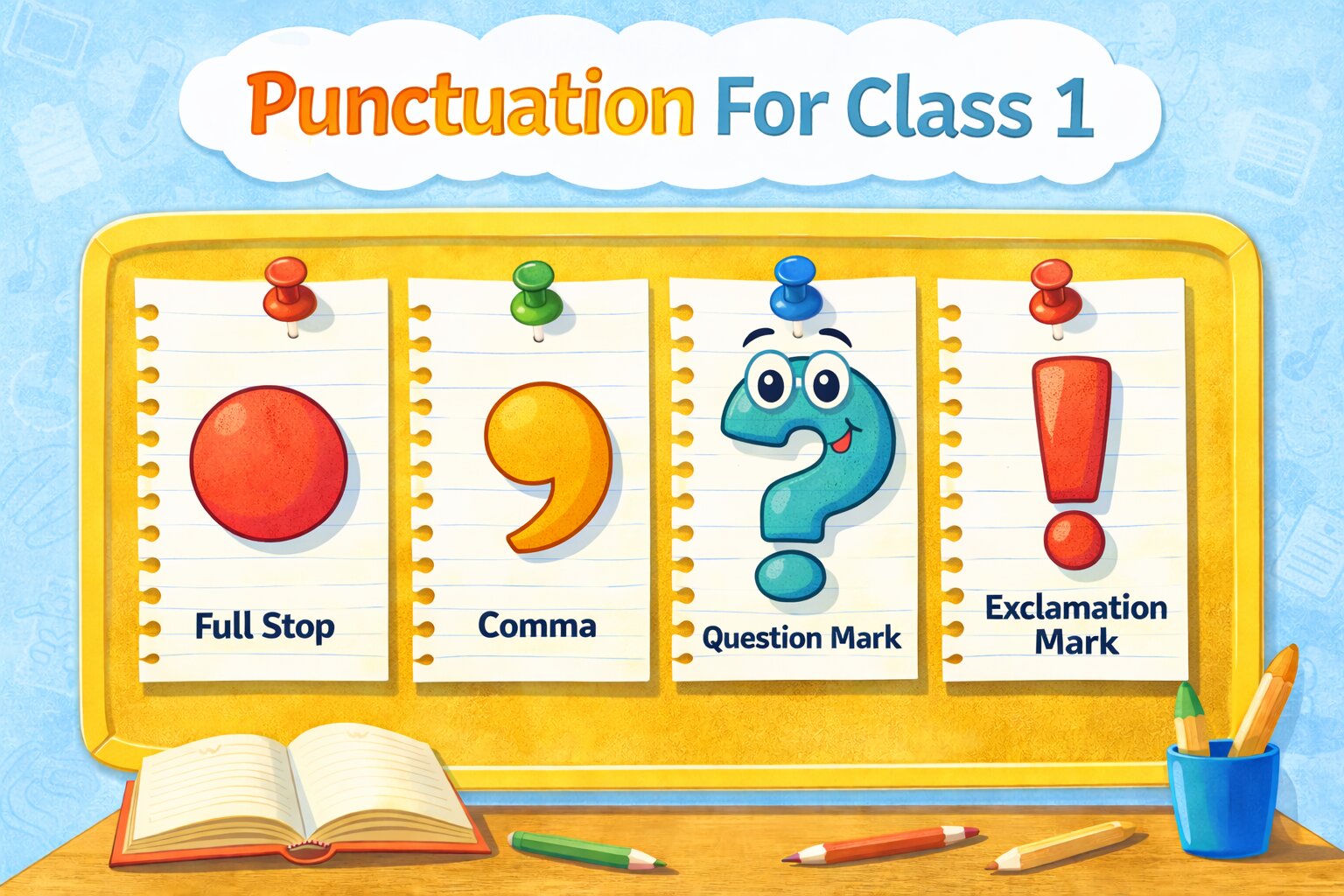
Discover simple punctuation rules here: full stops (.) end a thought, question marks (?) seek answers, exclamation marks (!) shout joy or surprise, and commas (,) offer a quick breath. Perfect for young learners, this guide includes engaging punctuation worksheets for class 1 to practise at school or at home.
With fun examples and simple steps, your child will soon write clear and lively sentences. Let’s make punctuation their new best friend!
What Is Punctuation?
This section explains the definition of punctuation for class 1 in a simple, child-friendly way. Get ready to discover how these magic marks make writing clear and exciting for young learners.
Punctuation consists of special marks used in writing to help readers understand the meaning and flow of sentences. These marks show when a sentence ends, asks a question, or expresses strong feeling. For example, a full stop (.) ends a sentence, a question mark (?) shows a question, and an exclamation mark (!) indicates excitement. Without punctuation, writing can become confusing and difficult to read.
Why Is It Important To Teach Punctuation Important To Class 1 Students?
This section explores why punctuation for grade 1 matters from the start of a child’s learning journey. Discover how it builds clear communication and confident writing skills early on.
1. Makes Writing Clear
Punctuation helps young writers separate ideas, so readers understand sentences without confusion. Without it, words jumble together like a messy puzzle.
2. Teaches Sentence Structure
Learning marks like full stops shows children where one sentence ends and another begins. This builds a strong foundation for longer stories later.
3. Expresses Emotions Properly
Exclamation marks let children show excitement or surprise, making their writing lively. It helps them share feelings in the right way.
4. Asks Questions Correctly
Question marks teach how to form and spot questions, improving conversations in reading and speaking. Children learn to seek answers clearly.
5. Encourages Good Habits Early
Starting punctuation for grade 1 now prevents bad writing habits. It makes editing fun and automatic as they grow.
6. Boosts Reading Confidence
Understanding punctuation helps children read aloud smoothly, pausing at commas and stopping at full stops. This makes books more enjoyable.
Types Of Punctuation For Class 1 With Examples
This section introduces the main class 1 punctuation marks every young learner should know. Each type comes with simple examples to make learning easy and fun.
1. Full Stop (.)
A full stop marks the end of a complete sentence. It signals the reader to pause before starting the next one.
Example: The sun is shining brightly.
If you leave out full stops, sentences run into each other, making your writing hard to follow.
2. Question Mark (?)
A question mark shows that a sentence is asking something. It helps readers know to expect an answer.
Example: What is your favourite game?
A missing question mark can make it unclear if someone is asking something or just making a comment.
3. Exclamation Mark (!)
An exclamation mark expresses strong feelings like joy or surprise. It adds excitement to words.
Example: What a beautiful rainbow!
When an exclamation mark is not used, exciting or surprising sentences lose their strong feeling.
4. Comma (,)
A comma gives a short pause between words or parts of a sentence. It separates lists or ideas clearly.
Example: I like apples, bananas, and oranges.
Leaving out commas in lists or long sentences can confuse readers about what belongs together.
Rules Of Punctuation Marks
This section outlines simple punctuation rules tailored for Class 1 learners. Follow these guidelines to use marks correctly in every sentence.
1. Use A Full Stop At The End
Always place a full stop (.) after a complete sentence that tells a fact or idea. It creates a full pause, helping readers clearly understand separate thoughts.
Example: The dog runs to the pond. It stops to drink.
2. Add A Question Mark For Questions
End every asking sentence with a question mark (?) if it seeks information. Use it for questions that start with who, what, when, where, why, or how.
Example: Where is my hat? I need it for school.
3. Use An Exclamation Mark For Strong Feelings
Place an exclamation mark (!) after sentences showing big emotions like happiness, anger, or danger.
It adds excitement and shows strong feelings in your sentence, but use it sparingly to keep writing balanced.
Example: Look out! That dog is coming this way!
4. Insert Commas In Lists
Separate items in a series of three or more with commas (,), but skip before “and” at the end. This keeps your lists clear and easy to read.
Example: I like apples, bananas, and grapes.
5. Start Sentences With Capital Letters
Begin each new sentence with a capital letter (A-Z) to mark its start. Always write the word “I” with a capital letter, no matter where it appears in a sentence.
Example: I like to read. I am happy when I get a new book.
6. Capitalise Proper Names
Write names of people, places, days, or months with capital letters wherever they appear. This highlights unique things, even in the middle of sentences.
Example: Riya goes to Delhi on Monday. She is excited to visit her grandma.
Punctuated Sentences for Class 1
This section provides ready examples of correctly punctuated sentences for young learners. Practise reading and writing them to build confidence step by step.
- The bird flies high in the sky.
- Do you like ice cream?
- What a big elephant!
- I have a red ball, a blue bag, and a green book.
- Ria plays with her friends after school.
- My friend Aarav loves to draw pictures.
- Ria plays with her friends after school.
How To Teach Punctuation to Class 1 Kids?
This section provides practical strategies for educators and parents to introduce punctuation effectively. Simple games and visuals make learning full stops, questions, and more engaging for young minds.
1. Punctuation Sorting Game
Print cards with sentences missing marks and picture icons for full stop, question mark, or exclamation mark. Children sort and stick them, saying aloud why each fit.
2. Story Time Pauses
Read a picture book, pausing dramatically at punctuation; ask kids to name the mark and mimic the pause or voice change with toys.
3. Human Sentence Chain
Give each child a word card from a sentence and have them stand in sequence. Assign one child to hold up the correct punctuation sign at the end. As a group, act out reading the full sentence with the correct ending.
4. Punctuation Treasure Hunt
Hide strips of sentences without punctuation around the room. Children search for the strips, add the correct punctuation using coloured pens, then read the sentence aloud to earn a sticker.
5. Draw And Mark Activity
Let children draw comic strips and create speech bubbles. They decide where to add question marks for surprised illustrations or commas in lists, then explain their choices to peers.
6. Song And Rhythm Method
Sing familiar nursery rhymes with children. Clap hands when a comma should be used, and stop singing briefly for full stops. Let children lead and fill in the claps or pauses themselves to reinforce the rhythm.
Punctuation Practice Worksheets For Class 1
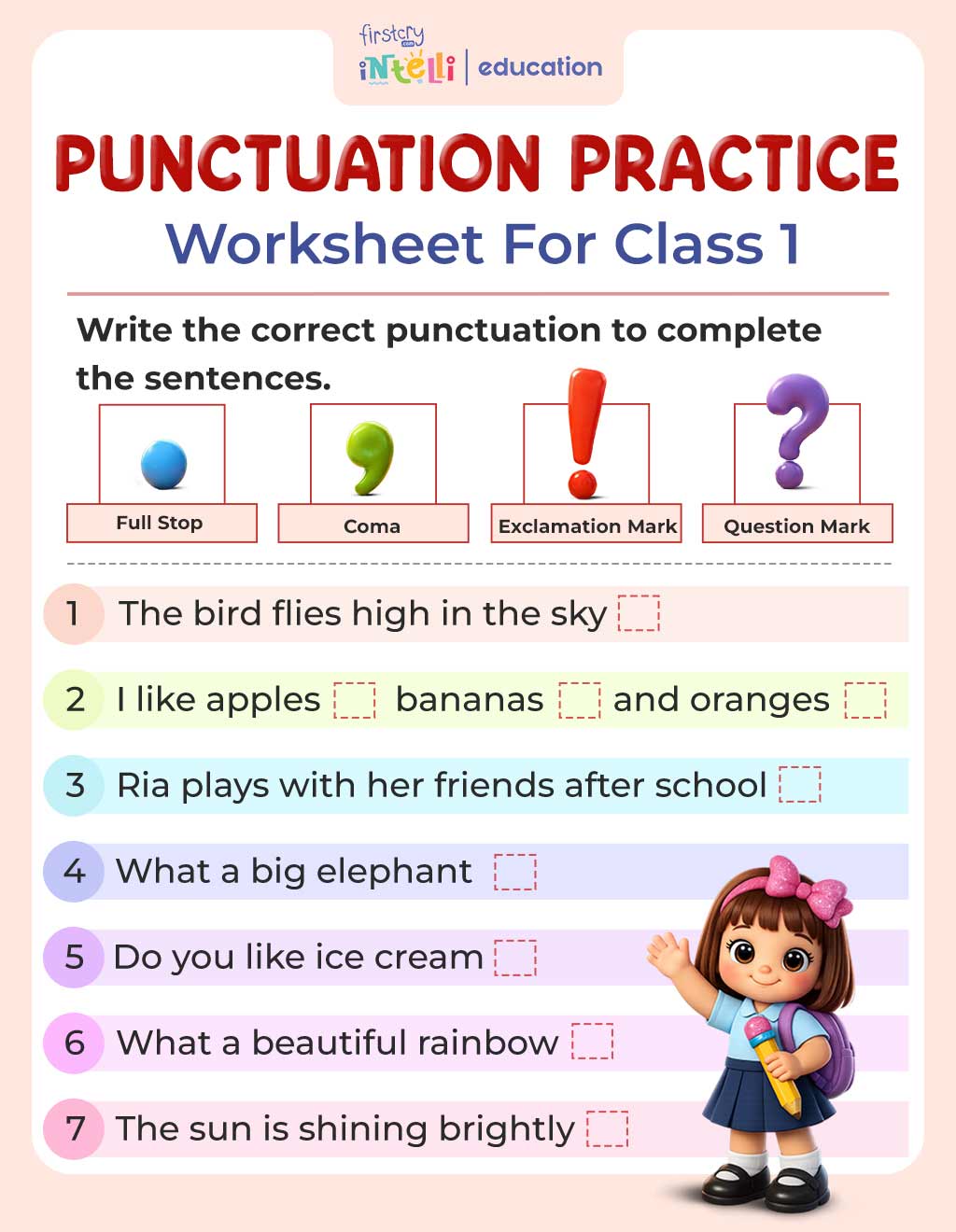
This section offers a fun punctuation exercise for class 1 through printable worksheets. If you are looking for a punctuation worksheet with answers, these activities will help. Children can add missing marks to sentences and build skills independently.
FAQs
1. Can Punctuation Change A Sentence’s Meaning?
Yes, it can! “Let’s eat, Grandma” uses a comma to invite her, but “Let’s eat Grandma” sounds scary without it. Always place marks carefully to say what you mean.
2. How Do I Spot Where Punctuation Goes?
Pause after a full idea for a full stop, raise your voice for a question mark, or feel excited for an exclamation mark. Practise saying sentences aloud to feel the right spots naturally.
3. What Are Capital Letters Used For?
Capital letters start every sentence and name special things like people (Ravi), places (school), or days (Monday). They signal new beginnings and make writing neat and proper.
4. Who Can Help Me Learn Punctuation?
Teachers show rules in class, parents read books aloud to spot marks, and friends check your writing together. Online games and the worksheets in this article make practice fun, too!
Punctuation marks are essential tools that bring clarity and fun to Class 1 writing. With types, rules, examples, and worksheets from this guide, young learners can master full stops, questions, exclamations, and more — building confident storytellers for life.
Also Read:
Sentences For Class 1
Sight Words for Class 1
Opposite Words for Class 1 Kids