



- Key Points To Remember When Writing A Speech on Rabindranath Tagore
- 10 Line Speech on Rabindranath Tagore
- 1 Minute Speech on Rabindranath Tagore
- 2 Minute Speech on Rabindranath Tagore
- 5 Minute Speech on Rabindranath Tagore
- Short Speech on Rabindranath Tagore
- Long Speech on Rabindranath Tagore
- Famous Quotes By Rabindranath Tagore
- FAQs
Whether you are preparing a speech on Rabindranath Tagore for a school assembly, a literary event, or a classroom presentation, finding the right words to honour this extraordinary figure can feel like a daunting task. Rabindranath Tagore poet, philosopher, Nobel laureate, and visionary remains one of the most celebrated minds in human history, whose wisdom transcends borders and generations.
Thank you for reading this post, don't forget to subscribe!
This collection has been thoughtfully curated to help students and children deliver the best speech on Rabindranath Tagore with confidence and eloquence. From short addresses for younger pupils to more detailed orations for senior students, every piece is crafted to inspire and inform.
If you are looking for a compelling speech on Rabindranath Tagore in English that captures his remarkable legacy his poetry, philosophy, and enduring contributions to literature and humanity you have come to precisely the right place.
Key Points To Remember When Writing A Speech on Rabindranath Tagore
Writing a good speech on Rabindranath Tagore becomes much easier when you know what to focus on. Here are some important points to keep in mind, whether you are preparing a speech on Rabindranath Tagore for classes 1, 2, and 3 or for higher classes.
- Learn the basic facts about Rabindranath Tagore’s life, including his birth, education, and achievements.
- Keep your language simple and age-appropriate for your audience.
- Begin with a strong opening line that captures your listeners’ attention.
- Mention his most notable works, such as Gitanjali, and his significance as Asia’s first Nobel laureate.
- Include his contributions to music, art, and education, not just literature.
- Keep your speech within the allotted time do not try to cover everything.
- End with an inspiring thought or quote drawn from his works or philosophy.
- Read your speech aloud once you have finished writing it to check the flow.
- Time yourself to ensure you are within the required duration.
- Make changes where sentences feel too long or difficult to say out loud.
- Practise in front of a mirror or a family member before your presentation.
10 Line Speech on Rabindranath Tagore
A 10-line speech is ideal for younger students who need a short, simple address for school events and assemblies. Here is a 10-line speech on Rabindranath Tagore that is easy to memorise and deliver with confidence.
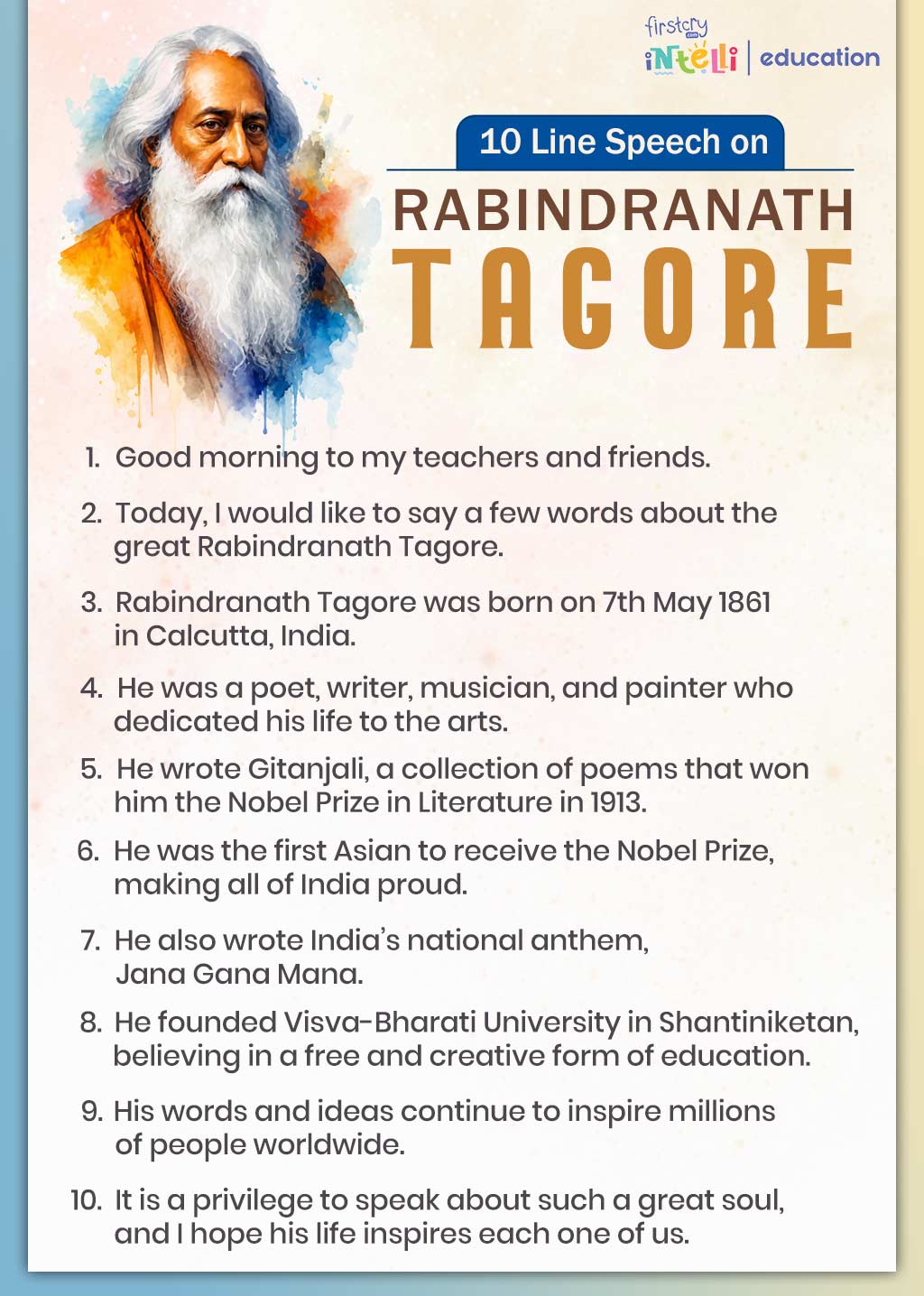
- Good morning to my teachers and friends.
- Today, I would like to say a few words about the great Rabindranath Tagore.
- Rabindranath Tagore was born on 7th May 1861 in Calcutta, India.
- He was a poet, writer, musician, and painter who dedicated his life to the arts.
- He wrote Gitanjali, a collection of poems that won him the Nobel Prize in Literature in 1913.
- He was the first Asian to receive the Nobel Prize, making all of India proud.
- He also wrote India’s national anthem, Jana Gana Mana.
- He founded Visva-Bharati University in Shantiniketan, believing in a free and creative form of education.
- His words and ideas continue to inspire millions of people worldwide.
- It is a privilege to speak about such a great soul, and I hope his life inspires each one of us.
1 Minute Speech on Rabindranath Tagore
A one-minute speech is a popular format in school competitions and classroom activities, requiring a student to speak clearly and concisely within a limited time. Here is a one-minute speech on Rabindranath Tagore that covers the key aspects of his life and legacy.
Good morning to my respected teachers and dear friends.
Today, I stand before you to speak about one of the greatest minds the world has ever known Rabindranath Tagore.
Born on 7th May 1861 in Calcutta, Tagore showed an extraordinary gift for words and music from a very young age. He went on to become a poet, novelist, playwright, composer, and painter a true Renaissance man whose talents knew no bounds.
His most celebrated work, Gitanjali, earned him the Nobel Prize in Literature in 1913, making him the first Asian to receive this honour. He also gave India its national anthem, Jana Gana Mana, a gift that resonates across the nation to this day.
Beyond his writings, Tagore founded Visva-Bharati University in Shantiniketan, where he reimagined education as a joyful and creative experience.
His philosophy of humanity, peace, and love remains as relevant today as it ever was. Let us carry his words in our hearts and his values in our actions.
Thank you.
2 Minute Speech on Rabindranath Tagore
A two-minute speech about Rabindranath Tagore in English gives students the opportunity to go beyond the basics and explore his life and contributions in greater detail. Here is a two-minute speech on Rabindranath Tagore that is well-suited for school competitions, annual functions, and classroom presentations.
Good morning to my respected teachers and dear friends.
Rabindranath Tagore was not simply a poet he was a voice for the deepest emotions of the human soul. Born into a distinguished Calcutta family in 1861, he started writing poetry as a child, and his passion for literature only grew with time.
Tagore’s genius lay in his range. He wrote over two thousand songs Rabindra Sangeet still beloved in India and Bangladesh. He painted hundreds of works later in life, proving creativity has no bounds or age.
In 1901, he founded a school in Shantiniketan based on nature, freedom, and curiosity a challenge to the rigid colonial education system. This school later became Visva-Bharati University.
Tagore was also a thinker who engaged fearlessly with the world. He returned his knighthood in 1919 as a protest against the Jallianwala Bagh massacre, demonstrating that principles must always come before privilege.
His Nobel Prize in 1913 brought Indian literature to a global stage for the very first time.
Tagore’s legacy is not just history it shows us that art, compassion, and courage can change the world. As students, we can look to him as an inspiration to value learning, creativity, and dignity.
5 Minute Speech on Rabindranath Tagore
A five-minute speech allows students to present a thorough and well-rounded account of Rabindranath Tagore’s life, works, and philosophy. Here is a five-minute speech on Rabindranath Tagore, suitable for senior students, inter-school competitions, and formal literary events.
Good morning to my respected teachers, honoured guests, and dear friends.
Today, I have the privilege of speaking about a man whose words have moved millions, whose music has stirred the soul of a nation, and whose vision continues to shape the way we think about education, art, and humanity Rabindranath Tagore.
Rabindranath Tagore was born on 7th May 1861 in Jorasanko, Calcutta, into a family that was itself a centre of intellectual and cultural life. From his earliest years, he was immersed in literature, music, and philosophy. He began writing poetry at the age of eight and, by his teenage years, had already published works that drew considerable attention.
Tagore was largely self-educated. He found the rigid structure of formal schooling stifling, and this experience would later shape his revolutionary approach to education. In 1901, he founded an experimental school in Shantiniketan, where classes were held outdoors, creativity was encouraged, and the relationship between teacher and student was built on mutual respect. This school eventually grew into Visva-Bharati University, one of India’s most distinctive institutions of higher learning.
His literary output was staggering in both volume and range. He wrote poetry, novels, short stories, essays, and plays that explored themes of love, nature, spirituality, and the human condition. His most celebrated collection, Gitanjali, was translated into English and published in 1912. The following year, it earned him the Nobel Prize in Literature the first time the prize had been awarded to an Asian writer.
Beyond literature, Tagore composed over two thousand songs, collectively known as Rabindra Sangeet, which remain deeply cherished in both India and Bangladesh. He wrote the national anthems of both nations Jana Gana Mana for India and Amar Sonar Bangla for Bangladesh — a distinction no other individual in history holds. Later in life, he also turned to painting, producing hundreds of works that were exhibited internationally and praised for their originality.
Tagore was equally fearless as a citizen. When the British colonial government massacred hundreds of unarmed civilians at Jallianwala Bagh in 1919, he renounced his knighthood in protest, declaring that titles lose their meaning when standing beside the suffering of innocent people. It was an act of remarkable moral courage at a time when few dared to speak openly against colonial rule.
His philosophy was rooted in the belief that true education must awaken the spirit rather than merely fill the mind with facts. He travelled widely, engaging with thinkers and leaders across the world, including Albert Einstein, with whom he held celebrated conversations on science, religion, and the nature of reality.
Tagore passed away on 7th August 1941, leaving behind a legacy so vast it is difficult to capture in a single speech. He showed us how to see the world with greater sensitivity, greater curiosity, and greater kindness and that, perhaps, is the finest lesson any of us can take from his extraordinary life.
Short Speech on Rabindranath Tagore
A short speech is often the most practical option for younger students or for occasions where speaking time is limited. Here is a short speech on Rabindranath Tagore that is simple, easy to remember, and suitable for students of all ages.
Good morning to my respected teachers and dear friends.
Today, I would like to speak about Rabindranath Tagore a man who is widely regarded as one of the greatest literary figures the world has ever produced.
Rabindranath Tagore was born on 7th May 1861 in Calcutta, India. From a very young age, he showed a remarkable gift for words and went on to become a poet, novelist, playwright, musician, and painter. His talents spanned so many fields that it is difficult to define him by any single one.
His most celebrated work, Gitanjali, a collection of deeply moving poems, earned him the Nobel Prize in Literature in 1913. With this honour, he became the first Asian writer to receive the Nobel Prize, bringing immense pride to India and placing Indian literature on the world stage for the very first time.
Tagore also composed over two thousand songs, known as Rabindra Sangeet, which are sung and cherished across India and Bangladesh to this day. His contribution to both nations goes even further he wrote Jana Gana Mana, India’s national anthem, and Amar Sonar Bangla, Bangladesh’s national anthem.
His commitment to education was equally remarkable. Dissatisfied with the rigid schooling of his time, he founded a school in Shantiniketan in 1901 that placed nature, creativity, and freedom at its heart. This institution later became Visva-Bharati University.
Tagore was also a man of deep principle. He returned his knighthood in 1919 to protest the Jallianwala Bagh massacre, choosing conscience over honour.
He passed away on 7th August 1941, but his words, his music, and his ideas live on. Tagore reminds us that a life devoted to truth, beauty, and compassion is a life well lived.
Long Speech on Rabindranath Tagore
A long speech is best suited for formal occasions, senior students, and events commemorating Rabindranath Tagore’s life and contributions in depth. Here is a long speech on Rabindranath Tagore that covers his life, literary achievements, philosophy, and enduring legacy in considerable detail.
Good morning to our respected Principal, dear teachers, honoured guests, and my wonderful friends. It is a true honour to stand before you today and speak about one of the most extraordinary human beings to have ever walked this earth Rabindranath Tagore.
Rabindranath Tagore was not simply a poet or a writer he was a civilisation unto himself. In a single lifetime, he produced a body of work that spanned poetry, fiction, drama, music, painting, and philosophy, touching the lives of countless people across generations and borders. To speak about Tagore is to speak about the very soul of India its traditions, its spirituality, and its unshakeable belief in the dignity of every human being.
The Life Of Rabindranath Tagore
Rabindranath Tagore was born on 7th May 1861 in the Jorasanko district of Calcutta, into a distinguished family that pulsed with intellectual energy and artistic pursuit. He showed a gift for writing at a remarkably young age, composing his first poem at the age of eight. Despite being sent to England to study law, he returned to India without completing his degree, choosing instead to pursue a career as a writer and thinker.
A period spent managing his family’s estates in rural Bengal proved deeply formative, bringing him close to the lives of ordinary villagers and the beauty of the Bengali countryside — both of which would find their way into his writing. He travelled extensively throughout his life, engaging with some of the greatest minds of his era, including Albert Einstein. He passed away on 7th August 1941 in the same house in Jorasanko where he had been born.
Rabindranath Tagore’s Contributions And Achievements
Tagore’s contributions to literature, music, art, and education are difficult to fully capture in a single address. He wrote more than 2,000 poems, 8 novels, dozens of short stories, and over 30 plays. His poetry collection Gitanjali earned him the Nobel Prize in Literature in 1913 the first ever awarded to an Asian writer bringing Indian literature to a global stage for the very first time.
In music, he composed over two thousand songs known as Rabindra Sangeet, which remain deeply cherished across India and Bangladesh. He wrote the national anthems of both nations Jana Gana Mana for India and Amar Sonar Bangla for Bangladesh a distinction no other individual in history holds.
In education, he founded an experimental school in Shantiniketan in 1901, where students learned outdoors, emphasising creativity and holistic development. This institution later grew into Visva-Bharati University, which continues to function as one of India’s most distinctive centres of learning.
His Role In Indian Culture And The Freedom Movement
Tagore was a patriot who held his nation to the highest standards of justice and truth. During the Swadeshi Movement of 1905, he was a prominent voice, writing songs that became anthems of Bengali identity and resistance. Yet he also questioned narrow nationalism, warning that blind patriotism could divide people and breed hostility.
His most powerful act of resistance came in 1919, when he renounced his knighthood in protest against the Jallianwala Bagh massacre an act of remarkable moral courage that resonated deeply across the nation.
Tagore showed us that curiosity, compassion, and courage are not abstract ideals they are choices we make every single day. As students, let us carry his legacy not merely as a chapter in a textbook, but as a living source of inspiration in everything we do.
Thank you.
Famous Quotes By Rabindranath Tagore
No speech about Rabindranath Tagore would be complete without a mention of his timeless words, which continue to resonate with people across the world. Here are some of his most famous quotes that students can draw upon to add depth and meaning to their speech.
- “You can’t cross the sea merely by standing and staring at the water.”
- “Faith is the bird that feels the light when the dawn is still dark.”
- “The butterfly counts not months but moments, and has time enough.”
- “Don’t limit a child to your own learning, for he was born in another time.”
- “If you cry because the sun has gone out of your life, your tears will prevent you from seeing the stars.”
- “The roots below the earth claim no rewards for making the treetops possible.”
- “Where the mind is without fear, and the head is held high, into that heaven of freedom, my Father, let my country awake.”
- “Love is not a mere impulse; it must contain truth, which is its law.”
- “Everything comes to us that belongs to us if we create the capacity to receive it.”
- “The highest education is that which does not merely give us information but makes our life in harmony with all existence.”
FAQs
1. How Do I Choose The Right Tone For A Speech On Rabindranath Tagore?
Since Tagore was a deeply thoughtful and sensitive figure, your tone should reflect that. Aim for a warm, respectful, and sincere delivery rather than an overly dramatic or loud one. Let the words carry the emotion naturally.
2. Should I Explain The Meaning Of Tagore’s Works In My Speech?
For younger students, it is enough to mention his works by name and describe them simply. Older students can briefly explain the themes or significance of a work like Gitanjali, but avoid going into too much detail, as it can make the speech feel like a lecture.
3. How Should I Use My Voice When Delivering The Speech?
Vary your pace — slow down when making an important point and pick up slightly during descriptive passages. Avoid speaking in a flat, monotonous tone. Pause after key statements to allow your audience to absorb what you have said.
4. What Should I Do If I Forget My Lines During The Speech?
Take a brief pause, take a breath, and try to recall the next point rather than the exact words. If you lose your place entirely, it is perfectly acceptable to rephrase the point in your own words and move on. The audience rarely notices small gaps the way the speaker does.
5. How Do I Hold The Attention Of My Audience During The Speech?
Make eye contact with different parts of the audience rather than staring at one spot. Use natural hand gestures where appropriate, stand straight, and speak clearly. An engaged, confident presence on stage draws the audience in far more effectively than the words alone.
Rabindranath Tagore’s life offers students an abundance of material to draw from whether they are stepping on stage for the first time or preparing for a competitive event. The speeches and guidance in this article are designed to make that preparation as straightforward as possible, giving every student the tools they need to speak with confidence and understanding about this remarkable figure. As Tagore himself believed, learning should be a joyful experience and delivering a speech about his life is a wonderful opportunity to celebrate one of the greatest minds the world has ever known.
Also Read:
Essay on Rani Lakshmi Bai
Essay on Rabindranath Tagore
Essay on Dr Sarvepalli Radhakrishnan