



Last Updated on April 29, 2026
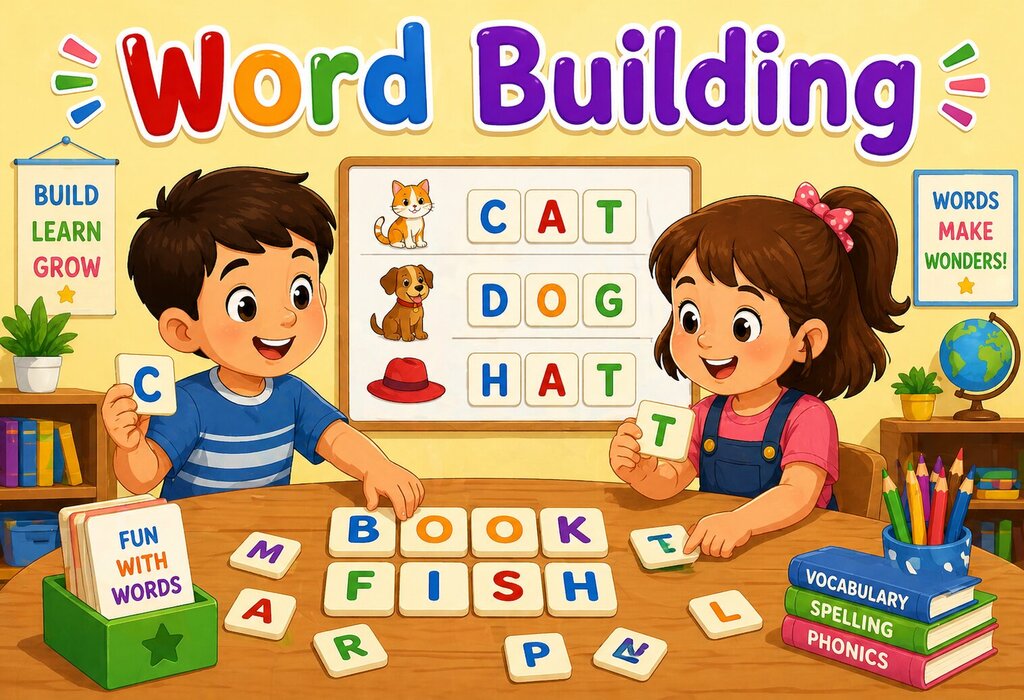
Word building in English is an essential technique that enables children to create new words by adding prefixes and suffixes to root words. This method strengthens vocabulary, improves spelling accuracy, and enhances comprehension skills.
Thank you for reading this post, don't forget to subscribe!
The article presents clear word-building examples, such as changing ‘happy’ to ‘unhappy’ or ‘happiness’, and ‘play’ to ‘player’ or ‘playful’. These illustrations demonstrate how base words expand into related forms.
Included are practical activities for word-building for classes 1, 2, and 3, including prefix identification exercises and suffix-combination tasks, along with a comprehensive worksheet for reinforcement in class or at home. Through systematic practice, pupils develop proficiency in word formation, laying a strong foundation for advanced language studies.
What Is Word Building?
Word building refers to the process of forming new words by combining root words with prefixes (such as ‘un-‘ or ‘re-‘) and suffixes (like ‘-ness’ or ‘-er’). This technique helps children understand word structure and meaning, fostering independence in reading and writing.
Word building for kindergarten is particularly beneficial, as it introduces young learners to basic word patterns through engaging, age-appropriate activities. Simple examples like turning ‘big’ into ‘bigger’ or ‘happy’ into ‘unhappy’ help children grasp the concept easily. Early exposure to word-building in kindergarten not only builds phonemic awareness and spelling confidence but also lays a strong foundation for more complex literacy skills as students progress in their education.
Benefits Of Word Building For Kids
Word building offers numerous advantages for children’s language development. This section explores how these benefits support young learners in expressing ideas clearly and confidently.
1. Enhanced Vocabulary
Word building teaches children to create new words from familiar roots, prefixes, and suffixes. This expands their word bank, enabling richer expression in speech and writing.
2. Improved Spelling Skills
By recognising patterns in word families, such as ‘play’, ‘player’, and ‘playful’, pupils gain confidence in spelling. Regular practice reduces errors and builds accuracy.
3. Better Reading Comprehension
Understanding word construction helps decode unfamiliar terms quickly. Children infer meanings from context, making reading more fluent and enjoyable.
4. Boosted Creative Writing
Word building encourages experimentation with language, like turning ‘joy’ into ‘joyful’ or ‘enjoy’. This fosters imaginative storytelling and descriptive skills.
5. Stronger Grammar Awareness
Exploring prefixes and suffixes reveals how words change function, such as nouns to adjectives. This lays a foundation for grammatical precision.
How Is Word Building Taught?
Word building is taught through structured, interactive methods that suit early learners. Teachers introduce root words first, then demonstrate how to add prefixes like ‘un-‘ or suffixes such as ‘-ful’ using visual aids, flashcards, and word webs. Hands-on activities follow, including sorting games, building mats with magnetic letters, and group challenges in which children construct families such as ‘read’, ‘reader’, and ‘reread’. Digital tools and worksheets reinforce practice, with progress tracked via simple assessments. This gradual approach ensures mastery, adapting to kindergarten through class 3 levels for optimal engagement and retention.
Simple Steps To Form A Word From Letters
Forming words from letters is a foundational aspect of word building that introduces children to the systematic blending of sounds and structures. This section outlines clear, sequential steps to guide young learners from individual letters to complete words with ease.
1. Select A Root Word
Begin by choosing a simple root word, such as ‘act’. This provides the core meaning and phonetic base, aiding word-building by establishing familiarity and preparing for the addition of a prefix or suffix in the next step.
2. Identify Prefixes Or Suffixes
Examine suitable prefixes such as ‘re-‘ or suffixes like ‘-or’ that match the root. This step logically expands options, building versatility and leading to meaningful combinations in the next step.
3. Combine Elements
Attach the prefix or suffix to the root, forming ‘react’ or ‘actor’. Hands-on blending reinforces structure recognition, boosting confidence and setting up pronunciation practice ahead.
4. Pronounce And Spell Aloud
Say the new word clearly while spelling it letter by letter. This auditory reinforcement solidifies phonics links, enhances retention, and supports a smooth transition to the exploration of meaning.
5. Explore The Meaning
Discuss the word’s definition and use in a sentence, like ‘An actor performs on stage’. This contextual application cements understanding and encourages creative use in writing or speech.
Word Building Examples
Concrete examples illustrate how root words change with the addition of prefixes and suffixes, making abstract concepts tangible for children. This section provides varied instances across common word families to inspire practice and application.
1. From Happy To Unhappy And Happiness
The word happy means feeling glad or cheerful. If you put “un-” at the beginning, you get “unhappy,” which means not glad or sad. Add -ness to the end, and you have happiness, which is the feeling of being glad. These words help you talk about different feelings.
2. Building From Play: Player And Playful
Start with play, which is something fun to do. Add -er to make player, meaning someone who plays a game or sport. Add -ful to make playful, describing someone who likes to have fun and be silly. These words show how we can talk about doing fun things and people who enjoy them.
3. Kind, Unkind, And Kindness
Kind means being gentle and caring to others. If you put “un-” before it, you get “unkind,” which means not nice or mean. Add -ness to make kindness, which means showing care and being friendly. These words help you talk about being nice or not nice.
4. Read Becomes Reader And Reread
Read means looking at words in a book. If you add -er, you get reader, which means a person who reads. Add re- at the start to make reread, which means to read something again. These words are perfect for kids who love stories!
5. Big, Bigger, Biggest
Big means something is large. Add -er to make bigger, which means larger than something else. Add -est to make the biggest, meaning the largest of all. You can use these words to compare the sizes of things, like toys or animals.
6. Act To Actor And Action
Act means to do something, like pretending in a play. Add -or to make ‘actor’, which is the person who acts in stories or on stage. Add -ion to get action, which means the things that happen in a story or game. These words are fun to use when talking about plays and movies.
7. Quick, Quickly, Quickest
Quick means moving fast. Add -ly to make quickly, which describes how something is done fast. Add -est to make quickest, meaning the fastest of all. Use these words when you talk about races or moving fast in games.
8. Teach Family: Teacher And Teaching
Teach means to help someone learn. Add -er to make teacher, which is a person who helps others learn, like at school. Add -ing to make teaching, which means helping to learn right now. These words are great for talking about school and learning together.
9. Joy, Joyful, Enjoy
Joy means a lot of happiness. Add -ful to make joyful, which describes someone who is very happy. Add “en-” at the beginning of “enjoy” to mean “to have fun” or “to feel joy.” These words are perfect for talking about fun times and happy feelings.
10. Walk, Walker, Walking
Walk means to move by taking steps. Add -er to make walker, which is someone who walks, like a person or even a pet. Add -ing to make walking, which means the action of walking right now. These words are used every day when talking about moving around.
Word Building Activities For Kids
Engaging activities make word building interactive and memorable for children, turning lessons into play. This section offers simple, home and classroom-ready ideas for practising prefixes, suffixes, and roots effectively.
1. Prefix Hunt Game
Give each child or group a set of picture cards or a book. Ask them to look for words that begin with prefixes like ‘un-‘ or ‘re-‘. As they find words, have them write each one down and share what the prefix means in that word. This activity helps everyone spot and understand prefixes while having fun searching.
2. Suffix Snap Cards
Make two sets of cards: one with root words and one with suffixes. Spread them out face down. Kids take turns flipping over a root and a suffix card, trying to make a real word (like ‘play’ + ‘-er’ = ‘player’). If they get a match, they keep the pair. The player with the most pairs at the end wins. This game makes learning suffixes fast and fun!
3. Word Family Trees
Give each child a paper and ask them to draw a big tree. Write the root word on the trunk. Then, on each branch, write a new word made from the root, like ‘happy’, ‘unhappy’, and ‘happiness’. Encourage them to colour the tree and label each word. This colourful map will help them remember how the words are connected.
4. Build-A-Word Mats
Provide each child with a mat containing spaces for a root word, a prefix, and a suffix. Use letter tiles or cards for the prefixes, roots, and suffixes. Kids build new words by placing tiles in the right spaces, then say the word out loud. This hands-on activity helps with spelling, reading, and correctly saying new words.
5. Story Word Chain
Begin with a simple sentence using a root word, like ‘I play.’ The next child adds a new word by using a prefix or suffix, such as ‘The player runs.’ Continue around the group, with each child adding their own sentence using a new word in the family. This activity gets everyone thinking creatively and using new words in stories together.
6. Matching Worksheet Relay
Split the class into teams and give each team a worksheet with three columns: root words, prefixes/suffixes, and full words. Teams race to draw lines connecting roots and affixes to form real words, then match them to the correct full words. The fastest team with all correct matches wins. This relay helps everyone learn by working together and thinking fast.
Word Building Worksheet To Help Kids Practice
Worksheets provide focused practice for word building, including a handy word-building list for reference, allowing children to apply skills independently or in class. This section describes a simple, printable worksheet featuring varied exercises to effectively reinforce learning.
FAQs
1. What Tools Help With Word Building?
Use flashcards, letter tiles, or drag-and-drop word apps. These make practice fun and let you try combinations at your own speed.
2. How Often Should I Practise Word Building?
Try 10-15 minutes daily, like during playtime or homework. Short sessions help you remember better without feeling tired.
3. How Can Parents Help At Home?
Read books together, underline word families, and play ‘add a bit’ during dinner. Praise efforts to keep practising exciting.
4. Does Word Building Help With Poems?
Yes! Use families like ‘sing/singer/singing’ to rhyme and describe. It makes poems flow better and sound musical.
Word building helps children use English more effectively by creating new words from roots, prefixes, and suffixes. The examples, activities, and worksheet in this article support practice for kindergarten to class 3. Use them often to improve spelling, reading, and writing. Start today for steady progress.
Also Read:
Spelling Rules for Kids
Vocabulary Words for Kids
High Frequency Words for Children