



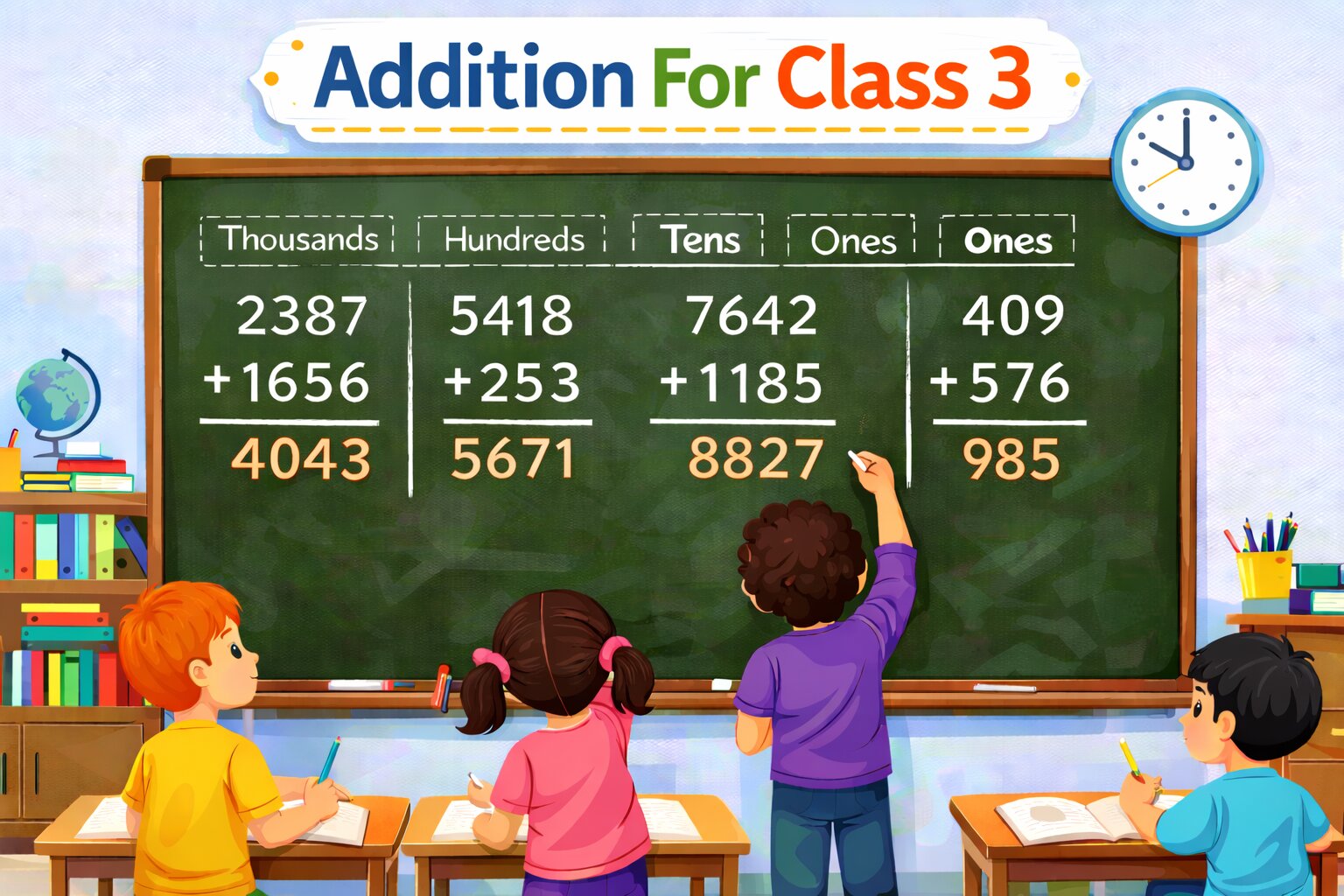
Class 3 Addition builds on the basics children have already learned, helping them work confidently with larger numbers. At this stage, students begin to add three‑digit numbers, solve simple word problems, and understand the idea of carrying in a more structured way. This section focuses on addition sums for class 3, with clear, step‑by‑step examples that make the process easy to follow and repeat.
Thank you for reading this post, don't forget to subscribe!
You will also find a ready‑to‑use addition worksheet for class 3 that includes a mix of direct sums and short stories to strengthen problem‑solving skills. For extra practice, the plus sums for class 3 in this section are designed to be fun, familiar, and just hard enough to keep young learners thinking without feeling overwhelmed. This introduction aims to help parents and teachers guide class 3 students smoothly from simple addition to more confident mental and written work.
Simple Addition for Class 3
Simple addition for class 3 helps children strengthen their basic addition skills before moving on to bigger numbers. This section focuses on easy sums and clear steps so students can confidently add sums for class 3 with speed and accuracy.
1. 124+135 = 259
Add the ones first: 4+5=9, then tens: 2+3=5, then hundreds: 1+1=2. This shows how to add three‑digit numbers step by step, writing each digit as you go.
2. 231+142 = 373
Start from the right: 1+2=3, then 3+4=7, then 2+1=3. This teaches class 3 kids to add each column one by one, in the same way every time.
3. 305+217 = 522
Ones: 5+7=12, write 2 and carry 1; tens: 0+1+1=2; hundreds: 3+2=5. This introduces carrying in a simple way, showing that only the next column changes.
4. 76+23 = 99
Ones: 6+3=9, tens: 7+2=9. This two‑digit example helps class 3 kids practise adding without carrying and understand column‑wise addition.
5. 58+47=105
Ones: 8+7=15, write 5 carry 1; tens: 5+4+1=10. This shows how a two‑digit plus sum can give a three‑digit answer when there is carrying.
Addition With Carrying
Addition with carrying shows how to add numbers when a column total is 10 or more. This section explains the idea in simple steps so children can handle addition for 3rd class with confidence.
1. What Carrying Means
When the sum in a column is 10 or more, we write the ones digit and carry the tens to the next column.
Example: in 56+37, ones: 6+7=13, write 3 and carry 1; tens: 5+3+1=9; answer is 93.
2. Carrying In Two‑Digit Numbers
Carrying can happen in the ones column while adding two‑digit numbers.
Example: 48+35; ones: 8+5=13, write 3 carry 1; tens: 4+3+1=8; answer 83.
3. Carrying Across Tens And Hundreds
Three‑digit addition may carry from ones to tens and then from tens to hundreds.
Example: 218+196; ones: 8+6=14, write 4 carry 1; tens: 1+9+1=11, write 1 carry 1; hundreds: 2+1+1=4; answer 414.
4. Carrying Only In One Column
Sometimes only one column needs to be carried, which helps children focus on that step.
Example: 324+158; ones: 4+8=12, write 2 carry 1; tens: 2+5+1=8; hundreds: 3+1=4; answer 482.
5. Always Write And Carry Step By Step
When adding with carrying, children should always add column by column from right to left and clearly write the carried digit above the next column.
Example: 176+259; ones: 6+9=15, write 5 carry 1; tens: 7+5+1=13, write 3 carry 1; hundreds: 1+2+1=4; answer 435.
This routine helps kids master addition with carrying safely and neatly.
Addition Without Carrying
Addition without carrying helps class 3 students add numbers in which each column total stays at 9 or less. This section focuses on simple two‑digit and three‑digit sums to help children build speed and accuracy before moving to carrying.
1. What Addition Without Carrying Means
In addition without carrying, the total in each column (ones, tens, hundreds) is always 9 or less, so nothing is carried to the next column.
Example: 34+25; ones: 4+5=9; tens: 3+2=5; answer 59.
2. Two‑Digit Addition Without Carrying
Two‑digit sums are easiest when there is no carry, so that children can focus on place value and neat columns.
Example: 43+26; ones: 3+6=9; tens: 4+2=6; answer 69.
3. Three‑Digit Addition Without Carrying
Three‑digit addition without carrying follows the same rule: add each column from right to left with no extra digit to carry.
Example: 123+245; ones: 3+5=8; tens: 2+4=6; hundreds: 1+2=3; answer 368.
4. Mixing Two‑Digit And Three‑Digit Numbers
Children can also add a two‑digit number to a three‑digit number without carrying when all column totals are small.
Example: 142+35; ones: 2+5=7; tens: 4+3=7; hundreds: 1+0=1; answer 177.
5. Why Practising Without Carrying Is Helpful
Practising sums without carrying helps Class 3 students become confident with column‑wise addition before they encounter carrying.
Example: 216+132; ones: 6+2=8; tens: 1+3=4; hundreds: 2+1=3; answer 348.
These neat sums build speed and accuracy for later addition in the 3rd class.
Addition Word Problems for Class 3
Addition word problems for class 3 help children use adding in real‑life situations. This section includes addition sums for class 3 with answers so students can practise and check their work quickly and easily.
- Riya has 48 stickers, and her friend gives her 35 more. How many stickers does Riya have now?
Ones: 8+5=13, write 3 carry 1; tens: 4+3+1=8; answer 83 stickers. - A toy shop sold 127 toy cars on Monday and 146 toy cars on Tuesday. How many toy cars were sold in two days?
Ones: 7+6=13, write 3 carry 1; tens: 2+4+1=7; hundreds: 1+1=2; answer 273 toy cars. - There are 214 red balloons and 158 blue balloons at the party. How many balloons are there altogether?
Ones: 4+8=12, write 2 carry 1; tens: 1+5+1=7; hundreds: 2+1=3; answer 372 balloons. - A school library has 325 storybooks and buys 147 more. How many storybooks are there now?
Ones: 5+7=12, write 2 carry 1; tens: 2+4+1=7; hundreds: 3+1=4; answer 472 storybooks. - Rohan has 136 marbles, and his sister adds 248 more. How many marbles do they have in total?
Ones: 6+8=14, write 4 carry 1; tens: 3+4+1=8; hundreds: 1+2=3; answer 384 marbles. - A fruit seller kept 215 apples in one box and 176 apples in another. How many apples are there in total?
Ones: 5+6=11, write 1 carry 1; tens: 1+7+1=9; hundreds: 2+1=3; answer 391 apples. - A farmer grew 248 carrots in one field and 139 in another. How many carrots did the farmer grow altogether?
Ones: 8+9=17, write 7 carry 1; tens: 4+3+1=8; hundreds: 2+1=3; answer 387 carrots. - A school has 234 students on one bus and 158 on another. How many students are travelling in both buses?
Ones: 4+8=12, write 2 carry 1; tens: 3+5+1=9; hundreds: 2+1=3; answer 392 students. - Sita collected 167 flowers, and Gita collected 224 flowers. How many flowers did they collect together?
Ones: 7+4=11, write 1 carry 1; tens: 6+2+1=9; hundreds: 1+2=3; answer 391 flowers. - A pet shop has 145 puppies and 239 kittens. How many pets are there in the shop?
Ones: 5+9=14, write 4 carry 1; tens: 4+3+1=8; hundreds: 1+2=3; answer 384 pets.
Fun Ways To Learn Addition
Learning addition can be playful and easy with simple games and everyday activities. These fun methods help Class 3 kids build speed and confidence while enjoying maths.
1. Storytime Addition
Children listen to or create short stories in which numbers are added, such as “Riya had 5 apples and got 3 more.” This helps them connect addition to real situations and improves number sense in a fun way.
2. Count And Move Game
Kids move around, counting steps, claps, or jumps, and then adding them together. Active counting strengthens mental addition and keeps children engaged while learning.
3. Object Grouping Challenge
Students group small objects, such as buttons, blocks, or crayons, into two or more piles and then add the piles. Hands‑on grouping builds understanding of number combinations and place value.
4. Addition Relay Race
In teams, each child solves one part of an addition problem and passes the answer to the next teammate. Timed relays build speed, teamwork, and confidence with sums.
5. Drawing Number Houses
Children draw houses with windows or doors labelled with numbers and find the total by adding them. Visual drawing supports memory and makes repeated practice enjoyable.
Addition Tips And Tricks for Class 3 Students
Addition tips and tricks make adding numbers quick and easy for Class 3 students. These simple strategies help children solve sums faster, build confidence, and enjoy maths more.
1. Start With Small Numbers
Begin by adding numbers within 10 or 20 so children can visualise and count easily. This builds confidence and a strong foundation before moving to larger sums.
2. Use Real‑Life Examples
Relate addition to everyday situations, such as fruits, toys, or books. Connecting maths to familiar contexts makes the concept clearer and more meaningful.
3. Practice Daily For Short Durations
Do 5–10 minutes of focused addition practice every day, rather than long, tiring sessions. Short, regular practice improves recall and keeps children interested.
4. Encourage Mental Math
Ask children to solve simple sums in their heads before using fingers or paper. Building mental calculation skills supports speed and confidence in class.
5. Celebrate Every Small Win
Praise correct answers, neat work, or even honest attempts. Positive reinforcement reduces fear of mistakes and motivates children to keep trying.
Practice Addition Worksheet For Class 3
The practice addition worksheet for Class 3 gives children plenty of sums to build speed and accuracy. It can be paired with an addition chart for class 3 to help students visualise patterns and check their answers easily.
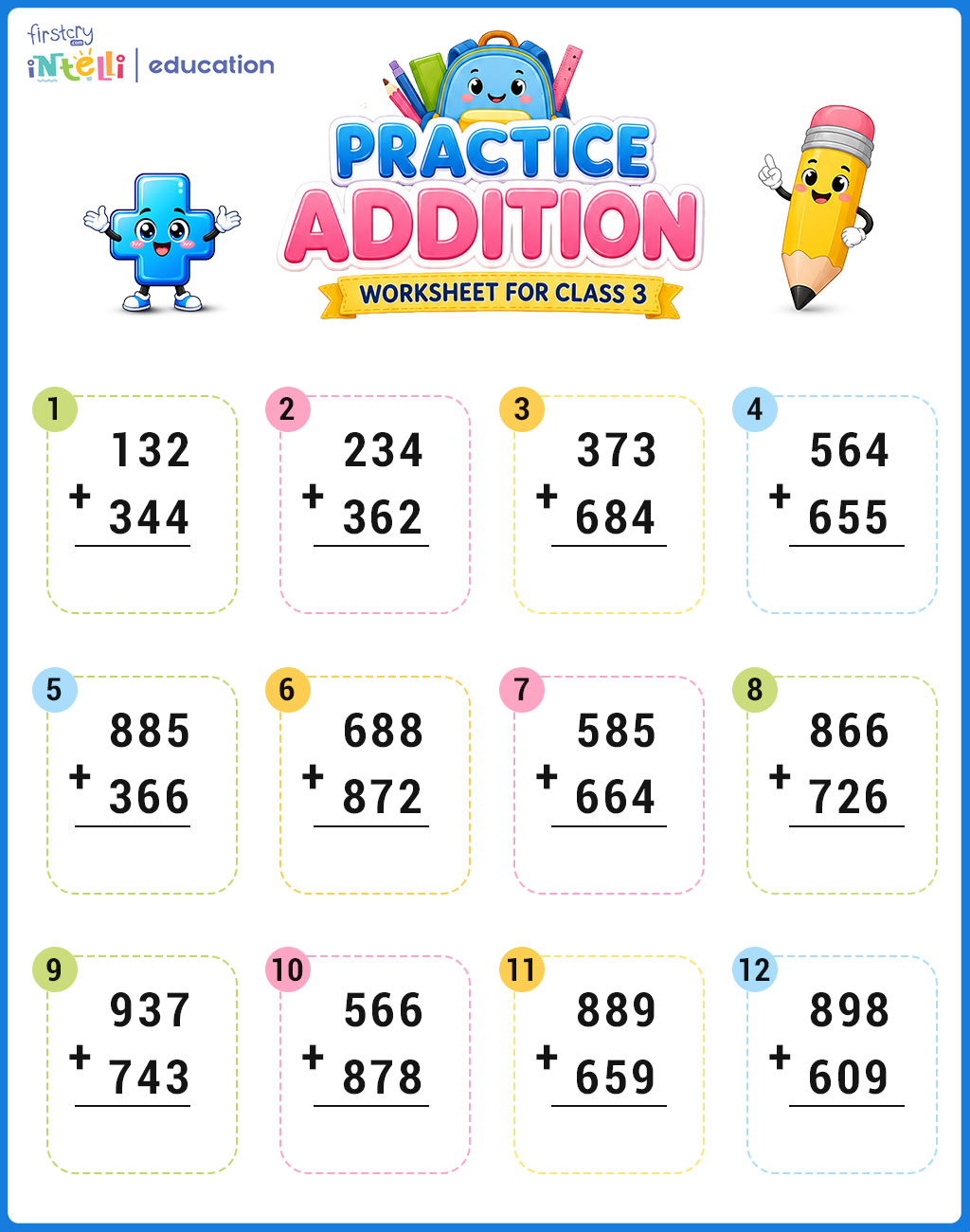
Maths addition for Class 3 lays a strong foundation for all future maths learning. With clear sums, relatable examples, and a practice worksheet, children can build speed, confidence, and a real understanding of how numbers come together.
Also Read:
Number Sense for Kids
Counting Activities for Preschoolers
Pre-Math Concepts for Preschoolers and Kids