



Father’s Day is the perfect occasion to pause and celebrate the men who shaped us — and what better way to honour them than through the power of storytelling? Whether tender or humorous, heartbreaking or uplifting, dad stories have a unique ability to capture the essence of fatherhood in all its wonderful complexity.
Thank you for reading this post, don't forget to subscribe!
In this special collection of stories about fathers, we invite you to journey through a tapestry of memories, lessons, and defining moments shared between fathers and their children. Each Father’s Day story reminds us that dads come in many forms — the quietly dependable, the boisterously fun, the endlessly patient — yet all leave an indelible mark on the lives they touch.
So whether you are reading this beside your father or holding his memory close, we hope these Happy Father’s Day stories move you, resonate with you, and remind you just how extraordinary ordinary dads truly are.
Story Behind Celebrating Father’s Day
Have you ever wondered how Father’s Day became the beloved celebration it is today? The story about Father’s Day is a fascinating tale of love, perseverance, and one daughter’s heartfelt mission to honour fathers everywhere.
The origins of Father’s Day trace back to the early 20th century in the United States, and the story begins with one woman’s love for her father. Sonora Smart Dodd grew up in Washington State, raised alongside five siblings by her father, William Jackson Smart, a Civil War veteran who became a single parent after his wife died in childbirth. He brought up his six children alone, working hard to provide for them and keep the family together.
In 1909, whilst attending a Mother’s Day sermon at her local church, Sonora had a simple but powerful thought — if mothers deserved a day of recognition, fathers did too. She brought her idea to the Spokane Ministerial Alliance and the YMCA, making the case for an official day to honour fatherhood.
Her efforts paid off on the 19th of June 1910, when Spokane, Washington, held what is widely regarded as the first ever Father’s Day celebration. Sonora chose June in honour of her father’s birth month.
The road to national recognition, however, was not straightforward. For decades, Father’s Day remained an informal observance, with many people dismissing it as a commercial exercise. It was not until 1972 — over sixty years after Sonora first campaigned for the idea — that President Richard Nixon signed Father’s Day into law as a permanent national holiday in the United States, to be celebrated on the third Sunday of June each year.
Sonora lived to the age of 96 and saw her idea become a celebration observed around the world. Her story is a reminder that behind most great traditions, there is usually one determined person who believed something was worth fighting for.
Today, Father’s Day is marked in countries across the globe, each with its own traditions and customs. But at its core, it remains what Sonora intended — a straightforward opportunity to acknowledge the fathers and father figures who give a great deal of themselves, often without recognition or fanfare.
Inspiring Stories About Fathers
This collection of real and heartfelt accounts is sure to resonate with readers of all ages, whether you are searching for a touching Father’s Day story in English or want to celebrate the men who raised us. We have also included plenty of funny stories about fathers that will have you chuckling in recognition.
1. The Hike That Was “Just Around the Corner”

It was Dad’s idea to go hiking.
“It will be fun,” he said, spreading a map across the kitchen table with great enthusiasm. “Fresh air, open sky, good exercise. We will be back before lunch.”
They were not back before lunch.
By mid-morning, the family had walked in what felt like a very large circle and arrived back at the same large rock they had passed an hour ago. Dad studied the map carefully. He turned it around. He turned it around again.
“Are we lost?” asked eight-year-old Ines.
“We are not lost,” said Dad. “We are taking the scenic route.”
“The scenic route goes past the same rock twice?” asked Ines.
Dad looked at the rock. The rock offered no helpful information.
They pressed on. Dad led them up a hill that he said was a shortcut on the map. At the top of the hill, there was no shortcut. There was another hill.
Ines’s little brother, Theo, sat down on the path and announced that his legs had stopped working. Dad lifted him onto his back and carried him for the next twenty minutes, still holding the map, which was now slightly crumpled and had a muddy thumbprint on one corner.
At half past one, they came out of the trees onto a road that Dad recognised immediately. “There we go,” he said, trying very hard to sound calm even though he was very relieved. “Exactly where I knew we would end up.”
“You said we would be home before lunch,” said Ines.
“I said we would come out here before lunch,” said Dad.
“You definitely did not say that.”
“I definitely did,” said Dad.
They stopped at a small roadside café and ordered hot drinks and something to eat. Dad had two helpings and declared it the greatest hike he had ever been on. Ines and Theo looked at each other and then nodded. It actually had been quite a good day.
On the drive home, Ines tried to read the map to figure out where they had gone wrong. She studied it for a long time.
“Dad,” she said finally. “I think you were holding this upside down the entire time.”
Dad looked at the map. He turned it around. He stared at it.
“Oh,” he said quietly.
Theo woke up just long enough to hear this, burst out laughing, and fell straight back asleep. Ines laughed too, and then Dad laughed, and soon all three of them were laughing together in the car.
When they got home, Dad stuck the map on the fridge. Underneath it, he wrote in big letters: THE GREATEST HIKE EVER. Ines added in smaller letters: MAP WAS UPSIDE DOWN THE WHOLE TIME. Dad saw it, smiled, and left it exactly where it was.
2. The Day Dad Wore the Costume
It was the school’s annual book character day, and every child was supposed to come dressed as a character from their favourite book.
Aria had spent weeks planning her costume. She was going to be a brave explorer from her favourite adventure story — a wide hat, a little canvas bag, a notebook tucked under her arm. It was exactly right.
What Aria had not planned for was her dad deciding to dress up, too.
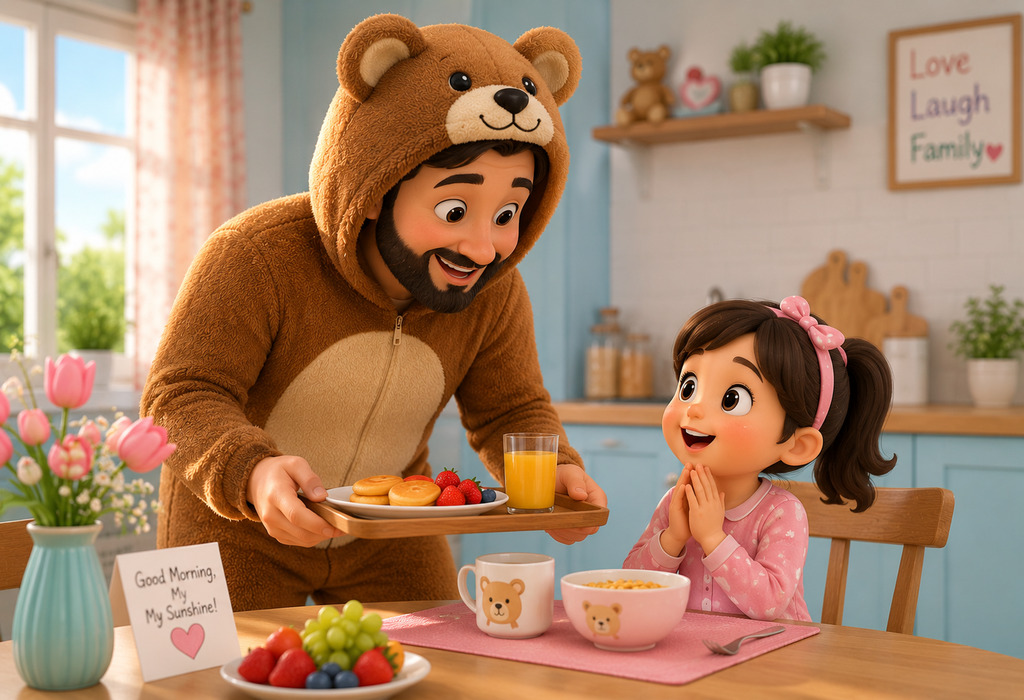
“I thought it would be fun,” he said, appearing at the breakfast table in a full bear costume — round ears, fuzzy belly, and an enormous brown nose. He spread his arms wide. “The bear from your story! We match!”
Aria stared at him.
“You are dropping me at school,” she said slowly.
“I know,” said Dad, sitting down and reaching for his cup of tea. One bear ear flopped forward. He pushed it back.
“In that costume,” said Aria.
“In this costume,” said Dad happily.
Aria spent the entire journey to school sliding down in her seat. When they pulled up outside, she could already see other parents dropping their children off in perfectly normal clothes.
“Dad,” she said firmly. “Please just stay in the car.”
“Absolutely,” said Dad. He got out of the car.
He gave a small bear wave to nobody in particular. Three children on the pavement turned around. Two of them pointed. One of them started laughing.
Aria’s best friend, Priya, came running over. “Is that your dad?” she said.
“No,” said Aria.
“HAVE A WONDERFUL DAY, ARIA,” called Dad, doing a slow bear walk along the pavement.
Priya looked at Aria. “That is completely your dad.”
But then the children who had been pointing started gathering around Dad, asking about the costume, pulling the bear ears, telling him which character they had come as. Dad listened to every single one of them, asked them questions about their books, and made each one feel like the most important person there.
After school, Dad was waiting by the gate. He had changed out of the costume but was still wearing the bear ears without realising. A few children walking past glanced at him. One small boy gave him a thumbs-up. Dad gave a thumbs-up back, very seriously.
Aria walked up to him. “Four people told me you were the best dad at school today,” she said.
Dad looked genuinely delighted. “Four whole people?”
“Four,” said Aria. “I counted.”
Dad put his arm around her shoulders, and they walked to the car together. When they got home, Aria told Mum the whole story — the costume, the bear walk, the bear ears that were still on Dad’s head right now. Mum laughed. Dad took a bow. Aria shook her head, but she was smiling too, and the three of them sat at the kitchen table laughing about it all through dinner.
3. The Recipe in the Drawer
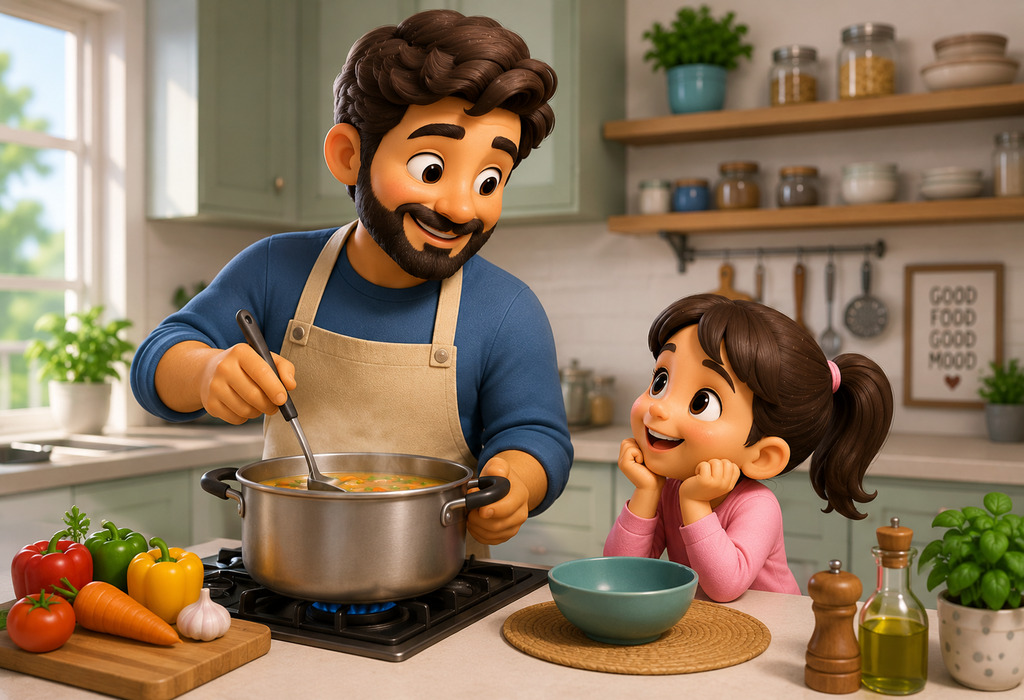
Every Sunday, Eli’s dad made soup.
Not just any soup. His father’s soup. His grandfather’s soup before that. A recipe that had been passed down so many times that the card it was written on had gone soft at the corners, and the handwriting had faded so much that it was hard to read in places.
Dad kept it in the kitchen drawer, tucked carefully inside a small envelope.
One Sunday, when Eli was seven, his dad lifted him onto the counter and said, “Today you are going to help me.”
Eli had never been allowed to help before.
Dad brought out the old recipe card and laid it flat. Together, they read through it slowly. Some of the words were difficult to make out. Dad leaned in and squinted at one particular line for a long moment.
“What does that say?” Eli asked.
“I have been making this soup for twelve years,” said Dad, “and I still cannot tell. I think it says a pinch of something. I add a pinch of everything and hope for the best.”
Eli chopped the vegetables — slowly and carefully, with Dad’s hand resting over his. He stirred the pot when Dad told him to stir. He added the mysterious pinch. He stood on his tiptoes to smell the steam rising, and it smelled warm and delicious, just like every Sunday he could remember.
When the soup was ready, they sat down together and ate.
“Did your dad teach you this?” Eli asked.
“His dad taught him,” said Dad. “And now I am teaching you.”
Eli smiled at that. He liked the idea that this same soup had been made by so many people in his family, all the way back to someone he had never met but was still connected to.
After lunch, Dad washed the pot and handed Eli the old recipe card to put back in the envelope.
Eli looked at it carefully. The faded handwriting. The soft corners. The mysterious word that nobody had ever managed to read.
“What if I figure out what it says one day?” he said.
“Then you will know something the rest of us never did,” said Dad.
Eli put the card back in the envelope and placed it carefully in the drawer. Then he pulled up a stool, sat down, and said, “Can we make it again next Sunday?”
“Every Sunday,” said Dad. “That is the deal.”
And that is exactly what they did. Every Sunday after that, Eli and his dad stood in the kitchen together and made the soup. Eli got better at chopping the vegetables. He learned when to stir and when to leave it alone. He never did figure out the mysterious word on the recipe card. But he decided that was perfectly fine, because the soup always tasted wonderful, and making it with his dad was the best part of the whole week.
4. The Worst Treehouse in the World
Dad built the treehouse in the spring, when the evenings were long, and he had a solid plan and plenty of confidence.
But when the treehouse was finished, it did not look quite the way Dad had planned.
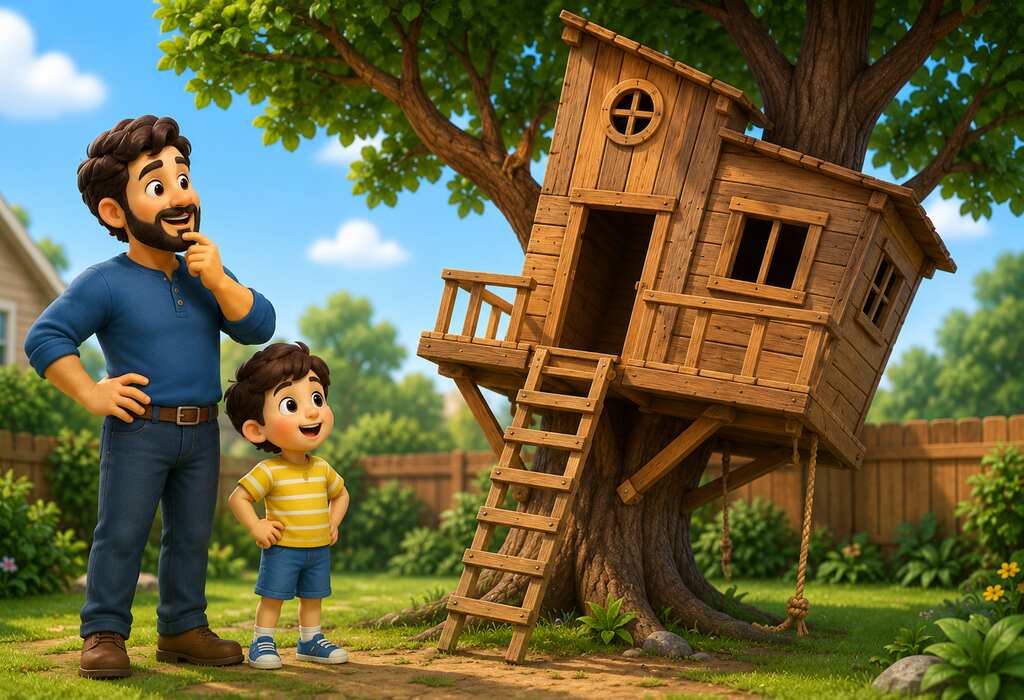
It leaned slightly to one side. One wall was taller than the other three, and Dad could not really explain why. The roof had a narrow gap running along the middle that let in a thin strip of sky. Dad called it a skylight. On rainy days, water dripped through it, which was less helpful. The ladder had seven rungs going up and, for some reason, only six coming down.
“It has character,” said Dad, standing back to look at it with his hands on his hips.
“It has a hole in the roof,” said his daughter Noa.
“That is the skylight,” said Dad.
Noa climbed up and sat inside. The floor was solid. The walls kept out the wind. Through the gap, she could see a strip of sky and the tree’s branches shifting gently overhead.
She sat there quietly for a long time.
After a while, Dad climbed up and sat beside her. They looked out through the small, lopsided window at the garden below without saying much.
“I know it is not perfect,” said Dad eventually.
“I like it,” said Noa. And she meant every word.
She spent more time in that treehouse than anywhere else that summer. She read there. She ate her lunch there. She brought her best friend up to see it, and her best friend said it was the finest treehouse she had ever set foot in, which was very kind.
One evening near the end of summer, Dad climbed up to find Noa already there, reading, a blanket pulled around her shoulders.
“Room for one more?” he said.
She moved over, and he sat down beside her. They looked out through the small, lopsided window at the garden below. The sun was going down, and everything looked warm and golden.
“I think it is actually a good skylight,” Noa said, looking up at the gap in the roof.
“I think so too,” said Dad.
Noa smiled. “It is my favourite place,” she said. “I love it.”
Dad smiled back. “I am very glad,” he said. “I built it just for you.”
Noa leaned against his arm, and they sat there together until it got dark and Mum called them in for dinner. And even then, Noa did not really want to leave.
5. Dad Always Cried at the Films
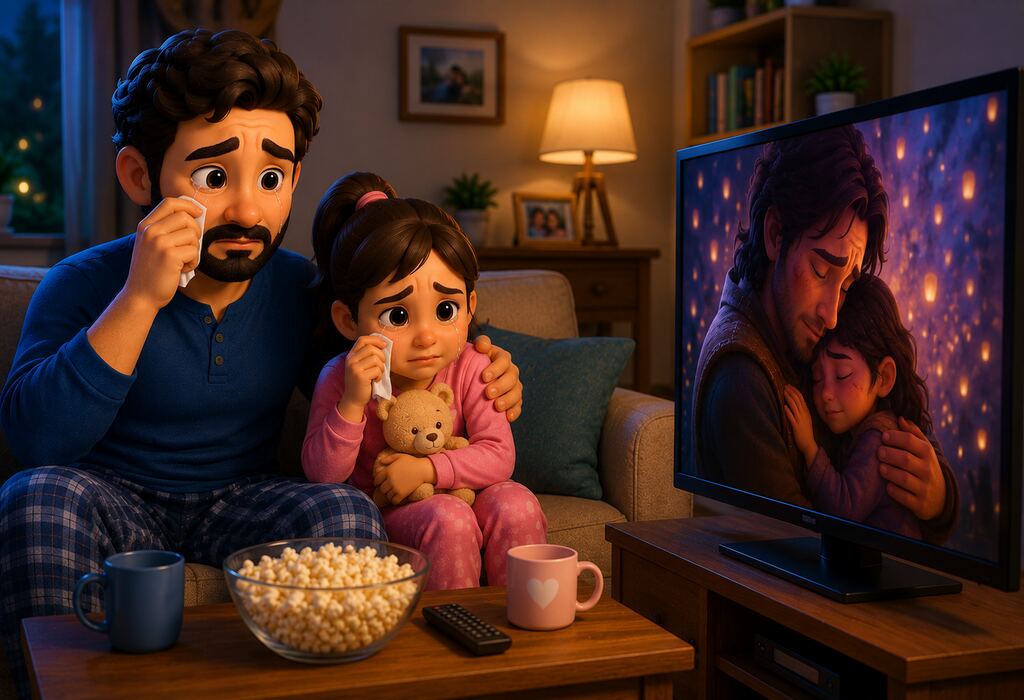
Everyone in the family knew it. Dad cried at films.
Not just sad films. Any film. He cried at the end of animated movies when the characters said their goodbyes. He cried at the part in the adventure story where the lost child finally found his way home. He once cried at a short clip of a dog being reunited with its owner that lasted less than a minute.
“Dad,” said his son Remi one evening, passing him a tissue during a particularly moving scene. “It is an animated fish.”
“He just wants to find his family,” said Dad, taking the tissue.
“He finds them,” said Remi. “Every single time. We have watched this four times.”
“I know,” said Dad, wiping his eyes. “It still makes me sad for him.”
Remi did not understand it. His dad was not someone who made a fuss about things. He was calm and steady. He fixed things when they broke. He found solutions when things went wrong. Watching him cry at a cartoon was very surprising to Remi.
One evening, Remi asked him about it.
“How come you cry at films but not at real things?” he said.
Dad thought about it carefully before he answered.
“I think,” he said slowly, “it is because films remind me of things I love. Home. Family. People finding their way back to each other. When I watch those things in a film, it makes me feel very happy and a little bit emotional at the same time.”
Remi nodded. That made sense.
The following weekend, they watched a new film together. Within the first twenty minutes, a small dog on-screen was separated from its owner during a rainstorm.
Remi looked over at his dad. His dad was already reaching for the tissues.
Remi looked back at the screen. The dog was very small. The rain was very heavy. The dog looked very sad indeed.
Remi reached over and took a tissue for himself.
His dad looked at him. Remi looked at his dad.
“The dog is very small,” said Remi.
“He is,” said Dad.
“And the rain is very heavy,” said Remi.
“It is,” said Dad.
They both turned back to the screen and watched the rest of the film together, each with their own tissue, side by side on the sofa. The dog did find his way home in the end, which made both of them very happy. Dad cheered. Remi cheered too. And from that day on, watching films together was one of their favourite things to do.
6. The Night Shift

Soren’s dad worked the night shift.
This meant that when Soren woke up in the morning, his dad was only arriving home. When he came back from school in the afternoon, his dad was sleeping. By the time dinner was over and bedtime came around, his dad was putting on his coat and heading out into the dark.
Some mornings, Soren came downstairs and found a small note on the table. Not a long one. Just a few words in his dad’s careful handwriting. “Good morning. Sleep well? I made you something for breakfast — it is on the stove.” Or sometimes: “Have a good day. I will see you soon.”
Once he found a small drawing tucked beside his glass — a sketch of the two of them sitting together on the front steps, tiny and simple but easy to recognise. Soren put it on his bookshelf.
On the mornings when his dad had not yet gone to sleep, Soren would find him sitting at the kitchen table in his coat, tired but happy to see him. Those mornings, they did not talk very much. Soren would eat his breakfast, his dad would drink his tea, and they would sit together in the quiet of the early morning while the rest of the house slowly woke up.
“You do not have to wait up,” Soren told him one morning.
“I know,” said his dad. “But I like to see you before you go to school.”
He always waited anyway.
A few weeks later, Soren came downstairs to find his dad still awake at the kitchen table. In front of him were several pieces of paper covered in attempted drawings.
“What are you doing?” said Soren.
“I am trying to draw us,” said his dad, holding one up. The two figures were completely unrecognisable. One appeared to have three arms.
“That is terrible,” said Soren.
“I know,” said his dad. He held up another one. This one was somehow worse.
Soren sat down, picked up a pencil, and showed his dad how to draw two people sitting at a kitchen table — simple shapes, two heads, four arms, a table between them.
“That is us,” said Soren.
“That is exactly us,” said his dad. He carefully wrote both their names underneath the drawing. Then he looked at it for a moment and smiled a big, happy smile. “I am going to keep this,” he said.
He folded the drawing and put it in his coat pocket. That night at work, whenever he felt tired, he took it out and looked at it. It made him feel warm and happy every single time.
When he got home the next morning, Soren was just waking up. Dad sat down at the kitchen table and took the drawing out of his pocket.
“I looked at this all night,” he said.
Soren looked at the drawing, then looked at his dad, and felt very proud indeed.
FAQs
1. Can Kids Write Their Own Father’s Day Story?
Absolutely! You do not need to be a grown-up or a professional writer to write a Father’s Day story. All you need is a memory, a feeling, or something you love about your dad. Even a few sentences about a funny moment or a favourite thing you do together can make a beautiful and meaningful story.
2. What If I Cannot Think of Anything to Write?
Try asking yourself these simple questions: What is one thing my dad always says? What is something my dad does that makes me laugh? What is my favourite thing we do together? What do I love most about my dad? Once you answer one of these questions, you will find that the words start to come much more easily.
3. Can I Add Drawings to My Father’s Day Story?
Yes, and it is a brilliant idea! Adding drawings or doodles to your story makes it even more personal and special. You could draw a picture of the moment you wrote about, a portrait of your dad, or even decorate the edges of the page. Your dad will love seeing your artwork alongside your words.
4. How Can I Practise Writing Better Stories?
The best way to get better at writing stories is to practise as often as you can. Try writing about one small thing that happened each day, even if it is just two or three sentences. Read lots of stories too, because the more you read, the more ideas and words you pick up without even realising it.
In short, the stories collected here celebrate the many faces of fatherhood — protector, teacher, friend and quiet hero. They remind us that fatherhood is built from everyday acts of care, imperfect but deeply loving. This Father’s Day, let us honour those who shaped us with patience and strength, and carry their lessons forward with gratitude.
Also Read:
Father’s Day Poems
Essay on Father’s Day
Speech on Father’s Day
Father’s Day Craft Ideas