



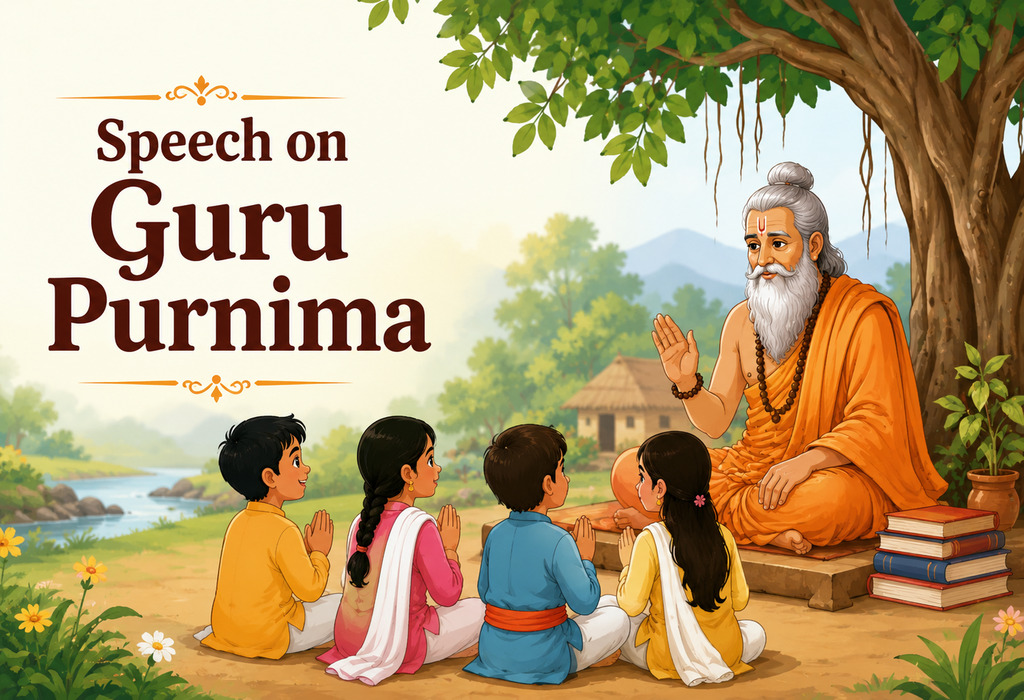
Guru Purnima is a special occasion celebrated to honour teachers and mentors for the knowledge and guidance they share with their students. Delivering a Guru Purnima speech in English for students is a wonderful way for children to express gratitude towards their teachers while building public speaking skills. The festival holds deep cultural significance in India, marking the day devoted to the memory of Guru Vyasa, a revered sage in Hindu tradition.
Thank you for reading this post, don't forget to subscribe!
Preparing a speech on Guru Purnima helps children understand the importance of teachers in shaping their lives, while also giving them a chance to practise structuring thoughts and speaking confidently. In this article, we bring you a range of speeches on Guru Purnima, from short ten-line versions for younger students to longer, more detailed speeches for older children, to help your child prepare a heartfelt speech for this meaningful occasion.
Key Points To Remember For Preparing A Speech on Guru Purnima
A well-prepared speech can make all the difference in how confidently your child delivers it. Here are some key points to keep in mind while preparing a speech on Guru Purnima.
- Understand the Significance First – Help your child learn the meaning and importance of Guru Purnima before writing, so the speech reflects genuine understanding rather than just facts.
- Start with a Strong Opening – Begin the speech with a greeting and a line that captures the audience’s attention, such as a quote or a thought about teachers.
- Keep the Language Simple – Use easy words and short sentences suited to the child’s age, so the speech is clear and easy to deliver confidently.
- Include Personal Touches – Encourage your child to mention a teacher who has inspired them, as this adds warmth and sincerity to the speech.
- Maintain a Respectful Tone – Since the occasion honours teachers and mentors, the speech should carry a tone of gratitude and respect throughout.
- End with a Meaningful Note – Conclude the speech with a thank-you note or a thoughtful line that leaves a lasting impression on the audience.
- Review and Practise – Read through the speech to check for mistakes, then rehearse it a few times aloud to build confidence and improve tone and pace.
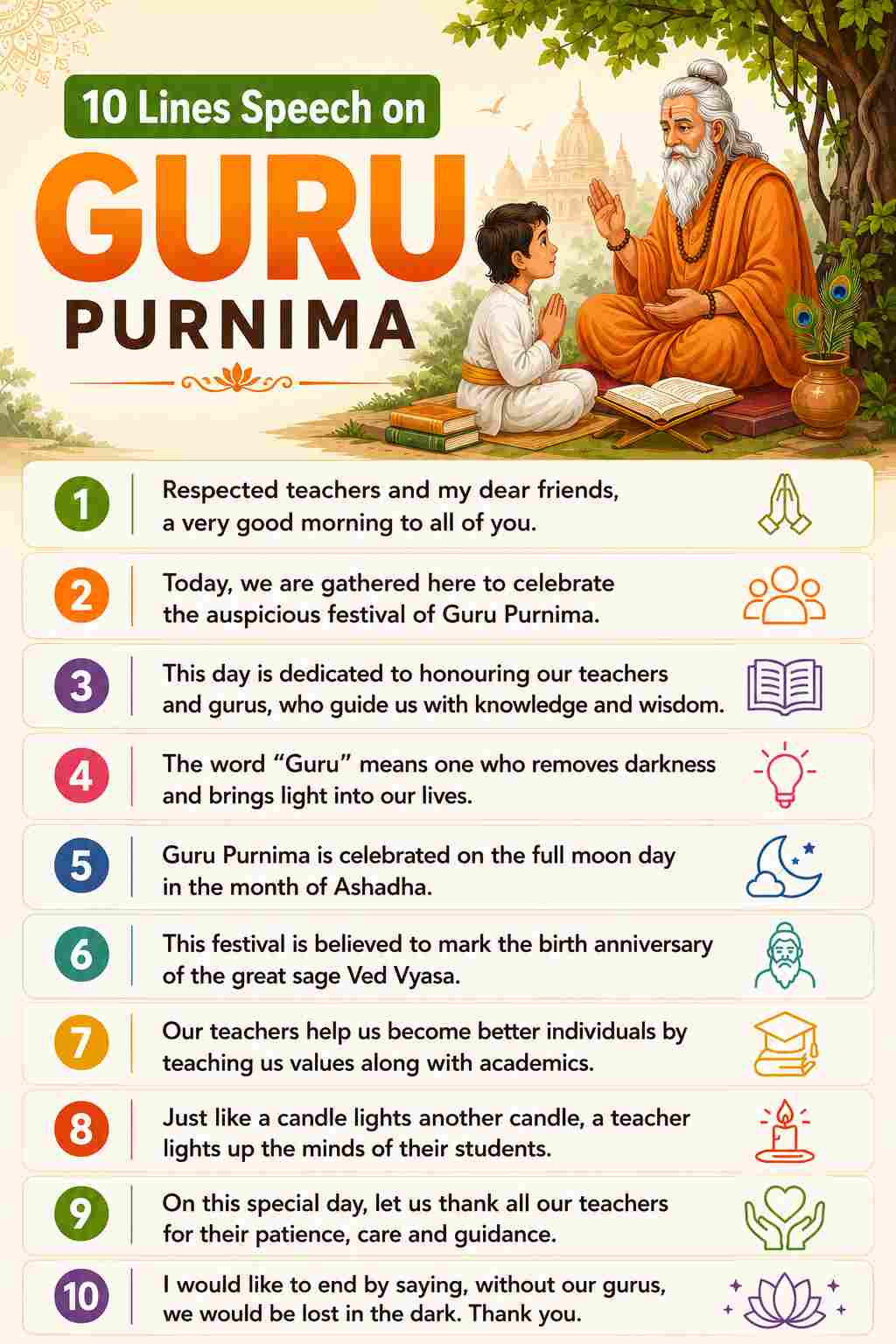
10 Line Speech on Guru Purnima
Not every speech needs to be long to be meaningful. These ten lines capture the spirit of Guru Purnima in a way that’s easy for young students to remember and deliver.
- Respected teachers and my dear friends, a very good morning to all of you.
- Today, we are gathered here to celebrate the auspicious festival of Guru Purnima.
- This day is dedicated to honouring our teachers and gurus, who guide us with knowledge and wisdom.
- The word “Guru” means one who removes darkness and brings light into our lives.
- Guru Purnima is celebrated on the full moon day in the month of Ashadha.
- This festival is believed to mark the birth anniversary of the great sage Ved Vyasa.
- Our teachers help us become better individuals by teaching us values along with academics.
- Just like a candle lights another candle, a teacher lights up the minds of their students.
- On this special day, let us thank all our teachers for their patience, care and guidance.
- I would like to end by saying, without our gurus, we would be lost in the dark. Thank you.
1 Minute Speech on Guru Purnima
For quick classroom slots where time is limited, a one-minute speech gets straight to the point without losing meaning. This version keeps things brief while still honouring the spirit of the occasion.
Good morning, everyone. Today, we celebrate Guru Purnima, a day dedicated to thanking our teachers and gurus for their guidance.
It falls on the full moon day of the Hindu month of Ashadha and is linked to the sage Ved Vyasa, known for his contribution to ancient Indian texts. Beyond religious roots, this day reminds us that much of what we know comes from someone who patiently taught us. Our teachers shape not just our academics but our character too.
On this occasion, let us take a moment to genuinely thank the teachers who have guided us. Thank you.
2 Minute Speech on Guru Purnima
For students who need a slightly longer piece, this two-minute speech offers more depth on the significance of Guru Purnima. It strikes a good balance between simplicity and detail for a classroom setting.
Respected teachers and my dear friends, a very good morning to all of you.
Today, I am honoured to speak on the occasion of Guru Purnima, a festival dedicated to expressing gratitude towards our teachers and gurus.
The word “Guru” comes from two Sanskrit words, “Gu” meaning darkness and “Ru” meaning light, symbolising someone who removes ignorance and brings knowledge into our lives. Guru Purnima is celebrated on the full moon day in the Hindu month of Ashadha, and it is believed to mark the birth anniversary of the great sage Ved Vyasa, who is credited with writing the Mahabharata and compiling the Vedas.
In Indian culture, the relationship between a guru and their student, known as a “shishya,” has always been deeply respected. A true guru does not just teach academic subjects but also shapes our character, values and outlook towards life. Just as a lamp lights another lamp without losing its own flame, a good teacher shares their knowledge selflessly, helping students grow and shine in their own way.
On this special day, let us take a moment to thank all our teachers, past and present, for their guidance, patience and unwavering support.
Without our gurus, we would be lost in a world of darkness. Thank you.
Short Speech on Guru Purnima
Sometimes a few well-chosen words say just as much as a long speech. Here is a short speech on Guru Purnima that your child can deliver with confidence at a school assembly.
Good morning, everyone. Today marks Guru Purnima, a day set aside each year to acknowledge the people who have taught us how to think, question and grow. It falls on the full moon of the Hindu month of Ashadha, usually in June or July, and traditionally honours the sage Ved Vyasa, remembered for his contribution to some of India’s oldest texts, including the Mahabharata.
But this occasion isn’t only about ancient sages. It’s really about anyone who has taken the time to explain something we didn’t understand, correct us when we were wrong, or simply show up for us consistently. That could be a school teacher, a coach, a grandparent, or even an older sibling who taught us to ride a bicycle or solve a tricky sum. Learning, after all, rarely happens in just one place.
What makes a good teacher isn’t just what they know; it’s how patiently they pass it on. Most of us can think of at least one teacher who noticed something in us before we noticed it ourselves, or who pushed us to try again after we’d already given up. Those moments rarely make it into textbooks, but they shape us more than most lessons do. A teacher’s real influence often shows up years later, in the way we approach a problem or treat other people.
In earlier times, students would live alongside their teachers for years, learning not just subjects but a whole way of approaching life. The gurukul system placed enormous trust in that relationship. Classrooms look very different today, with timetables, exams and syllabi shaping most of our learning, but that basic exchange, someone sharing what they know so someone else can do better, hasn’t really changed.
It’s easy to take that exchange for granted, especially when we’re caught up in deadlines and grades. But behind every subject we’ve learned is usually a person who explained it more than once, who stayed a little longer to help, or who simply believed we could do better.
So today, let’s take a moment to think of the people who’ve taught us something that stuck. A thank you doesn’t have to be elaborate or rehearsed. Sometimes just telling a teacher, in person or otherwise, that they made a difference is enough, and it often means more to them than we realise.
That’s what Guru Purnima is really about, and I hope we all carry a bit of that gratitude with us today, not just in speeches, but in how we treat the people who continue to teach us. Thank you.
Long Speech on Guru Purnima
Senior students often get more speaking time at assemblies, which calls for a fuller English speech on Guru Purnima than the shorter versions above. This one has room to cover the festival’s history, meaning and relevance in more detail.
Respected principal, teachers and my dear friends, a very good morning to all of you.
Today, I have the honour of speaking on the occasion of Guru Purnima, a day that holds a quiet but significant place in our calendar. It is a day set aside not for gifts or celebrations in the usual sense, but for something simpler: acknowledging the people who have taught us how to learn, think and grow.
History of Guru Purnima
Guru Purnima is observed on the full moon day of the Hindu month of Ashadha, which usually falls in June or July. The day is traditionally linked to the sage Ved Vyasa, credited with compiling the four Vedas and writing the epic Mahabharata, among other significant texts. His contribution to Indian philosophy and literature was so substantial that this day came to be associated with honouring teachers in general, not just Vyasa himself. Over centuries, the occasion moved beyond its religious origins and became a broader tradition observed across schools, universities and spiritual institutions, where students take a moment to express gratitude towards those who have guided them.
Importance of Guru Purnima
The importance of this day lies less in ritual and more in what it represents: a pause to recognise that very little of what we know we figured out entirely on our own. Every subject we’ve mastered, every skill we’ve built, usually traces back to someone who explained it patiently, sometimes more than once. Teachers rarely ask for recognition, and in the routine of assignments and exams, it’s easy to overlook how much of our thinking has been shaped by them. Guru Purnima exists precisely to correct that oversight, even if just for a day.
Guru Purnima Celebrations
Celebrations of Guru Purnima vary depending on where you are. In schools, it’s common to see students organising small programmes, giving speeches, or simply spending a class period thanking their teachers directly. In more traditional or spiritual settings, students visit their gurus, offer flowers or gifts, and seek their blessings. Some communities hold satsangs or discourses focused on the value of education and mentorship. What’s consistent across all these forms of celebration is the underlying idea: taking a moment to actively express thanks, rather than assuming teachers already know how much they’re valued.
Values We Learn
Beyond academics, the relationship between a teacher and a student teaches us things that are harder to name but easy to recognise later in life. Here are some of the values that emerge from this bond:
- Patience – We’ve all needed a concept explained more than once, and a good teacher never makes that feel like a burden.
- Humility – Learning requires admitting what we don’t yet know, and a good guru helps us feel comfortable doing so.
- Accountability – A good teacher holds us to a standard even when we’d rather not meet it that day, teaching us to take responsibility for our own growth.
- Generosity – Most teachers give far more than their job technically requires, showing us what it looks like to help without expecting much in return.
- Respect – Watching how teachers treat their students, and how students in turn value their guidance, teaches us the importance of mutual respect in any relationship.
As we mark Guru Purnima today, I’d encourage all of us to think of one teacher, in school or otherwise, who made a real difference, and to actually tell them so, whether today or sometime soon. It doesn’t need to be a grand gesture. A short, honest thank you often means more than we assume. With that thought, I’d like to conclude my speech and once again thank everyone for listening. Good morning to you all once again.
How Can Students Thank Their Teachers?
A thank you doesn’t need to be elaborate to mean something. Students can write a short note or card expressing what a particular lesson or piece of advice meant to them, or simply say it out loud, which often carries more weight than people expect.
Small gestures, like paying attention in class, following through on feedback, or helping a classmate the way a teacher once helped them, are also quiet ways of showing appreciation. For students who want to do something a little more visible, organising a small classroom activity or writing a short speech, like the one above, can be a meaningful way to mark the occasion.
Quotes For The Guru Purnima Speech
A well-placed quote can add weight to a speech and make it more memorable for the audience. Here are a few that work well for a Guru Purnima address.
- “Education breeds confidence. Confidence breeds hope. Hope breeds peace.” — Confucius.
- “When educating the minds of our youth, we must not forget to educate their hearts.” — Dalai Lama.
- “The mediocre teacher tells. The good teacher explains. The superior teacher demonstrates. The great teacher inspires.” — William Arthur Ward.
- “One good teacher in a lifetime may sometimes change a delinquent into a solid citizen.” — Philip Wylie.
- “Live as if you were to die tomorrow. Learn as if you were to live forever.” — Mahatma Gandhi.
FAQs
1. Can I Mention a Teacher Other Than a School Teacher in My Speech?
Yes, you can mention anyone who has taught you something meaningful, such as a parent, coach or grandparent, as Guru Purnima celebrates all forms of guidance, not just formal schooling.
2. How Should I Practise Delivering My Speech Confidently?
Try rehearsing in front of a mirror or a family member a few times before the actual day, paying attention to your pace, tone and eye contact.
3. Is It Necessary to Use Sanskrit or Hindi Words in My Speech?
No, it isn’t necessary, though using a few relevant words like “Guru” or “Shishya” can add cultural context, as long as you explain their meaning for the audience.
4. What Should I Do if I Forget My Speech Midway?
Pause calmly, take a breath, and try to recall the next point using the flow of your speech rather than rushing, as audiences are often more understanding than we expect.
Whether your child needs a quick ten-line piece or is aiming to deliver the best speech on Guru Purnima at a school assembly, the key lies in genuine gratitude rather than perfect words. With a little practice and the examples covered in this article, your child can honour their teachers with a speech that feels both confident and heartfelt.
Also Read:
Essay on Guru Purnima
Essay on Gautam Buddha
Story of Eklavya and Dronacharya