



World Environment Day, observed annually on 5th June, serves as a powerful reminder of our collective responsibility to protect and preserve the natural world. Organised by the United Nations Environment Programme (UNEP), this global occasion encourages individuals, communities, and nations to reflect upon the pressing environmental challenges of our time.
Thank you for reading this post, don't forget to subscribe!
For students and children, delivering a speech on World Environment Day is particularly significant. It nurtures environmental awareness from an early age and empowers young voices to advocate for meaningful change. A well-crafted Environment Day speech can inspire audiences to adopt sustainable habits, reduce pollution, and champion biodiversity conservation.
Whether you are preparing an Environment Day speech for students at a school assembly or a community gathering, the right words can leave a lasting impression. This collection of speeches provides thoughtful, age-appropriate content to help young speakers confidently articulate their commitment to a greener, healthier planet.
Points to Remember When Preparing a Speech on World Environment Day
Before you write a speech on World Environment Day, there are a few key points worth bearing in mind. Here’s what to keep in mind to craft a confident, impactful speech.
- Know Your Audience – Consider whether you are speaking to classmates, teachers, or a wider community gathering, and tailor your language and tone accordingly.
- Choose a Clear Theme – Focus on a specific environmental issue such as climate change, deforestation, or plastic pollution, rather than attempting to cover everything at once.
- Research Your Topic – Support your speech with relevant facts, figures, and real-world examples to make your message more credible and compelling.
- Structure Your Speech – Organise your content into a clear introduction, main body, and conclusion to ensure your speech flows naturally and is easy to follow.
- Use Simple, Powerful Language – Avoid overly complex vocabulary and instead opt for clear, emotive language that connects with your audience and drives your message home.
- Review and Refine – Once your speech is written, read it back carefully to check for clarity, flow, and accuracy, making any necessary improvements before the final delivery.
- Practise Aloud – Rehearse your speech multiple times beforehand to build confidence, improve delivery, and ensure you stay within your allotted time.
10 Line Speech on World Environment Day
Not every speech on World Environment Day needs to be lengthy to leave an impression. These 10 lines are perfectly suited for young children seeking a simple yet meaningful way to mark the occasion.
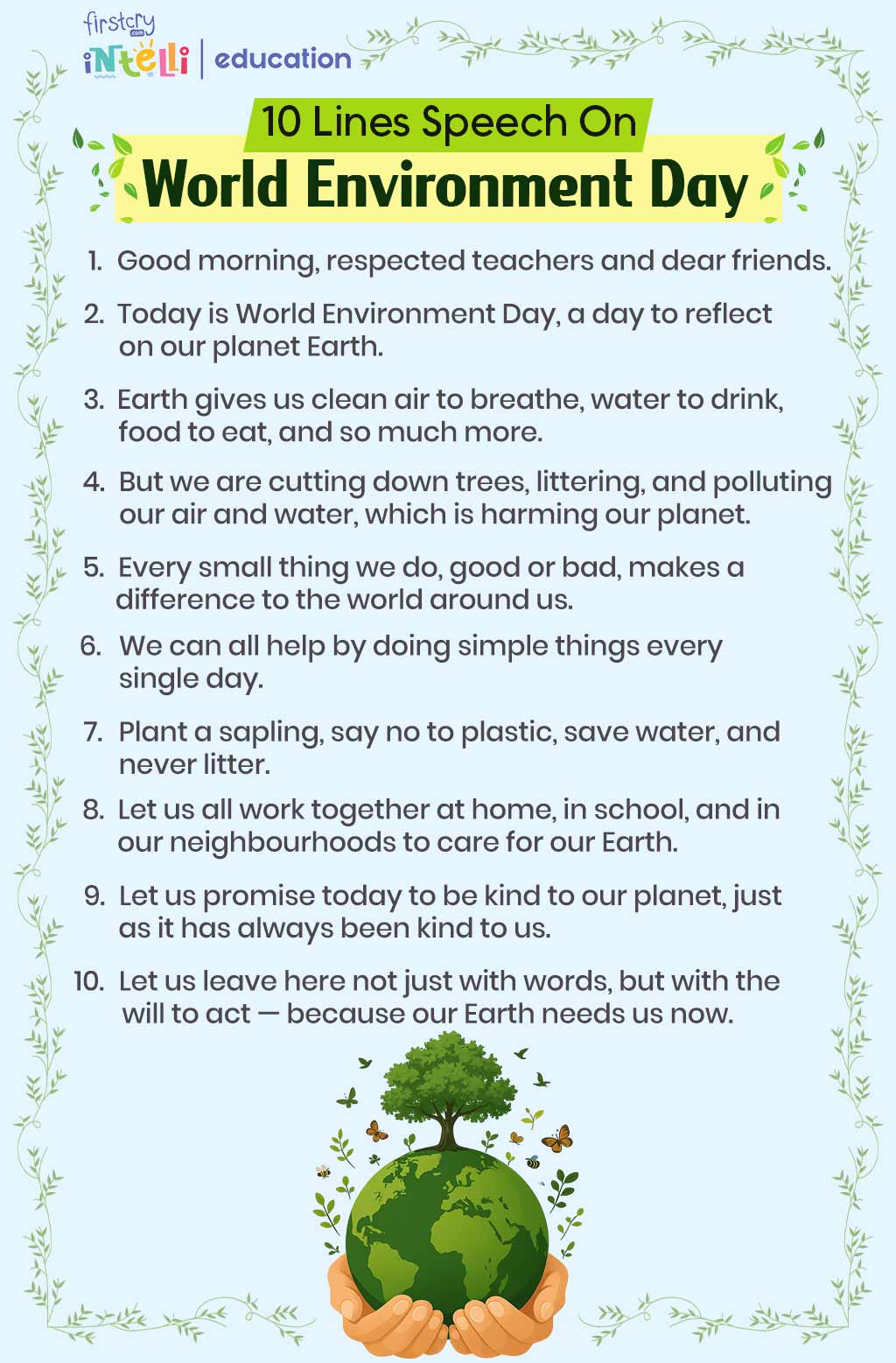
- Good morning, respected teachers and dear friends.
- Today is World Environment Day, a day to reflect on our planet Earth.
- Earth gives us clean air to breathe, water to drink, food to eat, and so much more.
- But we are cutting down trees, littering, and polluting our air and water, which is harming our planet.
- Every small thing we do, good or bad, makes a difference to the world around us.
- We can all help by doing simple things every single day.
- Plant a sapling, say no to plastic, save water, and never litter.
- Let us all work together at home, in school, and in our neighbourhoods to care for our Earth.
- Let us promise today to be kind to our planet, just as it has always been kind to us.
- Let us leave here not just with words, but with the will to act — because our Earth needs us now.
Speech on World Environment Day in 150 Words
A 2-Minute Speech On Environment Day strikes the perfect balance between brevity and impact. Here is a ready-to-deliver 150-word speech for students.
Good morning, respected teachers and dear friends.
Today, on World Environment Day, we gather to acknowledge a truth we can no longer afford to ignore — our planet is under threat. Deforestation, air pollution, rising temperatures, and vanishing wildlife are not distant problems; they are unfolding around us every single day.
The Earth has sustained humanity for thousands of years, offering clean air, fertile land, and abundant water. Yet in return, we have polluted its rivers, stripped its forests, and filled its oceans with plastic.
The time for debate is over. What our planet needs now is action — from governments, communities, and individuals alike. Simple choices such as conserving water, reducing waste, and planting trees can collectively create enormous change.
As students, we are not merely the leaders of tomorrow — we are the advocates of today.
Let us act before tomorrow becomes too late. Thank you.
Speech on World Environment Day in 200 Words
For those needing a little more depth, this Environment Day speech in English expands on key environmental themes without losing clarity or focus. At 200 words, it suits students who are comfortable speaking for slightly longer and wish to leave a stronger impression.
Good morning, respected teachers and dear friends.
World Environment Day, observed every year on 5th June, is more than a date on the calendar — it is a global call to conscience. This year, let us move beyond awareness and commit to genuine accountability.
Our planet is experiencing an unprecedented environmental crisis. Glaciers are retreating, oceans are acidifying, and biodiversity is declining at an alarming rate. Behind each of these statistics lies a simple truth — human choices are driving this destruction.
Yet the same choices that caused the problem can also solve it. Governments must enforce stronger environmental policies. Industries must embrace cleaner, more sustainable practices. And individuals must take responsibility for their daily habits — from the food they consume to the waste they generate.
As students, we carry a unique responsibility. We are inheriting a world shaped by previous generations, but the world we leave behind will be shaped entirely by us. Environmental education, community action, and a genuine respect for nature must become the foundation of how we live.
World Environment Day is not a moment for speeches alone — it is a moment for resolve.
Let us honour it with action, not just words. Thank you.
Short Speech on World Environment Day
Sometimes a single, well-chosen message lands harder than a lengthy address. This welcome speech for Environment Day is brief, focused, and well within the reach of younger or less experienced speakers.
Good morning, respected teachers, dear friends, and everyone gathered here today.
We meet on a day that carries real weight — World Environment Day. Not because a calendar tells us to, but because the state of our natural world demands that we stop, reflect, and speak honestly about where we stand.
For centuries, nature has operated with remarkable precision. Forests have regulated our climate, oceans have absorbed our carbon, and ecosystems have sustained every form of life on this planet. This is not a coincidence — it is a finely balanced system, one that took millions of years to develop and one that we are dismantling at extraordinary speed.
Consider the numbers. Over 15 billion trees are felled every year. More than 8 million tonnes of plastic enter our oceans annually. Nearly one million plant and animal species currently face extinction. These are not projections — they are present realities, unfolding quietly while daily life continues around them.
What makes this particularly challenging is that environmental damage rarely dramatically announces itself. It accumulates in the gradual warming of temperatures, the slow disappearance of pollinators, and the creeping loss of arable land. By the time the consequences become impossible to ignore, the window for easy solutions has often already closed.
This is why education matters so deeply. A child who understands the water cycle is more likely to conserve water. A student who learns about soil degradation is more likely to think carefully about food waste. Knowledge does not automatically change behaviour, but it creates the conditions in which change becomes possible.
Beyond individual action, we must also demand systemic change. Corporations that externalise environmental costs must be held accountable. Urban planning must prioritise green spaces and sustainable infrastructure. Agricultural practices must evolve to protect rather than deplete the land.
None of this is beyond our reach. Renewable energy is now more affordable than ever. Reforestation projects worldwide are demonstrating measurable success. Communities are finding innovative ways to reduce waste and restore degraded ecosystems.
The narrative around our environment need not be one of despair. It can be one of determined, informed, collective action.
We are standing at a crossroads that every generation before us has helped create. What we do next, however, is entirely our decision.
Choose wisely. Act decisively. The planet is not asking for our sympathy — it is asking for our commitment.
Thank you.
Long Speech On World Environment Day
A longer speech allows for greater depth and stronger arguments, making it ideal for formal school events or competitions. The following address covers today’s most pressing environmental challenges with clarity and purpose.
Good morning, respected teachers, distinguished guests, and dear friends.
It is a privilege to stand before you on World Environment Day — a day that reminds us that the health of our planet is not a political issue, a scientific abstraction, or someone else’s responsibility. It is a human issue that belongs to all of us.
The History Of World Environment Day
World Environment Day was established by the United Nations in 1972, following the Stockholm Conference on the Human Environment — the first major global gathering to address environmental concerns at an international level. It was first celebrated in 1974 and has since grown into the largest global platform for environmental awareness, observed by millions across more than 143 countries every year. Each year carries a distinct theme, directing collective attention towards a specific and urgent aspect of our environmental crisis.
Importance Of Protecting The Environment
The environment is not a backdrop to human life — it is its foundation. Clean air, fresh water, productive soil, and stable temperatures are not luxuries; they are the basic conditions that make civilisation possible. Protecting the environment means protecting agriculture, public health, economic stability, and ultimately, human survival. When we speak of saving the planet, we are in truth speaking of saving ourselves.
Environmental Problems
The scale of the challenges we face today is sobering. Global temperatures continue to rise as greenhouse gas emissions trap heat within our atmosphere, triggering erratic weather patterns, prolonged droughts, and rising sea levels. Deforestation is eliminating critical habitats at a rate that scientists describe as catastrophic, whilst simultaneously reducing the Earth’s capacity to absorb carbon dioxide. Our oceans, which cover over 70 per cent of the planet’s surface, are warming, acidifying, and filling with plastic waste. Meanwhile, air pollution claims approximately 7 million lives annually, making it one of the leading environmental causes of premature death worldwide. Soil degradation, freshwater scarcity, and the rapid decline of pollinators further compound a crisis that touches every corner of the globe.
How Can We Save The Environment?
The challenges are significant, but so are the solutions — and many of them are already within our grasp.
At an individual level, small but consistent actions carry real weight. Reducing single-use plastic, conserving water, choosing public transport, supporting local and seasonal food, and planting trees are choices available to most of us, and their cumulative impact is considerable.
At a community level, local environmental initiatives — clean-up drives, urban greening projects, waste segregation programmes — build the culture of responsibility that policy alone cannot create.
At a national and global level, governments must accelerate the transition to renewable energy, enforce stronger protections for forests and waterways, and hold polluting industries accountable. International cooperation is not optional — environmental challenges do not respect borders, and neither can our solutions.
Education remains one of the most powerful tools available. A generation that grows up understanding ecosystems, resource cycles, and the consequences of consumption will make fundamentally different decisions from those that preceded it. Schools, families, and media all share a role in shaping that understanding.
Technology, too, offers genuine promise. From solar and wind energy to biodegradable materials and precision agriculture, innovation is providing tools that allow human progress to coexist with environmental sustainability, rather than come at its expense.
We are not the first generation to recognise the environmental crisis, but we may well be the last with a meaningful opportunity to address it. The decisions made in the coming years — in parliaments, boardrooms, classrooms, and households — will determine the kind of planet that future generations inherit.
World Environment Day is not an annual ritual of speeches and pledges that fade by the following morning. It must be a genuine moment of recommitment — to living more thoughtfully, demanding more accountability, and acting with the urgency this moment requires.
The Earth has given us everything. What we give back is now the defining question of our time.
I thank my respected teachers for the opportunity to speak today, and I thank each of you for listening. Let us walk away not merely informed, but truly resolved.
Thank you.
FAQs
1. How Can I Make My Speech Sound Natural And Not Memorised?
Rather than memorising your speech word-for-word, focus on the key points you want to cover and speak around them. Practise in front of a mirror, record yourself on a phone, or deliver your speech to a family member. The more familiar you are with your content, the more natural and confident you will sound.
2. What Are Some Good Topics To Cover In An Environment Day Speech?
Climate change, deforestation, plastic pollution, water conservation, biodiversity loss, and the importance of renewable energy are all strong topics. Choose one or two themes and explore them in depth rather than attempting to cover every environmental issue in a single speech.
3. Should I Use Facts And Figures In My Speech?
Yes, but use them selectively. One or two well-chosen statistics can make your speech far more credible and impactful. However, avoid overloading your audience with numbers, as this can make a speech feel like a report rather than an address. Always make sure any facts you include are accurate and from a reliable source.
4. Can I Add A Poem Or Quote To My Speech?
Absolutely. A relevant quote from an environmental thinker, scientist, or world leader can add authority and depth to your speech. A short, original poem or a well-known nature verse can also make your address more memorable. Just ensure it fits naturally within the flow of your speech rather than feeling like an addition.
World Environment Day is an opportunity for young voices to rise, reflect, and inspire change. Whether delivering a simple 10-line address or a formal 700-word speech, what matters most is sincerity — a genuine understanding of why our planet needs our attention and a real commitment to doing something about it. The speeches and guidance provided in this article are a starting point, but the conviction must come from within. Prepare thoroughly, speak honestly, and let your words carry the weight they deserve.
Also Read:
Speech on Earth Day
Essay on Environment
Essay on World Environment Day