



- 10 Line Speech On Yoga Day
- 1 Minute Speech about International Yoga Day
- 2 Minute Speech on Yoga Day
- 3 Minute Speech on International Yoga Day
- Short Speech on Yoga Day In English
- Long Speech On International Yoga Day
- Quotes To Use In A Yoga Day Speech
- Key Points To Remember When Writing a Speech on International Yoga Day
- FAQs
International Yoga Day, celebrated every year on the 21st of June, is a momentous occasion that unites millions of people across the globe in the pursuit of health, harmony, and inner peace. Whether you are preparing a speech on Yoga Day for your school assembly or a community event, understanding the true essence of this ancient practice is of the utmost importance.
Thank you for reading this post, don't forget to subscribe!
Rooted in the civilisations of the Indian subcontinent and recognised by the United Nations in 2014, yoga has transcended borders to become a truly universal discipline. It nurtures not only the body but also the mind and spirit, making it especially valuable for students and children navigating the pressures of modern life.
This International Yoga Day speech in English aims to inspire young minds to embrace yoga — not merely as an exercise, but as a lifelong philosophy of balance, mindfulness, and wellbeing.
10 Line Speech On Yoga Day
Delivering a short and impactful speech on Yoga Day is a wonderful way for students and children to express their understanding of this ancient practice. The following 10 lines are ideal for young learners participating in school events and assemblies.
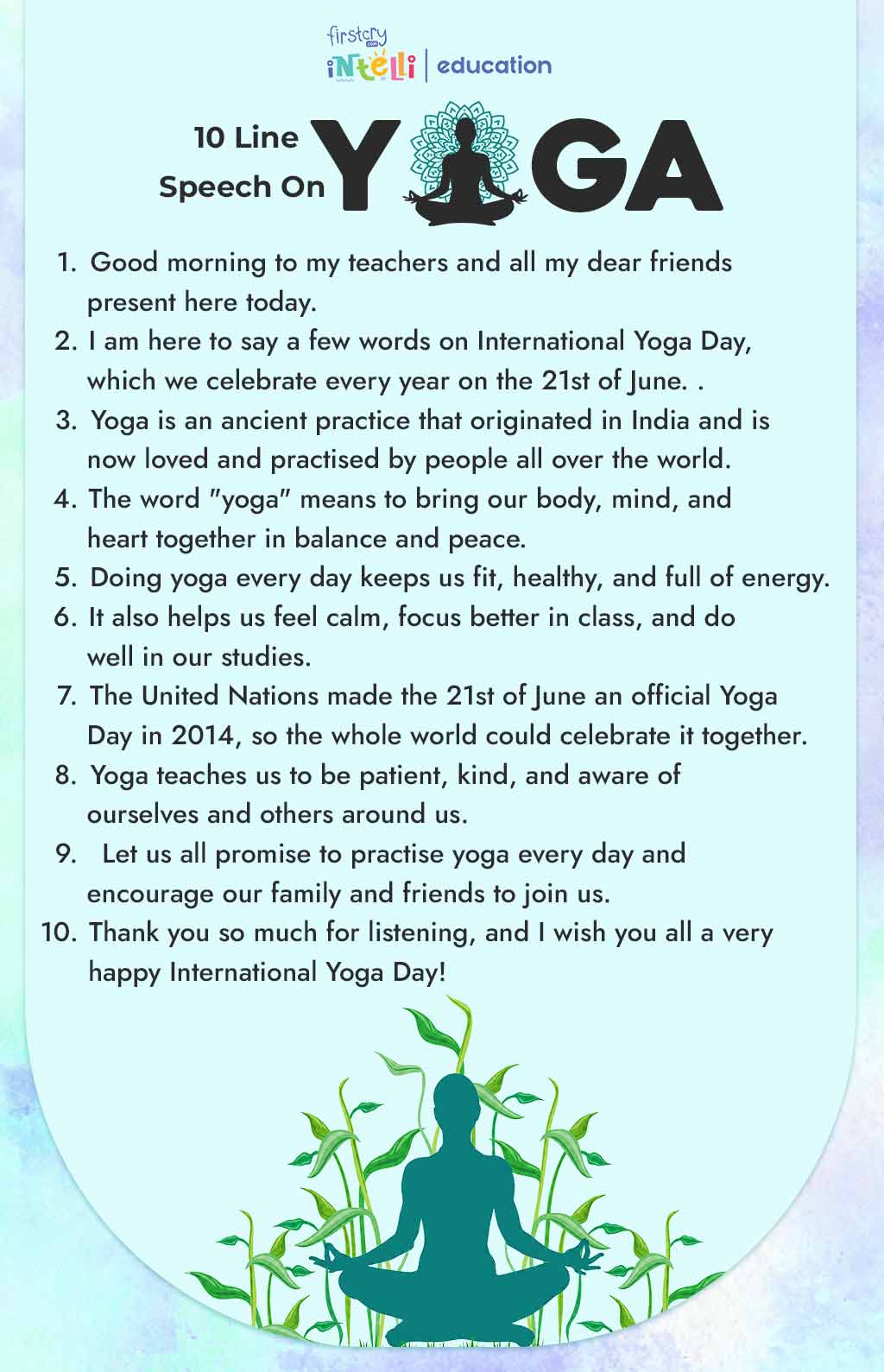
- Good morning to my teachers and all my dear friends present here today.
- I am here to say a few words on International Yoga Day, which we celebrate every year on the 21st of June.
- Yoga is an ancient practice that originated in India and is now loved and practised by people all over the world.
- The word “yoga” means to bring our body, mind, and heart together in balance and peace.
- Doing yoga every day keeps us fit, healthy, and full of energy.
- It also helps us feel calm, focus better in class, and do well in our studies.
- The United Nations made the 21st of June an official Yoga Day in 2014, so the whole world could celebrate it together.
- Yoga teaches us to be patient, kind, and aware of ourselves and others around us.
- Let us all promise to practise yoga every day and encourage our family and friends to join us.
- Thank you so much for listening, and I wish you all a very happy International Yoga Day!
1 Minute Speech about International Yoga Day
A welcome speech for Yoga Day need not be lengthy to be meaningful and memorable. Here is a simple and engaging one-minute speech that students and children can deliver with confidence at any school or community event.
Good morning to everyone present here today. I warmly welcome you all to this special celebration of International Yoga Day.
Yoga is an ancient Indian practice that beautifully unites our body, mind, and spirit. Celebrated every year on the 21st of June, this day reminds us of the incredible gift that yoga is to all of humanity.
For us students, yoga is a powerful tool that reduces stress, improves concentration, and keeps us healthy and happy.
Let us all commit to making yoga a part of our daily lives and spread its wonderful benefits to everyone around us.
Thank you and good day!
2 Minute Speech on Yoga Day
The following speech gives students enough time to express their thoughts on yoga meaningfully, making it ideal for school assemblies and International Yoga Day events.
Good morning to my respected teachers, dear friends, and everyone gathered here today.
I stand before you on this wonderful occasion of International Yoga Day, celebrated every year on the 21st of June, to share a few thoughts on one of the greatest gifts of ancient India — yoga.
The word “yoga” comes from the Sanskrit word yuj, meaning to unite. It is a practice that brings together the body, the mind, and the spirit in perfect harmony. Yoga is not simply a form of exercise — it is a complete way of living that teaches us patience, discipline, and self-awareness.
Yoga was born in India thousands of years ago and was gifted to the world by great sages and scholars. Today, it is practised by hundreds of millions of people across every continent. In 2014, the United Nations officially declared the 21st of June as International Yoga Day, recognising its universal value and importance.
For students like us, yoga is particularly powerful. It helps us manage stress, sleep better, concentrate more effectively, and maintain a healthy and active body. Even a few minutes of yoga each morning can bring about a remarkable change in how we feel throughout the day.
Beyond the physical benefits, yoga teaches us to be kinder — to ourselves and to others. It encourages us to slow down, breathe, and appreciate the present moment.
On this special day, let us pledge to embrace yoga not just as an activity, but as a lifelong companion on our journey through life.
Thank you.
3 Minute Speech on International Yoga Day
A three-minute speech strikes the sweet spot — long enough to captivate your audience, yet short enough to leave them wanting more. Here is a compelling speech that older students can deliver with confidence and enthusiasm at any International Yoga Day event or inter-school competition.
Good morning to my respected teachers, beloved friends, and every wonderful soul gathered here today.
It is said that the greatest journeys begin within. And that is precisely what yoga invites us to do — to turn inward, to discover ourselves, and to build a life of balance, strength, and peace. Today, on the occasion of International Yoga Day, I am truly honoured to share a few thoughts on this remarkable practice that has transformed millions of lives worldwide.
Yoga is one of the oldest systems of knowledge ever developed by human civilisation. Born in the ancient lands of India thousands of years ago, it was nurtured by great sages and scholars who understood the profound connection between the human body, the mind, and the universe. The word “yoga” itself comes from the Sanskrit word yuj, meaning to unite — and that is exactly what yoga does. It unites us with ourselves, with one another, and with the world around us.
For centuries, yoga remained a deeply personal and spiritual practice, passed down from teacher to student through generations. Over time, it evolved and branched into many beautiful forms — Hatha yoga, Bhakti yoga, Karma yoga, and Raja yoga, to name but a few. Each path is unique, yet all lead to the same destination — a life of harmony, awareness, and inner fulfilment.
In 2014, the Prime Minister of India, Narendra Modi, proposed to the United Nations that a special day be dedicated to yoga. The response was extraordinary. On the 21st of June 2015, the very first International Yoga Day was celebrated in over 190 countries simultaneously — a truly historic moment that demonstrated just how deeply yoga had woven itself into the fabric of human life across the globe.
But why does this matter to us as students? Why should young people care about a practice that is thousands of years old?
The answer is simple — because we need it now more than ever.
We live in a world that moves at a breathtaking pace. Examinations, deadlines, social pressures, and the constant noise of digital life can leave us feeling overwhelmed, anxious, and disconnected. Yoga offers us something that no app or gadget ever can — a moment of genuine stillness. A chance to breathe. A space to simply be.
Research has consistently shown that regular yoga practice improves concentration, boosts memory, reduces anxiety, and promotes better sleep. For students, these benefits are invaluable. A calm and focused mind is far better equipped to learn, to create, and to overcome challenges than one that is cluttered and stressed.
Beyond academics, yoga shapes our character. It teaches us discipline — to show up on the mat even when we do not feel like it. It teaches us humility — to acknowledge our limitations and work gently within them. And it teaches us compassion — first for ourselves, and then for every living being around us.
Yoga is not about being flexible enough to touch your toes. It is about being present enough to enjoy the journey of trying.
As we celebrate International Yoga Day today, let us make a sincere commitment — not just to practise yoga, but to live its values each day.
Thank you all so very much.
Short Speech on Yoga Day In English
A short speech on Yoga Day in English is perfect for younger students who are taking to the stage for the very first time. The following speech is simple, confident, and easy to deliver with a smile.
Good morning to my respected teachers, dear friends, and all those present here today.
Today, I stand before you to speak on a subject that is close to my heart — yoga. Every year on the 21st of June, the world comes together to celebrate International Yoga Day, and it deserves every bit of the joy and enthusiasm we bring to it.
Yoga is one of the most precious gifts that ancient India has given to the world. It is a practice that is thousands of years old, yet feels remarkably relevant to every single one of us today. The word “yoga” comes from the Sanskrit word yuj, which means to unite — to bring together the body, the mind, and the spirit in a state of perfect balance.
What makes yoga truly special is that it belongs to everyone. You do not need expensive equipment, a fancy gym, or any particular level of fitness to begin. All you need is a little space, a willing mind, and the desire to feel better. Whether you are six years old or sixty, yoga has something wonderful to offer you.
For students in particular, the benefits of yoga are truly extraordinary. We live in demanding times — exams, homework, extracurricular activities, and the pressures of growing up can sometimes feel like too much to bear. Yoga gives us the tools to handle all of it with grace. It teaches us how to breathe through difficult moments, focus our minds, and approach challenges with calm and clarity.
Physically, yoga strengthens our muscles, improves our posture, boosts our immunity, and energises us. Mentally, it sharpens our concentration and lifts our mood. And spiritually, it connects us to something deeper within ourselves — a quiet place of peace that is always there, waiting for us to find it.
The United Nations recognised the power of yoga when it declared the 21st of June as International Yoga Day in 2014. Since then, millions of people across the globe have come together on this day to celebrate, practise, and share the joy of yoga.
Let us honour that spirit today by making a genuine promise to ourselves — to roll out the mat, to breathe deeply, and to carry the light of yoga into everything we do.
Thank you so much for listening. Let us embrace yoga not just for a day, but as a way of life, spreading its message of harmony and well-being every day.
Long Speech On International Yoga Day
For students ready to make a lasting impression, a long speech offers the perfect opportunity to delve into the history, philosophy, and far-reaching benefits of yoga. The following speech is ideal for senior students, special assemblies, and prestigious International Yoga Day events.
Good morning to my respected principal, beloved teachers, dear friends, and every distinguished guest gathered here today.
It is a profound honour to stand before such a wonderful audience on this most auspicious occasion of International Yoga Day. Today, the 21st of June, is not merely a date on the calendar — it is a celebration of one of humanity’s greatest treasures. Yoga is a practice that has endured for thousands of years, shaped countless lives, and continues to offer the world something that no modern invention ever could — true and lasting wellbeing. I am deeply grateful for this opportunity to share my thoughts on a subject that I believe every one of us, young and old, deserves to know more about.
Importance Of Yoga Day
International Yoga Day was officially declared by the United Nations on the 11th of December 2014, following a heartfelt proposal by the Prime Minister of India, Narendra Modi. Since its very first celebration on the 21st of June 2015, this day has grown into one of the most widely observed occasions in the world, bringing together people from over 190 countries in a shared spirit of health and harmony.
But why is this day so important? In a world increasingly consumed by speed, stress, and disconnection, yoga offers us a path back to ourselves. It reminds us that true health is not merely the absence of illness — it is a state of complete physical, mental, and spiritual wellbeing. For students and young people navigating the pressures of modern life, this message could not be more vital. International Yoga Day gives us a moment to pause, reflect, and recommit to caring for ourselves and one another.
Popular Yoga Asanas
At the heart of yoga practice are the asanas — physical postures that strengthen the body, calm the mind, and channel our energy in positive directions. Here are eight of the most popular and beneficial asanas for students and children:
- Tadasana (Mountain Pose) — A foundational standing posture that improves posture, strengthens the legs, and instils a quiet sense of confidence and groundedness.
- Vrikshasana (Tree Pose) — A beautiful balancing posture that sharpens concentration, strengthens the core, and teaches us the art of finding stillness amidst movement.
- Adho Mukha Svanasana (Downward Dog) — One of the most recognised poses in yoga, this posture stretches the entire body, relieves tension in the spine, and energises the mind.
- Bhujangasana (Cobra Pose) — A gentle backbend that opens the chest, strengthens the spine, and is particularly effective in relieving the stiffness caused by long hours of sitting and studying.
- Balasana (Child’s Pose) — A deeply restorative posture that encourages rest, releases tension in the back and shoulders, and offers a safe and comforting retreat whenever we feel overwhelmed.
- Trikonasana (Triangle Pose) — A dynamic standing posture that stretches the legs, hips, and spine whilst improving balance, digestion, and overall body awareness.
- Setu Bandhasana (Bridge Pose) — A gentle yet powerful posture that strengthens the back, opens the chest, and is widely recommended for students who experience anxiety or low energy.
- Shavasana (Corpse Pose) — Perhaps the most important posture of all, this deeply relaxing pose is practised at the end of every session, allowing the body to absorb the benefits of the practice and the mind to enter a state of profound calm.
As I draw my speech to a close, I would like to leave you with a thought that has always stayed with me — yoga is not a destination, it is a journey. It is not about how perfectly you can hold a posture or how flexibly you can bend. It is about showing up for yourself, day after day, with patience, kindness, and an open heart.
In a world that so often tells us to do more, be more, and achieve more, yoga gently whispers something far more profound — that you are already enough. That within you lies a reservoir of strength, peace, and wisdom that no examination result or social media post can ever measure.
Let us carry that truth with us as we step off the mat and back into the world. Let us be ambassadors of yoga — not just today, but every single day of our lives.
On behalf of all my fellow students, I wish each and every one of you a joyful, healthy, and deeply peaceful International Yoga Day.
Thank you so very much.
Quotes To Use In A Yoga Day Speech
A great quote can make your speech truly unforgettable — here are some wonderful ones to get you started!
- “Yoga is the journey of the self, through the self, to the self.” — The Bhagavad Gita
- “Yoga does not just change the way we see things, it transforms the person who sees.” — B.K.S. Iyengar
- “The nature of yoga is to shine the light of awareness into the darkest corners of the body.” — Jason Crandell
- “Yoga is not about touching your toes. It is what you learn on the way down.” — Jigar Gor
- “True yoga is not about the shape of your body, but the shape of your life.” — Aadil Palkhivala
- “Yoga is the art of awakening; through its practice, we gradually unveil the light of awareness within us.” — Donna Farhi
- “Yoga is 99% practice and 1% theory.” — Sri K. Pattabhi Jois
- “Yoga teaches us to cure what need not be endured and endure what cannot be cured.” — B.K.S. Iyengar
- “Yoga is like music: the rhythm of the body, the melody of the mind, and the harmony of the soul create the symphony of life.” — B.K.S. Iyengar
- “Yoga is not a religion. It is a science — the science of wellbeing, the science of youthfulness, the science of integrating body, mind, and soul.” — Amit Ray
Key Points To Remember When Writing a Speech on International Yoga Day
A great speech does not happen by accident — it is built on a strong foundation of clarity, structure, and purpose. Here are some essential tips to help you write a speech that truly stands out.
- Know Your Audience — Tailor your speech to suit the age group and occasion you are speaking at.
- Start With A Strong Opening — Begin with a powerful quote, an interesting fact, or a warm greeting to capture attention instantly.
- Keep It Focused — Stick to a clear central message and avoid drifting into unrelated topics.
- Use Simple Language — Choose words that are easy to understand without compromising on quality and depth.
- Include Facts And Figures — Add credibility by referencing accurate facts, such as when International Yoga Day was established.
- Speak From The Heart — The most memorable speeches feel genuine, so do not be afraid to share your own thoughts on yoga.
- Structure It Well — Always include a clear opening, a well-developed middle, and a strong conclusion with closing salutations.
- Review And Revise — Read your speech back carefully, checking for errors, repetition, and anything that does not flow naturally.
- Practise Out Loud — Rehearsing aloud helps you control your pace, iron out awkward phrases, and build confidence before the big day.
FAQs
1. Can I Use Notes While Delivering My Speech?
It is perfectly fine to use notes, especially if you are a beginner. However, try to use them only as prompts rather than reading them word for word, as making eye contact with your audience makes your speech far more engaging.
2. What Should I Do If I Forget My Lines?
Take a slow, deep breath and pause for a moment — the audience will not mind. You can glance at your notes, repeat your last sentence, or simply carry on from wherever you remember. Everyone forgets a line sometimes, and composure is what counts.
3. How Can I Make My Speech Sound More Confident?
Stand tall, speak slowly, and project your voice so that everyone in the room can hear you clearly. Practising in front of a mirror or a small group of friends and family before the event makes a tremendous difference to your confidence.
4. Should I Memorise My Entire Speech?
You do not need to memorise every single word, but you should know your key points well enough to speak naturally. Understanding what you want to say is far more important than reciting a script perfectly.
Whether you are stepping onto the stage for the very first time or looking to deliver a speech that truly leaves a mark, the most important ingredient is always sincerity. Use the speeches, quotes, and tips in this article as your starting point, make them your own, and step up to that stage with confidence. Happy International Yoga Day!
Also Read:
Essay on Yoga for Children
Essay on Health and Fitness
Essay on International Yoga Day
Essay on the Importance Of Exercise