



- What are Polar Animals?
- Importance of Polar Animals
- Characteristics of Polar Animals
- Types of Polar Animals
- List of Polar Animals of the Arctic
- Polar Animals of the Antarctic
- What are the Threats to Polar Animals?
- How we can Help Protect Polar Animals?
- Interesting Facts about Polar Animals
- Polar Animal Names Chart
- FAQs
Last Updated on August 31, 2026
The icy world of the Arctic and Antarctic is home to some of the most fascinating creatures on Earth. Learning about polar animals’ names opens up a wonderful world of snow, ice, and survival for young learners. From the mighty polar bear to the tiny snow petrel, this list of polar region animals for kids & students covers a wide range of species that thrive in freezing temperatures.
Thank you for reading this post, don't forget to subscribe!
Each creature has its own special way of surviving the cold, whether through thick fur, blubber, or clever hunting skills. Exploring polar region animals’ names helps children understand how animals adapt to extreme climates. With simple facts and engaging descriptions, this article makes learning about polar wildlife both fun and educational for curious young minds.
What are Polar Animals?
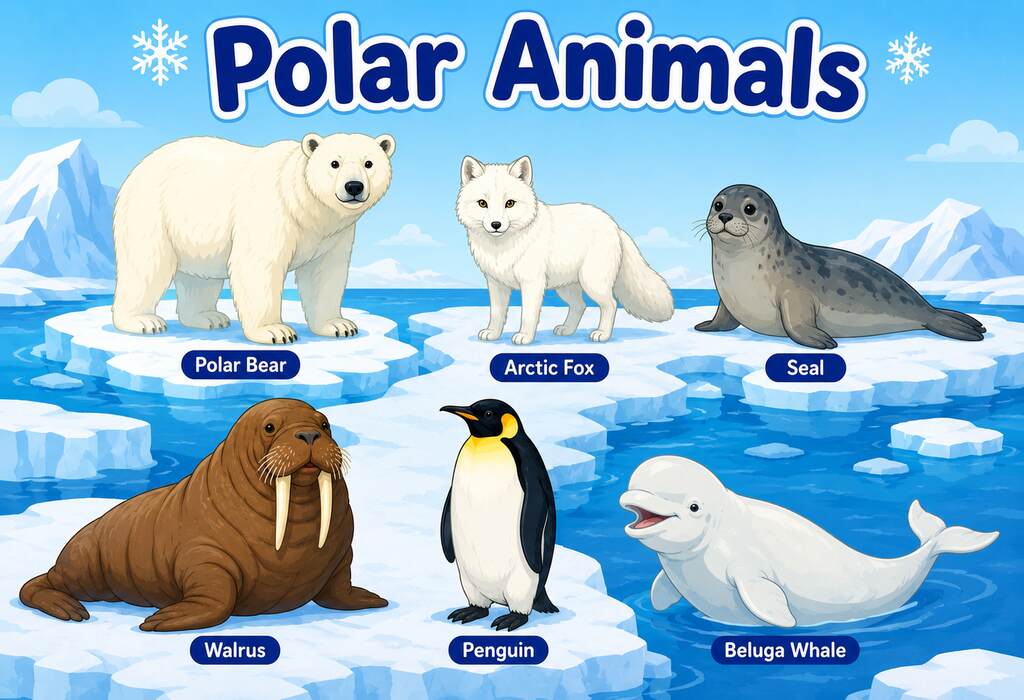
Polar animals are creatures that live in the freezing regions near the North and South Poles, known as the Arctic and Antarctic. These animals have special features, such as thick fur, blubber, or feathers, that help them survive extremely cold temperatures and harsh weather conditions. Many polar animals have also adapted their hunting and feeding habits to suit the icy landscapes and limited food sources found in these regions. From polar bears and penguins to seals and arctic foxes, these creatures show us how life can thrive even in the coldest parts of our planet.
Importance of Polar Animals
Polar animals play a vital role in maintaining the delicate balance of Arctic and Antarctic ecosystems. As predators and prey, they help control population levels within their habitats, ensuring that no single species overwhelms the food chain. Many polar animals are also indicators of climate health, as changes in their numbers or behaviour often signal shifts in temperature and ice levels. Learning about their importance helps children understand the bigger picture of environmental balance and why protecting these species and their habitats matters for our planet’s future.
Polar animals also contribute to the wider ocean and coastal ecosystems by supporting nutrient cycles that benefit marine life far beyond the poles. For instance, animals like whales and seals help recycle nutrients through their waste, which supports the growth of plankton and other tiny organisms at the base of the food chain. Understanding these connections helps children see how polar regions, though far away, are linked to the health of oceans and wildlife everywhere.
Characteristics of Polar Animals
Surviving in icy, freezing regions requires some truly remarkable features. These polar animal adaptations help creatures stay warm, hunt effectively, and thrive in extreme conditions.
- Thick Fur Or Feathers – Many polar animals have dense fur or feathers that trap heat and keep them warm in freezing temperatures.
- Layer Of Blubber – Animals like seals and whales have a thick layer of fat beneath their skin to insulate their bodies against the cold.
- White Or Light-Coloured Fur – Creatures such as polar bears and arctic foxes have light coloured coats that help them blend into the snow.
- Small Ears And Limbs – Many polar animals have smaller ears and shorter limbs to reduce heat loss.
- Slow Metabolism – Some polar animals have a slower metabolic rate, allowing them to conserve energy during long, harsh winters.
- Strong Sense Of Smell – Many polar predators rely on a sharp sense of smell to find food hidden under snow or ice.
- Webbed Feet Or Flippers – Animals like penguins and seals have webbed feet or flippers that help them swim efficiently in icy waters.
- Ability To Store Fat – Many polar animals eat large amounts of food when available, storing fat to survive periods of scarcity.
Types of Polar Animals
Polar animals can be grouped into two main types: Arctic and Antarctic. Exploring these types helps children understand the variety of life found in icy regions.
1. Arctic Animals
Arctic animals live in the freezing region around the North Pole, which includes parts of Canada, Russia, Greenland, and Alaska. This region is home to creatures such as polar bears, Arctic foxes, snowy owls, and reindeer, all of which have adapted to survive the icy tundra and frozen seas. Unlike Antarctica, the Arctic has land connected to other continents, allowing animals like wolves and caribou to migrate in search of food during different seasons.
2. Antarctic Animals
Antarctic animals live in the icy region surrounding the South Pole, which is mostly covered by a thick ice sheet and surrounded by the Southern Ocean. This continent is home to species such as emperor penguins, leopard seals, and various whales, many of which rely on the surrounding ocean for food rather than on land. Since Antarctica is isolated by water and far colder than the Arctic, the animals found here have developed unique adaptations, such as huddling behaviour and specialised diving skills, to survive in one of the most extreme environments on Earth.
List of Polar Animals of the Arctic
The Arctic is home to a fascinating range of creatures built to withstand its icy landscape. This list, along with images of polar animals, helps children recognise and learn about these remarkable species.
1. Polar Bear
The polar bear is the largest land carnivore and the most iconic Arctic animal, known for its thick white fur and powerful build. It relies on a layer of blubber to stay warm and is an excellent swimmer, often travelling long distances across ice and water in search of seals to hunt.
2. Arctic Fox
The Arctic fox has a thick, white coat that turns brownish-grey in summer, helping it blend into its surroundings throughout the year. It has small ears and a compact body to minimise heat loss, and it often follows polar bears to feed on leftover prey.
3. Snowy Owl
The snowy owl is a striking white bird with thick feathers covering its body, including its feet, to protect against the cold. It is a skilled hunter, often preying on small mammals like lemmings, and can be seen during the day, unlike most owl species.
4. Reindeer
Reindeer, also known as caribou, are large herbivores with thick fur and wide hooves that help them walk on snow without sinking. They migrate in large herds across the Arctic tundra in search of food, particularly moss and lichen.
5. Arctic Wolf
The arctic wolf is a subspecies of the grey wolf, with a thick white coat that helps it survive freezing temperatures. It hunts in packs, often preying on muskoxen and arctic hares, and can endure months of darkness during the Arctic winter.
6. Muskox
The muskox is a large, shaggy mammal known for its long, woolly coat that protects it from harsh winds and cold. It often travels in herds and uses its strength to dig through snow to find food during the winter months.
7. Walrus
The walrus is a large marine mammal known for its long tusks and thick layer of blubber that keeps it warm in icy waters. It uses its tusks to break through ice and defend itself, often resting in large groups on ice floes.
8. Beluga Whale
The beluga whale is easily recognised by its white skin and rounded head, which helps it navigate through icy Arctic waters. It is known for its vocal communication, often making clicks and whistles that have earned it the nickname “sea canary.”
9. Narwhal
The narwhal is famous for its long, spiral tusk, which is actually an elongated tooth used for various purposes, including sensing changes in its environment. It lives in the cold Arctic waters and often travels in groups, diving deep to find prey such as fish and squid.
10. Arctic Hare
The arctic hare has thick fur that turns white in winter and greyish brown in summer, helping it stay camouflaged year-round. It has powerful legs that allow it to hop quickly across snow and escape predators such as Arctic foxes and wolves.
11. Snow Goose
The snow goose is a white bird with black wingtips, known for migrating in large, noisy flocks across the Arctic. It feeds mainly on grasses and roots, often digging through snow to find food during colder months.
12. Lemming
The lemming is a small rodent that plays an important role in the Arctic food chain, serving as a primary food source for predators such as Arctic foxes and snowy owls. It has thick fur and burrows under snow to stay warm and avoid predators.
13. Arctic Tern
The arctic tern is a small seabird known for having one of the longest migration routes of any animal, travelling between the Arctic and Antarctic each year. It has sharp wings built for long-distance flight and feeds mainly on small fish.
14. Harp Seal
The harp seal has a thick layer of blubber and a sleek body that helps it swim efficiently in cold Arctic waters. Young harp seals have white fur at birth, which helps them blend into the snow and ice for protection.
15. Caribou
Caribou, closely related to reindeer, are known for their impressive antlers and ability to travel long distances across the Arctic tundra. They have specially adapted hooves that work well on both snow and rocky terrain, helping them migrate efficiently in search of food.
Polar Animals of the Antarctic
The Antarctic is home to a unique set of creatures adapted to survive its extreme cold and icy waters. With images of Antarctic polar animals and simple descriptions, children can explore and identify the species that call this frozen continent home.
1. Emperor Penguin
The emperor penguin is the largest of all penguin species, known for its striking black-and-white feathers and bright yellow neck patches. It can withstand extremely cold temperatures and often huddles together in large groups to stay warm during harsh Antarctic winters.
2. Leopard Seal
The leopard seal is a powerful predator with a spotted coat and sharp teeth, often hunting penguins and smaller seals. It is one of the top predators in the Antarctic and is known for its strong, muscular body built for speed in water.
3. Antarctic Krill
Antarctic krill are tiny shrimp-like creatures that form massive swarms in the Southern Ocean, serving as a vital food source for many larger animals. Despite their small size, they play a huge role in supporting the entire Antarctic food chain.
4. Blue Whale
The blue whale is the largest animal on Earth and is often found feeding in the nutrient-rich waters surrounding Antarctica. It primarily eats krill, consuming massive amounts daily to maintain its enormous size.
5. Orca
The orca, also known as the killer whale, is a highly intelligent predator found in Antarctic waters, often hunting in coordinated groups. It has a distinctive black-and-white pattern and preys on seals, fish, and even smaller whales.
6. Wandering Albatross
The wandering albatross has the largest wingspan of any bird, allowing it to glide over the Southern Ocean for long distances without resting. It feeds mainly on squid and fish, often following ships in search of food.
7. Snow Petrel
The snow petrel is a small, all-white seabird that nests on rocky cliffs and ice formations across Antarctica. It is known for its ability to navigate through snowstorms and harsh winds while searching for food at sea.
8. South Polar Skua
The south polar skua is a bold seabird known for stealing food from other birds, including penguins. It has a strong, hooked beak and is one of the few birds capable of surviving in the harsh Antarctic environment.
9. Antarctic Tern
The Antarctic tern is a small seabird with grey and white feathers, well-adapted to life along the icy coastlines of Antarctica. It feeds mainly on small fish and crustaceans, often hovering above the water before diving in to catch its prey.
10. Giant Petrel
The giant petrel is a large seabird known for its powerful build and broad wingspan, often seen scavenging along the Antarctic coastline. It is an opportunistic feeder, eating anything from fish and krill to carrion left behind by other predators.
11. Colossal Squid
The colossal squid is one of the largest invertebrates on Earth, living deep in the cold waters surrounding Antarctica. It has enormous eyes, the largest of any animal, which help it spot predators and prey in the dark depths of the ocean.
12. Antarctic Toothfish
The Antarctic toothfish is a large, slow-growing fish that lives in the freezing waters beneath the ice shelves. It has a special protein in its blood that acts like antifreeze, preventing it from freezing in the icy temperatures.
13. Icefish
The icefish is unique among vertebrates because its blood is completely colourless, lacking the red blood cells found in most other fish. This unusual adaptation allows it to survive in the oxygen-rich, freezing waters of the Southern Ocean.
14. Antarctic Limpet
The Antarctic limpet is a small sea snail that clings tightly to rocks along the Antarctic coastline, surviving in icy, nutrient-rich waters. It plays an important role in the ecosystem by grazing on algae that grow on rocky surfaces.
15. Sea Spider
The sea spider is a unique creature found in the cold waters of Antarctica, with a small body and unusually long, thin legs. Unlike true spiders, it lives underwater and uses its legs to crawl slowly across the ocean floor while feeding on soft-bodied animals.
What are the Threats to Polar Animals?
Polar animals face several growing dangers that put their survival at risk. Understanding these threats helps children appreciate the importance of protecting these fragile habitats.
- Climate Change – Rising temperatures are rapidly melting ice, destroying the natural habitats that many polar animals depend on for survival.
- Loss Of Sea Ice – Animals like polar bears and seals rely on sea ice for hunting and resting, and its disappearance makes it harder for them to find food.
- Pollution – Plastic waste and oil spills in polar regions can harm animals directly or contaminate the food sources they rely on.
- Overfishing – Excessive fishing reduces the availability of fish and krill, which are essential food sources for many polar species, including whales and seabirds.
- Habitat Disruption – Human activities such as shipping, tourism, and resource exploration can disturb breeding grounds and migration patterns of polar animals.
How we can Help Protect Polar Animals?
Even small actions can make a big difference in protecting polar animals and their habitats. Here are some simple ways children and families can contribute to their conservation.
- Reduce, Reuse, And Recycle – Cutting down on plastic use and recycling waste helps prevent pollution from reaching oceans and polar habitats.
- Save Energy At Home – Using less electricity and choosing energy-efficient appliances helps reduce carbon emissions that contribute to climate change.
- Support Wildlife Organisations – Donating to or learning about organisations that protect polar animals helps fund important conservation efforts.
- Spread Awareness – Talking to friends and family about the threats polar animals face encourages more people to care about their protection.
- Choose Sustainable Products – Picking eco-friendly, ethically sourced products helps reduce environmental impact on polar regions.
Interesting Facts about Polar Animals
Polar animals have some truly amazing abilities and characteristics that make them stand out. Here are a few fascinating facts that children will enjoy learning.
- A polar bear’s fur is not actually white; it is transparent and only appears white because it reflects light.
- Emperor penguins can dive deeper than any other bird, reaching depths of over 500 metres in search of food.
- Arctic terns travel the longest migration route of any animal, flying from the Arctic to the Antarctic and back each year.
- Narwhals use their long tusks, which are actually teeth, to sense changes in water pressure and temperature.
- Walruses can slow their heart rate to survive in icy waters for long periods without losing too much body heat.
- Leopard seals are known to mimic the calls of other animals, including penguins, to lure them closer.
- The Antarctic icefish has clear blood because it lacks red blood cells, an adaptation that helps it survive in freezing waters.
- Beluga whales are sometimes called “sea canaries” because of the wide variety of sounds they make underwater.
- Arctic foxes can survive temperatures as low as minus 50 degrees Celsius without shivering.
- Colossal squids have the largest eyes of any animal on the planet, helping them spot predators in the deep, dark ocean.
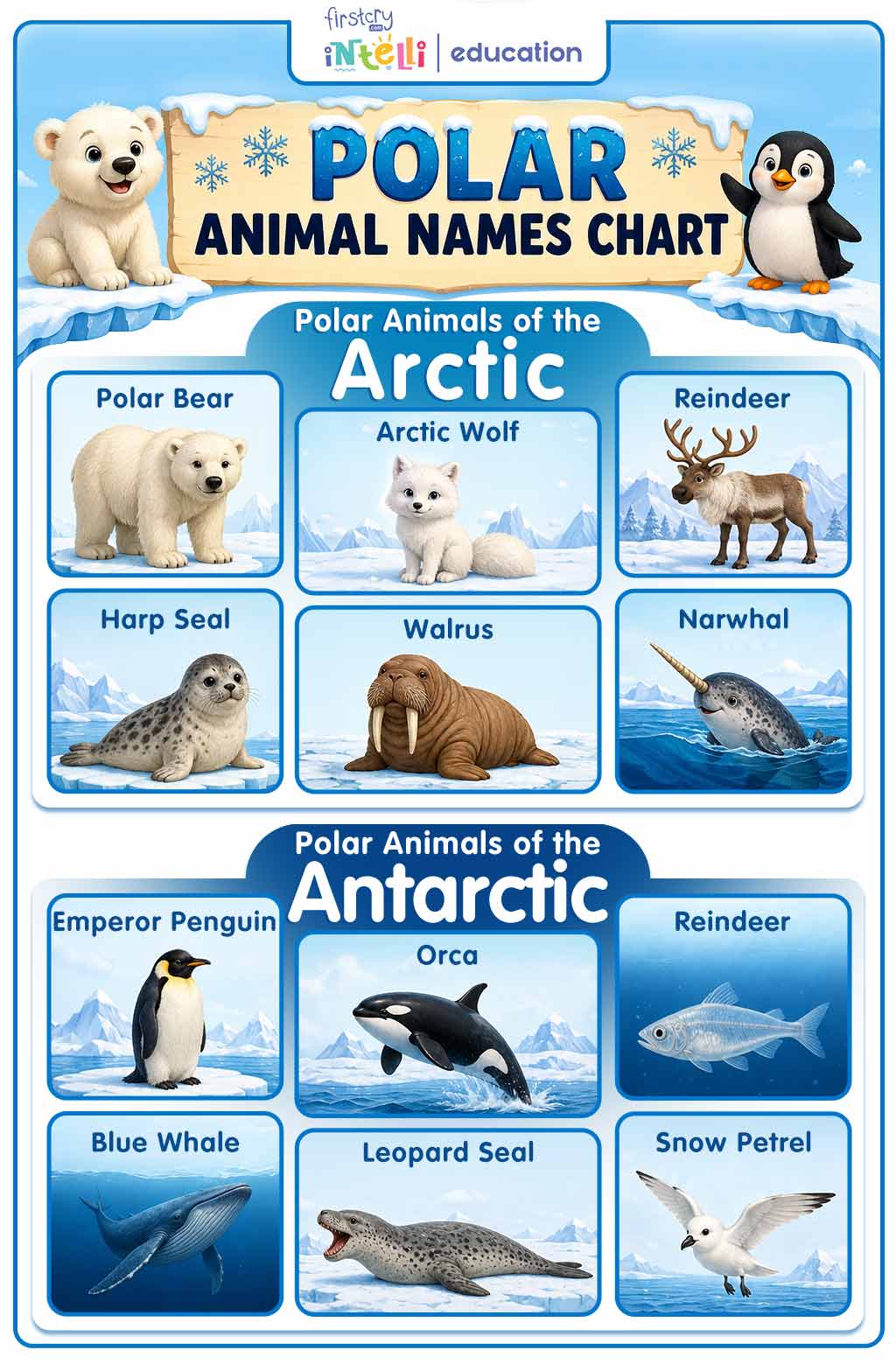
Polar Animal Names Chart
This simple chart brings together the names of polar animals from both the Arctic and Antarctic in one place. It makes for a handy reference that children can revisit to remember these fascinating creatures.
FAQs
1. Why Don’t Polar Bears Live in Antarctica?
Polar bears are only found in the Arctic because they evolved there, and the Antarctic environment and food sources are too different to support them naturally.
2. Can Any Animals Be Found In Both The Arctic And Antarctic?
Yes, the Arctic tern is one of the few animals that travel between the two regions, migrating from the Arctic to the Antarctic every year.
3. Why Are Polar Regions Important For The Rest Of The World?
Polar regions help regulate the Earth’s temperature and ocean currents, and changes in these areas can affect weather patterns and sea levels worldwide.
4. Do Polar Animals Hibernate During Winter?
Not all polar animals hibernate; some, like polar bears, may enter a resting state, while others, like arctic foxes and seals, stay active throughout the cold months.
Polar animals are remarkable creatures, equipped with incredible adaptations that allow them to survive in some of the harshest environments on Earth. Learning about their types, behaviours, and the threats they face helps children develop a deeper appreciation for wildlife and the importance of protecting these icy habitats for generations to come.
Also Read:
Domestic Animal Names
Names of Wild Animals
List of Mammals Names
Herbivores, Carnivores and Omnivores Animals