



- What are Composite Numbers?
- Importance of Composite Numbers
- Composite Number Examples
- Properties of Composite Numbers
- Types of Composite Numbers
- How to Identify Composite Numbers?
- Composite Numbers Between 1 to 100
- Common Misconceptions about Composite Numbers
- Solved Examples
- Practice Problems on Composite Numbers
- FAQs
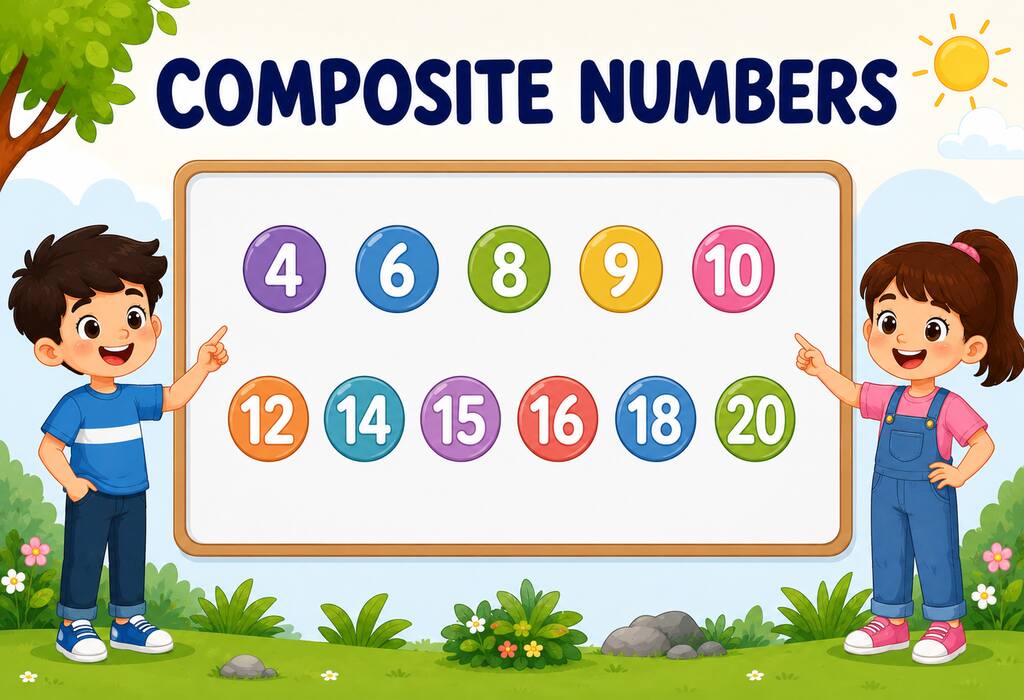
Numbers are everywhere, and understanding their types helps children build a strong foundation in mathematics. Composite numbers are an important part of this learning journey, as they help young learners recognise patterns and relationships between numbers. Simply put, these are numbers with more than two factors, unlike numbers that can only be divided by one and themselves, as shown through a sample of composite numbers.
Thank you for reading this post, don't forget to subscribe!
Knowing the difference between primary and composite numbers helps children classify numbers correctly and solve problems with confidence. This article explains the composite number meaning & examples in a clear and simple way, so children can master the topic and strengthen their overall number sense.
What are Composite Numbers?
Understanding the definition of composite numbers is the first step to mastering this topic.
A composite number is any whole number greater than one that has more than two factors, meaning it can be divided evenly by numbers other than just one and itself. For example, 4, 6, 8, and 9 are composite numbers because they can be divided by more than two numbers without leaving a remainder.
Importance of Composite Numbers
Composite numbers play an important role in helping children understand the building blocks of mathematics. Learning about them strengthens a child’s grasp of multiplication, division, and factors, which are essential skills for solving more complex problems later on.
Composite numbers also form the basis of concepts like prime factorisation, helping children break down larger numbers into smaller, simpler parts. By understanding these numbers, children develop sharper number sense and become more confident in tackling everyday maths problems.
Composite Number Examples
Seeing composite numbers in action makes the concept much easier to understand. Here are some examples that show how these numbers can be divided by more than just one and themselves.
- 4 – Divisible By 1, 2, and 4
- 6 – Divisible By 1, 2, 3, and 6
- 8 – Divisible By 1, 2, 4, and 8
- 9 – Divisible By 1, 3, and 9
- 12 – Divisible By 1, 2, 3, 4, 6, and 12
Properties of Composite Numbers
Composite numbers share certain features that set them apart from other numbers. Looking at all composite numbers, a few common properties help children identify and work with them confidently.
- More Than Two Factors – Every composite number has at least three factors, including 1 and itself.
- Always Greater Than One – Composite numbers start from 4, as 0 and 1 are neither prime nor composite.
- Can Be Even Or Odd – Numbers like 4, 6, and 8 are even composites, while 9, 15, and 21 are odd composites.
- Divisible By Smaller Composite Or Prime Numbers – Every composite number can be divided evenly by at least one prime number.
- Can Be Expressed As A Product Of Primes – Every composite number can be broken down into a multiplication of prime numbers, known as prime factorisation.
- Have Multiple Factor Pairs – Composite numbers can be written as the product of two or more different factor pairs.
- Infinite In Number – There is no limit to composite numbers, as they continue endlessly along the number line.
- Found Between Prime Numbers – Composite numbers often appear between prime numbers on the number line, making it easier for children to spot patterns.
Types of Composite Numbers
Composite numbers can be grouped into two main types: even composite numbers and odd composite numbers. Understanding these types helps children see the variety within composite numbers more clearly.
1. Even Composite Numbers
These are composite numbers that can be divided exactly by 2, meaning they always end in 0, 2, 4, 6, or 8. Examples include 4, 6, 8, 10, and 12, which are all divisible by more than two numbers. Since every even number greater than 2 has at least three factors (1, 2, and itself), all even numbers except 2 are composite numbers. This makes even composites the larger and more easily recognisable group, as children can quickly spot them just by checking the last digit.
2. Odd Composite Numbers
These are composite numbers that cannot be divided exactly by 2, meaning they always end in 1, 3, 5, 7, or 9. Examples include 9, 15, 21, and 25, which can still be divided by numbers other than one and themselves. Unlike even composites, odd composites are not as easy to identify at a glance, since children must check for divisibility by numbers like 3, 5, or 7 to confirm they are composite. The smallest odd composite number is 9, and recognising these numbers helps children strengthen their understanding of factors and multiplication.
How to Identify Composite Numbers?
Identifying composite numbers becomes simple once children know what to look for. A few simple steps can help them check whether a number is composite.
- Check For Divisibility – If a number can be divided evenly by any number other than 1 and itself, it is composite.
- Look At The Last Digit – Numbers ending in 0, 2, 4, 5, 6, or 8 are often composite, except for the number 2 itself.
- Find The Factors – List all the factors of the number; if there are more than two, the number is composite.
- Use The Multiplication Test – Try dividing the number by small primes such as 2, 3, 5, and 7 to see if it divides evenly.
- Rule Out Prime Numbers – If a number is not prime and greater than 1, it is automatically composite.
Composite Numbers Between 1 to 100
This list of composite numbers gives children a handy reference for practising identifying them. Looking at 1 to 100 composite numbers together helps young learners spot patterns and build confidence with larger numbers.
| COMPOSITE NUMBERS | COMPOSITE NUMBERS |
| 4 | 54 |
| 6 | 55 |
| 8 | 56 |
| 9 | 57 |
| 10 | 58 |
| 12 | 60 |
| 14 | 62 |
| 15 | 63 |
| 16 | 64 |
| 18 | 65 |
| 20 | 66 |
| 21 | 68 |
| 22 | 69 |
| 24 | 70 |
| 25 | 72 |
| 26 | 74 |
| 27 | 75 |
| 28 | 76 |
| 30 | 77 |
| 32 | 78 |
| 33 | 80 |
| 34 | 81 |
| 35 | 82 |
| 36 | 84 |
| 38 | 85 |
| 39 | 86 |
| 40 | 87 |
| 42 | 88 |
| 44 | 90 |
| 45 | 91 |
| 46 | 92 |
| 48 | 93 |
| 49 | 94 |
| 50 | 95 |
| 51 | 96 |
| 52 | 98 |
| 54 | 99 |
| 55 | 100 |
Common Misconceptions about Composite Numbers
Children often get confused between composite numbers and other number types while learning this topic. Clearing up these common misconceptions helps them understand the concept more accurately.
- 1 Is A Composite Number – Many children think 1 is composite, but it is neither prime nor composite since it has only one factor.
- All Even Numbers Are Composite – This is false, as 2 is an even number but is prime since it has only two factors.
- Composite Numbers Are Always Large – Children often assume composite numbers start from large numbers, but 4 is the smallest composite number.
- Prime And Composite Numbers Overlap – Some believe a number can be both prime and composite, but every number is either one or the other, never both.
- Odd Numbers Are Always Prime – This is a common mix-up, as numbers like 9, 15, and 21 are odd but still composite.
Solved Examples
Practising with solved examples helps children understand composite numbers more clearly. These examples show, step by step, how to check whether a number is composite.
- Is 15 A Composite Number? – List the factors of 15, which are 1, 3, 5, and 15. Step 2: Count the factors; since there are more than two, 15 is a composite number.
- Is 17 A Composite Number? – List the factors of 17, which are only 1 and 17. Step 2: Since there are exactly two factors, 17 is a prime number, not a composite number.
- Is 21 A Composite Number? – List the factors of 21, which are 1, 3, 7, and 21. Step 2: Count the factors; since there are more than two, 21 is a composite number.
- Is 28 A Composite Number? – List the factors of 28, which are 1, 2, 4, 7, 14, and 28. Step 2: Count the factors; since there are more than two, 28 is a composite number.
- Is 30 A Composite Number? – List the factors of 30, which are 1, 2, 3, 5, 6, 10, 15, and 30. Step 2: Count the factors; since there are more than two, 30 is a composite number.
Practice Problems on Composite Numbers
Practice problems give children the chance to test what they have learnt about composite numbers. Trying these on their own helps build confidence and strengthens their understanding of the topic.
- Find Out Whether 23 Is A Composite Number Or A Prime Number.
- List All The Factors Of 36 And State Whether It Is Composite.
- Pick Out The Composite Numbers From This List: 11, 14, 19, 20, 29.
- Write Down The First Three Odd Composite Numbers.
- State True Or False: All Numbers Ending In 0 Are Composite Numbers.
FAQs
1. How Can Kids Practise Identifying Composite Numbers Quickly?
Kids can practise by picking any number between 1 and 50 and checking if it has more than two factors, doing this daily to build speed and confidence.
2. Are There Any Fun Ways To Learn Composite Numbers?
Yes, kids can use number charts, colouring activities, or simple games that sort numbers into prime and composite groups to make learning more enjoyable.
3. How Can Kids Remember The Difference Between Prime And Composite Numbers?
Kids can remember that prime numbers have only two factors, while composite numbers have more, and practising with small numbers first makes this easier to recall.
4. What Is The Best Way For Kids To Check Their Answers While Practising?
Kids can check their answers by listing out all the factors of a number and counting them, making sure there are more than two before calling it composite.
Understanding composite numbers helps children build a strong foundation in maths, making it easier for them to grasp factors, multiplication, and prime factorisation later on. With regular practice and simple examples, kids can confidently identify composite numbers and apply this knowledge to solve problems.
Also Read:
Prime Numbers
Odd Numbers for Kids
Ordinal Numbers for Kids
Cardinal Numbers for Children