



Last Updated on April 27, 2026
Punctuation marks act as essential guides in writing, helping readers understand meaning with accuracy and rhythm. Learning punctuation for Class 3 students is important because it helps them write clear, lively sentences. This article explains key types—full stops, commas, question marks, exclamation marks, apostrophes, and speech marks—and provides simple rules for their correct use.
Thank you for reading this post, don't forget to subscribe!
These tools clarify pauses, questions, and emotions, transforming ordinary writing into engaging stories. Punctuation worksheets for class 3 are ideal for classroom or home use, featuring interactive exercises such as identifying errors and adding the correct punctuation to sentences. Encourage young learners to master punctuation marks through hands-on practice, building their confidence for writing essays, dialogues, and creative pieces. Start this journey and watch every sentence come alive!
Types of Punctuation For Class 3 With Examples
Punctuation for grade 3 equips children with key marks to clarify and enliven their writing. Discover essential types such as full stops, commas, and question marks, with straightforward examples.
1. Full Stop (.)
A full stop marks the end of a complete thought. It gives your writing a natural pause, like taking a brief breath.
Example: The sun sets slowly.
Without it, sentences can run on endlessly and confuse readers.
2. Question Mark (?)
A question mark ends sentences that seek information or confirmation. It sparks interest and invites responses.
Example: Have you seen the rainbow?
Leaving it out turns questions into plain statements.
3. Exclamation Mark (!)
An exclamation mark expresses strong feelings, such as joy or surprise. It adds energy and emphasis to your words.
Example: What a brilliant goal!
Leaving it out dulls excitement, making the text feel ordinary.
4. Comma (,)
A comma separates ideas, items in lists, or adds pauses within a sentence. It prevents jumbling and helps your writing flow smoothly.
Example: Apples, bananas, and oranges are fruits.
Without commas, lists blur into chaos.
5. Apostrophe (‘)
An apostrophe shows ownership or shrinks words like “do not.” It makes writing more concise and personal.
Example: The dog’s tail wagged happily.
Misplacing it can create mix-ups, like “dogs” versus “dog’s.”
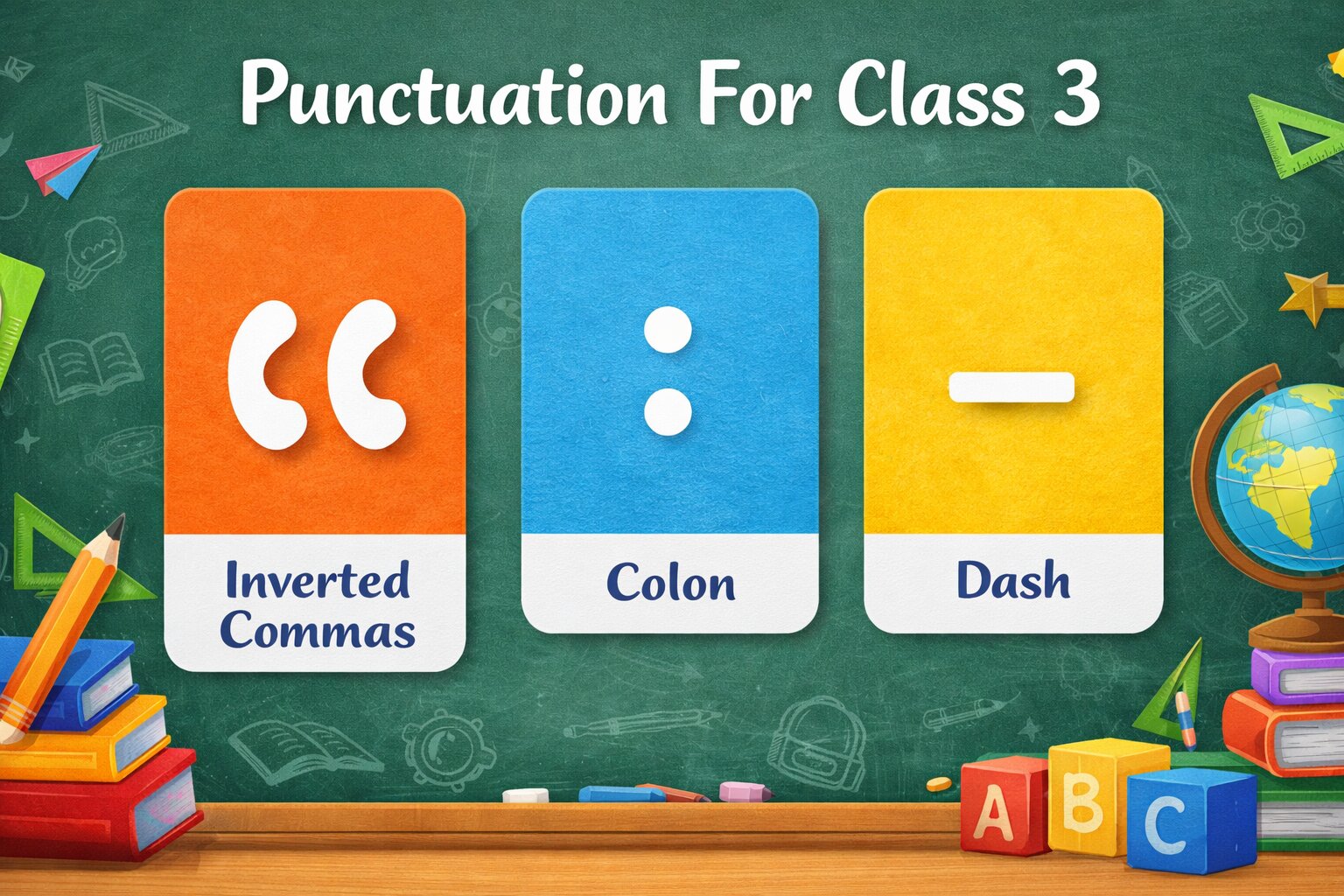
6. Inverted Commas(“ ”)
Inverted commas are used to enclose direct speech or quotations. They set spoken words apart from the rest of the sentence.
Example: “Time for lunch!” called Mum.
Without them, dialogue can become confusing and blend into the main text.
7. Semicolon (;)
A semicolon links related independent clauses that are not joined by a conjunction. It connects ideas smoothly, especially in more advanced writing.
Example: I love reading; stories spark imagination.
Using commas instead can weaken the connection between ideas.
8. Colon (:)
A colon introduces lists, explanations, or quotations. It builds anticipation for what comes next.
Example: Pack these: water, snacks, and a hat.
Without a colon, introductions may feel abrupt or unclear.
9. Hyphen (-)
A hyphen joins compound words or divides syllables at the end of a line. It clarifies meanings in combined terms.
Example: Well-known author.
Confusing it with a dash can make word breaks unclear.
10. Dash (—)
A dash adds emphasis, marks interruptions, or includes extra details. It creates dramatic pauses that commas cannot provide.
Example: My favourite—chocolate cake—is gone!
It highlights surprises with extra emphasis.
Rules For Using Punctuation Marks
Rules for using punctuation marks ensure sentences flow clearly and convey the right meaning. Learn simple guidelines for full stops, commas, question marks, and more to avoid common errors.
1. Use at the end of any complete statement
Put a full stop (.) to finish any sentence sharing information. Readers know one idea ends and another begins.
Example: Elephants trumpet loudly. Stars twinkle at night.
2. Place at the end of direct questions
Attach a question mark (?) to words seeking details or yes/no. This turns statements into true questions.
Example: Is it raining? Why do leaves fall?
3. Use to show strong emotion or surprise
Add an exclamation mark (!) to convey thrill or alarm. Words jump off the page with power.
Example: Help! Ice cream for everyone!
4. Insert to separate items, phrases, or clauses within a sentence
Drop commas (,) into lists or before contrasting phrases. Flow stays natural without overload.
Example: Red, yellow, green lights. Eat slowly, then run.
5. Use to show ownership or contractions
Slip an apostrophe (‘) before “s” for who owns what. Ownership snaps into focus quickly.
Example: The child’s toy broke. Birds’ eggs hatched.
6. Enclose direct speech or quotations
Surround exact quotes or talk with inverted commas (“ ”). Voices stand out from the scene.
Example: “Climb the hill,” urged the guide. “Look below!”
7. Join two related sentences without a conjunction
Link full sentences on similar topics using a semicolon (;). Unity grows without conjunctions.
Example: Clouds gather; thunder follows. Practice hard; win big.
8. Introduce a list, explanation, or example after a complete thought
Follow a complete sentence with a colon (:) for lists ahead. Expectation builds for the reveal.
Example: Tools needed: hammer, nails, wood. Goal: score high.
9. Combine words or parts of words to clarify meaning
Bind two words acting as one modifier with a hyphen (-). Meanings merge without doubt.
Example: Two-wheeled bike. Sun-dried tomatoes.
10. Set off or emphasise information within a sentence
Place dashes (—) around interruptions or highlights. Tension rises in the break.
Example: The hero—brave and quick—saved the day.
Punctuation Sentences For Class 3
Punctuation sentences for Class 3 demonstrate how each of the 10 marks works in action. Study these examples featuring full stops, question marks, exclamation marks, and more to see their real-world sparkle.
- Full Stop (.): The kitten slept peacefully.
- Question Mark (?): “Where is my red ball?” asked Sam.
- Exclamation Mark (!): What a tasty mango!
- Comma (,): I packed sandwiches, juice, and biscuits for the picnic.
- Apostrophe (‘): The children’s laughter filled the park.
- Inverted Commas (“ ”): “Let’s build a sandcastle,” suggested Aria.
- Semicolon (;): Practice daily; skills improve quickly.
- Colon (:): Ingredients: flour, eggs, sugar.
- Hyphen (-): Her state-of-the-art robot beeped.
- Dash (—): The explorer—brave and curious—found treasure.
Ways To Teach Punctuation To Grade 3
Effective ways to teach punctuation make learning interactive and memorable. Try games, stories, and punctuation exercises to help children master marks confidently.
1. Punctuation Treasure Hunt
Hide clue cards with simple, fun sentences missing punctuation around the classroom. Kids solve each by adding the right punctuation to get the next clue and a small treat!
It turns learning punctuation into an exciting adventure.
2. Emoji Punctuation Party
Match smiley or surprised emojis to sentences that need exclamation marks or question marks, then draw your own fun emoji faces.
It helps kids see how punctuation changes feelings in sentences.
3. Superhero Punctuation Relay
Dress up as punctuation heroes (like a cape for Comma Kid or a mask for Question Mark Girl)! Kids race in teams to spot and fix missing punctuation marks on a big story poster.
It makes learning punctuation a fun team challenge.
4. Punctuation Freeze Dance
Dance to music—when it stops, freeze! The teacher shows a punctuation mark, and kids make a face or pose to match it (like a question face).
5. Punctuation Playground Hunt
Scatter clue cards with missing punctuation around the playground. Kids solve each one by adding the right punctuation and race to find the next clue!
It makes punctuation practice a playful outdoor adventure.
6. Emoji Punctuation Party
Match emojis to sentences that need exclamation marks or question marks, then draw your own comic-style emoji faces.
It lets kids show their creativity while learning punctuation.
7. Superhero Punctuation Rescue
Dress up as punctuation superheroes and work as a team to fix stories with missing punctuation in a fun relay race.
This activity builds teamwork and makes punctuation feel like a rescue mission.
8. Punctuation Dance-Off
Dance to music—when it stops, freeze and strike a pose for a punctuation mark (like making arms into an exclamation point) and say a sentence that uses it.
It helps kids remember punctuation by connecting movement and learning.
9. Magic Marker Storytelling
Pass around a sparkly “magic wand” marker. Each child takes a turn adding a sentence to a class fairy tale, making sure to use the correct punctuation.
It creates a magical story together and helps everyone practice punctuation.
10. Animal Apostrophe Adventure
Invent funny animal characters with names that use possessive apostrophes (like Bella’s bone or Max’s hat). Kids act out a short skit about their pet’s day using sentences with apostrophes.
It makes learning about apostrophes fun and memorable with animal characters.
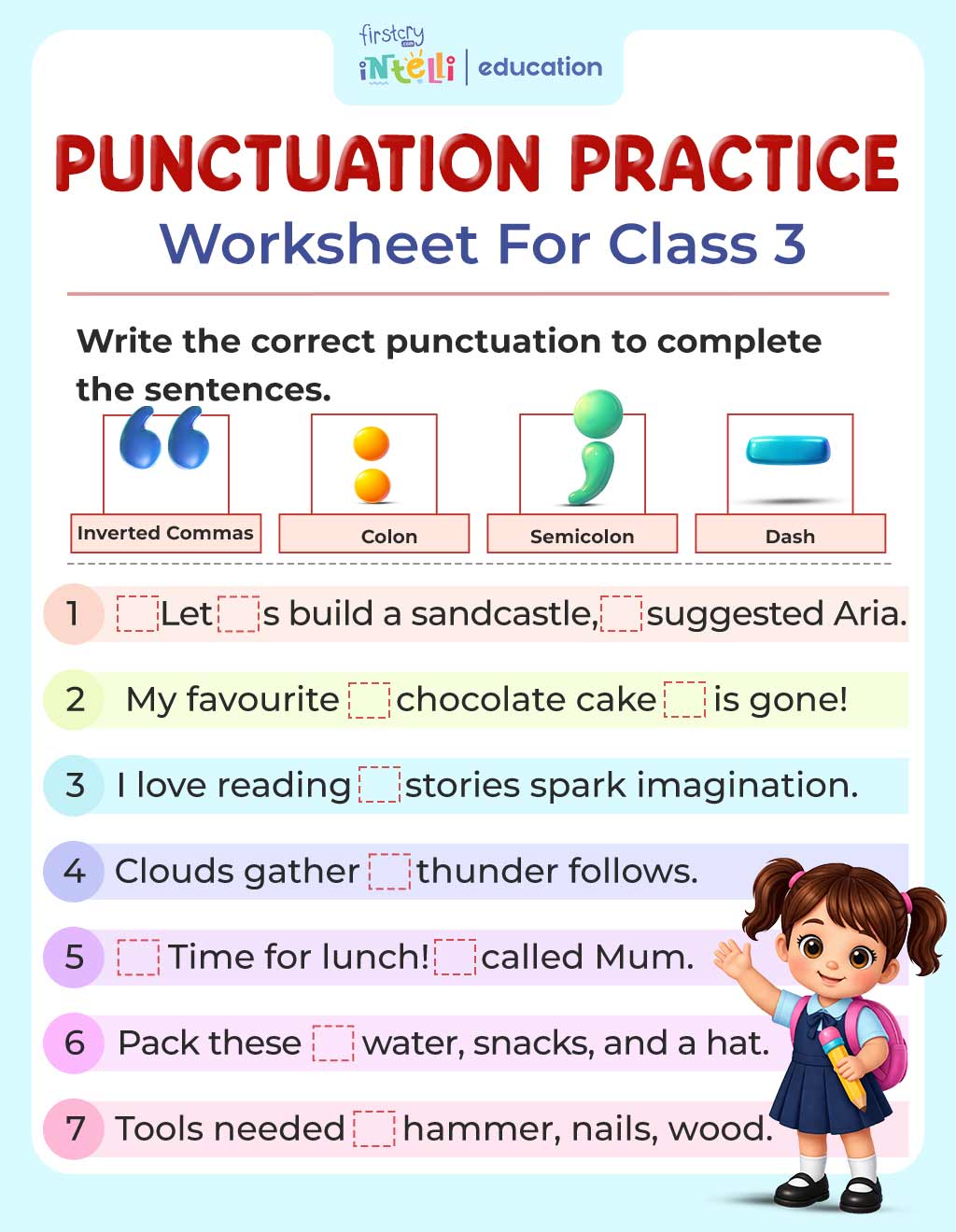
Punctuation Worksheets For Class 3
These punctuation practice worksheets with answers provide engaging exercises for Class 3 to reinforce key punctuation rules. Tackle the tasks, then reveal solutions to sharpen skills instantly.
FAQs
1. What Is The Toughest Punctuation Mistake?
Mixing up apostrophes for possession (like “cat’s hat”) with plurals (“cats’ hats”)—practice by drawing owned items!
2. Why Was Punctuation Invented?
Long ago, writing had no breaks, so readers got lost; punctuation began in ancient Greece to mark pauses like musical notes.
3. Can Punctuation Change A Story’s Mood?
Yes! “Come here.” sounds bossy, but “Come here!” feels excited—try rewriting tales for fun twists.
4. When Do We Use Two Punctuation Marks Together?
Like quotes with questions: “Are you coming?”—place the question mark outside if it’s the whole sentence’s mood.
Learning punctuation for Class 3 is an important step in helping children become confident readers and writers. By understanding how to use full stops, commas, question marks, and exclamation marks, kids can express their thoughts more clearly and correctly. With regular practice through fun activities and worksheets, punctuation becomes easier and more enjoyable. Encouraging children to apply these rules in their daily writing will build a strong foundation for their future language skills.
Also Read:
Adjectives For Kids
Punctuation for Class 1
Punctuation for Class 2