


- What Are Math Riddles?
- Funny Math Riddles with Answers
- Easy Math Riddles
- Hard Math Riddles
- Math Riddles By Grade
- Addition Riddles
- Subtraction Riddles
- Multiplication Riddles
- Division Riddles
- Number Sense and Counting Riddles
- Time & Money Riddles
- Benefits of Solving Mathematical Riddles
- How To Help Kids To Solve Math Riddles?
- FAQs
Last Updated on September 4, 2026
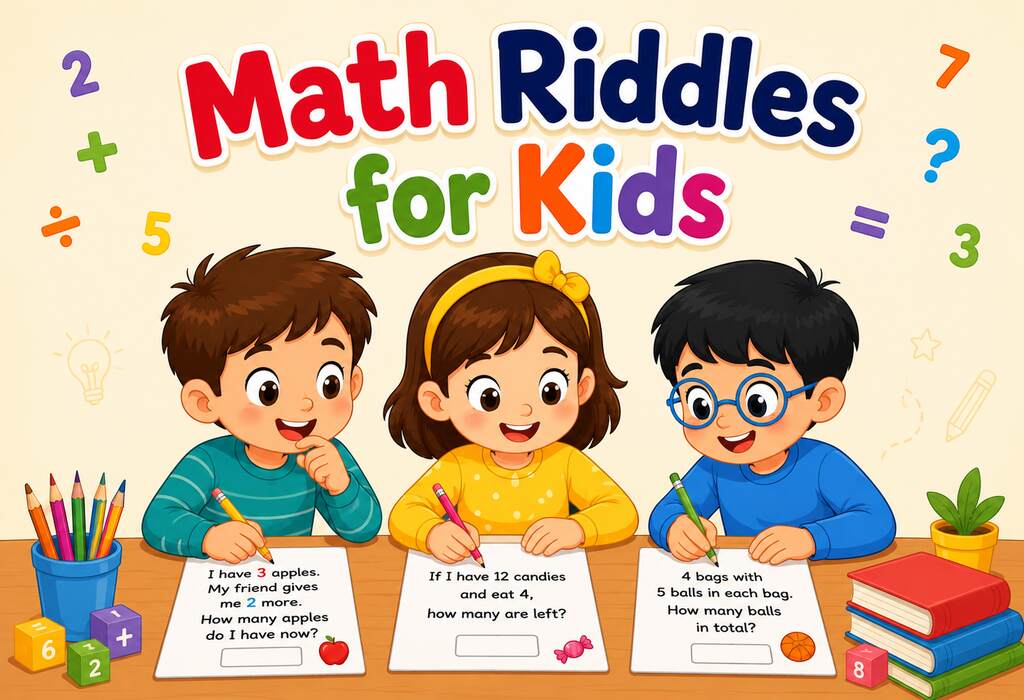
Math riddles for kids make numbers, counting and simple sums feel like a fun little game. With each puzzle, children can giggle, think, and work out the answer using their maths skills. These math riddles are suitable for kindergarten, first, second and third grader to build confidence while keeping little minds busy. Whether it is a quick brain teaser or a tricky number puzzle, math riddles can turn everyday learning into an exciting challenge.
Thank you for reading this post, don't forget to subscribe!
What Are Math Riddles?
Math riddles are fun puzzles that use numbers, counting, shapes, patterns, or simple sums to make children think and find the answer. Instead of solving maths problems in the usual way, children get to play detective and look for clues. They are a fun way to practise maths skills, improve logical thinking, and build confidence while learning.
Funny Math Riddles with Answers
Ready for some number-filled fun? These funny math riddles with answers turn simple maths into playful brain teasers. Let’s see how many interesting maths riddles with answers kids can solve.
1. I am a number. Add 2 to me and you get 7. What number am I?
Answer: 5
2. There are 5 apples in a basket. You take away 2. How many apples do you have?
Answer: 2
3. What number comes next: 2, 4, 6, 8, ___?
Answer: 10
4. I have 3 sides and 3 corners. What shape am I?
Answer: Triangle
5. If you have 4 sweets and get 3 more, how many sweets do you have?
Answer: 7
6. What number is hiding between 9 and 11?
Answer: 10
7. You have 10 balloons and 4 fly away. How many are left?
Answer: 6
8. What is 5 + 5? Even a sleepy cat could solve this one!
Answer: 10
9. I am greater than 3 but smaller than 5. What number am I?
Answer: 4
10. There are 2 ducks in a pond. 2 more ducks join them. How many ducks are there altogether?
Answer: 4
Easy Math Riddles
Let’s start with some easy math riddles that are simple, playful, and fun to solve. Read each riddle carefully, have a guess, and then check the answer to see if you got it right!
1. What is 2 + 3?
Answer: 5
2. I have 5 fingers on one hand. How many fingers are on two hands?
Answer: 10
3. What number comes after 6?
Answer: 7
4. You have 4 toys and get 2 more. How many toys do you have?
Answer: 6
5. What is 10 – 3?
Answer: 7
6. Which number is bigger: 5 or 8?
Answer: 8
7. There are 3 birds on a tree. 2 more fly over. How many birds are there?
Answer: 5
8. What number comes before 10?
Answer: 9
9. You have 6 crayons and give 1 away. How many crayons are left?
Answer: 5
10. What is 4 + 4?
Answer: 8
Hard Math Riddles
Ready for a bigger brain challenge? These difficult math riddles will make children slow down, think carefully, and look for clever clues. Take a guess before checking the answer!
1. I am a number. Double me and add 2, and you get 10. What number am I?
Answer: 4
2. What number comes next: 3, 6, 9, 12, ___?
Answer: 15
3. I am greater than 10, less than 20, and my digits add up to 7. What number am I?
Answer: 16
4. There are 12 sweets. You share them equally among 3 children. How many sweets does each child get?
Answer: 4
5. I am an even number between 10 and 20. My digits add up to 6. What number am I?
Answer: 12
6. A farmer has 4 chickens and each chicken lays 2 eggs. How many eggs are there altogether?
Answer: 8
7. What number is missing: 5 + ___ = 13?
Answer: 8
8. You have 15 balloons and 5 pop. Then you get 3 more. How many balloons do you have now?
Answer: 13
9. I am a number between 20 and 30. I am odd, and my digits add up to 7. What number am I?
Answer: 25
10. There are 3 boxes with 4 toys in each box. How many toys are there altogether?
Answer: 12
Math Riddles By Grade
Math riddles can be a fun way to practise number skills while making learning feel like a game. Here are math riddles with answers grouped by grade, so children can try puzzles that match their learning level and gradually take on trickier challenges.
Riddles for First Grader
1. What is 7 + 2?
Answer: 9
2. What is 10 – 4?
Answer: 6
3. What number comes after 14?
Answer: 15
4. You have 5 pencils and get 3 more. How many pencils do you have?
Answer: 8
5. Which is bigger: 12 or 9?
Answer: 12
6. What is 6 + 6?
Answer: 12
7. There are 9 ducks. 2 swim away. How many are left?
Answer: 7
8. What number comes before 20?
Answer: 19
9. What is 15 – 5?
Answer: 10
10. How many sides does a square have?
Answer: 4
Riddles for Second Grader
1. What is 12 + 8?
Answer: 20
2. What is 25 – 9?
Answer: 16
3. What is 4 × 3?
Answer: 12
4. What is 20 ÷ 4?
Answer: 5
5. What number comes next: 5, 10, 15, 20, ___?
Answer: 25
6. You have 18 sweets and share them equally between 3 children. How many does each child get?
Answer: 6
7. What is double 7?
Answer: 14
8. What number is 5 more than 16?
Answer: 21
9. There are 6 bags with 2 apples in each. How many apples are there?
Answer: 12
10. What is half of 18?
Answer: 9
Riddles for Third Grader
1. What is 7 × 6?
Answer: 42
2. What is 48 ÷ 6?
Answer: 8
3. What is 35 + 27?
Answer: 62
4. What is 75 – 38?
Answer: 37
5. What number comes next: 4, 8, 12, 16, ___?
Answer: 20
6. A box has 24 crayons. If 8 are given away, how many are left?
Answer: 16
7. What is half of 50?
Answer: 25
8. A farmer has 5 rows of 6 plants. How many plants are there altogether?
Answer: 30
9. I am a number greater than 30 but less than 40. My digits add up to 9. What number am I?
Answer: 36
10. What is 100 – 45?
Answer: 55
Addition Riddles
Ready to make numbers join the fun? These addition riddles help children practise adding numbers while solving playful little puzzles.
1. What is 3 + 5?
Answer: 8
2. What is 7 + 6?
Answer: 13
3. What is 9 + 4?
Answer: 13
4. You have 6 apples and get 7 more. How many apples do you have?
Answer: 13
5. What is 12 + 8?
Answer: 20
6. There are 5 birds on a tree and 6 more fly over. How many birds are there?
Answer: 11
7. What is 15 + 5?
Answer: 20
8. What is 9 + 9?
Answer: 18
9. You have 10 toy cars and receive 4 more. How many toy cars do you have?
Answer: 14
10. What is 20 + 7?
Answer: 27
Subtraction Riddles
Time to make some numbers disappear! These subtraction riddles turn taking away into a fun challenge. Solve each puzzle carefully and see if you can work out how many are left.
1. What is 8 – 3?
Answer: 5
2. What is 12 – 5?
Answer: 7
3. You have 10 balloons and 4 pop. How many are left?
Answer: 6
4. What is 15 – 7?
Answer: 8
5. There are 18 sweets and 6 are eaten. How many remain?
Answer: 12
6. What is 20 – 9?
Answer: 11
7. You have 14 crayons and give 5 away. How many are left?
Answer: 9
8. What is 25 – 10?
Answer: 15
9. There are 16 ducks in a pond. 7 swim away. How many remain?
Answer: 9
10. What is 30 – 12?
Answer: 18
Multiplication Riddles
Ready to make groups of numbers? These multiplication riddles make times tables more playful by using familiar things such as toys, sweets, and animals.
1. What is 2 × 3?
Answer: 6
2. What is 4 × 5?
Answer: 20
3. There are 3 bags with 4 sweets in each. How many sweets are there altogether?
Answer: 12
4. What is 6 × 2?
Answer: 12
5. There are 5 boxes with 3 toys in each. How many toys are there?
Answer: 15
6. What is 7 × 4?
Answer: 28
7. There are 4 rows with 5 chairs in each row. How many chairs are there?
Answer: 20
8. What is 8 × 3?
Answer: 24
9. A farmer has 6 groups of 2 chickens. How many chickens are there?
Answer: 12
10. What is 9 × 5?
Answer: 45
Division Riddles
Let’s share and split our way through some fun division riddles. Read each question carefully, have a go at solving it, and then check the answer.
1. What is 6 ÷ 2?
Answer: 3
2. You have 8 sweets and share them equally between 4 children. How many sweets does each child get?
Answer: 2
3. What is 12 ÷ 3?
Answer: 4
4. There are 15 apples. You put them equally into 3 baskets. How many apples go in each basket?
Answer: 5
5. What is 20 ÷ 4?
Answer: 5
6. You have 18 crayons and share them equally among 6 children. How many crayons does each child get?
Answer: 3
7. What is 24 ÷ 6?
Answer: 4
8. There are 21 biscuits shared equally among 3 friends. How many biscuits does each friend get?
Answer: 7
9. What is 30 ÷ 5?
Answer: 6
10. You have 16 toy cars and put the same number into 4 boxes. How many cars go in each box?
Answer: 4
Number Sense and Counting Riddles
Ready to have some number fun? Read each riddle aloud, let children have a think, and then check the answer!
1. I come after 7 and before 9. What number am I?
Answer: 8
2. How many fingers are there on one hand?
Answer: 5
3. You have 9 balloons and 2 pop. How many balloons are left?
Answer: 7
4. There are 5 ducks in a pond. 3 more join them. How many ducks are there?
Answer: 8
5. Which number is smaller: 6 or 9?
Answer: 6
6. Count backwards: 10, 9, 8, 7, ___?
Answer: 6
7. I am a number greater than 4 but smaller than 6. What number am I?
Answer: 5
8. There are 10 apples. If you count 3 of them, how many apples are left uncounted?
Answer: 7
9. What number comes next: 5, 10, 15, 20, ___?
Answer: 25
10. You have 4 red balls and 4 blue balls. How many balls do you have altogether?
Answer: 8
Time & Money Riddles
Tick-tock! Ready for some fun with clocks and coins? These time and money riddles help children practise telling the time, counting money, and thinking through everyday situations.
1. If it is 2 o’clock now, what time will it be in 1 hour?
Answer: 3 o’clock
2. How many minutes are there in 1 hour?
Answer: 60
3. A toy costs 50 cents and you have 20 cents. How many more cents do you need?
Answer: 30 cents
4. What time is 30 minutes after 4 o’clock?
Answer: 4:30
5. You have three 10-cent coins. How many cents do you have?
Answer: 30 cents
6. If a film starts at 5 o’clock and lasts 2 hours, what time does it finish?
Answer: 7 o’clock
7. You have 100 cents and spend 40 cents. How many cents are left?
Answer: 60 cents
8. How many minutes are there in half an hour?
Answer: 30 minutes
9. A book costs 60 cents and a pencil costs 20 cents. How many cents do they cost altogether?
Answer: 80 cents
10. If it is 9 o’clock and you wait for 3 hours, what time will it be?
Answer: 12 o’clock
Benefits of Solving Mathematical Riddles
Solving mathematical riddles can make maths feel less like a lesson and more like a playful challenge. Along the way, kids can strengthen their thinking skills, practise basic maths concepts, and become more confident problem-solvers. Here are some key benefits:
1. Builds Logical Thinking
Riddles on mathematics encourage children to look for clues, connect ideas, and work out solutions step by step.
2. Improves Problem-Solving Skills
Each riddle presents a small challenge that encourages children to think carefully and try different ways to find the answer.
3. Makes Maths More Enjoyable
Playful puzzles can make numbers and calculations more exciting, helping children develop a positive attitude towards maths.
4. Strengthens Mental Maths
Regular practice helps children become quicker and more confident with counting, addition, subtraction, multiplication, and division.
5. Encourages Curiosity
A tricky question can make children want to find out why an answer is correct, turning everyday maths practice into an engaging learning experience.
How To Help Kids To Solve Math Riddles?
Helping kids solve riddles on mathematics is all about making the process relaxed and enjoyable. Instead of giving them the answer straight away, encourage them to read the clues carefully.
- Start with simple riddles: Begin with questions they can solve comfortably, then gradually introduce trickier ones.
- Read the riddle together: Help children spot important numbers, words, and clues.
- Use everyday objects: Try toys, coins, pencils, or snacks to demonstrate counting and calculations.
- Give hints instead of answers: A small clue can help children reach the solution independently.
- Celebrate their effort: Praise careful thinking and trying, even when the first answer is not quite right.
FAQs
1. What makes a maths riddle different from a regular maths question?
A maths riddle usually presents a problem through a story, clue, pattern, or playful question, making children think about the answer in a different way.
2. Can children solve maths riddles without using paper and pencil?
Yes. Many simple riddles can be solved mentally, making them a handy activity for car journeys, waiting times, or quick brain breaks.
3. How can I choose the right maths riddles for my child?
Choose riddles based on the maths skills your kid is currently practising, such as counting, addition, subtraction, multiplication, division, shapes, or patterns.
4. What should I do if my child gets a maths riddle wrong?
Encourage them to look at the clues again and try a different approach. Give a small hint if needed rather than revealing the answer straight away.
Maths can be full of little surprises, and these math brain teasers make learning feel like a playful challenge. Encourage kids to solve the puzzles, share their thinking, and have another go when an answer does not come easily. With regular practice, math riddles and answers can help build confidence, sharpen problem-solving skills, and make maths a fun part of everyday learning.
Also Read:
Tricky Riddles for Kids
Animal Riddles for Children
Science Quiz with Answers for Kids