



Last Updated on August 27, 2026
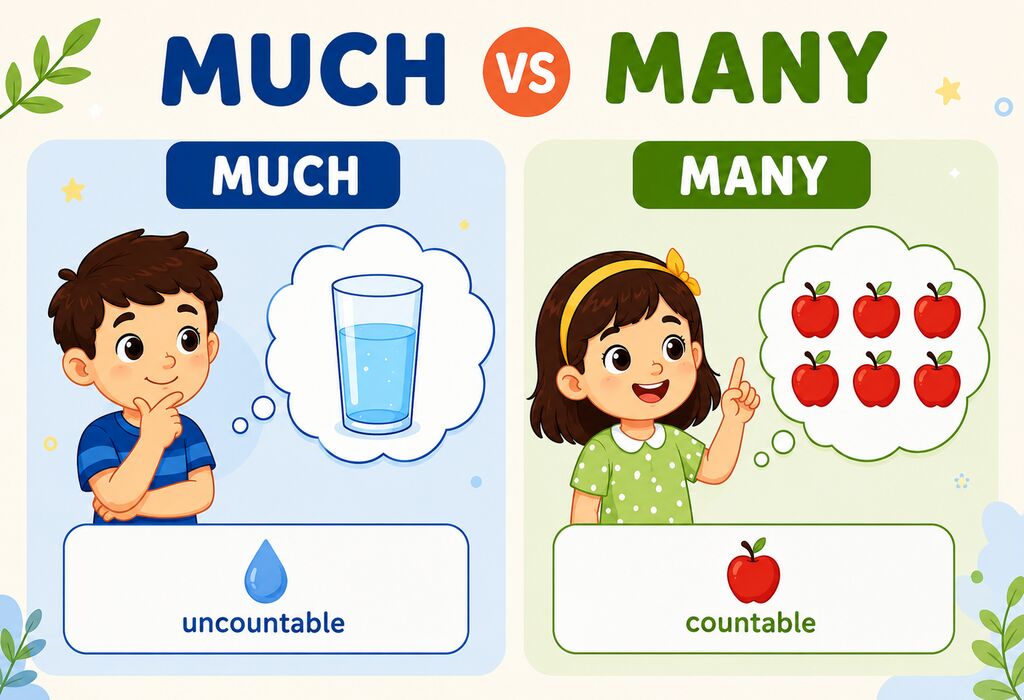
“Much” and “many” are two commonly confused words in English, and understanding the difference between much and many is essential for children learning to speak and write correctly. Both words indicate quantity, but they follow distinct rules depending on the noun they accompany. “Much” is used with uncountable nouns, such as water or time, while “many” is used with countable nouns, such as books or friends.
Thank you for reading this post, don't forget to subscribe!
The much vs. many distinction isn’t complicated once the underlying rule is understood, but it does take consistent practice to apply correctly in everyday speech and writing. Misusing these words is a common mistake, even among older students, which is why clear examples and simple explanations help build confidence. In this article, we break down the uses, rules and examples of “much” and “many,” helping your child understand exactly when and how to use each word with ease.
What Are ‘Much’ And ‘Many’?
“Much” and “many” are both quantifiers, words used to describe the amount or quantity of something in a sentence. The key difference lies in the type of noun each word is paired with. “Much” is used with uncountable nouns, things that can’t be counted individually, such as water, sugar, time or advice. “Many” is used with countable nouns, things that can be counted as separate units, such as apples, chairs or friends.
Understanding when to ask how many and how much is a useful way to remember this rule in everyday conversation. If you can count the items one by one, like “how many books do you have,” you’ll use “many.” If the noun can’t be broken into countable units, like “how much water is left,” you’ll use “much” instead. This simple distinction forms the foundation for using both words correctly in speech and writing.
When To Use ‘Much’ and ‘Many’?
Choosing the right quantifier comes down to a simple rule: whether the noun can be counted individually or not. Here’s a quick breakdown to help your child use ‘much’ and ‘many’ correctly every time.
| Word | Used With | Example |
| Much | Uncountable nouns (things that can’t be counted individually, such as water, time or advice) | There isn’t much water left in the bottle. |
| Many | Countable nouns (things that can be counted as separate units, such as books or friends) | There are many books on the shelf. |
Difference Between ‘Much’ and ‘Many’
Understanding whether to use many versus much becomes much easier once the core distinction is clear. Here’s a side-by-side comparison to help your child spot the difference at a glance.
| MUCH | MANY |
| Used with uncountable nouns. | Used with countable nouns. |
| Refers to quantity that can’t be counted individually. | Refers to a number of items that can be counted individually. |
| Common examples: much water, much time, much advice. | Common examples: many books, many friends, many chairs. |
| Often used in negative sentences and questions, such as “not much” or “how much.” | Commonly used in both positive and negative sentences, such as “many people” or “not many.” |
| In casual speech, “a lot of” is often used instead of “much” in positive sentences. | “Many” is used comfortably in both formal and everyday English. |
Examples Of ‘Much’ In Sentences With An Uncountable Noun
Seeing ‘much’ used correctly alongside uncountable nouns helps children apply the rule naturally in their own writing. Here are ten simple examples to illustrate this usage.
- There isn’t much water left in the bottle.
- She doesn’t have much time to finish her homework.
- How much sugar do we need for the cake?
- He gave me much advice before my exam.
- There is much confusion about the new school rules.
- I don’t have much money left this month.
- There isn’t much milk in the fridge.
- We don’t need much rice for this recipe.
- There is much excitement about the upcoming festival.
- She doesn’t show much interest in sports.
Examples Of ‘Many’ In Sentences With A Countable Noun
Seeing ‘many’ used correctly alongside countable nouns helps children understand how to apply the rule confidently in their own writing. Here are ten simple examples to illustrate this usage.
- There are many books on the shelf.
- How many apples did you buy from the market?
- She has many friends in her new school.
- There are many students in the classroom today.
- He asked many questions during the lesson.
- We saw many birds flying over the lake.
- There are many toys scattered across the room.
- I have many ideas for the school project.
- There weren’t many people at the event.
- She has read many books this year.
Common Mistakes with Much and Many
Even after learning the rule, children often slip up when deciding between much or many in their sentences. Here are five common mistakes to watch out for.
- Using “Much” With Countable Nouns – A common mistake is saying “much books” instead of “many books,” since countable nouns should always pair with “many.”
- Using “Many” With Uncountable Nouns – Saying “many water” instead of “much water” is another frequent error, as uncountable nouns require “much,” not “many.”
- Overusing “Much” in Positive Sentences – In casual speech, “much” can sound overly formal in positive sentences, such as “I have much homework,” when “a lot of homework” would sound more natural.
- Confusing “How Much” and “How Many” in Questions – Children sometimes mix up these question forms, asking “how much friends” instead of the correct “how many friends.”
- Forgetting That Some Nouns Can Be Both Countable and Uncountable – Words like “time” can be uncountable in general use (“much time”) but countable in specific contexts (“many times”), which can confuse young learners.
Useful Tips
Looking at much and many examples side by side can help reinforce the rule until it becomes second nature. Here are five practical tips to make the distinction easier to remember.
- Ask If You Can Count It – If the noun can be counted one by one, like “apples” or “friends,” use “many.” If it can’t, like “water” or “advice,” use “much.”
- Use “How Many” and “How Much” as Question Cues – Practising these two question forms helps children instinctively pair the right quantifier with the right type of noun.
- Replace “Much” With “A Lot Of” in Casual Speech – In everyday conversation, especially in positive sentences, “a lot of” often sounds more natural than “much.”
- Watch Out for Tricky Dual-Use Nouns – Some words, like “time,” can be both countable and uncountable depending on context, so pay close attention to how they’re used in a sentence.
- Practise With Real-Life Examples – Applying the rule to everyday situations, such as describing how much water is left or how many friends are coming over, helps make the concept feel more natural.
‘Much’ Vs. ‘Many’: Practice Exercise
A little practice goes a long way in helping your child use ‘much’ and ‘many’ correctly and confidently. Try these ten exercises together to reinforce the rule.
- How ______ (much/many) sugar do you need for the recipe?
- Are there ______ (much/many) chairs in the classroom?
- We don’t have ______ (much/many) time before the bus arrives.
- How ______ (much/many) friends does she have at her new school?
- They bought ______ (much/many) books from the store yesterday.
- There isn’t ______ (much/many) milk left in the fridge.
- How ______ (much/many) water do we need for the plants?
- There weren’t ______ (much/many) people at the event.
- He doesn’t have ______ (much/many) money left this week.
- How ______ (much/many) apples are there in the basket?
Answers: 1. much, 2. many, 3. much, 4. many, 5. many, 6. much, 7. much, 8. many, 9. much, 10. many
FAQs
1. Can “Much” or “Many” Be Used Without a Noun Following Them?
Yes, both words can stand alone in certain contexts, such as “I don’t have much” or “There aren’t many left,” where the noun is implied from earlier in the conversation.
2. Why Does “Much” Sound Strange in Some Positive Sentences?
In everyday spoken English, “much” is more commonly used in questions and negative sentences, which is why phrases like “I have much time” can sound overly formal compared to “I have a lot of time.”
3. Is “Money” Countable or Uncountable, and Which Word Should I Use With It?
“Money” is uncountable, so it should always be paired with “much,” as in “much money,” even though individual coins or notes can technically be counted.
4. Can “Many” Be Used With Numbers Directly, Like “Many Two Books”?
No, “many” is used on its own with plural countable nouns, such as “many books,” and should never be paired directly with a specific number like “two.”
Knowing when to use ‘much’ versus ‘many’ comes down to one simple question: can you count it? With regular practice using the rules, examples and exercises covered in this article, your child can confidently apply this distinction in both everyday conversation and formal writing, without second-guessing themselves.
Also Read:
This Vs That for Kids
Left Vs Right Concept
Thick and Thin Concept for Children