



Last Updated on August 30, 2026
The letter C brings together an unusually diverse set of birds, spanning towering flightless giants, sharp-eyed hunters, and small garden favourites. Kids curious about bird names that start with the letter ‘C’ will find plenty to explore here, from the fast-running cassowary to the deep-diving common kingfisher.
Thank you for reading this post, don't forget to subscribe!
This guide gathers together a useful set of birds that start with ‘C’ for preschoolers and kids, complete with pictures and short, memorable facts. Working through these ‘C’ letter bird names is an easy way for children to pick up new vocabulary while learning where different birds live and how they behave. Here’s a closer look at some notable birds starting with C.
List Of Bird Names That Start With ‘C’
Some birds beginning with ‘C’ rule the skies, while others prefer to run, dive, or dance their way through life. Here is a selection of well-known species, along with facts and sightings to help kids recognise them.
1. Cassowary
The cassowary is a large, flightless bird known for its tall, bony head crest and powerful legs, which make it one of the most dangerous birds in the world.
Did You Know?
- Cassowaries can run at speeds of up to 50 kilometres per hour.
- They have a sharp, dagger-like claw on each foot used for defence.
- Cassowaries play an important role in spreading seeds across the rainforest.
- Their loud, booming calls are among the lowest of any bird.
Where You Might See : Cassowaries are found in the tropical rainforests of northern Australia and New Guinea.
2. Cardinal
The cardinal is a striking songbird, with males easily recognised by their bright red feathers and distinctive crest.
Did You Know?
- Only the male cardinal is bright red; the female has a warm brown colour with red tinges.
- Cardinals are one of the few backyard birds that sing all year round.
- They mate for life and are often seen feeding one another during courtship.
- Cardinals do not migrate, even during cold winters.
Where You Might See : Cardinals are widely found across the eastern and central United States, often in gardens, parks, and woodlands.
3. Cockatoo
The cockatoo is a large, expressive parrot known for its striking crest, which it raises when excited or alarmed.
Did You Know?
- Cockatoos are highly intelligent and can learn to solve simple puzzles.
- They can live for 40 to 70 years, with some living even longer in captivity.
- Cockatoos form strong bonds with their flock or family members.
- Their loud calls can be heard from great distances.
Where You Might See : Cockatoos are commonly found across Australia, Indonesia, and the Philippines.
4. Chickadee
The chickadee is a small, energetic songbird known for its cheerful call, which sounds much like its own name.
Did You Know?
- Chickadees can remember the exact locations of thousands of hidden seeds.
- They often join mixed flocks with other small birds during winter.
- Chickadees have excellent memories that help them survive cold months.
- Their black cap and bib make them easy to identify.
Where You Might See : Chickadees are commonly found across North America, particularly in forests, gardens, and parks.
5. Crane
The crane is a tall, elegant bird known for its long legs, graceful neck, and elaborate dancing displays during courtship.
Did You Know?
- Cranes perform energetic dancing displays that include jumps, bows, and wing flapping.
- Some crane species can fly at altitudes of over 6,000 metres during migration.
- Cranes mate for life and often return to the same nesting site each year.
- They are considered a symbol of luck and long life in several cultures.
Where You Might See : Cranes are found across wetlands in Africa, Asia, Europe, and North America.
6. Chaffinch
The chaffinch is a small, colourful finch, with males showing a soft pink chest and blue-grey head during the breeding season.
Did You Know?
- Chaffinches have distinct regional “dialects” in their song, which can vary between areas.
- They mainly feed on seeds and insects.
- Male chaffinches display bold white wing patches, visible in flight.
- Chaffinches are one of the most common finches across Europe.
Where You Might See : Chaffinches are widely found across the United Kingdom and Europe, often in woodlands, hedgerows, and gardens.
7. Common Kingfisher
The common kingfisher is a small, vividly coloured bird known for its lightning-fast dives to catch fish from rivers and streams.
Did You Know?
- Kingfishers can dive into water at speeds fast enough to catch fish before they react.
- Their bright blue and orange feathers help them blend into dappled light near water.
- Kingfishers dig long nesting tunnels into riverbanks.
- They can eat their own body weight in fish within a single day.
Where You Might See : Common kingfishers are found across the United Kingdom, Europe, and parts of Asia, usually near slow-moving rivers and streams.
8. Cormorant
The cormorant is a large waterbird often seen perched with its wings spread out to dry after diving for fish.
Did You Know?
- Cormorant feathers are not fully waterproof, which helps them dive more easily underwater.
- They can dive to depths of over 20 metres in search of fish.
- Cormorants are excellent swimmers, using their feet to propel themselves underwater.
- Some cultures have trained cormorants to help catch fish for humans.
Where You Might See : Cormorants are commonly found along coastlines, rivers, and lakes across the United Kingdom, Europe, and beyond.
9. Common Buzzard
The common buzzard is a broad-winged bird of prey often seen soaring in wide circles high above open countryside.
Did You Know?
- Buzzards have keen eyesight that allows them to spot small prey from great heights.
- They often reuse the same nest, adding new material to it each year.
- Buzzards feed mainly on small mammals, birds, and carrion.
- Their loud, mewing call is often heard before the bird is seen.
Where You Might See : Common buzzards are widely found across the United Kingdom and much of Europe, especially near open farmland and woodland edges.
10. Chicken (Red Junglefowl)
The red junglefowl is the wild ancestor of the domestic chicken, known for its colourful feathers and loud crowing call.
Did You Know?
- All domestic chickens are believed to have descended from the red junglefowl.
- Male junglefowl have glossy, colourful feathers, while females are duller for camouflage.
- They are strong fliers over short distances, unlike most domestic chickens.
- Junglefowl live in small social groups led by a dominant male.
Where You Might See : Red junglefowl are native to the forests of South and Southeast Asia, including India and Thailand.
11. Common Loon
The common loon is a striking waterbird known for its haunting, echoing call often heard across quiet lakes.
Did You Know?
- Loons are powerful swimmers and can dive to depths of over 60 metres.
- Their bones are heavier than most birds, helping them dive more easily.
- Loons need a long stretch of open water to take off in flight.
- Their eerie call is often associated with wild, remote lakes.
Where You Might See : Common loons are found across lakes in Canada and the northern United States, especially during the breeding season.
12. Cedar Waxwing
The cedar waxwing is a sleek, crested songbird known for its smooth feathers and the bright red, waxy tips on its wings.
Did You Know?
- Cedar waxwings mainly feed on berries and can sometimes become mildly intoxicated from overripe fruit.
- They often travel in large, tight-knit flocks.
- Waxwings are known for their habit of passing berries to one another before eating.
- Their name comes from the small, red, wax-like tips found on their wing feathers.
Where You Might See : Cedar waxwings are commonly found across North America, particularly in orchards, gardens, and woodlands.
13. Curlew
The curlew is a large wading bird recognised by its long, downward-curving beak, used to probe deep into mud for food.
Did You Know?
- The curlew has the longest beak of any wading bird in the United Kingdom.
- Its haunting, bubbling call is often associated with open moorlands.
- Curlews feed mainly on worms, shellfish, and small insects.
- They are considered a species of conservation concern in several countries.
Where You Might See : Curlews are found across the United Kingdom, Europe, and parts of Asia, often in wetlands, moorlands, and coastal mudflats.
14. Crested Caracara
The crested caracara is a bold bird of prey known for its striking black cap and habit of walking on the ground in search of food.
Did You Know?
- Unlike most birds of prey, caracaras often walk or run to catch prey rather than swooping down.
- They are opportunistic feeders, eating carrion as well as live prey.
- Caracaras are closely related to falcons, despite behaving quite differently.
- They are known for their loud, rattling calls.
Where You Might See : Crested caracaras are found across the southern United States, Mexico, and parts of South America.
15. Chukar Partridge
The chukar partridge is a plump, ground-dwelling bird known for its distinctive black-and-white striped flanks.
Did You Know?
- Chukars prefer running over flying when startled, only taking to the air when necessary.
- They are well suited to rocky, dry hillsides and mountainous terrain.
- Chukars live in small flocks known as coveys.
- Their sharp, chuckling call gives the bird its name.
Where You Might See : Chukar partridges are native to parts of Asia and the Middle East, and have also been introduced to parts of North America.
More ‘C’ Letter Birds
Beyond this list, the letter C covers many more ‘C’ starting bird names worth adding to your child’s bird-watching vocabulary. The table below rounds up 20 additional species.
| California Condor | Canada Goose |
| Carolina Wren | Caspian Tern |
| Cattle Egret | Cave Swallow |
| Chestnut-backed Chickadee | Chimney Swift |
| Common Nighthawk | Common Redpoll |
| Common Tern | Coot |
| Crested Tit | Crossbill |
| Crow | Cuckoo |
| Curl-crested Aracari | Cactus Wren |
| Chinstrap Penguin | Collared Dove |
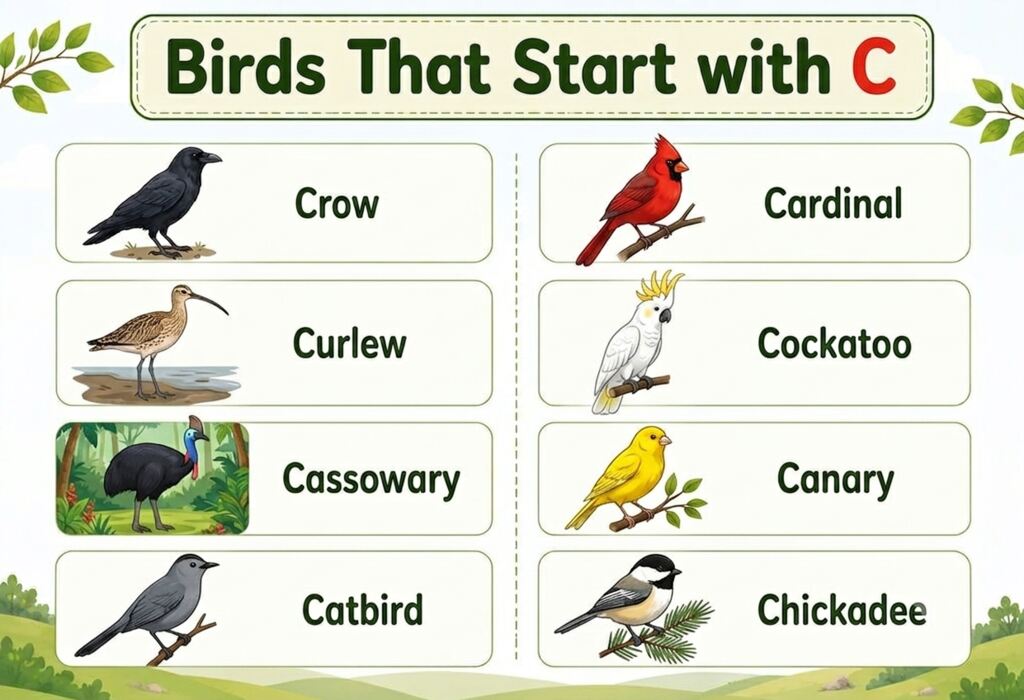
Birds That Start With ‘C’ – Chart
For a quick answer to what bird starts with the letter ‘C’, this chart pulls together every name mentioned in the article, making it easy to revisit any bird at a glance.
FAQs
1. Which ‘C’ Bird Is Considered One Of The Most Dangerous In The World?
The cassowary is often regarded as one of the most dangerous birds in the world, thanks to its powerful legs and sharp, dagger-like claws.
2. Which Bird Starting With ‘C’ Is Known For Its Elaborate Dancing Display?
The crane is well known for its graceful and energetic dancing display, which includes jumps, bows, and wing flapping during courtship.
3. Are All Birds Starting With ‘C’ Able To Fly?
No, the cassowary is a flightless bird, while most other birds on this list, such as the cardinal and chickadee, are strong fliers.
4. Which ‘C’ Bird Is The Wild Ancestor Of The Domestic Chicken?
The red junglefowl is believed to be the wild ancestor of the domestic chicken and is still found in forests across South and Southeast Asia.
From the towering cassowary to the tiny, tuneful chickadee, bird names starting with ‘C’ give kids plenty of curious characters to remember. Along the way, this list also helps build kids’ vocabulary, turning each new bird into a small, memorable lesson about the natural world.