



Last Updated on August 30, 2026
The letter D introduces kids to a memorable mix of birds, from the deep-diving duck to the fierce diving falcon, each bringing its own set of quirks and skills to the table. Anyone hunting for bird names that start with the letter ‘D’ will come across everything from familiar backyard visitors to birds found only in far-off corners of the world.
Thank you for reading this post, don't forget to subscribe!
Below is a handpicked set of birds that start with ‘D’ for preschoolers and kids, each paired with a picture and a few fun facts to make learning stick. Getting to know these ‘D’ letter bird names gives children an easy way to grow their vocabulary while picking up small details about how different species live, hunt, and survive. Here’s a closer look at some notable birds starting with D.
List Of Bird Names That Start With ‘D’
Some birds beginning with ‘D’ are known for graceful flight, while others stand out for their unusual calls or striking colours. Here is a selection of well-known species, along with facts and sightings to help kids recognise them.
1. Dodo
The dodo was a large, flightless bird once found only on the island of Mauritius, now remembered as one of the most famous extinct species in history.
Did You Know?
- The dodo became extinct in the late 1600s after being hunted and losing its natural habitat.
- It had no natural predators before humans arrived on its island home.
- The dodo is believed to have weighed around 10 to 18 kilograms.
- Its name is often used today to describe something outdated or gone forever.
Where You Might See : The dodo is now extinct, but it was once found only on the island of Mauritius in the Indian Ocean.
2. Duck
The duck is a familiar waterbird known for its webbed feet, flat beak, and distinctive quacking call.
Did You Know?
- Ducks have waterproof feathers thanks to a special oil they spread while preening.
- Baby ducks can swim within hours of hatching.
- Not all ducks quack; some species make whistling or grunting sounds instead.
- Ducks have excellent eyesight, allowing them to see in almost every direction at once.
Where You Might See : Ducks are found on lakes, ponds, and rivers across almost every continent except Antarctica.
3. Dove
The dove is a gentle bird often associated with peace, known for its soft cooing call and smooth, rounded body.
Did You Know?
- Doves are closely related to pigeons and share many similar features.
- Both parent doves produce a special liquid called “crop milk” to feed their chicks.
- Doves are known for their strong homing instincts.
- They are often used as a symbol of peace in art and literature.
Where You Might See : Doves are found almost worldwide, commonly seen in cities, parks, and gardens.
4. Diving Petrel
The diving petrel is a small seabird known for its unusual habit of “flying” underwater to catch food.
Did You Know?
- Diving petrels use their wings to swim underwater, much like penguins do.
- They can dive straight into waves without slowing down first.
- These birds nest in burrows dug into coastal cliffs and islands.
- Diving petrels mainly feed on tiny crustaceans and plankton.
Where You Might See: Diving petrels are found along the coastlines of the Southern Hemisphere, including parts of New Zealand and South America.
5. Darter
The darter is a slender waterbird known for swimming with only its long neck above the surface, much like a snake.
Did You Know?
- Darters spear fish underwater using their sharp, pointed beaks.
- Their feathers are not fully waterproof, which helps them stay submerged.
- Darters often spread their wings out to dry after swimming.
- They are sometimes called “snakebirds” because of how they swim.
Where You Might See: Darters are found across wetlands in Africa, Asia, Australia, and parts of the Americas.
6. Demoiselle Crane
The demoiselle crane is a small, elegant crane known for its soft grey feathers and delicate black plumes on its neck.
Did You Know?
- Demoiselle cranes are the smallest species of crane in the world.
- They migrate over the Himalayas, one of the most challenging routes for any bird.
- These cranes are known for graceful, dance-like courtship displays.
- They travel in large flocks during migration.
Where You Might See: Demoiselle cranes breed in parts of Central Asia and migrate to India and Africa for winter.
7. Dunlin
The dunlin is a small wading bird recognised by its slightly curved beak and busy feeding habits along muddy shorelines.
Did You Know?
- Dunlins often feed in large, tightly packed flocks.
- Their feathers change colour with the seasons, from reddish-brown in summer to greyer tones in winter.
- Dunlins can travel thousands of kilometres during migration.
- They use their beaks to probe mud for worms and small creatures.
Where You Might See : Dunlins are commonly found along coastlines in the United Kingdom, Europe, and North America.
8. Drongo
The drongo is a bold, glossy black bird known for fearlessly chasing away much larger birds that come near its nest.
Did You Know?
- Drongos are known to mimic the alarm calls of other animals to steal their food.
- They often perch on the backs of grazing animals to catch insects stirred up from the ground.
- Drongos have long, forked tails that help with quick, agile flight.
- They are considered one of the most fearless small birds.
Where You Might See : Drongos are commonly found across Africa, Asia, and parts of Australia.
9. Double-crested Cormorant
The double-crested cormorant is a large waterbird known for the small feathery tufts that appear on its head during the breeding season.
Did You Know?
- This cormorant can dive to depths of several metres in search of fish.
- Its name comes from the two small crests of feathers seen briefly each breeding season.
- Double-crested cormorants often nest in large, noisy colonies.
- They are strong swimmers, using their feet to move quickly underwater.
Where You Might See: Double-crested cormorants are widely found across lakes, rivers, and coastlines in North America.
10. Downy Woodpecker
The downy woodpecker is the smallest in North America, known for its black-and-white pattern and steady drumming on tree trunks.
Did You Know?
- Downy woodpeckers drum on wood both to find food and to communicate with other birds.
- They have specially adapted skulls that help absorb the shock of constant pecking.
- Their long, sticky tongues help them pull insects out from under tree bark.
- Downy woodpeckers are common visitors to garden bird feeders.
Where You Might See : Downy woodpeckers are commonly found across the United States and Canada, particularly in forests and gardens.
11. Diving Duck
The diving duck is a category of duck species specially adapted to dive underwater in search of food, unlike dabbling ducks that feed near the surface.
Did You Know?
- Diving ducks have legs set further back on their bodies, which helps with swimming but makes walking on land more difficult.
- They can dive several metres underwater in search of food.
- Diving ducks often need a running start across the water to take flight.
- Common examples include the pochard and the scaup.
Where You Might See : Diving ducks are found on lakes, rivers, and coastal waters across the United Kingdom, Europe, and North America.
12. Domestic Goose
The domestic goose is a large, sturdy bird commonly kept on farms, known for its loud honking and protective nature.
Did You Know?
- Domestic geese are believed to have been bred from wild greylag geese thousands of years ago.
- They are known to be excellent “guard animals,” often honking loudly at strangers.
- Geese have strong memories and can recognise familiar faces.
- A group of geese on the ground is called a gaggle.
Where You Might See : Domestic geese are commonly kept on farms across the United Kingdom, Europe, and many other parts of the world.
13. Dovekie
The dovekie is a tiny seabird known for its stout body, short wings, and habit of nesting in large colonies on Arctic cliffs.
Did You Know?
- Dovekies are one of the smallest seabirds in the North Atlantic.
- They can dive underwater to catch tiny crustaceans.
- Dovekies nest in massive colonies that can number in the millions.
- Despite their small size, they can fly long distances between feeding and nesting grounds.
Where You Might See: Dovekies are found in Arctic regions, including parts of Greenland and Svalbard.
14. Dunnock
The dunnock is a small, unassuming brown bird often overlooked despite being a common visitor to gardens.
Did You Know?
- Dunnocks are sometimes mistaken for sparrows due to their plain colouring.
- They have a quiet, high-pitched song often sung from low bushes.
- Dunnocks feed mostly on the ground, searching for insects and seeds.
- They are known for unusual and complex breeding behaviours involving multiple mates.
Where You Might See: Dunnocks are commonly found across the United Kingdom and much of Europe, often in gardens and hedgerows.
15. Desert Lark
The desert lark is a small, sandy-coloured bird well suited to life in dry, open landscapes.
Did You Know?
- Desert larks have feather colouring that closely matches the sand and rocks around them.
- They can survive with very little water, getting most of their moisture from food.
- Desert larks feed mainly on seeds and small insects.
- They are known for their soft, melodic song.
Where You Might See: Desert larks are found across desert regions in North Africa and the Middle East.
More ‘D’ Letter Birds
Beyond this list, the letter D covers many more ‘D’ starting birds’ names worth adding to your child’s bird-watching vocabulary. The table below rounds up 20 additional species.
| Dabchick | Dartford Warbler |
| Desert Sparrow | Diademed Sandpiper-Plover |
| Diamond Dove | Diving-petrel |
| Dickcissel | Djibouti Francolin |
| Doctor Bird | Double-banded Plover |
| Double-toothed Kite | Duck Hawk |
| Dusky Grouse | Dusky Woodswallow |
| Dwarf Cassowary | Dwarf Jay |
| Dwarf Tinamou | Dyeing Dye Bird |
| Dark-eyed Junco | Dickinson’s Kestrel |
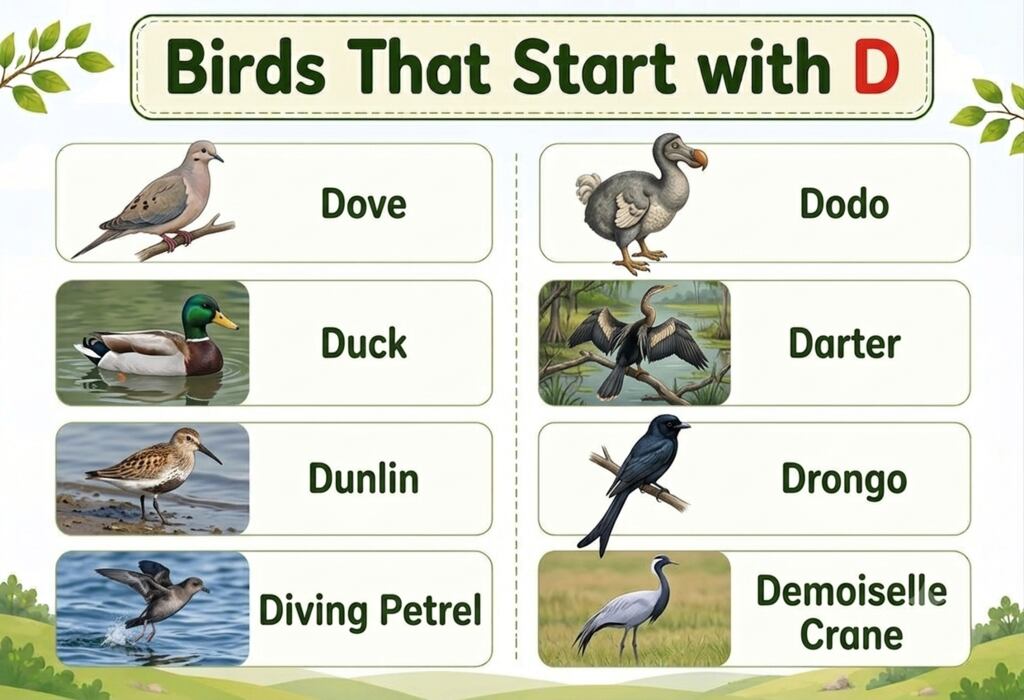
Birds That Start With ‘D’ – Chart
For a quick answer to what bird starts with the letter ‘D’, this chart pulls together every name mentioned in the article, making it easy to revisit any bird at a glance.
FAQs
1. Which ‘D’ Bird Is Now Extinct And Well Known Around The World?
The dodo is perhaps the most famous extinct bird in the world, having disappeared in the late 1600s after living only on the island of Mauritius.
2. Which Bird Starting With ‘D’ Migrates Over One Of The World’s Highest Mountain Ranges?
The demoiselle crane is known for migrating over the Himalayas, making its journey one of the most difficult of any bird in the world.
3. Are All Birds Starting With ‘D’ Found Near Water?
No, while birds like the duck, dunlin, and darter are closely tied to water, others, such as the desert lark and dunnock, are commonly found in dry or garden habitats instead.
4. Which ‘D’ Bird Is Known For Chasing Away Much Larger Birds?
The drongo is known for fearlessly chasing away birds far larger than itself, especially when defending its nest.
From the long-extinct dodo to the tiny, tireless dunlin, bird names starting with ‘D’ offer children a memorable mix of history and nature to explore. Along the way, this list also helps build kids’ vocabulary, turning each new bird into a small, engaging lesson worth remembering.