



Last Updated on September 9, 2026
The letter L brings together an eye-catching mix of birds, from towering wading birds to swift hunters known for astonishing speed and agility. For kids exploring bird names that start with the letter ‘L’, this list covers everything from the graceful lapwing to the record-breaking lammergeier.
Thank you for reading this post, don't forget to subscribe!
Below is a carefully chosen set of birds that start with ‘L’ for preschoolers and kids, each paired with a picture and a handful of memorable facts. Learning these ‘L’ letter bird names gives children a simple way to grow their vocabulary while discovering how different species feed, nest, and adapt to their surroundings. Take a look at some notable birds starting with L below.
List Of Bird Names That Start With ‘L’
From striking waders to skilled aerial hunters, birds beginning with ‘L’ bring plenty of character to this list. Here is a selection of well-known species, along with facts and sightings to help kids recognise them.
1. Lapwing
The lapwing is a striking wading bird known for its rounded wings, wispy head crest, and tumbling display flight.
Did You Know?
- Lapwings perform dramatic, tumbling flight displays to defend their territory.
- Their wide, rounded wings make a distinctive wobbling sound in flight.
- Lapwings often nest in open fields, relying on camouflage to protect their eggs.
- They are known for their loud, wailing call, which gives them one of their nicknames, the “peewit.”
Where You Might See: Lapwings are widely found across the United Kingdom and Europe, particularly in farmland and wetlands.
2. Lovebird
The lovebird is a small, colourful parrot known for forming strong, affectionate bonds with its mate.
Did You Know?
- Lovebirds get their name from the way pairs often sit closely together, preening one another.
- They are among the smallest parrot species in the world.
- Lovebirds are known for their loud, energetic chirping.
- Several lovebird species display bright green, orange, and peach-coloured feathers.
Where You Might See: Lovebirds are native to Africa and Madagascar, particularly in dry woodlands and savannas.
3. Loon
The loon is a striking waterbird known for its haunting, echoing call often heard across quiet northern lakes.
Did You Know?
- Loons are powerful swimmers and can dive to depths of over 60 metres.
- Their bones are heavier than most birds, which helps them dive more easily.
- Loons need a long stretch of open water to take off in flight.
- Their eerie call is often associated with wild, remote lakes.
Where You Might See: Loons are found across lakes in Canada and the northern United States, especially during the breeding season.
4. Lorikeet
The lorikeet is a small, vividly coloured parrot known for its unique brush-tipped tongue, used to feed on nectar.
Did You Know?
- Lorikeets have a specially adapted tongue with tiny bristles that help them lap up nectar and pollen.
- They are fast, acrobatic fliers, often seen in noisy, colourful flocks.
- Lorikeets mainly feed on nectar, pollen, and soft fruit rather than seeds.
- Their bright rainbow-like colouring makes them easy to identify.
Where You Might See: Lorikeets are commonly found across Australia, particularly in gardens, forests, and coastal areas.
5. Lammergeier
The lammergeier, also known as the bearded vulture, is a large bird of prey known for its unusual habit of dropping bones from great heights to crack them open.
Did You Know?
- Lammergeiers drop large bones onto rocks from high in the air to break them into smaller, edible pieces.
- Their diet consists almost entirely of bone marrow, unlike most vultures.
- Lammergeiers have distinctive reddish-orange feathers, which come from bathing in iron-rich mud.
- They have one of the largest wingspans of any bird of prey in Europe.
Where You Might See: Lammergeiers are found in mountainous regions across Europe, Africa, and Asia, particularly the Himalayas and the Alps.
6. Long-tailed Tit
The long-tailed tit is a tiny, round songbird known for its extremely long tail relative to its small body.
Did You Know?
- Long-tailed tits build intricate, dome-shaped nests using moss, spider webs, and feathers.
- They often travel in small, tight-knit family flocks.
- Long-tailed tits huddle together in a row to stay warm during cold nights.
- Their soft, twittering calls help keep the flock together while feeding.
Where You Might See: Long-tailed tits are commonly found across the United Kingdom and Europe, particularly in woodlands and hedgerows.
7. Little Owl
The little owl is a small, compact owl known for its fierce expression and habit of bobbing its head when alert.
Did You Know?
- Little owls are often active during the day, unlike many other owl species.
- They have distinctive yellow eyes and a flattened head shape.
- Little owls mainly feed on insects, small mammals, and earthworms.
- They often perch in the open, watching for movement below.
Where You Might See: Little owls are found across the United Kingdom and much of Europe, particularly in farmland and open countryside.
8. Laughing Gull
The laughing gull is a medium-sized seabird known for its distinctive, high-pitched call that resembles laughter.
Did You Know?
- Laughing gulls get their name from their loud, cackling call.
- They develop a striking black head during the breeding season.
- Laughing gulls are opportunistic feeders, often seen near beaches and fishing boats.
- They are highly social and often gather in large, noisy colonies.
Where You Might See: Laughing gulls are commonly found along coastlines in the eastern United States, Central America, and the Caribbean.
9. Long-eared Owl
The long-eared owl is a slender, well-camouflaged owl known for its tall, prominent feather tufts that resemble ears.
Did You Know?
- The “ears” of a long-eared owl are actually just feather tufts and have nothing to do with hearing.
- They roost in dense trees during the day, relying on camouflage to stay hidden.
- Long-eared owls hunt small mammals almost exclusively at night.
- They can stretch their bodies tall and thin to blend in with tree trunks.
Where You Might See: Long-eared owls are found across the United Kingdom, Europe, Asia, and North America, particularly in dense woodlands.
10. Little Egret
The little egret is a small, elegant white heron known for its slender black legs and bright yellow feet.
Did You Know?
- Little egrets shuffle their bright yellow feet in shallow water to startle small fish out of hiding.
- They were once hunted heavily for their delicate breeding plumes.
- Little egrets often feed alongside other wading birds in shallow wetlands.
- Their all-white feathers make them easy to spot against dark mud or water.
Where You Might See: Little egrets are commonly found near wetlands and coastlines across the United Kingdom, Europe, Africa, and Asia.
11. Lark
The lark is a small, ground-dwelling songbird known for singing melodiously while flying high into the sky.
Did You Know?
- Skylarks, a well-known lark species, can sing continuously for several minutes while hovering high above the ground.
- Larks build their nests directly on the ground, hidden among grass.
- They mainly feed on seeds and insects found in open fields.
- Their song has inspired poets and musicians for centuries.
Where You Might See: Larks are widely found across the United Kingdom, Europe, Asia, and Africa, particularly in open farmland and grassland.
12. Limpkin
The limpkin is a large, brown wading bird known for its haunting, wailing call, often heard at night.
Did You Know?
- Limpkins feed almost exclusively on large freshwater snails, using their curved beak to extract them from their shells.
- Their eerie call has earned them the nickname “crying bird.”
- Limpkins are considered a close relative of both cranes and rails.
- They often walk with a slightly awkward, limping gait, which gives them their name.
Where You Might See: Limpkins are found in wetlands across Florida, Central America, and parts of South America.
13. Least Tern
The least tern is the smallest tern species in North America, known for its quick, darting flight over water.
Did You Know?
- Least terns hover briefly before diving sharply to catch small fish.
- They nest in shallow scrapes on open sandy or gravelly beaches.
- Least terns are considered a species of conservation concern due to habitat loss.
- Despite their small size, they defend their nests fiercely against intruders.
Where You Might See: Least terns are found along coastlines and rivers across the United States, particularly during the breeding season.
14. Lilac-breasted Roller
The lilac-breasted roller is a strikingly colourful bird known for its vivid mix of blue, green, and lilac feathers.
Did You Know?
- Lilac-breasted rollers perform tumbling, rolling flight displays, which is how the roller family got its name.
- They mainly feed on insects, small reptiles, and amphibians caught from a perch.
- Their bright colours make them a popular sight on African safaris.
- Lilac-breasted rollers are fiercely territorial despite their small size.
Where You Might See: Lilac-breasted rollers are commonly found across eastern and southern Africa, particularly in open woodlands and savannas.
15. Lesser Flamingo
The lesser flamingo is the smallest flamingo species in the world, known for its deep pink colouring and enormous flock sizes.
Did You Know?
- Lesser flamingos can gather in flocks numbering in the millions.
- Their deep pink colour comes from pigments found in the algae they filter-feed on.
- Lesser flamingos have a specially curved beak adapted for filtering tiny food particles.
- They often stand and feed in extremely shallow, salty lakes.
Where You Might See: Lesser flamingos are found across parts of Africa and South Asia, particularly around soda lakes in East Africa.
More ‘L’ Letter Birds
Beyond this list, the letter L covers several more ‘L’ starting birds’ names, many of which are lesser known but just as interesting to discover. The table below rounds up 20 additional species.
| Ladder-backed Woodpecker | Lammer Goose |
| Lanner Falcon | Lapland Longspur |
| Large-billed Crow | Laysan Albatross |
| Lazuli Bunting | Leach’s Storm Petrel |
| Lesser Goldfinch | Lesser Kestrel |
| Lesser Nighthawk | Lesser Yellowlegs |
| Lewin’s Honeyeater | Little Bittern |
| Little Bustard | Little Grebe |
| Little Tern | Long-billed Curlew |
| Long-tailed Duck | Luzon Bleeding-heart |
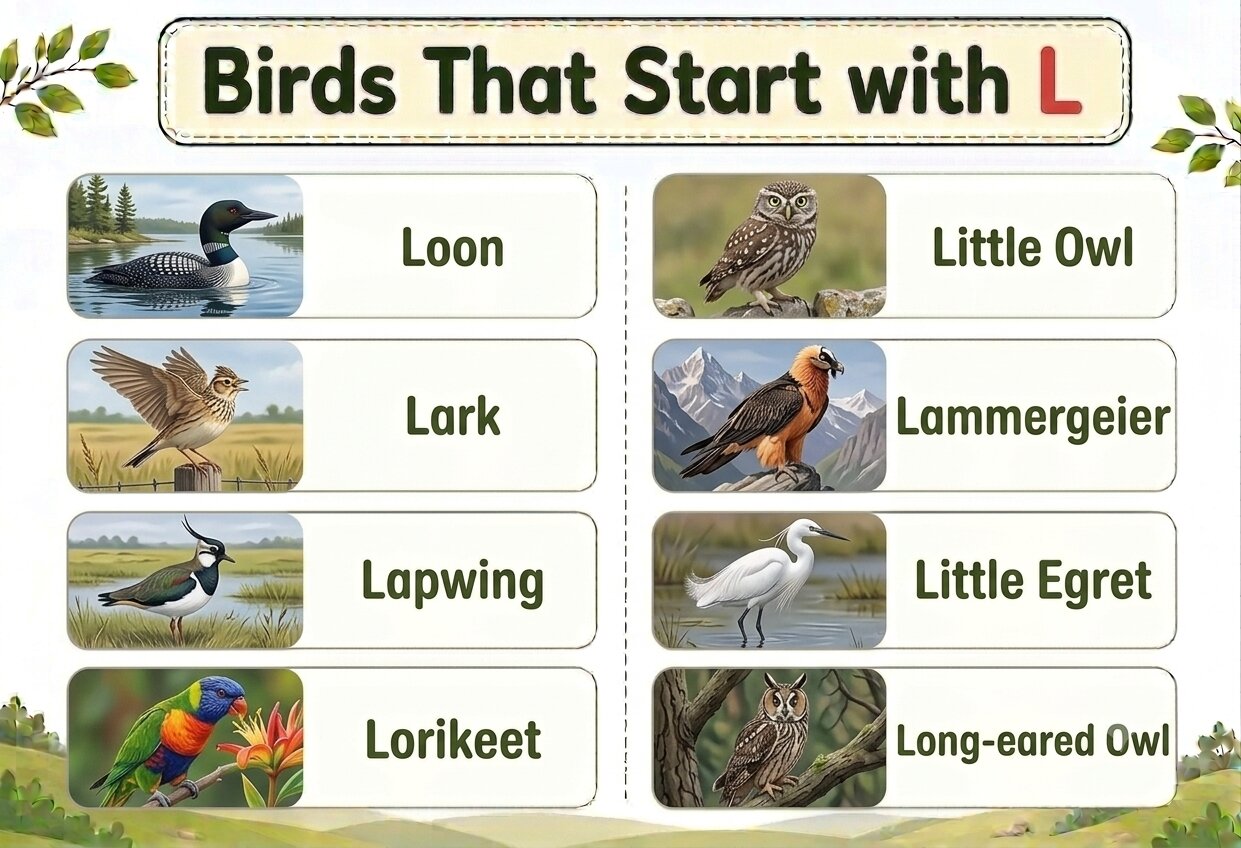
Birds That Start With ‘L’ – Chart
Curious what bird starts with the letter ‘L’? The chart below brings together every species mentioned in this guide, making it easy to revisit any name at a glance.
FAQs
1. Which ‘L’ Bird Is Known For Dropping Bones From Great Heights?
The lammergeier, also called the bearded vulture, is known for dropping large bones onto rocks from high in the air to break them into smaller pieces before eating the marrow.
2. Which Bird Starting With ‘L’ Feeds Almost Entirely On Freshwater Snails?
The limpkin feeds almost exclusively on large freshwater snails, using its curved beak to carefully extract them from their shells.
3. Are All Birds Starting With ‘L’ Found Near Water?
No, while birds like the loon and little egret are closely tied to water, others, such as the lovebird and lark, are commonly found in dry woodlands and open fields instead.
4. Which ‘L’ Bird Is Known For Its Rolling, Tumbling Flight Display?
The lilac-breasted roller is known for its tumbling, rolling flight display, which is how the roller family of birds got its name.
From the bone-dropping lammergeier to the vividly coloured lorikeet, bird names starting with ‘L’ introduce children to a striking and varied set of species. Along the way, this list also helps build kids’ vocabulary, turning each new bird into a small, engaging lesson about the natural world.