



Last Updated on September 9, 2026
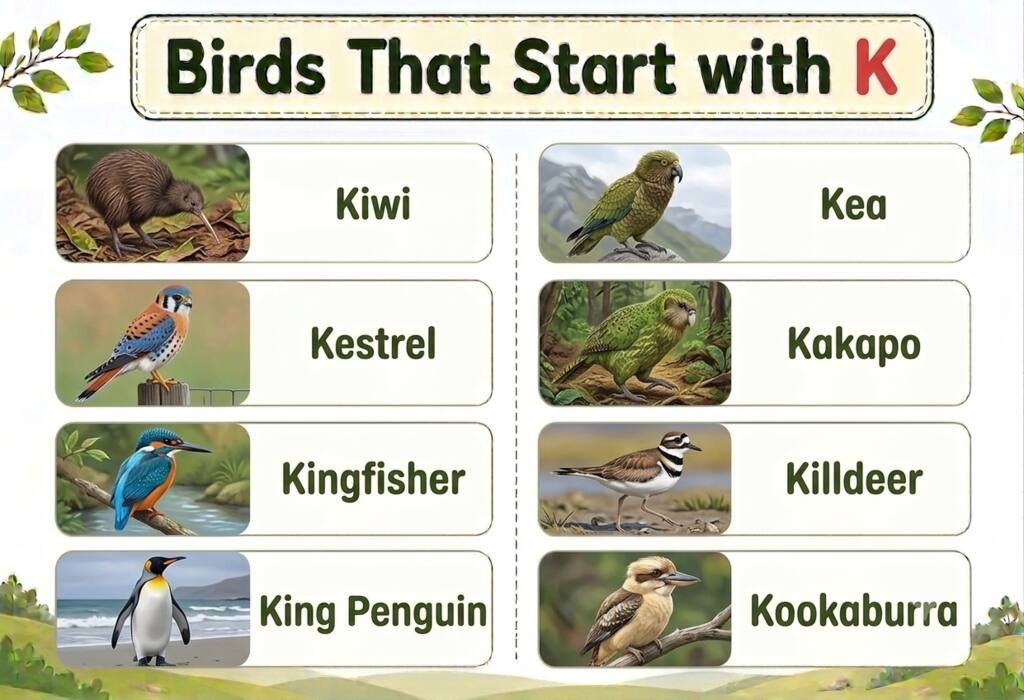
The letter K introduces kids to a bold and varied group of birds, from towering flightless species to sharp, fast-diving hunters found near water. For kids exploring bird names that start with the letter ‘K’, this list covers everything from the flightless kiwi to the striking kingfisher.
Thank you for reading this post, don't forget to subscribe!
Below is a carefully chosen set of birds that start with ‘K’ for preschoolers and kids, each paired with a picture and a handful of memorable facts. Learning these ‘K’ letter bird names gives children a simple way to grow their vocabulary while discovering how different species feed, nest, and adapt to their surroundings. Take a look at some notable birds starting with K below.
List Of Bird Names That Start With ‘K’
From flightless wonders to sharp-eyed hunters, birds beginning with ‘K’ bring plenty of variety to this list. Here is a selection of well-known species, along with facts and sightings to help kids recognise them.
1. Kiwi
The kiwi is a small, flightless bird known for its long beak, tiny wings, and surprisingly strong sense of smell.
Did You Know?
- Kiwis are the only birds with nostrils located at the very tip of their beak.
- They lay one of the largest eggs relative to body size of any bird.
- Kiwis are nocturnal, doing most of their foraging at night.
- They are a national symbol of New Zealand, whose people are sometimes nicknamed after the bird.
Where You Might See: Kiwis are found only in New Zealand, particularly in forests and shrublands.
2. Kingfisher
The kingfisher is a small, brightly coloured bird known for its lightning-fast dives to catch fish from rivers and streams.
Did You Know?
- Kingfishers can dive into water at speeds fast enough to catch fish before they react.
- Their bright blue and orange feathers help them blend into dappled light near water.
- Kingfishers dig long nesting tunnels into riverbanks.
- They can eat their own body weight in fish within a single day.
Where You Might See: Kingfishers are found across the United Kingdom, Europe, Asia, Africa, and Australia, usually near slow-moving rivers and streams.
3. Kestrel
The kestrel is a small falcon known for its ability to hover almost motionless in the air while scanning the ground for prey.
Did You Know?
- Kestrels can see ultraviolet light, which helps them track the urine trails of small rodents.
- They hover by flying directly into the wind and adjusting their wingbeats constantly.
- Kestrels mainly hunt small mammals, insects, and birds.
- They are one of the most commonly seen birds of prey along motorways and open fields.
Where You Might See: Kestrels are widely found across the United Kingdom, Europe, Africa, and Asia, particularly near open countryside.
4. King Penguin
The king penguin is a large, striking penguin species known for its bright orange neck patches and upright posture.
Did You Know?
- King penguins are the second-largest penguin species in the world, after the emperor penguin.
- They can dive over 300 metres deep in search of fish and squid.
- King penguin chicks are covered in thick brown down, making them look very different from adults.
- They breed in enormous, densely packed colonies.
Where You Might See: King penguins are found on sub-Antarctic islands, including South Georgia and the Falkland Islands.
5. Kakapo
The kakapo is a large, flightless parrot known for being one of the rarest and heaviest parrot species in the world.
Did You Know?
- Kakapos are the only flightless parrot species in the world.
- They are nocturnal and use a strong, musty smell to communicate with each other.
- Kakapos can live for many decades, with some individuals reaching over 60 years old.
- They are critically endangered, with conservation programmes carefully tracking every known bird.
Where You Might See: Kakapos are found only on a few predator-free islands in New Zealand, where conservationists closely monitor them.
6. Killdeer
The killdeer is a wading bird known for its loud, repetitive call and dramatic “broken wing” display used to distract predators.
Did You Know?
- Killdeer pretend to have a broken wing to lure predators away from their nests.
- They often nest directly on open ground, including gravel driveways and rooftops.
- Killdeer chicks can walk and feed themselves within hours of hatching.
- Their name comes from the sound of their piercing call.
Where You Might See: Killdeer are commonly found across North America, particularly in fields, parking lots, and near water.
7. Kea
The kea is a large, intelligent mountain parrot known for its curious, mischievous behaviour around people.
Did You Know?
- Keas are considered one of the most intelligent bird species in the world.
- They are known to investigate and sometimes damage cars, backpacks, and other human belongings out of curiosity.
- Keas can solve complex puzzles to access food.
- They are the only parrot species adapted to alpine, snowy environments.
Where You Might See: Keas are found in the mountainous regions of New Zealand’s South Island.
8. Kookaburra
The kookaburra is a large, stocky bird famous for its loud, laughing call, often heard echoing through Australian forests.
Did You Know?
- Kookaburras are actually part of the kingfisher family, despite mainly hunting on land.
- Their call is often used as a sound effect in films to represent the jungle, regardless of the setting.
- Kookaburras hunt insects, small reptiles, and even snakes.
- They live in family groups and take turns caring for young.
Where You Might See: Kookaburras are found across Australia, particularly in forests, woodlands, and suburban gardens.
9. Knot
The knot is a medium-sized wading bird known for its long-distance migration and dramatic seasonal colour change.
Did You Know?
- Knots turn a rich reddish colour during the breeding season, contrasting with their duller grey winter feathers.
- They travel in enormous flocks, sometimes numbering in the tens of thousands.
- Knots can fly thousands of kilometres without stopping during migration.
- They feed by probing soft mud for small shellfish and worms.
Where You Might See: Knots are found along coastlines in the United Kingdom, Europe, and the Americas, particularly during migration season.
10. King Vulture
The king vulture is a large, striking bird known for its colourful, bare head and powerful build.
Did You Know?
- King vultures have brightly coloured heads in shades of orange, purple, and yellow.
- They play an important role in the ecosystem by cleaning up carrion.
- King vultures have a strong sense of smell, unusual among birds of prey.
- Their bald heads help keep them clean while feeding.
Where You Might See: King vultures are found in the forests and grasslands of Central and South America.
11. Kagu
The kagu is a rare, ground-dwelling bird known for its soft grey feathers and crest, found only in one part of the world.
Did You Know?
- Kagus are almost flightless, relying mainly on running to escape danger.
- They make a distinctive barking call, unusual for a bird.
- Kagus are considered a national symbol of New Caledonia.
- They are endangered due to introduced predators like dogs and cats.
Where You Might See: Kagus are found only in the forests of New Caledonia, a French territory in the South Pacific.
12. Kittiwake
The kittiwake is a small, elegant gull known for nesting on narrow cliff ledges high above the sea.
Did You Know?
- Kittiwakes get their name from the sound of their distinctive call.
- They spend much of the year far out at sea, only returning to land to breed.
- Kittiwakes build nests on extremely narrow cliff ledges, often just wide enough to balance on.
- They feed mainly on small fish caught near the ocean’s surface.
Where You Might See: Kittiwakes are found along coastal cliffs in the United Kingdom, Scandinavia, and other North Atlantic regions.
13. Knysna Turaco
The Knysna turaco is a striking forest bird known for its vivid green feathers and bright crimson flight feathers.
Did You Know?
- Turacos have a unique green pigment not found in any other bird family.
- Their bright red wing feathers are only visible when the bird is in flight.
- Knysna turacos mainly feed on fruit found in dense forest canopy.
- They are considered shy birds, often heard before they are seen.
Where You Might See: Knysna turacos are found in forests along South Africa’s southern coast.
14. Kite
The kite is a graceful bird of prey known for its long, forked tail and effortless, gliding flight.
Did You Know?
- Kites are highly adaptable and often scavenge for food near towns and rubbish dumps.
- Their forked tail helps them twist and turn easily while gliding on air currents.
- Some kite species are known to snatch food directly from people’s hands.
- Kites can spend long periods soaring with barely a flap of their wings.
Where You Might See: Kites are found across Europe, Asia, Africa, and Australia, particularly near towns and open countryside.
15. Kentish Plover
The Kentish plover is a small, pale wading bird known for its quick, darting movements along sandy beaches.
Did You Know?
- Kentish plovers nest in shallow scrapes directly on open sand or shingle.
- Their pale colouring helps camouflage both the adults and their eggs.
- Kentish plovers run in short, quick bursts rather than walking steadily.
- They feed mainly on small insects and invertebrates found along the shoreline.
Where You Might See: Kentish plovers are found along coastlines in Europe, Asia, and parts of Africa.
More ‘K’ Letter Birds
Beyond this list, the letter K covers several more ‘K’ starting birds’ names, many of which are lesser known but just as interesting to discover. The table below rounds up 20 additional species.
| Kalij Pheasant | Kamchatka Leaf Warbler |
| Karoo Prinia | Kashmir Flycatcher |
| Kenya Rufous Sparrow | Kerguelen Petrel |
| Kermadec Petrel | Kikuyu White-eye |
| King Eider | King Quail |
| King Rail | Kirtland’s Warbler |
| Knob-billed Duck | Kori Bustard |
| Kordofan Lark | Kuhl’s Lorikeet |
| Kumlien’s Gull | Kurrichane Thrush |
| Kyushu Nuthatch | Klamath Grouse |
Birds That Start With ‘K’ – Chart
Looking for what bird starts with the letter ‘K’ at a glance? The chart below rounds up every species covered in this guide for easy reference.
FAQs
1. Which ‘K’ Bird Is The Only Flightless Parrot In The World?
The kakapo is the only flightless parrot species in the world and is also one of the rarest and heaviest parrots known.
2. Which Bird Starting With ‘K’ Is Known For Its Loud, Laughing Call?
The kookaburra is famous for its loud, laughing call, often heard echoing through Australian forests and woodlands.
3. Are All Birds Starting With ‘K’ Found Near Water?
No, while birds like the kingfisher and kittiwake are closely tied to water, others, such as the kea and kakapo, are found in mountainous or forested regions instead.
Which ‘K’ Bird Pretends To Have A Broken Wing To Protect Its Nest?
The killdeer is known for its dramatic “broken wing” display, used to lure predators away from its nest and eggs.
From the flightless kiwi to the fast-diving kingfisher, bird names starting with ‘K’ introduce children to a bold and varied set of species. Along the way, this list also helps build kids’ vocabulary, turning each new bird into a small, engaging lesson about the natural world.