



Last Updated on September 9, 2026
The letter J brings together a distinctive group of birds, from bold, intelligent forest dwellers to wading birds with unusually long toes. For kids exploring bird names that start with the letter ‘J’, this list covers everything from the clever jackdaw to the graceful jacana.
Thank you for reading this post, don't forget to subscribe!
Below is a carefully chosen set of birds that start with ‘J’ for preschoolers and kids, each paired with a picture and a handful of memorable facts. Learning these ‘J’ letter bird names gives children a simple way to grow their vocabulary while discovering how different species feed, nest, and adapt to their surroundings. Take a look at some notable birds starting with J below.
List Of Bird Names That Start With ‘J’
From clever, chattering birds to graceful waders, birds beginning with ‘J’ bring plenty of personality to this list. Here is a selection of well-known species, along with facts and sightings to help kids recognise them.
1. Jay
The jay is a colourful, intelligent bird belonging to the crow family, known for its bold personality and habit of hiding food for later.
Did You Know?
- Jays bury acorns and seeds in autumn, often forgetting some, which helps new trees grow.
- They are known to imitate the calls of birds of prey to scare off rivals.
- Jays have excellent memories, helping them relocate hundreds of hidden food stashes.
- Their pinkish-brown body and bright blue wing patches make them easy to identify.
Where You Might See: Jays are commonly found across the United Kingdom and Europe, particularly in woodlands and parks.
2. Jackdaw
The jackdaw is a small, intelligent member of the crow family, easily recognised by its striking pale grey eyes.
Did You Know?
- Jackdaws are known to form strong, lifelong pair bonds.
- They are highly social birds, often seen gathering in large, noisy flocks.
- Jackdaws are capable of using simple tools to solve problems.
- Their pale eyes stand out sharply against their dark grey and black feathers.
Where You Might See: Jackdaws are widely found across the United Kingdom and much of Europe, often nesting in chimneys, church towers, and cliffs.
3. Jacana
The jacana is a wading bird known for its extremely long toes, which allow it to walk across floating lily pads without sinking.
Did You Know?
- A jacana’s long toes spread its weight evenly, letting it walk on floating vegetation.
- In several jacana species, the male takes on the main responsibility of incubating eggs and raising chicks.
- Jacanas are sometimes nicknamed “lily-trotters” because of how they move across water plants.
- They feed mainly on insects and small aquatic creatures.
Where You Might See: Jacanas are found in wetlands across Africa, Asia, and the Americas.
4. Junco
The junco is a small, round songbird known for its grey feathers and habit of hopping along the ground in search of seeds.
Did You Know?
- Dark-eyed juncos are sometimes called “snowbirds,” as they often appear in gardens during winter.
- Their outer tail feathers flash white during flight, helping with quick identification.
- Juncos mainly feed on seeds scattered on the ground.
- Their plumage can vary noticeably depending on the region they come from.
Where You Might See: Dark-eyed juncos are commonly found across North America, particularly in forests and gardens during colder months.
5. Java Sparrow
The Java sparrow is a plump, elegant finch known for its soft grey body, black head, and bright pink beak.
Did You Know?
- Java sparrows were historically considered a symbol of good fortune in parts of Asia.
- They are popular as pet birds due to their calm nature and striking appearance.
- Java sparrows feed mainly on rice and other seeds.
- Wild populations have declined in parts of their native range due to trapping.
Where You Might See: Java sparrows are native to the islands of Java and Bali in Indonesia, though they have also been introduced elsewhere.
6. Jabiru
The jabiru is one of the tallest flying birds in the Americas, known for its massive black head and thick, upturned beak.
Did You Know?
- Jabirus can stand over a metre tall, making them one of the largest storks in the world.
- They use their powerful beaks to catch fish, frogs, and small reptiles.
- Jabirus build enormous nests, often reused and added to year after year.
- Their name comes from a Tupi-Guarani word meaning “swollen neck.”
Where You Might See: Jabirus are found in wetlands across Central and South America, particularly in Brazil’s Pantanal region.
7. Jaeger
The jaeger is a fast, agile seabird known for its extremely long central tail feathers and habit of stealing food from other birds mid-air.
Did You Know?
- Long-tailed jaegers chase gulls and terns in flight until they drop their catch.
- Their long, streaming tail feathers make them easy to identify against other seabirds.
- Long-tailed jaegers breed on the Arctic tundra before migrating far out to sea.
- They are strong, agile fliers capable of sharp, sudden turns.
Where You Might See: Long-tailed jaegers are found along Arctic coastlines during the breeding season, migrating far out over open ocean for winter.
8. Junglefowl
The junglefowl is a colourful, wild bird best known as the ancestor of the domestic chicken, with males showing glossy, vibrant feathers.
Did You Know?
- All domestic chickens are believed to have descended from wild junglefowl.
- Male junglefowl have long, colourful tail feathers, while females are duller for camouflage.
- Junglefowl are strong, short-distance fliers, often roosting in trees at night.
- They live in small social groups led by a dominant male.
Where You Might See: Junglefowl are found across the forests of South and Southeast Asia, including India and Thailand.
9. Jungle Babbler
The jungle babbler is a noisy, sociable bird known for moving through gardens and scrubland in tight-knit groups.
Did You Know?
- Jungle babblers are often called “seven sisters” in India, as they typically move in groups of six to seven.
- They communicate constantly using a range of chattering calls.
- Jungle babblers work together to look out for predators while feeding.
- They mainly feed on insects, seeds, and small fruits.
Where You Might See: Jungle babblers are widely found across India and parts of South Asia, particularly in gardens and open scrub.
10. Japanese White-eye
The Japanese white-eye is a small, olive-green songbird known for the distinctive white ring around each eye.
Did You Know?
- Japanese white-eyes are important pollinators, often seen feeding on flower nectar.
- Their soft, high-pitched calls help keep flocks together while feeding.
- Japanese white-eyes are considered agile, acrobatic feeders among branches.
- They were introduced to Hawaii, where they are now widespread.
Where You Might See: Japanese white-eyes are found across Japan, East Asia, and parts of the Pacific, including Hawaii.
11. Jungle Myna
The jungle myna is a sturdy, sociable bird known for the small tuft of feathers on its forehead.
Did You Know?
- Jungle mynas are known for their loud, varied calls, often heard in busy flocks.
- They are considered highly adaptable, thriving in both rural and urban areas.
- Jungle mynas feed on insects, fruit, and scraps found near human settlements.
- Their pale yellow eyes help distinguish them from similar myna species.
Where You Might See: Jungle mynas are commonly found across South and Southeast Asia, particularly in India and Sri Lanka.
12. Jack Snipe
The jack snipe is a small, secretive wading bird known for its excellent camouflage and unusual bouncing movement while feeding.
Did You Know?
- Jack snipes bob their bodies up and down constantly while foraging in mud.
- They rely on camouflage rather than flight to avoid predators, often staying still until the last moment.
- Jack snipes are considered one of the hardest wading birds to spot in the wild.
- They feed mainly on worms and insects found in soft mud.
Where You Might See: Jack snipes are found in wetlands across the United Kingdom, Europe, and parts of Asia, particularly during winter.
13. Japanese Quail
The Japanese quail is a small, plump ground bird known for its mottled brown feathers and quick, low flight when startled.
Did You Know?
- Japanese quails are widely studied in science due to their fast breeding cycle.
- They are strong runners and prefer moving through grass rather than flying.
- Japanese quails have been domesticated for both eggs and meat for centuries.
- Their soft, camouflaged feathers help them stay hidden in fields.
Where You Might See: Japanese quails are found across East Asia and have also been introduced to other parts of the world through farming.
14. Juniper Titmouse
The juniper titmouse is a small, plain grey bird known for its curious, energetic behaviour around juniper woodlands.
Did You Know?
- Juniper titmice are closely tied to juniper trees, relying on them for both food and shelter.
- They often hold seeds with their feet while pecking them open.
- Juniper titmice are known for their inquisitive nature around humans.
- Their soft grey colouring helps them blend into dry woodland habitats.
Where You Might See: Juniper titmice are found across the southwestern United States, particularly in juniper and pinyon pine woodlands.
15. Jungle Crow
The jungle crow is a large, all-black bird known for its thick beak and loud, harsh call.
Did You Know?
- Jungle crows are highly intelligent and adaptable, often seen scavenging near towns and villages.
- They are known to use simple tools to access food.
- Jungle crows build large stick nests high in trees.
- Their deep, resonant call is often used to distinguish them from other crow species.
Where You Might See: Jungle crows are found across South and East Asia, particularly in India, China, and Japan.
More ‘J’ Letter Birds
Beyond this list, the letter J covers several more ‘J’ starting birds’ names, many of which are lesser known but just as interesting to discover. The table below rounds up 20 additional species.
| Jamaican Tody | Jamaican Woodpecker |
| Japanese Bush Warbler | Japanese Robin |
| Japanese Sparrowhawk | Java Kingfisher |
| Jerdon’s Baza | Jerdon’s Courser |
| Jerdon’s Leafbird | Jocotoco Antpitta |
| Jouanin’s Petrel | Juan Fernández Firecrown |
| Jungle Bush Quail | Jungle Nightjar |
| Jungle Owlet | Jungle Prinia |
| Jamaican Vireo | Jackson’s Widowbird |
| Jandaya Parakeet | Jerdon’s Nightjar |
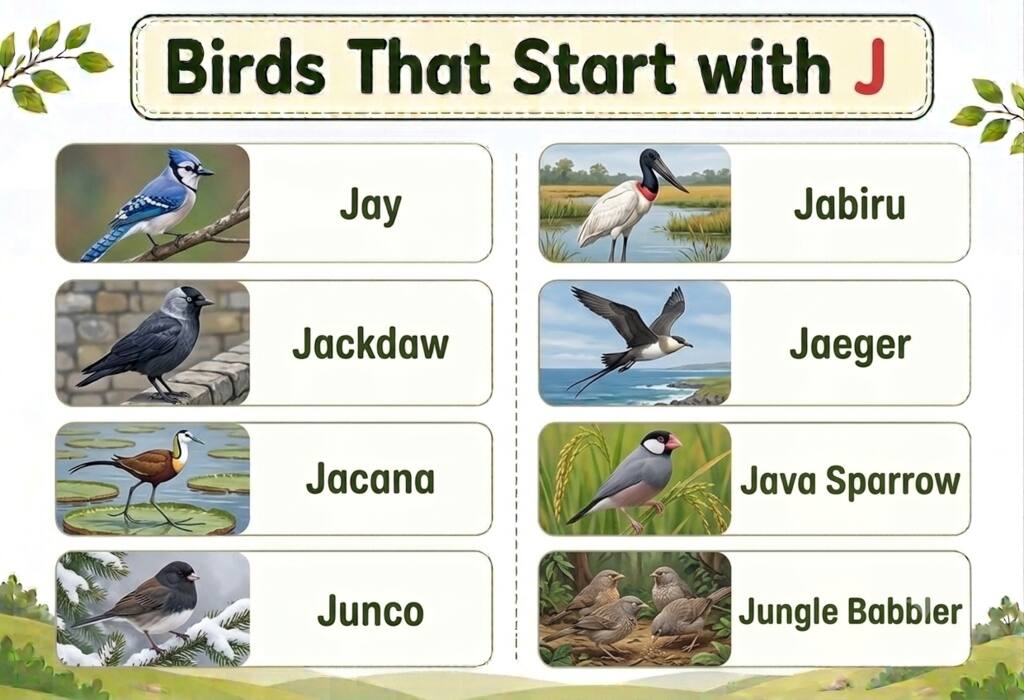
Birds That Start With ‘J’ – Chart
Anyone wondering what bird starts with the letter ‘J’ can use this chart to quickly revisit every name covered in the article so far.
FAQs
1. Which ‘J’ Bird Is Known For Walking Across Floating Lily Pads?
The jacana is known for its unusually long toes, which spread its weight evenly and allow it to walk across floating lily pads without sinking.
2. Which Bird Starting With ‘J’ Is Believed To Be The Ancestor Of The Domestic Chicken?
The junglefowl is believed to be the wild ancestor of the domestic chicken, with males showing glossy, colourful feathers not seen in most farmed chickens.
3. Are All Birds Starting With ‘J’ Found In Groups?
No, while birds like the jungle babbler and jackdaw are highly social and often seen in flocks, others, such as the jack snipe, are solitary and rely on staying hidden rather than grouping together.
4. Which ‘J’ Bird Is Widely Studied In Science Due To Its Fast Breeding Cycle?
The Japanese quail is widely used in scientific research because of its quick breeding cycle, making it useful for studying genetics and development.
From the clever jackdaw to the towering jabiru, bird names starting with ‘J’ introduce children to a distinctive and varied group of species. Along the way, this list also helps build kids’ vocabulary, turning each new bird into a small, engaging lesson about the natural world.