



Last Updated on September 7, 2026
The letter I brings together a smaller but genuinely fascinating set of birds, from striking wading birds to tropical parrots found in far-flung corners of the world. For kids exploring bird names that start with the letter ‘I’, this list covers everything from the elegant ibis to the vividly coloured Indian roller.
Thank you for reading this post, don't forget to subscribe!
Below is a carefully chosen set of birds that start with ‘I’ for preschoolers and kids, each paired with a picture and a handful of memorable facts. Learning these ‘I’ letter bird names gives children a simple way to grow their vocabulary while discovering how different species feed, nest, and adapt to their surroundings. Take a look at some notable birds starting with I below.
List Of Bird Names That Start With ‘I’
From graceful wetland waders to rare island specialists, birds beginning with ‘I’ offer plenty of interesting variety. Here is a selection of well-known species, along with facts and sightings to help kids recognise them.
1. Ibis
The ibis is a wading bird known for its long, downward-curving beak, used to probe mud and shallow water for food.
Did You Know?
- Ibises were considered sacred birds in ancient Egyptian culture and were often linked to the god Thoth.
- They feed by sweeping their curved beaks side to side through mud and water.
- Ibises often roost and feed in large, noisy groups.
- Their feathers can range from pure white to glossy black, depending on the species.
Where You Might See: Ibises are found near wetlands and rivers across Africa, Asia, the Americas, and parts of Europe.
2. Indian Roller
The Indian roller is a strikingly colourful bird known for its brilliant blue wings, which flash into view during flight.
Did You Know?
- Indian rollers perform dramatic, tumbling flight displays during the breeding season, which is how they got their name.
- They mainly feed on insects, often caught after swooping down from a perch.
- The Indian roller is considered the state bird of several Indian states.
- Its dull-looking plumage while perched contrasts sharply with its vivid colours in flight.
Where You Might See: Indian rollers are commonly found across India and other parts of South Asia, particularly in open farmland and villages.
3. Imperial Eagle
The imperial eagle is a large, powerful bird of prey known for its dark feathers and pale golden crown.
Did You Know?
- Imperial eagles mate for life and often reuse the same nest for many years.
- They mainly hunt small mammals, birds, and reptiles.
- Imperial eagles are considered a threatened species in parts of their range.
- Their broad wingspan allows them to soar for long periods while searching for prey.
Where You Might See: Imperial eagles are found across parts of Eastern Europe, the Middle East, and Central Asia.
4. Inca Tern
The Inca tern is an unusual seabird known for its curled white moustache-like feathers and dark grey body.
Did You Know?
- Inca terns are one of the few bird species with moustache-like facial feathers.
- They nest in crevices along rocky coastal cliffs.
- Inca terns feed mainly on small fish caught near the ocean’s surface.
- Their bright red beak and feet stand out sharply against their grey feathers.
Where You Might See : Inca terns are found along the Pacific coastlines of Peru and Chile.
5. Indigo Bunting
The indigo bunting is a small songbird, with males turning a brilliant deep blue during the breeding season.
Did You Know?
- Indigo buntings appear blue due to the structure of their feathers, not from blue pigment.
- Male indigo buntings turn a duller brown outside the breeding season.
- They are known to use the stars to help navigate during nighttime migration.
- Indigo buntings mainly feed on seeds and insects.
Where You Might See: Indigo buntings are commonly found across the eastern United States during the breeding season, particularly in fields and woodland edges.
6. Ivory Gull
The ivory gull is a striking all-white seabird well adapted to life in the Arctic’s icy landscapes.
Did You Know?
- Ivory gulls are one of the few gull species with completely white feathers.
- They often follow polar bears to feed on leftover scraps from seal kills.
- Ivory gulls are considered rare and are closely monitored due to habitat loss.
- Their black eyes and legs stand out clearly against their white feathers.
Where You Might See: Ivory gulls are found in the high Arctic, including parts of Greenland, Canada, and Svalbard.
7. Iiwi
The iiwi is a small, vividly red honeycreeper known for its long, curved beak, perfectly shaped for reaching deep into flowers.
Did You Know?
- The iiwi’s curved beak evolved specifically to feed on the nectar of certain native Hawaiian flowers.
- Its bright red feathers were historically used in traditional Hawaiian featherwork.
- Iiwi populations have declined due to habitat loss and introduced diseases.
- They are considered an important pollinator for native Hawaiian plants.
Where You Might See: Iiwis are found only in the forests of Hawaii, particularly at higher elevations.
8. Indian Peafowl
The Indian peafowl, commonly known as the peacock, is famous for the male’s dazzling, fan-shaped tail feathers.
Did You Know?
- Only male peafowl, known as peacocks, have the large, colourful tail feathers used to attract mates.
- Female peafowl, called peahens, have much duller brown feathers for camouflage.
- Indian peafowl are the national bird of India.
- A peacock’s train can contain over 200 individual feathers.
Where You Might See: Indian peafowl are widely found across India and parts of Sri Lanka, often in forests, farmland, and temple grounds.
9. Isabelline Shrike
The isabelline shrike is a small, pale songbird known for its habit of impaling prey on thorns to store for later.
Did You Know?
- Isabelline shrikes are sometimes called “butcher birds” due to their unusual food-storing habit.
- They mainly feed on large insects, small reptiles, and rodents.
- Despite their small size, isabelline shrikes are fierce and effective hunters.
- Their sandy, pale colouring helps them blend into dry, open habitats.
Where You Might See : Isabelline shrikes are found across Central Asia and migrate to parts of Africa and South Asia during winter.
10. Inca Dove
The Inca dove is a small, slender dove known for the scaly pattern created by the dark edges of its feathers.
Did You Know?
- Inca doves often sit close together in small groups to stay warm.
- Their soft, repetitive call is sometimes described as sounding like “no hope.”
- Inca doves are well adapted to dry, urban environments.
- They build small, fragile-looking nests made from twigs.
Where You Might See : Inca doves are commonly found across the southwestern United States, Mexico, and parts of Central America.
11. Island Canary
The island canary is a small, yellow-green songbird best known as the wild ancestor of the domestic canary kept as a pet.
Did You Know?
- Domestic canaries were bred from island canaries brought over centuries ago from their native islands.
- Wild island canaries are duller in colour compared to selectively bred domestic canaries.
- They are known for their pleasant, melodic song.
- Island canaries mainly feed on seeds and small insects.
Where You Might See: Island canaries are native to the Canary Islands, Azores, and Madeira.
12. Indian Pitta
The Indian pitta is a small, brightly coloured bird known for its rainbow-like mix of blue, green, yellow, and red feathers.
Did You Know?
- Indian pittas are more often heard than seen, thanks to their loud, whistling call.
- They mainly feed on insects and small invertebrates found on the forest floor.
- Indian pittas are shy birds that prefer dense undergrowth for cover.
- Their vivid colours are surprising given how well they typically stay hidden.
Where You Might See : Indian pittas are found across India and parts of South Asia, particularly during their migratory season.
13. Iberian Magpie
The Iberian magpie is a striking bird known for its pale blue wings, black cap, and long tail.
Did You Know?
- Iberian magpies live in small, social groups that help raise young together.
- They mainly feed on insects, seeds, and small fruits.
- Despite their name, Iberian magpies are also found in parts of East Asia, a curious case of separated populations.
- Their soft, chattering calls help maintain contact within the group.
Where You Might See: Iberian magpies are found across parts of Spain and Portugal, particularly in open woodlands.
14. Ictrine Warbler
The icterine warbler is a small, active songbird known for its bright yellow underparts and remarkable mimicry skills.
Did You Know?
- Icterine warblers can mimic the calls of many other bird species within their own song.
- They mainly feed on insects caught among leaves and branches.
- Icterine warblers migrate long distances between Europe and Africa each year.
- Their constant movement through foliage can make them tricky to spot.
Where You Might See: Icterine warblers are found across parts of Europe during the breeding season, migrating to Africa for winter.
15. Inland Thornbill
The inland thornbill is a small, soft brown bird known for its quiet, insect-hunting habits in dry scrubland.
Did You Know?
- Inland thornbills are skilled at mimicking the alarm calls of other birds to warn off predators.
- They build small, dome-shaped nests hidden low in shrubs.
- Inland thornbills mainly feed on tiny insects found among leaves and bark.
- Their soft colouring provides excellent camouflage in dry habitats.
Where You Might See: Inland thornbills are found across much of inland Australia, particularly in scrub and woodland areas.
More ‘I’ Letter Birds
Beyond this list, the letter I covers several more ‘I’ starting birds’ names worth adding to your child’s bird-watching vocabulary. The table below rounds up 20 additional species.
| Icterine Greenbul | Iceland Gull |
| Iiwi Honeycreeper | Imperial Amazon |
| Imperial Pigeon | Imperial Shag |
| Indian Cuckoo | Indian Grey Hornbill |
| Indian Nightjar | Indian Robin |
| Indian Silverbill | Indian Vulture |
| Inland Robin | Ipswich Sparrow |
| Iquitos Gnatcatcher | Iris Lorikeet |
| Island Scrub Jay | Ivory-billed Woodpecker |
| Ivory-billed Aracari | Isabelline Wheatear |
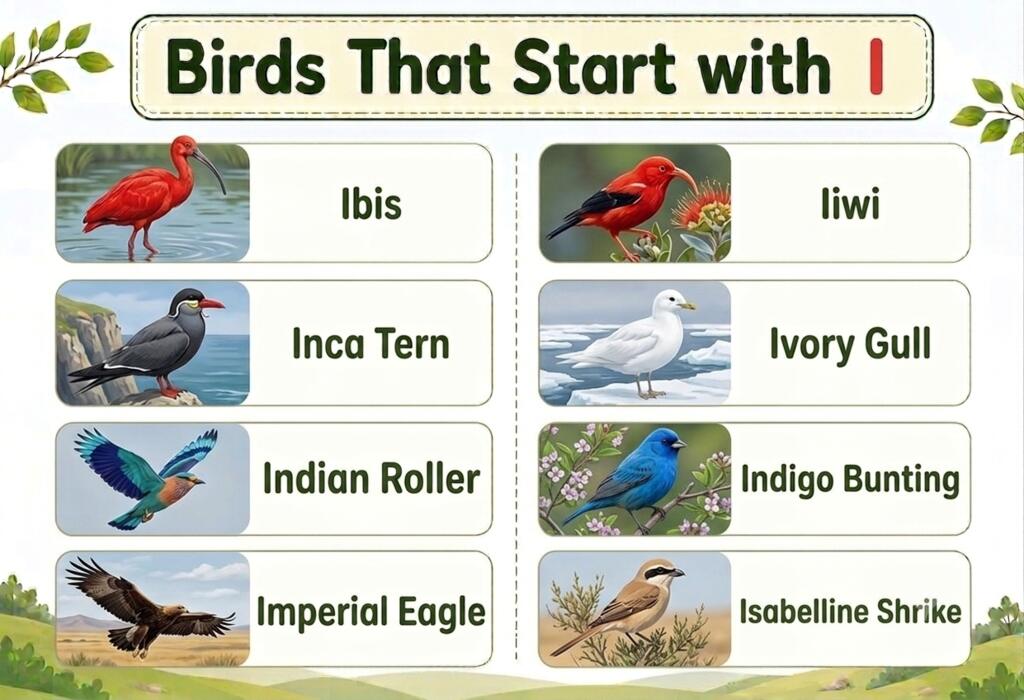
Birds That Start With ‘I’ – Chart
Anyone wondering what bird starts with the letter ‘I’ can use this chart to quickly revisit every name covered in the article so far.
FAQs
1. Which ‘I’ Bird Was Considered Sacred In Ancient Egypt?
The ibis was considered a sacred bird in ancient Egyptian culture and was closely linked to the god Thoth.
2. Which Bird Starting With ‘I’ Is Known For Its Colourful, Fan-Shaped Tail?
The Indian peafowl, commonly called the peacock, is famous for the male’s large, colourful tail feathers used to attract mates.
3. Are All Birds Starting With ‘I’ Found Near Water?
No, while birds like the ibis and Inca tern are closely tied to water, others, such as the indigo bunting and inland thornbill, are commonly found in fields and scrubland instead.
4. Which ‘I’ Bird Is The Wild Ancestor Of The Pet Canary?
The island canary is the wild ancestor of the domestic canary, which was bred over generations to develop its brighter colours and stronger song.
From the sacred ibis to the dazzling Indian peafowl, bird names starting with ‘I’ give children a smaller but memorable set of species to explore. Along the way, this list also helps build kids’ vocabulary, turning each new bird into a small, engaging lesson about the natural world.