



Last Updated on September 7, 2026
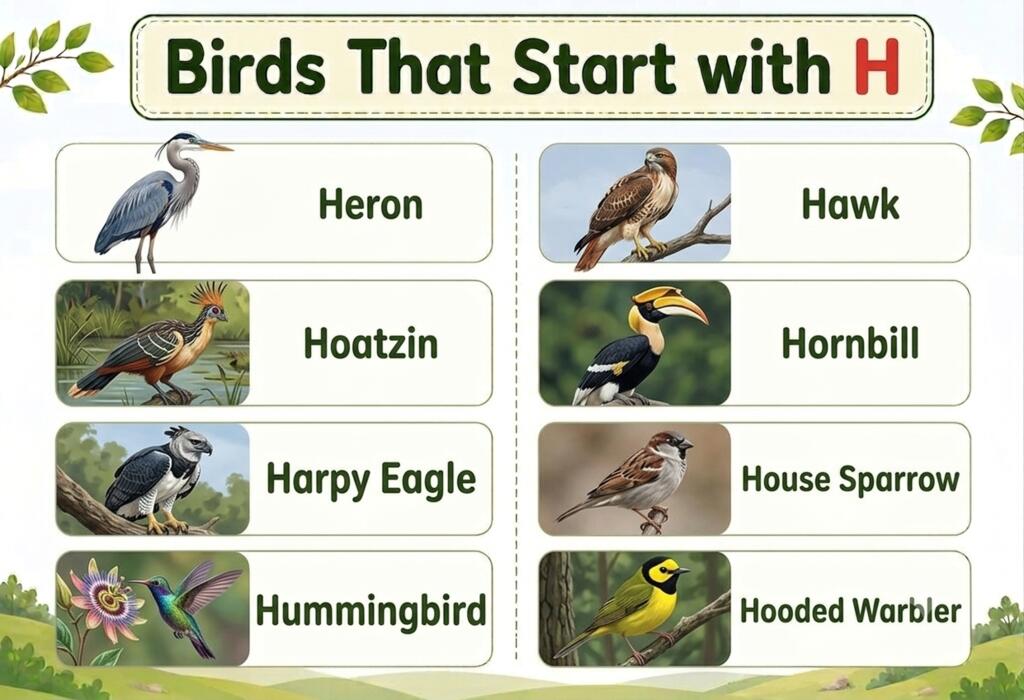
The letter H covers a fascinating range of birds, from swift, high-flying hunters to birds known for their unusual calls and striking appearances. For kids exploring bird names that start with the letter ‘H’, this list brings together everything from the powerful harpy eagle to the tiny, hovering hummingbird.
Thank you for reading this post, don't forget to subscribe!
Below is a carefully chosen set of birds that start with ‘H’ for preschoolers and kids, each paired with a picture and a handful of memorable facts. Learning these ‘H’ letter bird names gives children a simple way to grow their vocabulary while discovering how different species hunt, migrate, and adapt to their surroundings. Take a look at some notable birds starting with H below.
List Of Bird Names That Start With ‘H’
From fierce forest hunters to delicate garden visitors, birds beginning with ‘H’ show off a wide range of skills and appearances. Here is a selection of well-known species, along with facts and sightings to help kids recognise them.
1. Harpy Eagle
The harpy eagle is one of the largest and most powerful eagles in the world, known for its enormous talons and striking feathered crest.
Did You Know?
- A harpy eagle’s talons can be as large as a grizzly bear’s claws.
- They are powerful enough to snatch monkeys and sloths directly from tree branches.
- Harpy eagles have excellent hearing, helped by the feathers around their face.
- They are considered one of the most powerful birds of prey on Earth.
Where You Might See: Harpy eagles are found in the dense rainforests of Central and South America.
2. Hummingbird
The hummingbird is a tiny, colourful bird known for its incredible ability to hover in place while feeding on flower nectar.
Did You Know?
- Hummingbirds can beat their wings up to 80 times per second.
- They are the only birds capable of flying backwards.
- Hummingbirds have extremely fast heartbeats, sometimes over 1,200 beats per minute.
- They need to eat frequently throughout the day to fuel their high energy needs.
Where You Might See: Hummingbirds are found only in the Americas, ranging from Alaska down to southern Chile.
3. Heron
The heron is a tall wading bird known for standing motionless in shallow water while waiting patiently to catch fish.
Did You Know?
- Herons strike at prey with a sudden, lightning-fast movement of their long necks.
- They often nest in large colonies high up in trees.
- Herons can fly with their necks tucked into an S-shape, unlike most large birds.
- Some heron species have learnt to use bait, like bread, to attract fish.
Where You Might See: Herons are found near lakes, rivers, and wetlands across nearly every continent.
4. Hoatzin
The hoatzin is an unusual bird known for its spiky crest and the strong, musky smell it gives off, earning it the nickname “stinkbird.”
Did You Know?
- Hoatzin chicks have small claws on their wings, which help them climb back into trees if they fall.
- They have an unusual digestive system that ferments leaves, much like a cow.
- Hoatzins are considered clumsy, noisy fliers.
- Their strange combination of features has puzzled scientists for years.
Where You Might See: Hoatzins are found in the swamps and riverbanks of the Amazon rainforest in South America.
5. House Sparrow
The house sparrow is a small, familiar bird known for its cheerful chirping and close association with human settlements.
Did You Know?
- House sparrows are one of the most widespread wild bird species in the world.
- They often build messy, untidy nests in gaps around buildings.
- House sparrows are highly social and usually seen in noisy groups.
- Their population has declined in some cities, raising conservation concerns.
Where You Might See: House sparrows are found across most of the world, particularly in towns, cities, and farmland.
6. Hawk
The hawk is a sharp-eyed bird of prey known for soaring high above open land in search of small mammals and birds.
Did You Know?
- Hawks have eyesight several times sharper than that of humans.
- They often use rising warm air currents, called thermals, to glide without flapping.
- Hawks build large stick nests, often reused for several years.
- Different hawk species have adapted to hunt in forests, grasslands, and even cities.
Where You Might See: Hawks are found across a wide range of habitats worldwide, including forests, farmland, and urban areas.
7. Hooded Warbler
The hooded warbler is a small, bright yellow songbird, with males easily recognised by the black “hood” of feathers around their face.
Did You Know?
- Male hooded warblers use their hood-like markings during courtship displays.
- They are skilled at catching insects mid-flight.
- Hooded warblers migrate long distances between North and Central America.
- Females can also develop a partial hood, though usually less defined than males.
Where You Might See: Hooded warblers are commonly found in forests across the eastern United States during the breeding season.
8. Hornbill
The hornbill is a large bird known for its oversized, curved beak, often topped with a bony structure called a casque.
Did You Know?
- Some hornbill species seal the female inside a tree cavity with mud during nesting, leaving just a small opening for feeding.
- Their large beaks, though impressive, are surprisingly lightweight.
- Hornbills mainly feed on fruit, though some species also eat insects and small animals.
- Their wingbeats can be heard from a distance due to a lack of soft flight feathers.
Where You Might See: Hornbills are found across parts of Africa and Asia, particularly in forests and savannas.
9. Harrier
The harrier is a slender bird of prey known for flying low over open fields while searching for small mammals and birds.
Did You Know?
- Harriers rely heavily on hearing, helped by an owl-like facial disc, to locate hidden prey.
- They often glide close to the ground in a slow, tilting flight pattern.
- Harriers build their nests directly on the ground, hidden among tall grass.
- Male and female harriers often look quite different from one another.
Where You Might See: Harriers are found across grasslands, marshes, and farmland in the United Kingdom, Europe, and North America.
10. Hoopoe
The hoopoe is a striking bird known for its tall, fan-shaped crest and distinctive black-and-white striped wings.
Did You Know?
- Hoopoes raise their crest feathers when excited or alarmed.
- They use their long, curved beaks to probe soil for insects and grubs.
- Hoopoes are known for a soft, repetitive “oop-oop-oop” call, which gives them their name.
- Female hoopoes can release a foul-smelling liquid to deter predators near the nest.
Where You Might See: Hoopoes are found across parts of Europe, Africa, and Asia, particularly in open woodlands and farmland.
11. Herring Gull
The herring gull is a large, common seabird known for its loud calls and bold behaviour around coastal towns.
Did You Know?
- Herring gulls are highly intelligent and have learnt to drop shellfish onto hard surfaces to crack them open.
- They can live for over 30 years in the wild.
- Herring gulls are opportunistic feeders, eating almost anything they can find.
- They are known to steal food directly from unsuspecting beachgoers.
Where You Might See: Herring gulls are widely found along coastlines in the United Kingdom, Europe, and North America.
12. House Martin
The house martin is a small, fast-flying bird known for building distinctive mud nests under the eaves of houses.
Did You Know?
- House martins build their nests almost entirely from small pellets of mud.
- They catch insects while flying, rarely landing to feed.
- House martins migrate long distances to Africa each winter.
- Their glossy blue-black feathers and white underparts make them easy to identify.
Where You Might See: House martins are commonly found across the United Kingdom and Europe during the breeding season, often nesting on buildings.
13. Hazel Grouse
The hazel grouse is a shy, well-camouflaged forest bird known for its mottled brown and grey feathers.
Did You Know?
- Hazel grouse are extremely difficult to spot due to their excellent camouflage.
- They mainly feed on buds, seeds, and berries found in dense forest.
- Hazel grouse prefer to run and hide rather than fly when startled.
- Their soft, high-pitched call is often the only sign of their presence.
Where You Might See: Hazel grouse are found in forests across parts of Europe and Asia.
14. Hoary Redpoll
The hoary redpoll is a small, pale finch known for surviving in some of the coldest environments in the world.
Did You Know?
- Hoary redpolls can survive temperatures far below freezing.
- They store seeds in a special throat pouch to eat later when resting.
- Their pale, frosty-looking feathers help them blend into snowy landscapes.
- Hoary redpolls often travel in mixed flocks with other redpoll species.
Where You Might See: Hoary redpolls are found in Arctic regions across northern Canada, Greenland, and Scandinavia.
15. Hawaiian Goose
The Hawaiian goose, also known as the nene, is a rare goose species and the official state bird of Hawaii.
Did You Know?
- The Hawaiian goose is believed to have evolved from the Canada goose thousands of years ago.
- Unlike most geese, it has only partially webbed feet, suited to walking on volcanic rock.
- The species was once critically endangered but has slowly recovered through conservation efforts.
- Hawaiian geese are known for their loud, distinctive honking call.
Where You Might See: Hawaiian geese are found only in Hawaii, particularly on the islands of Maui and Hawaii.
More ‘H’ Letter Birds
Beyond this list, the letter H covers many more ‘H’ starting birds’ names worth adding to your child’s bird-watching vocabulary. The table below rounds up 20 additional species.
| Hairy Woodpecker | Harlequin Duck |
| Hen Harrier | Himalayan Monal |
| Hobby | Honey Buzzard |
| Honeycreeper | Honeyeater |
| Horned Grebe | Horned Lark |
| Horned Puffin | Horned Screamer |
| House Finch | House Wren |
| Huia | Hutton’s Shearwater |
| Hyacinth Macaw | Hooded Merganser |
| Hooded Vulture | Helmeted Guineafowl |
Birds That Start With ‘H’ – Chart
If you’re wondering what bird starts with the letter ‘H’, this chart brings together every name mentioned in the article, making it simple to revisit any bird at a glance.
FAQs
1. Which ‘H’ Bird Is Known For Its Enormous, Powerful Talons?
The harpy eagle is known for having some of the largest talons of any eagle, strong enough to snatch prey such as monkeys directly from tree branches.
2. Which Bird Starting With ‘H’ Is The Only One Able To Fly Backwards?
The hummingbird is the only bird capable of flying backwards, thanks to its unique wing structure and rapid wingbeats.
3. Are All Birds Starting With ‘H’ Found In Forests?
No, while birds like the harpy eagle and hoatzin are closely tied to forests and rainforests, others, such as the house sparrow and herring gull, are commonly found in towns and coastal areas instead.
4. Which ‘H’ Bird Is The Official State Bird Of Hawaii?
The Hawaiian goose, also known as the nene, is the official state bird of Hawaii and was once critically endangered.
From the powerful harpy eagle to the tiny, hovering hummingbird, bird names starting with ‘H’ introduce children to an impressive range of skills and habitats. Along the way, this list also helps build kids’ vocabulary, turning each new bird into a small, engaging lesson about the natural world.