



Last Updated on September 10, 2026
The letter M offers one of the richest collections in the alphabet, spanning tiny, iridescent hummingbirds to towering birds of prey and everything in between. For kids exploring bird names that start with the letter ‘M’, this list covers everything from the elegant mute swan to the mighty macaw.
Thank you for reading this post, don't forget to subscribe!
Below is a carefully chosen set of birds that start with ‘M’ for preschoolers and kids, each paired with a picture and a handful of memorable facts. Learning these ‘M’ letter bird names gives children a simple way to grow their vocabulary while discovering how different species feed, nest, and adapt to their surroundings. Take a look at some notable birds starting with M below.
List Of Bird Names That Start With ‘M’
From colourful tropical parrots to familiar garden visitors, birds beginning with ‘M’ bring an impressive range of colour and character to this list. Here is a selection of well-known species, along with facts and sightings to help kids recognise them.
1. Mallard
The mallard is one of the most familiar ducks in the world, with males easily recognised by their glossy green head.
Did You Know?
- Mallards are the ancestor of most domestic duck breeds.
- Male mallards lose their bright feathers for a few weeks each year during moulting.
- Mallards can fly at speeds of up to 65 kilometres per hour.
- They are highly adaptable and thrive in parks, ponds, and rivers.
Where You Might See: Mallards are found almost worldwide, particularly on lakes, ponds, and rivers.
2. Macaw
The macaw is a large, vividly coloured parrot known for its long tail and powerful, curved beak.
Did You Know?
- Macaws can live for 50 years or longer, with some individuals reaching over 80 years old.
- They have an extremely strong bite, capable of cracking open hard nuts and seeds.
- Macaws are highly social and often mate for life.
- Their loud calls can carry for over a kilometre through dense rainforest.
Where You Might See: Macaws are found in the rainforests of Central and South America.
3. Magpie
The magpie is a bold, intelligent bird known for its striking black and white feathers and long, sweeping tail.
Did You Know?
- Magpies are one of the few animals able to recognise themselves in a mirror.
- They are known to hoard shiny objects, though this behaviour is less common than folklore suggests.
- Magpies live in complex social groups with clear pecking orders.
- Their feathers can show a glossy blue-green sheen in bright sunlight.
Where You Might See: Magpies are widely found across the United Kingdom, Europe, and Asia, particularly in gardens and open woodlands.
4. Mockingbird
The mockingbird is a small, grey songbird famous for its remarkable ability to imitate the songs of other birds.
Did You Know?
- Mockingbirds can learn and mimic over 150 different songs during their lifetime.
- They often sing at night, especially during a full moon.
- Mockingbirds are fiercely territorial and will chase away much larger animals.
- Their scientific name means “many-tongued mimic.”
Where You Might See: Mockingbirds are commonly found across the United States, particularly in gardens, parks, and open scrubland.
5. Mute Swan
The mute swan is a large, graceful waterbird known for its pure white feathers and elegantly curved neck.
Did You Know?
- Despite their name, mute swans are not actually silent and can hiss loudly when threatened.
- They are among the heaviest flying birds in the world.
- Mute swans mate for life and fiercely defend their nesting territory.
- A group of swans on water is called a “bevy” or “wedge” in flight.
Where You Might See: Mute swans are commonly found on lakes and rivers across the United Kingdom and Europe.
6. Myna
The myna is a sturdy, sociable bird known for its noisy calls and remarkable talent for mimicking human speech.
Did You Know?
- Mynas are considered one of the best talking birds, second only to parrots in some studies.
- They are highly adaptable, thriving in both rural and busy urban areas.
- Mynas often travel and feed in loud, chattering groups.
- Their bright yellow eye patches make them easy to identify.
Where You Might See: Mynas are widely found across South and Southeast Asia, and have also spread to parts of Africa and Australia.
7. Moorhen
The moorhen is a small waterbird known for its bright red beak with a yellow tip and jerky, bobbing swim.
Did You Know?
- Moorhens flick their tails constantly while swimming, revealing bright white feathers underneath.
- Chicks from earlier broods sometimes help their parents raise younger siblings.
- Moorhens are strong swimmers despite lacking webbed feet.
- Their loud, sharp calls are often heard before the bird itself is seen.
Where You Might See: Moorhens are commonly found on ponds, canals, and rivers across the United Kingdom and Europe.
8. Mourning Dove
The mourning dove is a slender, soft grey-brown bird known for its gentle, mournful cooing call.
Did You Know?
- Mourning doves get their name from their soft, sorrowful-sounding call.
- They are known for their fast, direct flight, capable of speeds up to 88 kilometres per hour.
- Mourning doves produce a special “crop milk” to feed their young.
- They are one of the most widespread and abundant birds in North America.
Where You Might See: Mourning doves are commonly found across the United States, Canada, and Mexico, particularly in open country and gardens.
9. Mandarin Duck
The mandarin duck is a strikingly colourful duck, with males displaying an extravagant mix of orange, green, and purple feathers.
Did You Know?
- Male mandarin ducks are considered among the most colourful waterfowl in the world.
- They perch and nest in trees, unlike most duck species.
- Mandarin ducks are a traditional symbol of love and fidelity in East Asian culture.
- Females have much duller, camouflaged feathers compared to males.
Where You Might See: Mandarin ducks are native to East Asia, particularly China and Japan, though they have also established wild populations in parts of Europe.
10. Marabou Stork
The marabou stork is a large, unusual-looking bird known for its bald head and enormous throat pouch.
Did You Know?
- Marabou storks have a wingspan among the largest of any land bird, reaching up to 3.7 metres.
- Their bald heads help keep them clean while feeding on carrion.
- Marabou storks are considered nature’s clean-up crew, feeding on leftover scraps from predator kills.
- Despite their appearance, they are strong, graceful fliers once airborne.
Where You Might See: Marabou storks are found across sub-Saharan Africa, often near towns, rubbish dumps, and wetlands.
11. Merlin
The merlin is a small, fast falcon known for its low, rapid hunting flights close to the ground.
Did You Know?
- Merlins hunt small birds in fast, direct pursuit rather than diving from great heights.
- They are one of the smallest falcon species in the world.
- Merlins often reuse the abandoned nests of crows or other birds.
- Their compact size makes them highly manoeuvrable in flight.
Where You Might See: Merlins are found across the United Kingdom, Europe, Asia, and North America, particularly in open moorland and coastal areas.
12. Marsh Harrier
The marsh harrier is a large bird of prey known for its slow, low flight over reedbeds and wetlands.
Did You Know?
- Marsh harriers hunt by gliding low over reeds, listening and watching for movement below.
- Females are noticeably larger than males, a trait known as reverse sexual dimorphism.
- Marsh harriers build their nests hidden deep within dense reedbeds.
- They mainly feed on small mammals, birds, and amphibians.
Where You Might See : Marsh harriers are found across wetlands in the United Kingdom, Europe, and parts of Asia.
13. Muscovy Duck
The Muscovy duck is a large, distinctive duck known for the bright red, bumpy skin around its face.
Did You Know?
- Muscovy ducks are strong fliers despite their heavy build.
- They are one of the few duck species that regularly perch in trees.
- Muscovy ducks make a soft, hissing sound rather than a typical quack.
- They have been domesticated for centuries for both meat and eggs.
Where You Might See: Muscovy ducks are native to Mexico, Central America, and South America, though they are now found worldwide in domesticated forms.
14. Meadow Pipit
The meadow pipit is a small, streaky brown songbird known for its fluttering, parachuting display flight.
Did You Know?
- Meadow pipits perform a distinctive “parachuting” song flight, dropping slowly to the ground with wings spread.
- They are a common host species for cuckoos, which lay their eggs in pipit nests.
- Meadow pipits mainly feed on insects and small seeds.
- They build well-hidden nests directly on the ground.
Where You Might See: Meadow pipits are widely found across the United Kingdom and northern Europe, particularly in moorlands and grassy fields.
15. Monarch Flycatcher
The monarch flycatcher is a small, energetic bird known for catching insects mid-air with quick, darting flights.
Did You Know?
- Monarch flycatchers often flick their tails while perched, helping to flush out hidden insects.
- They are skilled at catching prey directly out of the air.
- Several species show striking blue or black-and-white colouring.
- Monarch flycatchers are found mainly in forested regions.
Where You Might See: Monarch flycatchers are found across parts of Africa, Asia, and Australia, particularly in forests and woodlands.
More ‘M’ Letter Birds
Beyond this list, the letter M covers several more ‘M’ starting birds’ names, many of which are lesser known but just as interesting to discover. The table below rounds up 20 additional species.
| Madagascar Fody | Magellanic Penguin |
| Malachite Kingfisher | Malayan Peacock-Pheasant |
| Maleo | Mangrove Cuckoo |
| Marbled Godwit | Masked Booby |
| Mealy Amazon | Mexican Jay |
| Military Macaw | Mistle Thrush |
| Mountain Bluebird | Mourning Warbler |
| Mute Swan Cygnet | Montezuma Oropendola |
| Motmot | Mangrove Kingfisher |
| Mikado Pheasant | Milky Stork |
Birds That Start With ‘M’ – Chart
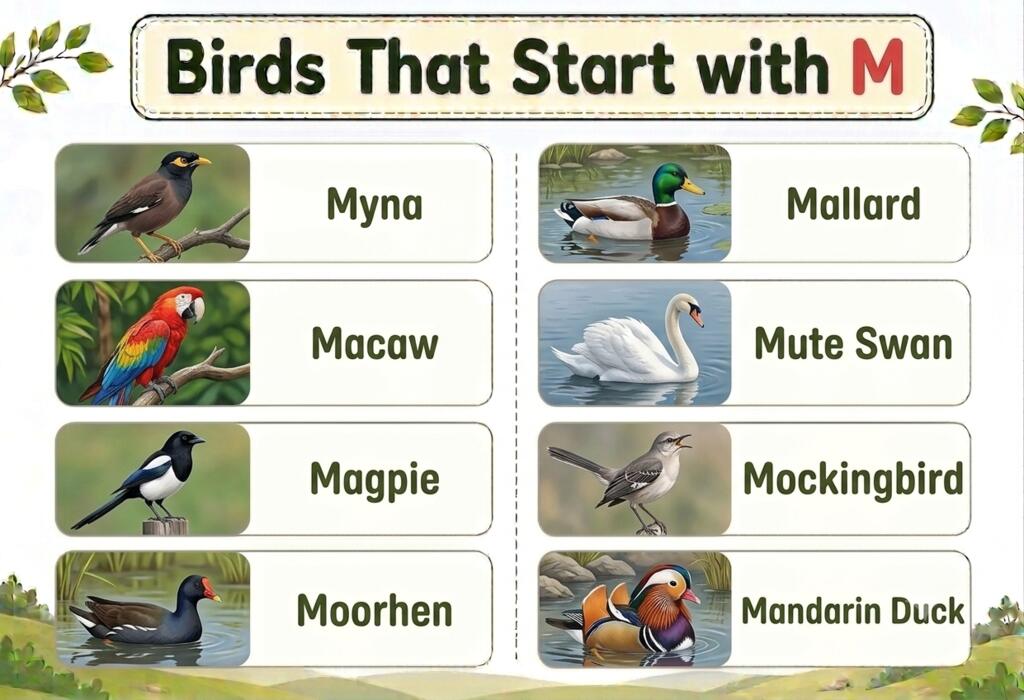
For those wondering what bird starts with the letter ‘M’, the chart below brings together every species mentioned in this guide, making it easy to revisit any name at a glance.
FAQs
1. Why Do Mockingbirds Sometimes Sing At Night?
Mockingbirds, especially unpaired males, are known to sing at night, particularly during a full moon, likely to attract a mate when there’s less competition from daytime bird calls.
2. Can Any Bird Starting With ‘M’ Recognise Itself In A Mirror?
Yes, the magpie is one of the few animals, and the only non-mammal confirmed, able to recognise itself in a mirror, a sign of unusually advanced intelligence.
3. Why Are Male And Female Marsh Harriers Different Sizes?
Female marsh harriers are noticeably larger than males, a trait called reverse sexual dimorphism, which is thought to reduce competition for food between the sexes while raising young.
4. What Makes The Marabou Stork’s Wingspan So Unusual?
The marabou stork has one of the largest wingspans of any land bird, reaching up to 3.7 metres, allowing it to soar efficiently despite its heavy, unusual appearance.
From the vividly coloured macaw to the elegant mute swan, bird names starting with ‘M’ introduce children to one of the richest collections in the alphabet. Along the way, this list also helps build kids’ vocabulary, turning each new bird into a small, engaging lesson about the natural world.