



Last Updated on September 10, 2026
The letter N brings together a compact but memorable group of birds, from familiar garden songsters to striking seabirds found along rocky coastlines. For kids exploring bird names that start with the letter ‘N’, this list covers everything from the cheerful nightingale to the sharp-eyed night heron.
Thank you for reading this post, don't forget to subscribe!
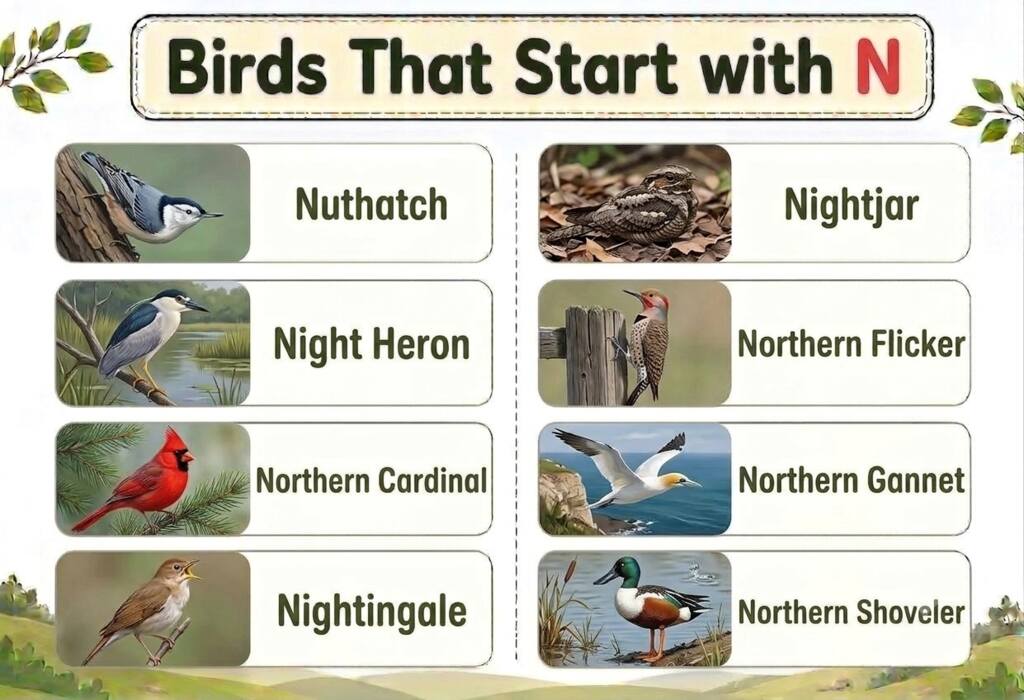
Below is a carefully chosen set of birds that start with ‘N’ for preschoolers and kids, each paired with a picture and a handful of memorable facts. Learning these ‘N’ letter bird names gives children a simple way to grow their vocabulary while discovering how different species feed, nest, and adapt to their surroundings. Take a look at some notable birds starting with N below.
List Of Bird Names That Start With ‘N’
From gifted night-time singers to skilled coastal hunters, birds beginning with ‘N’ bring their own quiet charm to this list. Here is a selection of well-known species, along with facts and sightings to help kids recognise them.
1. Nightingale
The nightingale is a small, plain brown songbird famous for its beautiful, powerful song, often heard after dark.
Did You Know?
- Nightingales are best known for singing at night, unlike most songbirds.
- Their song can include over 1,000 different sounds and phrases.
- Nightingales have inspired poets, writers, and musicians for centuries.
- Despite their famous song, they have quite plain, unremarkable feathers.
Where You Might See: Nightingales are found across the United Kingdom and Europe during the breeding season, particularly in dense woodland and scrub.
2. Nuthatch
The nuthatch is a small, agile bird known for its unusual ability to climb down tree trunks headfirst.
Did You Know?
- Nuthatches are one of the few birds able to move down a tree trunk head-first.
- They wedge nuts and seeds into bark crevices before hammering them open.
- Nuthatches often plaster mud around the entrance of their nesting hole to keep out predators.
- Their sharp, nasal call is a common sound in mature woodlands.
Where You Might See: Nuthatches are commonly found across the United Kingdom, Europe, Asia, and North America, particularly in mature woodlands.
3. Northern Cardinal
The northern cardinal is a familiar backyard bird, with males easily recognised by their vivid red feathers and pointed crest.
Did You Know?
- Only the male cardinal is bright red; the female has a warm brown colour with reddish tinges.
- Cardinals are one of the few backyard birds that sing throughout the year.
- They mate for life and are often seen feeding one another during courtship.
- Cardinals do not migrate, even during cold winters.
Where You Might See: Northern cardinals are widely found across the eastern and central United States, particularly in gardens and woodlands.
4. Night Heron
The night heron is a stocky wading bird known for its red eyes and habit of hunting mostly after dusk.
Did You Know?
- Night herons are most active at dawn and dusk, unlike many other herons that hunt during the day.
- They stand hunched and still for long periods before striking quickly at prey.
- Night herons nest in noisy colonies, often alongside other wading birds.
- Their bright red eyes help them see well in low light.
Where You Might See: Night herons are found near wetlands and rivers across the Americas, Europe, Asia, and Africa.
5. Northern Flicker
The northern flicker is a large, ground-feeding woodpecker known for its spotted chest and habit of hunting ants on lawns.
Did You Know?
- Unlike most woodpeckers, northern flickers spend much of their time feeding on the ground.
- They use their long, sticky tongues to lap up ants from soil and lawns.
- Northern flickers drum on trees and metal objects to communicate rather than to find food.
- Their curved beak is well suited for digging into soil.
Where You Might See: Northern flickers are commonly found across North America, particularly in open woodlands, parks, and gardens.
6. Northern Gannet
The northern gannet is a large seabird known for its spectacular high-speed dives into the ocean to catch fish.
Did You Know?
- Northern gannets can dive from heights of up to 30 metres, hitting the water at high speed.
- Special air sacs beneath their skin help cushion the impact of diving.
- They nest in enormous, densely packed coastal colonies.
- Gannets can spot fish shoals from high above the water’s surface.
Where You Might See: Northern gannets are commonly found along the coastlines of the United Kingdom, Ireland, and other parts of the North Atlantic.
7. Nightjar
The nightjar is a well-camouflaged nocturnal bird known for its odd, churring call heard at dusk.
Did You Know?
- Nightjars rest flat along tree branches during the day, relying entirely on camouflage to stay hidden.
- They catch flying insects mid-air with their wide, gaping mouths.
- Nightjars are most active during twilight hours, known as crepuscular behaviour.
- Their mottled brown feathers make them almost invisible against bark and leaves.
Where You Might See: Nightjars are found across the United Kingdom, Europe, Africa, and Asia, particularly in heathland and open woodland.
8. Northern Shoveler
The northern shoveler is a distinctive duck known for its oversized, spoon-shaped beak used to filter food from water.
Did You Know?
- Northern shovelers use their wide beaks to filter tiny food particles from the water’s surface.
- Males display a striking green head and bright chestnut sides during the breeding season.
- Shovelers often swim in tight circles to stir up food from the water below.
- Their unusual beak shape sets them apart from most other duck species.
Where You Might See: Northern shovelers are found across wetlands in the United Kingdom, Europe, Asia, and North America.
9. Nutcracker
The nutcracker is a stocky, intelligent bird known for its habit of storing thousands of seeds for the winter.
Did You Know?
- Nutcrackers can remember the locations of tens of thousands of buried seeds months later.
- They have a specially adapted throat pouch for carrying large quantities of seeds.
- Nutcrackers play an important role in spreading pine tree seeds across mountain forests.
- Their sharp, powerful beak can break open tough pine cones.
Where You Might See: Nutcrackers are found in mountainous coniferous forests across North America, Europe, and Asia.
10. Nene (Hawaiian Goose)
The nene, also known as the Hawaiian goose, is a rare goose species and the official state bird of Hawaii.
Did You Know?
- The nene is believed to have evolved from the Canada goose thousands of years ago.
- Unlike most geese, it has only partially webbed feet, suited to walking on volcanic rock.
- The species was once critically endangered but has slowly recovered through conservation efforts.
- Nenes are known for their loud, distinctive honking call.
Where You Might See: Nenes are found only in Hawaii, particularly on the islands of Maui and Hawaii.
11. Noisy Miner
The noisy miner is a bold, grey honeyeater known for its aggressive defence of territory and constant chattering calls.
Did You Know?
- Noisy miners live in large, highly organised colonies with cooperative breeding.
- They are known to aggressively chase away much larger birds from their territory.
- Noisy miners mainly feed on nectar, fruit, and insects.
- Their loud, repetitive calls make them easy to identify even before they’re seen.
Where You Might See: Noisy miners are commonly found across eastern Australia, particularly in open woodlands and urban parks.
12. Northern Shrike
The northern shrike is a songbird with a surprisingly predatory streak, known for impaling captured insects, mice, and small birds on thorns or barbed wire to store for later.
Did You Know?
- Northern shrikes are sometimes called “butcher birds” because of their unusual habit of storing prey on sharp points.
- Despite being a songbird, they hunt in a manner closer to birds of prey.
- Northern shrikes mainly feed on large insects, small mammals, and other birds.
- Their hooked beak helps them tear apart prey too large to swallow whole.
Where You Might See: Northern shrikes are found across northern Canada and Alaska during the breeding season, migrating to the northern United States in winter.
13. Northern Wheatear
The northern wheatear is a small, active songbird known for its bold, upright stance and striking black-and-white tail pattern.
Did You Know?
- Northern wheatears undertake one of the longest migrations of any small songbird, travelling between the Arctic and Africa.
- They often perch on rocks and fence posts, bobbing constantly while scanning for insects.
- Their name comes from an old English term referring to their white rump.
- Northern wheatears nest in burrows, crevices, or old rabbit holes.
Where You Might See: Northern wheatears are found across the United Kingdom, Europe, and parts of North America and Asia during the breeding season.
14. Namaqua Dove
The Namaqua dove is a small, slender dove known for its long, pointed tail and the male’s distinctive yellow-and-red beak.
Did You Know?
- Namaqua doves have one of the longest tails relative to body size among small doves.
- Males display a bright yellow-tipped, red beak, while females have a plainer grey one.
- They are well adapted to dry, semi-arid environments.
- Namaqua doves feed mainly on small seeds found on open ground.
Where You Might See: Namaqua doves are found across much of sub-Saharan Africa, particularly in dry savannas and scrubland.
15. New Zealand Bellbird
The New Zealand bellbird is a small, olive-green songbird known for its clear, bell-like song.
Did You Know?
- Bellbirds were among the first birds early European settlers described hearing in New Zealand’s forests.
- Their song is made up of clear, bell-like notes, giving the bird its name.
- Bellbirds play an important role in pollinating native New Zealand plants.
- They mainly feed on nectar, fruit, and small insects.
Where You Might See: New Zealand bellbirds are found in forests across New Zealand, including many offshore islands.
More ‘N’ Letter Birds
Beyond this list, the letter N covers several more ‘N’ starting birds’ names, many of which are lesser known but just as interesting to discover. The table below rounds up 20 additional species.
| Nankeen Kestrel | Narcondam Hornbill |
| Naretha Bluebonnet | Natal Francolin |
| Nazca Booby | Necklaced Spinetail |
| Needletail Swift | Negros Bleeding-heart |
| Nelicourvi Weaver | Nicobar Pigeon |
| Nightingale-Thrush | Nihoa Finch |
| Nile Valley Sunbird | Noisy Friarbird |
| Nordmann’s Greenshank | Norfolk Parakeet |
| North Island Kokako | Northern Beardless Tyrannulet |
| Northern Harrier | Numidian Woodpecker |
Birds That Start With ‘N’ – Chart
Trying to work out what bird starts with the letter ‘N’? Scan the chart below for a complete, at-a-glance list of every species featured in this guide.
FAQs
1. Why Are Nightjars So Difficult To Spot During The Day?
Nightjars rest flat along tree branches during daylight hours, and their mottled brown feathers blend so closely with bark and leaves that they’re almost invisible unless disturbed.
2. How Do Nutcrackers Remember Where They Buried So Many Seeds?
Nutcrackers rely on an exceptionally strong spatial memory, allowing them to recall the locations of tens of thousands of individually buried seeds even months after hiding them.
3. Why Do Male And Female Namaqua Doves Look Different?
Male Namaqua doves display a distinctive yellow-tipped, red beak, while females have a plainer grey beak, a difference that helps distinguish the sexes at a glance.
From the beautifully singing nightingale to the rare, ground-dwelling nene, bird names starting with ‘N’ offer children a smaller but genuinely memorable set of species to explore. Along the way, this list also helps build kids’ vocabulary, turning each new bird into a small, engaging lesson about the natural world.