



Last Updated on September 10, 2026
The letter O brings together a striking mix of birds, from wise-looking nocturnal hunters to sea-faring giants with some of the largest wingspans on Earth. For kids exploring bird names that start with the letter ‘O’, this list covers everything from the familiar owl to the wandering ocean-going osprey.
Thank you for reading this post, don't forget to subscribe!
Below is a carefully chosen set of birds that start with ‘O’ for preschoolers and kids, each paired with a picture and a handful of memorable facts. Learning these ‘O’ letter bird names gives children a simple way to grow their vocabulary while discovering how different species hunt, migrate, and adapt to their surroundings. Take a look at some notable birds starting with O below.
List Of Bird Names That Start With ‘O’
From silent night-time hunters to strong-winged ocean travellers, birds beginning with ‘O’ bring a wide mix of skills to this list. Here is a selection of well-known species, along with facts and sightings to help kids recognise them.
1. Owl
The owl is a familiar nocturnal bird known for its large eyes, silent flight, and ability to rotate its head almost all the way around.
Did You Know?
- Owls can rotate their heads up to 270 degrees without injury.
- Their feathers are specially structured to allow completely silent flight.
- Owls have excellent night vision, though they cannot see in complete darkness.
- Most owls swallow their prey whole and later cough up pellets of bone and fur.
Where You Might See: Owls are found on every continent except Antarctica, particularly in forests, farmland, and even cities.
2. Ostrich
The ostrich is the largest living bird in the world, known for its long legs, powerful stride, and inability to fly.
Did You Know?
- Ostriches can run at speeds of up to 70 kilometres per hour, faster than any other bird on land.
- They lay the largest eggs of any living bird.
- Ostriches have excellent eyesight, helping them spot predators from a great distance.
- A single kick from an ostrich can be powerful enough to injure a lion.
Where You Might See: Ostriches are native to the savannas and deserts of Africa.
3. Osprey
The osprey is a large bird of prey known for its skill at plunging feet-first into water to catch fish.
Did You Know?
- Ospreys have reversible outer toes, which help them grip slippery fish firmly.
- They can spot fish from up to 30 metres above the water’s surface.
- Ospreys are found on every continent except Antarctica.
- Their nests, often reused for years, can grow to be extremely large.
Where You Might See: Ospreys are found near lakes, rivers, and coastlines almost worldwide.
4. Oriole
The oriole is a brightly coloured songbird, with many species known for their vivid orange or yellow feathers and flute-like song.
Did You Know?
- Orioles weave intricate, hanging nests that sway gently in the breeze.
- Their diet includes insects, fruit, and nectar.
- Male orioles are often more brightly coloured than females.
- Orioles are known for their clear, whistling song.
Where You Might See: Orioles are found across the Americas, Europe, Asia, and Africa, particularly in woodlands and gardens.
5. Oystercatcher
The oystercatcher is a striking black-and-white wading bird known for its long, bright orange beak.
Did You Know?
- Oystercatchers use their strong beaks to pry open shellfish along the shoreline.
- They are known for their loud, piping calls, often heard before the bird is seen.
- Oystercatchers can live for over 30 years in the wild.
- Chicks learn feeding techniques by watching their parents closely.
Where You Might See: Oystercatchers are commonly found along coastlines in the United Kingdom, Europe, and other parts of the world.
6. Oilbird
The oilbird is an unusual nocturnal bird known for using echolocation, much like a bat, to navigate in complete darkness.
Did You Know?
- Oilbirds are one of the few birds known to use echolocation to fly through pitch-black caves.
- They feed exclusively on fruit, particularly from palm trees.
- Oilbirds nest deep inside caves, often in large, noisy colonies.
- Their name comes from the historical practice of harvesting oil from their fat-rich chicks.
Where You Might See: Oilbirds are found in the caves and forests of northern South America, particularly Venezuela and Trinidad.
7. Orange-bellied Parrot
The orange-bellied parrot is a small, critically endangered parrot known for its bright green feathers and orange belly patch.
Did You Know?
- Orange-bellied parrots are among the rarest parrot species in the world.
- They migrate across open sea between Tasmania and mainland Australia each year.
- Conservationists closely monitor the small remaining wild population.
- Their bright green colouring helps them blend into coastal vegetation.
Where You Might See: Orange-bellied parrots breed in Tasmania and migrate to coastal areas of mainland Australia during winter.
8. Olive-backed Sunbird
The olive-backed sunbird is a small, glossy songbird known for the male’s shimmering, iridescent throat feathers.
Did You Know?
- Male olive-backed sunbirds display a metallic, iridescent throat patch that changes colour depending on the light.
- They feed mainly on nectar, using their thin, curved beaks to reach deep into flowers.
- Olive-backed sunbirds build hanging, pouch-like nests.
- They play an important role in pollinating tropical flowers.
Where You Might See: Olive-backed sunbirds are found across South and Southeast Asia and parts of Australia, particularly in gardens and coastal areas.
9. Orange-tufted Sunbird
The orange-tufted sunbird is a small, active bird known for the bright orange tufts of feathers hidden beneath its wings.
Did You Know?
- The orange tufts are usually hidden and only become visible during courtship displays.
- Orange-tufted sunbirds feed almost entirely on nectar.
- They are agile fliers, capable of hovering briefly in front of flowers.
- Males display glossy, iridescent feathers that shimmer in sunlight.
Where You Might See: Orange-tufted sunbirds are found across the Middle East and parts of North Africa.
10. Orange-crowned Warbler
The orange-crowned warbler is a small, dull-coloured songbird known for the faint orange patch of feathers on its crown, rarely visible.
Did You Know?
- The orange crown feathers are usually hidden and only seen when the bird raises them slightly.
- Orange-crowned warblers mainly feed on insects and spiders.
- They are considered one of the least colourful warbler species.
- Their soft, trilling song is often heard before the bird is spotted.
Where You Might See: Orange-crowned warblers are found across North America, particularly in shrubby woodlands and gardens during migration.
11. Oahu Elepaio
The Oahu elepaio is a small, active flycatcher known for its curious nature and fanned tail, found only on one Hawaiian island.
Did You Know?
- Oahu elepaio were considered important guides by traditional Hawaiian canoe builders, believed to indicate healthy trees.
- They flick their tails constantly while hunting insects.
- Oahu elepaio populations have declined significantly due to habitat loss.
- They are considered an endangered subspecies.
Where You Might See: Oahu elepaio are found only on the island of Oahu in Hawaii, particularly in native forest patches.
12. Orinoco Goose
The Orinoco goose is a striking waterbird known for its rich chestnut body and pale, cream-coloured head.
Did You Know?
- Orinoco geese pair for life and are often seen together year-round.
- They feed mainly on grasses and aquatic plants.
- Orinoco geese are considered strong, agile fliers despite their sturdy build.
- Their loud, honking calls carry well across open wetlands.
Where You Might See: Orinoco geese are found across wetlands in South America, particularly along the Orinoco and Amazon river basins.
13. Orange-breasted Bunting
The orange-breasted bunting is a small, brightly coloured songbird known for its vivid orange chest and blue head.
Did You Know?
- Male orange-breasted buntings are considered among the most colourful songbirds in Central America.
- They mainly feed on seeds and small insects.
- Orange-breasted buntings prefer dry, scrubby habitats.
- Their bright colouring makes them a popular sighting for birdwatchers.
Where You Might See: Orange-breasted buntings are found in Mexico and parts of Central America, particularly in dry tropical forest.
14. Okinawa Rail
The Okinawa rail is a rare, flightless bird known for its bright red beak and legs, found only on one Japanese island.
Did You Know?
- Okinawa rails were only formally identified as a species in 1981.
- They are almost entirely flightless, relying on running through dense forest undergrowth.
- Okinawa rails are considered endangered due to habitat loss and introduced predators.
- Their loud, repetitive call is often heard before the bird is seen.
Where You Might See: Okinawa rails are found only in the forests of northern Okinawa, Japan.
15. Oahu Amakihi
The Oahu amakihi is a small, greenish-yellow honeycreeper known for its curved beak, suited to feeding on both nectar and insects.
Did You Know?
- Oahu amakihi are one of the few native Hawaiian honeycreepers still relatively common on their island.
- They feed on a mix of nectar, insects, and spiders.
- Oahu amakihi have shown some resistance to introduced avian diseases that have harmed other native birds.
- Their curved beak allows them to feed on a wide variety of flower shapes.
Where You Might See: Oahu amakihi are found in forests across Oahu in Hawaii.
More ‘O’ Letter Birds
Beyond this list, the letter O covers several more ‘O’ starting birds’ names, many of which are lesser known but just as interesting to discover. The table below rounds up 20 additional species.
| Oahu Akepa | Oasis Hummingbird |
| Ocellated Turkey | Ochre-bellied Flycatcher |
| Olive Ibis | Olive Sparrow |
| Olive Thrush | Olive-sided Flycatcher |
| Omao | Orange Ground Thrush |
| Orange-cheeked Waxbill | Orange-headed Thrush |
| Oriental Darter | Oriental Magpie-Robin |
| Oriental Pied Hornbill | Oriental Skylark |
| Oriental White-eye | Orinoco Piculet |
| Osprey Cousin: Secretarybird | Otago Shag |
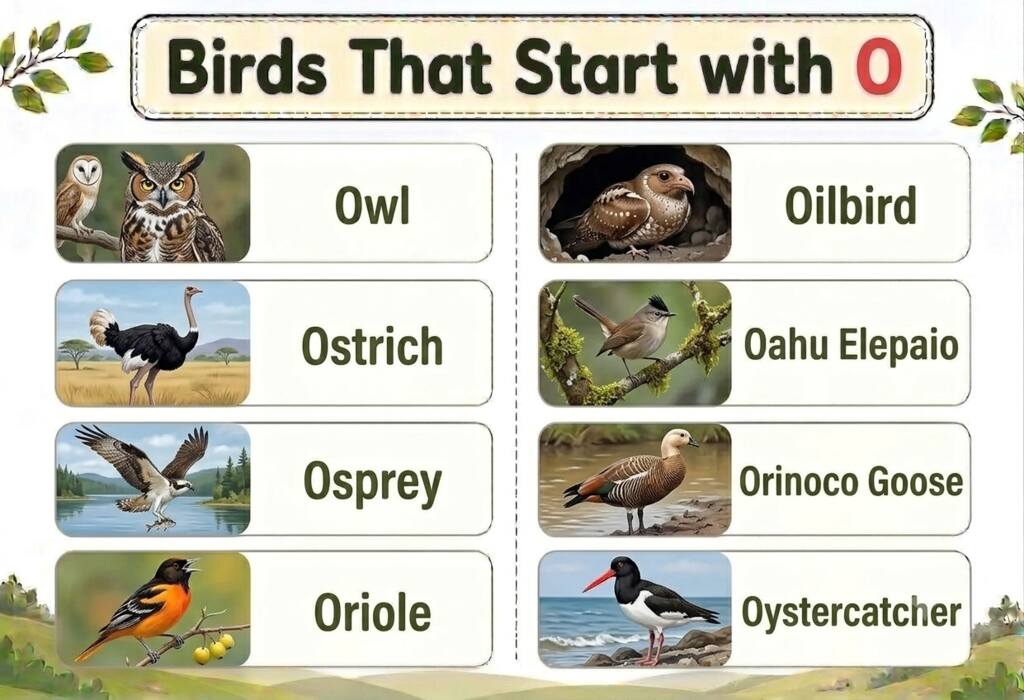
Birds That Start With ‘O’ – Chart
Need a quick way to check what bird starts with the letter ‘O’? The chart below lists every species this guide has covered, ready for a quick browse.
FAQs
1. How Does An Oilbird Navigate In Complete Darkness?
Oilbirds use a form of echolocation, similar to bats, sending out clicking sounds and listening for the echoes to navigate safely through pitch-black caves.
2. Why Do Ospreys Have Reversible Outer Toes?
An osprey’s reversible outer toes allow it to grip fish with two toes facing forward and two backward, giving it a much firmer hold on slippery prey.
3. Why Were Elepaio Considered Important By Traditional Hawaiian Canoe Builders?
Traditional Hawaiian canoe builders watched the elepaio’s behaviour around trees, believing the bird could help indicate which trees were healthy and suitable for building canoes.
4. When Was The Okinawa Rail First Identified As Its Own Species?
The Okinawa rail was only formally identified as a distinct species in 1981, making it one of the more recently documented birds in this list.
From the towering ostrich to the fish-hunting osprey, bird names starting with ‘O’ introduce children to a striking mix of size, skill, and habitat. Along the way, this list also helps build kids’ vocabulary, turning each new bird into a small, engaging lesson about the natural world.