



Last Updated on September 10, 2026
P turns out to be one of the busiest letters for bird names, packed with everything from beloved garden visitors to birds famous for their extraordinary courtship dances. Children searching for bird names that start with the letter ‘P’ will have plenty to choose from, spanning the humble pigeon to the flamboyant peacock.
Thank you for reading this post, don't forget to subscribe!
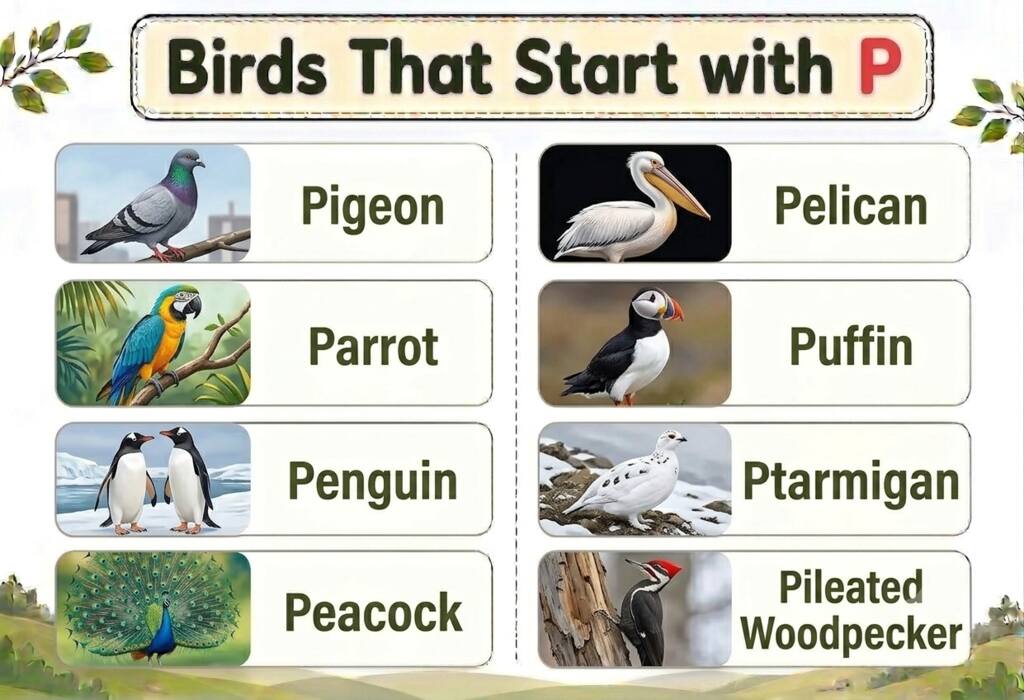
This guide rounds up a selection of birds that start with ‘P’ for preschoolers and kids, each one illustrated and explained through a few simple, memorable facts. Getting to know these ‘P’ letter bird names is a fun way for children to build their vocabulary while picking up small details about feeding habits, calls, and habitats along the way. Have a look at the birds starting with P below.
List Of Bird Names That Start With ‘P’
Some birds beginning with ‘P’ are backyard regulars, while others are known for putting on quite a show. Here is a selection of well-known species, along with facts and sightings to help kids recognise them.
1. Penguin
The penguin is a flightless seabird known for its upright waddle on land and remarkable swimming ability underwater.
Did You Know?
- Penguins use their wings as flippers, allowing them to “fly” through water instead of air.
- Some penguin species can dive to depths of over 500 metres.
- Penguins huddle together in large groups to conserve warmth in cold climates.
- Not all penguins live in icy regions; some species are found in much warmer climates.
Where You Might See: Penguins are found mainly in the Southern Hemisphere, including Antarctica, South Africa, and South America.
2. Peacock
The peacock is famous for the male’s dramatic, fan-shaped tail, covered in shimmering blue and green “eye” patterns.
Did You Know?
- Only male peafowl, known as peacocks, grow the large, colourful tail feathers.
- Female peafowl, called peahens, have much duller brown feathers for camouflage.
- A peacock’s train can contain over 200 individual feathers.
- Peacocks shake their tail feathers to create a rattling sound during courtship.
Where You Might See: Peacocks are widely found across India and parts of Sri Lanka, often in forests, farmland, and temple grounds.
3. Pigeon
The pigeon is a familiar bird known for its stocky body, cooing call, and remarkable ability to find its way home over long distances.
Did You Know?
- Pigeons have been used to carry messages for thousands of years thanks to their homing ability.
- They can recognise themselves in a mirror, a rare trait among birds.
- Pigeons produce a special “crop milk” to feed their chicks.
- Their exceptional sense of direction is still not fully understood by scientists.
Where You Might See: Pigeons are found almost worldwide, particularly in cities, parks, and farmland.
4. Parrot
The parrot is a colourful, intelligent bird known for its curved beak and, in many species, an impressive talent for mimicking speech.
Did You Know?
- Parrots can live for several decades, with some species reaching over 60 years old.
- Many parrot species mate for life.
- Parrots use their strong, curved beaks almost like a third foot for climbing.
- Some species can learn hundreds of words and phrases.
Where You Might See: Parrots are found in tropical and subtropical regions across the Americas, Africa, Asia, and Australia.
5. Pelican
The pelican is a large waterbird instantly recognisable by its enormous throat pouch, used to scoop up fish.
Did You Know?
- A pelican’s throat pouch can hold more than its stomach.
- They often fish cooperatively, working together to herd fish into shallow water.
- Pelicans are strong, graceful fliers despite their bulky appearance.
- Some species plunge-dive from considerable heights to catch fish.
Where You Might See: Pelicans are found near lakes, rivers, and coastlines across most continents except Antarctica.
6. Puffin
The puffin is a small seabird known for its brightly coloured beak and comical, waddling walk on land.
Did You Know?
- Puffins can flap their wings up to 400 times per minute in flight.
- They are excellent divers and can hold their breath underwater for around 30 seconds.
- Puffins mate for life and often return to the same nesting burrow each year.
- Their beaks turn brighter in colour during the breeding season.
Where You Might See: Puffins are commonly found along the coasts of the United Kingdom, Iceland, and parts of eastern Canada.
7. Pileated Woodpecker
The pileated woodpecker is a large, striking woodpecker known for its bright red crest and powerful, rectangular drilling holes.
Did You Know?
- Pileated woodpeckers can carve holes so large that they sometimes cause small trees to snap.
- Their loud, ringing call carries far through forests.
- They mainly feed on carpenter ants and wood-boring beetles.
- Pileated woodpeckers were the inspiration for a famous cartoon character.
Where You Might See: Pileated woodpeckers are found across forests in North America, particularly older woodlands with plenty of dead trees.
8. Ptarmigan
The ptarmigan is a hardy grouse species known for changing the colour of its feathers with the seasons to match its surroundings.
Did You Know?
- Ptarmigans turn white in winter and mottled brown in summer for camouflage.
- Feathers grow on their feet, acting like natural snowshoes.
- Ptarmigans can survive extremely cold Arctic and mountain conditions.
- They dig shallow burrows into snow for shelter during storms.
Where You Might See: Ptarmigans are found in Arctic and mountainous regions across North America, Europe, and Asia.
9. Plover
The plover is a small, quick-moving wading bird known for its short beak and habit of running in short bursts along the shore.
Did You Know?
- Plovers use a stop-start running technique to search for food rather than probing continuously.
- Several species perform distraction displays, pretending to be injured to lure predators from their nest.
- Plovers lay eggs that are extremely well camouflaged against sand and shingle.
- Their large eyes help them feed effectively in low light.
Where You Might See: Plovers are found on beaches, mudflats, and grasslands across nearly every continent.
10. Pheasant
The pheasant is a large, long-tailed bird, with males known for their striking, colourful feathers.
Did You Know?
- Male pheasants are far more colourful than females, which have duller, camouflaged feathers.
- Pheasants prefer running over flying when startled, though they can burst into fast, short flights.
- They were introduced to many countries originally for hunting purposes.
- Pheasants feed mainly on seeds, grain, and insects.
Where You Might See: Pheasants are widely found across the United Kingdom, Europe, and Asia, particularly in farmland and woodland edges.
11. Prairie Chicken
The prairie chicken is a plump grouse species famous for the male’s elaborate booming courtship display.
Did You Know?
- Male prairie chickens inflate bright orange air sacs on their necks during courtship displays.
- Their dramatic dances include foot-stomping and sudden leaps.
- Prairie chicken populations have declined significantly due to habitat loss.
- Their booming calls can be heard from over a kilometre away.
Where You Might See: Prairie chickens are found in the grasslands of the central United States.
12. Purple Martin
The purple martin is North America’s largest swallow, known for its glossy, dark blue-purple feathers.
Did You Know?
- Purple martins rely heavily on specially built birdhouses provided by humans in much of their range.
- They catch insects entirely on the wing, rarely landing to feed.
- Purple martins migrate long distances to South America each winter.
- Their cheerful, gurgling song is a familiar sound in early summer.
Where You Might See: Purple martins are found across North America during the breeding season, particularly near open fields and water.
13. Palm Cockatoo
The palm cockatoo is a large, striking parrot known for its dramatic black feathers and bright red cheek patches.
Did You Know?
- Palm cockatoos are one of the few non-human animals known to use a tool to create rhythm, drumming with sticks during courtship.
- They have one of the largest beaks of any parrot species.
- Palm cockatoos are slow breeders, often raising just one chick every couple of years.
- Their bright red cheeks can change colour depending on their mood.
Where You Might See: Palm cockatoos are found in the rainforests of northern Australia and New Guinea.
14. Painted Bunting
The painted bunting is a small songbird, with males considered among the most colourful birds in North America.
Did You Know?
- Male painted buntings display a striking mix of blue, green, and red feathers.
- Females are a much plainer green, helping them stay hidden while nesting.
- Painted buntings are shy birds, often more easily heard than seen.
- Their vivid colouring has made them a popular bird among birdwatchers.
Where You Might See: Painted buntings are found across the southern United States and parts of Mexico, particularly in thickets and scrub.
15. Pyrrhuloxia
The pyrrhuloxia is a desert songbird closely related to the cardinal, known for its grey body and reddish crest.
Did You Know?
- Pyrrhuloxias are sometimes called “desert cardinals” due to their close resemblance to the northern cardinal.
- They are well adapted to hot, desert environments.
- Pyrrhuloxias feed mainly on seeds and insects.
- Their stout, curved beak is well suited for cracking open tough seeds.
Where You Might See: Pyrrhuloxias are found in the deserts of the southwestern United States and Mexico.
More ‘P’ Letter Birds
Beyond this list, the letter P covers several more ‘P’ starting birds’ names, many of which are lesser known but just as interesting to discover. The table below rounds up 20 additional species.
| Pacific Loon | Painted Stork |
| Palm Warbler | Pallid Cuckoo |
| Paradise Flycatcher | Paradise Tanager |
| Parakeet Auklet | Patagonian Sierra Finch |
| Peregrine Falcon | Philippine Eagle |
| Piapiac | Pied Avocet |
| Pied Kingfisher | Pin-tailed Whydah |
| Pink-footed Goose | Pipit |
| Pomarine Jaeger | Ptarmigan Owl |
| Puna Ibis | Purple Sunbird |
Birds That Start With ‘P’ – Chart
Anyone looking for what bird starts with the letter ‘P’ can scan this quick reference chart, gathering all the names covered across the article in one place.
FAQs
1. Why Do Ptarmigans Change Colour With The Seasons?
Ptarmigans moult into white feathers in winter and mottled brown feathers in summer, allowing them to blend into snow or rocky ground and stay hidden from predators throughout the year.
2. How Do Pelicans Manage To Fly With Such A Large Beak And Pouch?
Despite their bulky appearance, pelicans have lightweight, air-filled bones and a strong wing structure, allowing them to fly gracefully and even soar for long distances using rising air currents.
3. Why Are Male Prairie Chickens’ Neck Sacs So Brightly Coloured?
Male prairie chickens inflate bright orange air sacs on their necks during courtship displays, using the colour and sound to attract females and compete with rival males.
4. What Makes The Palm Cockatoo’s Drumming Behaviour So Unusual?
The palm cockatoo is one of the few non-human animals known to fashion and use a tool purely to create rhythm, drumming sticks against tree trunks as part of its courtship display.
P has turned out to be a surprisingly rich letter, pairing household names like the pigeon and parrot with showier characters like the peacock and palm cockatoo. Learning these bird names starting with ‘P’ is a natural way to strengthen kids’ vocabulary, since each bird comes with its own set of details worth remembering long after the page is closed.