


- List Of Common 3-Letter Words Starting With O
- More 3-Letter ‘O’-Words
- 3-Letter Action Words That Start With O
- 3-Letter Everyday Objects That Start With O
- Three-Letter Animal Names That Start With O
- Positive Three-Letter Words That Begin With O
- Three-Letter Nouns Beginning With O
- 3-Letter Adjectives Starting With O
- Sentences Using Three-Letter O Words
- Activities To Teach 3-Letter Words Starting With O For Kids
- FAQs
Last Updated on October 20, 2026
3-letter words that start with O are a great set for children, since O often starts words with a strong, clear vowel sound. Words such as owl, oar, old and oil are short and useful, giving early readers a fresh sound to practise after working through the consonant-led letters.
Thank you for reading this post, don't forget to subscribe!
This guide is a handy set of three-letter words starting with O for students building their phonics skills, as well as parents and teachers looking for a ready-made lesson. Alongside the full word list, you’ll find grouped tables, example sentences and hands-on activities to make O words memorable.
List Of Common 3-Letter Words Starting With O
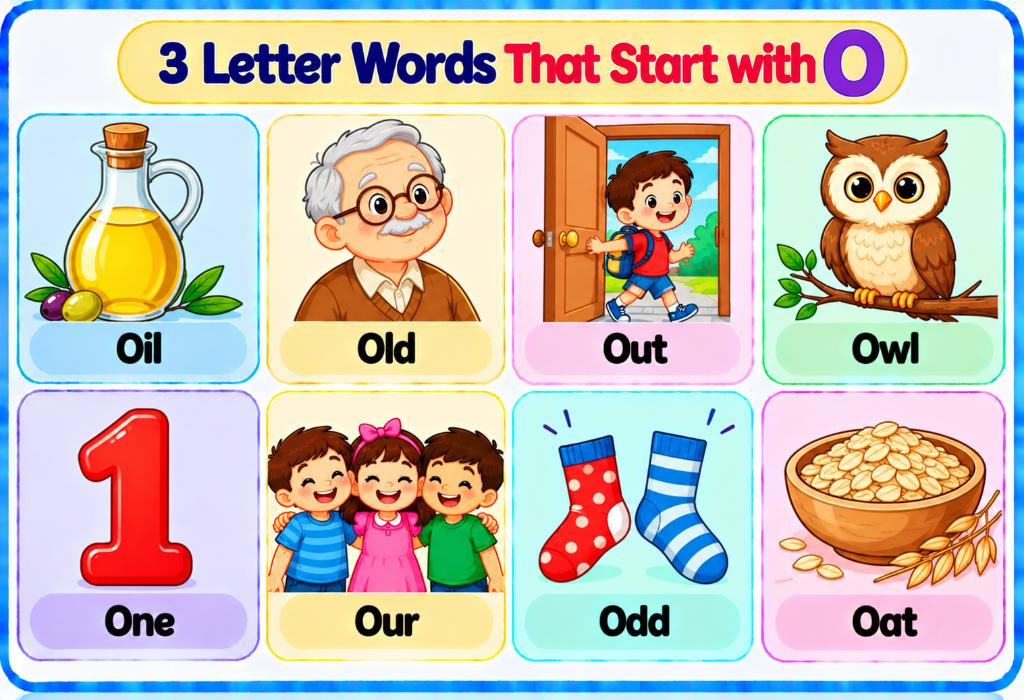
Here is a list of 3-letter words beginning with O that children come across early in their reading journey. Each word has a one-line meaning to help build understanding alongside recognition.
- Owl – A bird with large eyes, usually active at night.
- Oar – A long pole with a flat blade, used to row a boat.
- Old – Having lived or existed for a long time.
- Oil – A thick, slippery liquid used in cooking or machines.
- Off – Not on; away from a place or switched out.
- Out – Away from the inside of somewhere.
- Odd – Strange or unusual, or a number not divisible by two.
- One – The number 1.
- Our – Belonging to us.
- Orb – A sphere or ball-shaped object.
- Oak – A large tree known for its strength and acorns.
- Opt – To choose one option over another.
- Ore – Rock or mineral from which metal can be taken.
- Oat – A type of grain often eaten as porridge.
- Owe – To need to pay or give something back to someone.
More 3-Letter ‘O’-Words
Once children are confident with the common words, they can find a few more genuine, everyday 3-letter O words.
| Oho | Oot |
3-Letter Action Words That Start With O
These are genuinely useful three-letter words that start with O for building a child’s first simple sentences.
| Opt |
3-Letter Everyday Objects That Start With O
These O words name familiar items children may recognise at home, at school or outdoors.
| Oar | Orb |
| Oil |
Three-Letter Animal Names That Start With O
O has one genuine, well-known animal name at exactly three letters: a bird children often learn early because of its big eyes and night-time calls.
| Owl |
Positive Three-Letter Words That Begin With O
Clearly, positive three-letter O words are hard to find, but “oak” carries a steady, strong feeling, often used to describe something dependable.
| Oak |
Three-Letter Nouns Beginning With O
A noun names a person, animal, place or thing. These 3-letter O words cover nature, objects and everyday items.
| Owl | Oar |
| Oil | Orb |
| Oak | Ore |
| Oat |
3-Letter Adjectives Starting With O
O offers a couple of genuine describing words that children will find useful in everyday speech.
| Old | Odd |
Sentences Using Three-Letter O Words
Simple sentences help children see how three-letter O words work in real reading, rather than as single words on a list. Read each one aloud slowly, then ask your child to point to the O word and say it back to you.
- The owl hooted from the tall tree.
- Dad used an oar to row the boat.
- My grandpa own a very old clock.
- The pan was covered in a thin layer of oil.
- Please turn off the light before bed.
- We went out to play in the garden.
- It felt odd to wear two different socks.
- I only have one apple left.
- This is our favourite park to visit.
- I had warm oats for breakfast today.
Activities To Teach 3-Letter Words Starting With O For Kids
These playful activities suit 3-letter words starting with O for kindergarten and preschoolers, and they work well at home or in a classroom.
1. Owl Eyes In The Dark
Dim the room slightly and give children a torch to shine like “owl eyes” while they search for hidden owl pictures taped around the space. Each find comes with a soft hoot and the word “owl” said aloud together.
2. Odd One Out Line-Up
Set out four or five small toys where three share something in common, and one is different, such as three red blocks and one blue one. Children point to the “odd” one and explain why, linking the word to a simple sorting skill.
3. Rowing Without A Boat
Sit children on the floor in pairs, facing each other with legs touching, and have them gently rock back and forth as if rowing with an oar. Call out “oar” each time they pull back, turning the word into a shared physical rhythm.
4. Old Versus New Photo Match
Show children two photos of the same object or person taken years apart, such as a grandparent’s childhood photo and a recent one. Ask them to point out which looks “old,” prompting a simple conversation about time and change.
5. Counting Down From One
Line up a small group of objects and count them down together until only one remains, pausing on “one” each time to say the word clearly. This repetition links the number word to a concrete, visual quantity rather than just a sound.
FAQs
1. Why Does “Oar” Sound Exactly Like “Or” And “Ore”?
English has several short words that sound identical but are spelt differently and mean completely different things, and “oar,” “or” and “ore” are a good example. Reading each one in its own sentence, rather than comparing them side by side too early, helps children keep the meanings separate as they build confidence.
2. Is “Off” The Opposite Of Every “On”?
Mostly, but “off” can also describe food that has gone bad, as in “the milk smells off.” Pointing out this second meaning helps children see that small, common words often carry more than one use.
3. Why Are Owls Linked With Night-Time In So Many Stories?
Owls are genuinely active at night and have excellent hearing and eyesight in low light, which is why storybooks and folklore so often picture them awake while other animals sleep. Sharing this real fact alongside the word helps children connect “owl” to something true, not just a picture in a book.
4. Does “Opt” Always Involve A Difficult Decision?
Not necessarily, since “opt” simply means to choose, whether the decision is big, like choosing a school, or small, like choosing a snack. Using the word in low-stakes moments, such as letting a child “opt” for an apple or a banana, helps them get comfortable with it early.
5. Why Do So Few O Words End Up Being Animal Names?
Very few animals happen to have names that are both three letters long and start with O, which is why this list only includes “owl” in that category. It’s worth mentioning to children that word lists like this depend on how English happens to be built, not on how many animals actually exist.
Three-letter O words bring a fresh, vowel-led sound to a child’s reading practice, from a wise old owl to a simple word like “one.” Regular, playful repetition across different activities helps these words become a natural part of everyday speech.