


- List Of Common 3-Letter Words Starting With N
- More 3-Letter ‘N’-Words
- 3-Letter Action Words That Start With N
- 3-Letter Everyday Objects That Start With N
- Three-Letter Animal Names That Start With N
- Positive Three-Letter Words That Begin With N
- Three-Letter Nouns Beginning With N
- 3-Letter Adjectives Starting With N
- Sentences Using Three-Letter N Words
- Activities To Teach 3-Letter Words Starting With N For Kids
- FAQs
Last Updated on October 19, 2026
3-letter words that start with N are a small but useful set for early readers, with plenty of everyday words like net, nap and nod to build on. These short words are easy to sound out and help children grow their confidence with each new one they learn.
Thank you for reading this post, don't forget to subscribe!
This guide is a handy set of three-letter words starting with N for students building their phonics skills, as well as parents and teachers looking for a ready-made lesson. Alongside the full word list, you’ll find grouped tables, example sentences and hands-on activities to make N words memorable.
List Of Common 3-Letter Words Starting With N
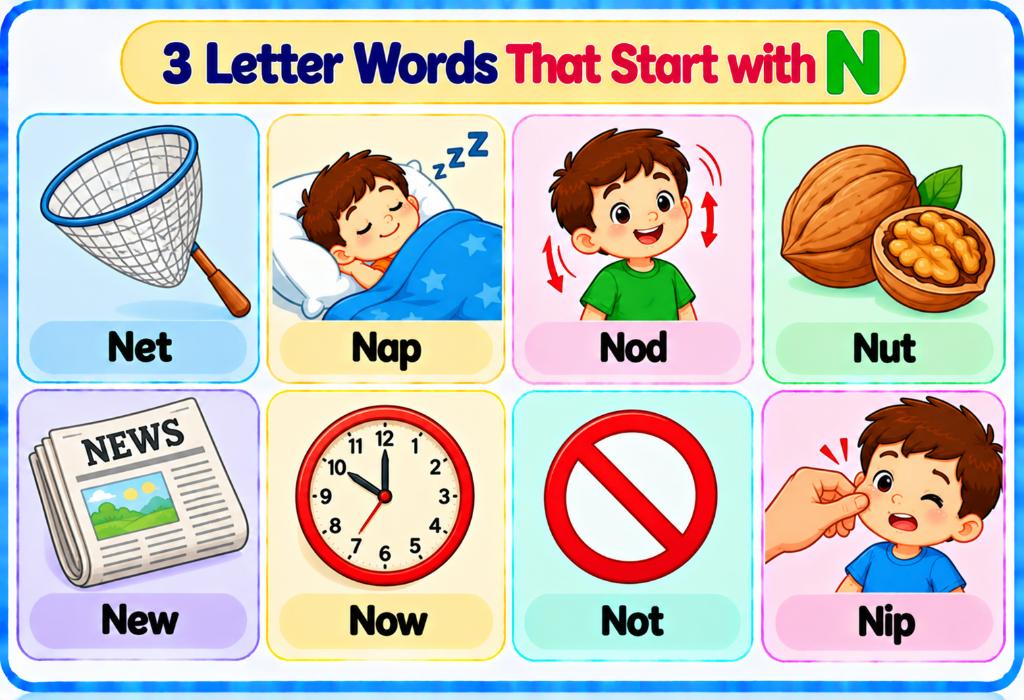
Here is a list of 3-letter words beginning with N that children come across early in their reading journey. Each word has a one-line meaning to help build understanding alongside recognition.
- Net: A material made of crossed threads with open spaces, used for catching things or playing sport.
- Nap: A short sleep, usually during the day.
- Nod: To move the head up and down, usually to agree.
- Nut: A hard-shelled fruit or seed.
- New: Recently made or not existing before.
- Now: At present.
- Not: Used to make a statement negative.
- Nob: An informal word for a wealthy or important person.
- Nip: A small, quick bite or pinch, or a brief, cold feeling.
- Nun: A woman who belongs to a religious community.
- Nab: To catch or grab something quickly.
- Nag: To keep asking or complaining about something repeatedly.
- Nil: Nothing; zero.
- Nix: To cancel or reject something.
- Nay: A word meaning “no,” often used in voting.
More 3-Letter ‘N’-Words
Once children are confident with the common words, they can explore a few more genuine, everyday 3-letter N words.
| Nae | Naw |
3-Letter Action Words That Start With N
Action words, or verbs, describe what someone is doing. These are genuinely useful three-letter words that start with N for building a child’s first simple sentences.
| Nod | Nap |
| Nab | Nag |
| Nix |
3-Letter Everyday Objects That Start With N
These N words name familiar items children may recognise at home, at school or outdoors.
| Net |
Three-Letter Animal Names That Start With N
Genuine animal names at exactly three letters are very rare, and N doesn’t have a common, well-known one that fits, so this list stays empty here, with plenty of animal words to explore at other letters in this series.
Positive Three-Letter Words That Begin With N
Genuinely positive three-letter N words are hard to find, but “new” carries a hopeful, fresh-start feeling that children often associate with something exciting.
| New |
Three-Letter Nouns Beginning With N
A noun names a person, animal, place or thing. These 3-letter N words cover objects, people and everyday ideas.
| Net | Nap |
| Nut | Nob |
| Nun | Nip |
3-Letter Adjectives Starting With N
N offers a couple of genuine describing words that children will find useful in everyday speech.
| New | Nil |
Sentences Using Three-Letter N Words
Simple sentences help children see how three-letter N words work in real reading, rather than as single words on a list. Read each one aloud slowly, then ask your child to point to the N word and say it back to you.
- We used a net to catch the butterfly.
- The baby took a long nap this afternoon.
- Dad gave a small nod to say yes.
- I found a nut on the ground.
- We bought a new pair of shoes.
- It is now time to go home.
- I am not ready to leave yet.
- The dog gave my hand a gentle nip.
- She tried to nab the last cookie.
- Please don’t nag me about my homework.
Activities To Teach 3-Letter Words Starting With N For Kids
These playful activities suit 3-letter words starting with N for kindergarten and preschoolers, and they work well at home or in a classroom.
1. Yes-Or-Nod Freeze Dance
Play music and have children dance freely. When the music stops, call out a simple statement, and instead of speaking, children respond by nodding for “yes” or staying still and silent for “no.” This turns the word “nod” into a game of listening and quick decisions rather than a flashcard.
2. Nutty Weight Guess
Place a few safe, shelled nuts of different sizes on a simple balance scale or in the child’s hands, and ask them to guess which feels heavier before checking. This connects “nut” to an early idea of comparing weight, not just naming an object.
3. The Nap Switch
Tell a short, silly story about a character who falls asleep at the wrong moment, like a napping cat who misses dinner. Pause at key points and ask children what they think happens next because the character took a nap, linking the word to cause and effect in a story.
4. New Versus Old Sort
Gather a small pile of mixed items, some clearly new and some obviously worn or old, like a fresh crayon next to a snapped one. Children sort them into two groups and explain their choices aloud, using the word “new” to justify their answers.
5. Net Toss Target
Hang a real or pretend net loosely between two chairs and give children soft balls to toss into it from a short distance. Each successful toss earns a turn to say a different N word from the list before the next throw.
FAQs
1. Why Does “Nod” Mean Agreement In So Many Cultures?
Nodding the head up and down to show “yes” is one of the most widely understood gestures across different countries and languages. This makes “nod” a useful word to connect to something children may already do naturally without realising it has a name.
2. Is “Nip” Always About Biting?
Not always, since “nip” can also describe a sudden burst of cold weather, as in “a nip in the air.” Pointing out this second meaning helps children see how the same short word can describe very different things.
3. Why Does English Have A Separate Short Word Like “Nay” When “No” Already Exists?
“Nay” is an older form of “no” that survives today mainly in formal voting, such as in parliament, even though everyday speech moved on to “no” long ago. This is a nice example to share with older children of how some old words stick around only in specific situations.
4. Can “Nil” Be Used Outside Of Sport?
Yes, although many children first hear “nil” in the context of a football score, it simply means zero or nothing and can be used in other situations too. Pointing out this wider use helps the word feel less limited to one setting.
5. Why Do N Words Often End Up Sounding Soft Or Gentle?
Many N words in everyday English, like nap, nod and new, tend to describe calm or quiet actions rather than loud or dramatic ones. Noticing this pattern can be a fun, light observation to make with children once they’ve learned a few N words together.
Three-letter N words may be a smaller set, but the ones here, from a quick nod to an afternoon nap, come up often in everyday life. Regular, natural practice through daily routines helps these words stick without needing a long or formal list.