


- List Of Common 3-Letter Words Starting With M
- More 3-Letter ‘M’-Words
- 3-Letter Action Words That Start With M
- 3-Letter Everyday Objects That Start With M
- Three-Letter Animal Names That Start With M
- Positive Three-Letter Words That Begin With M
- Three-Letter Nouns Beginning With M
- 3-Letter Adjectives Starting With M
- Sentences Using Three-Letter M Words
- Activities To Teach 3-Letter Words Starting With M For Kids
- FAQs
Last Updated on October 19, 2026
3-letter words that start with M are a warm, familiar sound for children, often starting with words close to home, like mum, map and mud. These short words are easy to sound out and give early readers a strong, confident set to practise with.
Thank you for reading this post, don't forget to subscribe!
This guide is a handy set of three-letter words starting with M for students building their phonics skills, as well as parents and teachers looking for a ready-made lesson. Alongside the full word list, you’ll find grouped tables, example sentences and hands-on activities to make M words memorable.
List Of Common 3-Letter Words Starting With M
Here is a list of 3-letter words beginning with M that children come across early in their reading journey. Each word has a one-line meaning to help build understanding alongside recognition.
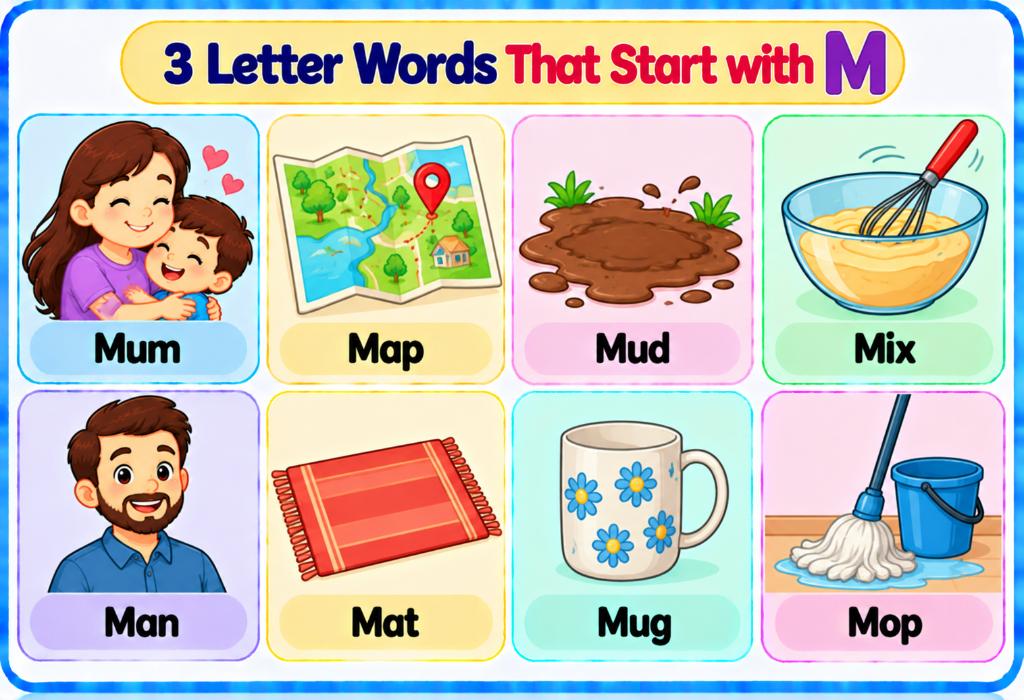
- Mum – A word children use for their mother.
- Map – A drawing that shows where places are.
- Mud – Soft, wet earth.
- Mix – To combine two or more things.
- Mat – A flat piece of material placed on a floor.
- Man – An adult male person.
- Mob – A large, disorderly crowd of people.
- Mug – A large cup with a handle, usually for hot drinks.
- Mop – A tool with a long handle used to clean floors.
- May – A word used to ask or give permission, or the fifth month of the year.
- Met – Past form of “meet”, meaning to have come together with someone.
- Mow – To cut grass short.
- Mad – Very angry, or informally, silly or wild.
- Max – The largest amount possible; short for maximum.
- Mid – Being in the middle of something, as in “mid-morning.”
More 3-Letter ‘M’-Words
Once children are confident with the common words, they can explore a few more genuine, everyday 3-letter M words.
| Mar | Mil |
3-Letter Action Words That Start With M
These are genuinely useful three-letter words that start with M for building a child’s first simple sentences.
| Mix | Mop |
| Mow | Met |
| Mar |
3-Letter Everyday Objects That Start With M
These M words name familiar items children may recognise at home or at school.
| Map | Mat |
| Mug | Mop |
Three-Letter Animal Names That Start With M
Genuine animal names at exactly three letters are very rare, and M doesn’t have a common, well-known one that fits, so this list stays empty here, with plenty of animal words to explore at other letters in this series.
Positive Three-Letter Words That Begin With M
Warm, family-related words are where M does best for positive meaning, since “mum” is one of the first words children learn with real affection attached.
| Mum |
Three-Letter Nouns Beginning With M
A noun names a person, animal, place or thing. These 3-letter M words cover family, places, objects and people.
| Mum | Map |
| Mud | Mat |
| Man | Mob |
| Mug |
3-Letter Adjectives Starting With M
M offers a couple of genuine describing words that children will find useful in everyday speech.
| Mad | Max |
Sentences Using Three-Letter M Words
Simple sentences help children see how three-letter M words work in real reading, rather than as single words on a list. Read each one aloud slowly, then ask your child to point to the M word and say it back to you.
- My mum read me a story before bed.
- We used a map to find the way.
- The dog left muddy paw prints near the mud.
- Please mix the paint before we start.
- I wiped my feet on the mat.
- The man waved from across the street.
- Dad filled his mug with hot tea.
- I used the mop to clean the kitchen.
- You may go outside after lunch.
- We will arrive at the mid-point soon.
Activities To Teach 3-Letter Words Starting With M For Kids
These playful activities suit 3-letter words starting with M for kindergarten and preschoolers, and they work well at home or in a classroom.
1. Mud Kitchen Play
Set up a simple mud kitchen outdoors with bowls, spoons and real mud. As children mix and pour, encourage them to say “mud” and “mix” aloud each time they stir something together.
2. Map Treasure Trail
Draw a simple map of the garden or living room with a few marked spots. Children follow the map to find small objects hidden at each point, saying “map” each time they check their route.
3. Mug Sorting Station
Gather a few mugs of different sizes and colours and ask children to sort them by size, colour or pattern. Saying “mug” aloud with each one builds repetition through a hands-on task.
4. Mid-Point Marker
Set up a short path with a clear halfway marker labelled “mid.” Children race or walk to the mid-point first, call out the word, then continue to the end.
5. Mat Hopscotch
Lay out a few mats in a row like stepping stones and ask children to hop from mat to mat, calling out “mat” each time they land. This combines movement with word repetition in a simple, active game.
FAQs
1. Why Do So Many Languages Use A Similar Word For “Mum”?
Words like “mum,” “mama” and “ma” sound alike across many languages because they come from some of the easiest sounds babies make. Sharing this with children is a gentle way to show how language connects across cultures.
2. Why Does “Mad” Have Two Different Meanings?
“Mad” can mean very angry in everyday speech, but it’s also used informally to describe something wild, silly or surprising. Noticing both meanings in context helps children build flexibility with familiar words.
3. Is “Max” Always Short For “Maximum”?
Not always, since “Max” is also a common short form of names like Maxwell or Maximilian. Pointing this out helps children understand that the same short word can work as both a regular word and a name.
4. Why Do Mops And Mats Often Appear Together In Early Word Lists?
Mop and mat are two of the easiest M objects for children to picture and point to around the house, which is why they turn up so often in early reading materials. Linking the words to real objects at home makes them easier to remember than an abstract list.
5. How Can Parents Turn Everyday Chores Into M-Word Practice?
Simple jobs like wiping the mat, tidying with a mop or helping mix dinner naturally bring up M words without any extra setup. Saying the word aloud while doing the task together helps children connect the sound to something they’re already doing.
Three-letter M words bring together some of the warmest, most familiar sounds in a child’s early vocabulary, from “mum” to “map.” Everyday moments at home offer plenty of natural chances to practise these words without needing a formal lesson every time.