


Last Updated on August 19, 2026
Nature is the biggest reason for our easy survival on this planet, providing us with food, clothing and shelter. Sunlight, plants, air, rain, animals and everything in between come together to complete nature, making our environment both liveable and beautiful. This article brings together several essays on nature in English to help your child understand the subject better. Nature has given life to human beings and existed long before our evolution, forming a natural cycle for the smooth functioning of every living being.
Thank you for reading this post, don't forget to subscribe!
Writing an essay on nature for classes 1, 2, and 3 is an excellent way to teach kids about this subject from an early age. There’s a reason nature is referred to as “mother,” as it continues to cherish and nurture us in return. Let’s look at examples of a nature essay in English across different formats, from short lines to longer compositions.
Key Points To Remember When Writing An Essay On Nature
Before diving into your essay, it’s important to first develop a clear understanding of the topic. Rather than relying on rote learning, watching relevant videos can help build a more well-rounded understanding of the subject. Here are some key points to guide you while crafting a nature essay:
- Follow a Clear Structure – An essay should include an introduction, a body and a conclusion, allowing ideas to flow logically from start to finish.
- Define Nature in the Introduction – Begin with a brief definition of nature, giving readers context before moving into the main content.
- Explain Its Role in the Body – Use the body of the essay to explore the role and importance of nature in our daily lives.
- Discuss Conservation in the Conclusion – Wrap up by reflecting on what we can do to help conserve nature for future generations.
- Add Relevant Quotes for Impact – Including well-known quotes or lines can help emphasise the importance of nature and add depth to the essay.
- Review and Proofread – Once done, read through the essay to check for spelling and grammar mistakes before finalising it.
5 Lines On Nature
A few lines on nature are a great way for young learners to practise writing about the world around them. Here are five simple lines your child can use as a starting point.
- Nature includes everything around us, such as trees, animals, air and water.
- Nature gives us fresh air to breathe and clean water to drink.
- Plants and trees provide us with food, shade and oxygen.
- We should take care of nature and keep our surroundings clean.
- Nature is beautiful, and we must protect it for future generations.
10 Lines On Nature
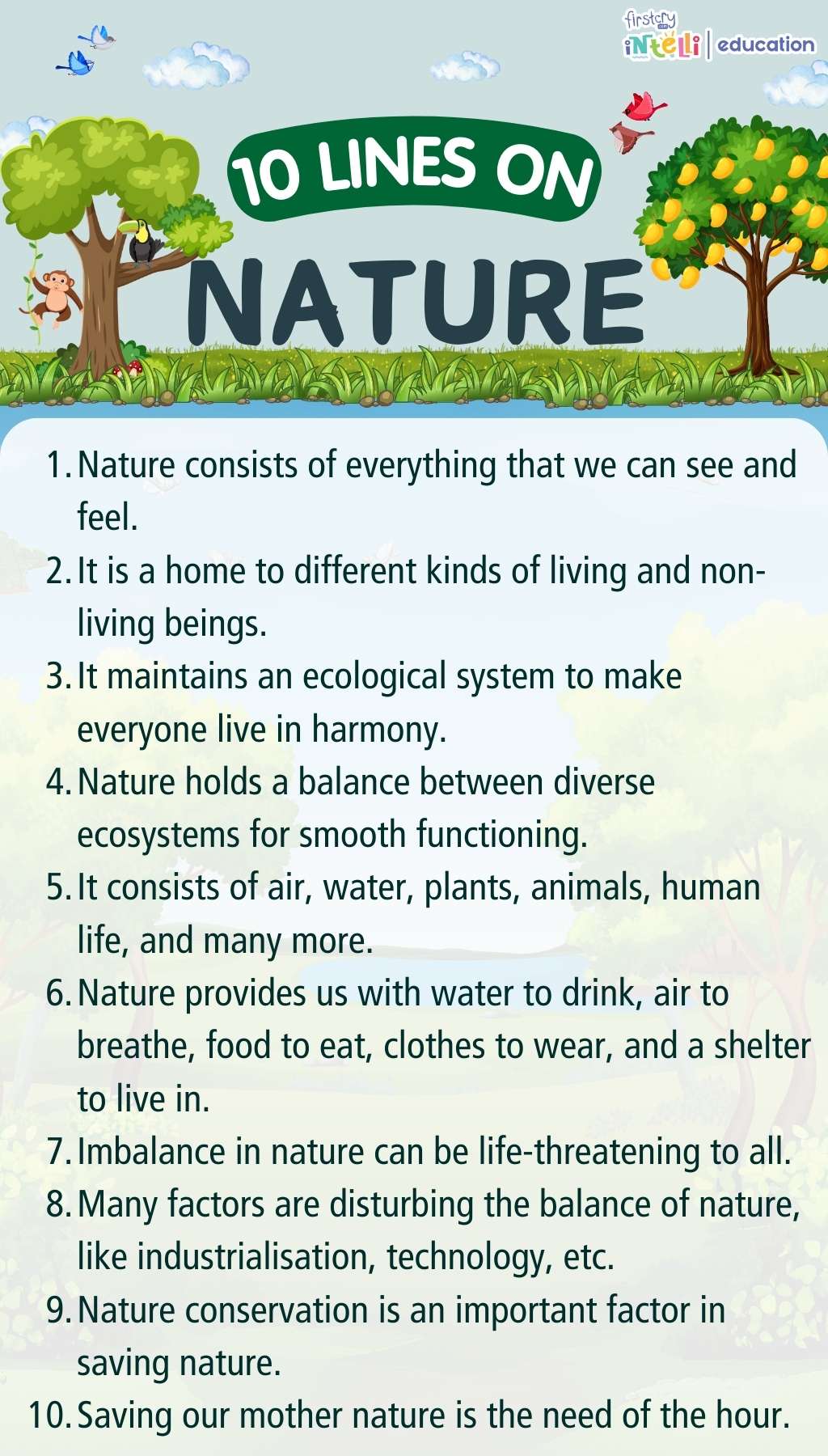
Kids grasp concepts more easily when explained in simple words, which is why understanding nature works best through clear, straightforward language. Here are a few lines on nature to help them understand and write a simple short essay for classes 1 and 2.
- Nature includes everything we can see, feel and experience around us.
- It is home to countless living and non-living things alike.
- Nature maintains a delicate ecological balance that allows every being to live in harmony.
- It holds together diverse ecosystems, ensuring their smooth and continuous functioning.
- Nature consists of air, water, plants, animals, human life and much more.
- It provides us with water to drink, air to breathe, food to eat, clothes to wear and shelter to live in.
- An imbalance in nature can pose a serious threat to all forms of life.
- Factors like industrialisation and rapid technological growth continue to disturb nature’s balance.
- Conservation plays a vital role in protecting and preserving nature.
- Saving our environment is no longer a choice, but a genuine need of the hour.
Paragraph On Nature
Nature, the grand canvas upon which life unfolds, has always been a source of inspiration and wonder. In this beauty of nature essay in 100 words, we’ll explore the significance of the natural world through a short, simple paragraph.
Nature is all around us, filled with beautiful sights and sounds. It includes trees, flowers, rivers and animals, making our world vibrant and alive. In spring, flowers bloom, and birds sing, bringing joy to our days. In summer, we enjoy sunny afternoons in parks and gardens, surrounded by green leaves and buzzing bees. Autumn paints the leaves in warm colours like red and gold, while winter blankets everything in soft, white snow. Nature isn’t just beautiful to look at; it also helps us relax and feel genuinely happy. Taking time to appreciate it each day can truly make our lives better.
Short Essay On Nature
Humankind has always depended on nature for survival, and gradually, we are exhausting Mother Nature’s resources. Let us understand its true value through this 150-word nature essay in English, written in simple language for easy understanding.
The fruits of nature have benefited us ever since we first arrived on this planet. Nature is far more than a blessing; it has given us the very gift of life. It shields us from harm, sustains our environment, and allows every living being to thrive. Every element of nature, whether living or non-living, plays a crucial role in maintaining this delicate balance. While nature has the power to protect and nurture us, it also holds enough force to bring devastating consequences if pushed too far. Over the years, human activities such as deforestation, pollution and excessive waste production have steadily exploited Mother Nature’s resources.
We must take conservation seriously by keeping our surroundings clean and green, reducing waste, and choosing more sustainable products in our everyday lives. Protecting nature today ensures a safer, healthier planet for generations to come.
Nature Essay In English In 200 Words
For students who need a slightly longer piece, this 200-word essay explores nature’s role and importance in a bit more depth. It works well as a simple template for school assignments.
Nature is one of the most beautiful gifts given to humankind, encompassing everything from towering mountains and vast oceans to the smallest blade of grass. It includes the air we breathe, the water we drink, the food we eat, and the countless plants and animals that share this planet with us. Since the beginning of human civilisation, nature has sustained life in every possible way, offering both the resources we need to survive and the beauty that inspires art, poetry and quiet reflection.
Beyond its practical benefits, nature also plays a vital role in maintaining ecological balance. Forests regulate our climate, oceans support marine life, and countless species work together to sustain a delicate web of interconnected ecosystems. Every element, whether living or non-living, contributes to this balance in its own unique way.
Unfortunately, human activities such as deforestation, pollution and excessive industrialisation have increasingly disrupted this natural harmony, threatening both wildlife and our own future wellbeing. It is our shared responsibility to protect and conserve nature through simple, consistent actions, such as reducing waste, planting trees and adopting more sustainable habits.
In conclusion, nature is not merely a resource to be used, but a living system that deserves our care, respect and protection for generations to come.
Long Essay On Nature
We are sitting in the comfortable lap of Mother Nature without worrying too much about its problems. It is a giver and never asks anything in return. Here is an outline of nature and its importance in the form of an essay for class 3.
Nature can be defined as the interaction between the physical surroundings around us. Physical surroundings include both living and non-living beings. Living beings include humans, animals, plants, and anything that can breathe in and out. Non-living beings are weather, climate, rocks, air, water, sand, and more.
Nature is all about the coexistence of living and non-living beings. It maintains an ecological balance between the two, and entire humankind depends on the smooth functioning of the ecosystem maintained by Mother Nature.
Importance and Role of Nature
The importance of nature is unparalleled. It gives us necessities like food, air and water. We breathe oxygen given by plants, and plants take in the carbon dioxide we breathe out. This is a simple example of how nature balances everything.
You can understand its importance from the fact that poets and writers have written exceptional pieces about Mother Nature. Writers and poets like Rudyard Kipling, William Wordsworth, Emily Dickinson, Robert Frost and many more gave us beautiful poems and prose to help us understand the value of nature. Their writings compel us to grow closer to nature and lead a happy, healthy life. Being closer to nature can help heal prolonged illness and make us fit as a horse.
The services of nature can be categorised as provisioning, regulating and non-material. Provisioning services are those activities that give direct benefits from nature, like food, water, medicinal plants and many more. Regulating services include the regulation of natural activities like water purification, decomposition and climate regulation. Non-material services include recreational activities like interacting with nature to explore art, music, culture and more.
Significance of Nature Conservation
The energy sources in nature are not infinite; we are exhausting them through continuous and careless usage. It has become very important to start acting on conserving nature to the best of our ability.
The increase in industrialisation, urbanisation and migration is causing a shortage of even basic amenities. There is a rapid surge in the greenhouse effect and global warming. Activities like deforestation and transportation are causing an increase in pollution. Dumps from industries, sewage waste, oil spills and more are a cause of disease in both humans and animals.
The health of Mother Nature is deteriorating because of our quest for comfortable living, and saving nature is the need of the hour. We can do a lot by simply switching to more sustainable living standards. Planting more trees, keeping our environment clean and green, and boycotting the use of plastic and non-biodegradable products are some habits we can inculcate into our daily lives to conserve nature. We should be rational in our use of clean water and should engage in rainwater harvesting wherever possible. If we want to pass on a beautiful environment to future generations, we should be willing to keep it clean today.
Nature has given us everything we need to survive and thrive, asking for nothing in return but our care and respect. By making small, mindful changes in how we live, we can help restore the balance we’ve disturbed and ensure that future generations inherit a planet as generous and beautiful as the one we were given.
What Will Your Child Learn From An Essay On Nature?
Our children learn primarily by observing us, and our everyday actions influence them far more than words ever could. If we make a conscious effort to keep our homes and surroundings clean, our children are likely to absorb and carry forward the same values naturally. This essay helps children understand the true significance of protecting nature, while also gently prompting them to reflect on whether their own actions might be causing harm, even unintentionally.
It encourages them to take meaningful steps towards conservation, offering practical ideas they can apply in their daily lives. Ultimately, it helps children realise that nature isn’t just something to protect; it’s also one of our greatest teachers, offering lessons in balance, patience and coexistence that few other subjects can.
FAQs
1. How Can Children Help Protect Nature?
There are many ways kids can help protect nature:
- Recycle paper, plastic, and other materials
- Turn off lights and electronics when not in use
- Pick up litter when they see it
- Plant trees and flowers
- Be kind to animals and do not disturb their homes
- Educate others about the importance of protecting nature
2. What Are Some Fun Activities Kids Can Do In Nature?
Here are some fun activities kids can do in nature:
- Nature Bingo or Scavenger Hunts: Create bingo cards or scavenger hunt lists to find different plants, animals, or natural objects. This makes exploring more engaging and fun.
- Art Projects: Create art using natural materials like leaves, flowers, and twigs. This encourages creativity while appreciating nature.
- Gardening: Help plant flowers, vegetables, or trees. This teaches kids how plants grow and the importance of caring for living things.
- Camping: Spend a night outdoors to connect with nature. Bring along activities like nature bingo to discover new things during your camping trip.
3. What Are Some Interesting Facts About Nature?
Here are a few fun facts:
- Trees communicate: Trees can share nutrients and information through underground networks.
- Dolphins have names: Dolphins use unique whistles to identify each other, similar to how humans use names.
- Bamboo is the fastest-growing plant: Some bamboo species can grow up to 35 inches in a single day!
4. How Can Nature Save Us?
Nature provides clean air, water, food, and medicine while regulating the climate and supporting our mental health. By maintaining biodiversity and healthy ecosystems, nature helps sustain life on Earth and protects us from natural disasters. It offers recreational opportunities that enhance well-being.
Nature is one of the most powerful forces on our planet, binding every living and non-living element together in a delicate balance. Even a small disruption can have far-reaching consequences, and our careless actions today can affect generations to come.
Protecting nature is essential to humanity’s survival, and it’s a two-way exchange: when we care for Mother Nature, she continues to care for us in return.
Also Read:
Save the Earth Essay for Kids
Essay on Air Pollution for Kids
Essay on Save the Environment for Kids
Long and Short Essay on Earth for Children